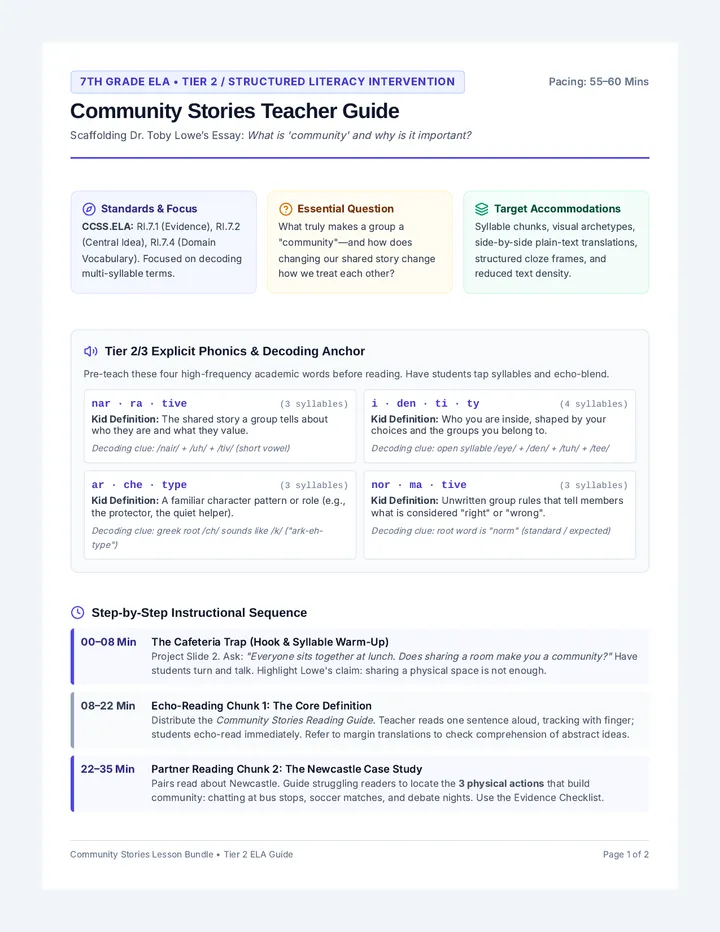
A 7th grade ELA informational text lesson centered on Dr. Toby Lowe's essay on the true meaning of 'community.' Students identify the central idea, analyze key academic vocabulary (narrative, identity, archetype, normative) in context, and evaluate how shared stories shape who we are and drive positive change.
Lowe didn't have the local accent, but he chose to write Newcastle's story into his own life:
Adopts the archetype: chats with strangers at bus stops
Attends football matches at St. James Park
Cares personally about city parks and buildings
Community is not where you sleep; it is what you actively invest in. Active Participation
Critical Thinking & Change
The Mafia Test & Rewriting Our Stories
The Counterexample
Communities Are Not Always "Good"
The Mafia fits every rule of a community: fierce loyalty, shared stories, and unwritten rules. Yet they cause harm! Community is powerful, but not automatically virtuous.
“Community is not, in and of itself, morally praiseworthy. It just is.”
Lowe's Big Conclusion
Rewriting Communal Stories
To change our school or neighborhood, we don't just change rules. We must rewrite the stories and character expectations we celebrate:
“Social change requires that we rewrite our communal narratives.”
Exit Question: What is one story about our school that we can rewrite to make it better?
2. The Mafia Counterexample: Are Communities Always Good?
Why does Lowe call the Mafia "one of the best examples of a community"? What common belief about the word "community" is he challenging?
3. Differentiating Groups: Crowd vs. Community
How is a true community different from a random group of people waiting for a bus or eating in a food court? What do community members have that a crowd lacks?
4
Synthesis: Rewriting Our School’s Communal Story
“Social change requires that we rewrite our communal narratives. Social change is change in community.” — Dr. Toby Lowe
Applying Lowe's Idea to 7th Grade:
Think about our school, your sports team, or your neighborhood. (A) What is one negative or unhelpful "story" people sometimes tell about it? (B) How could students work together to "rewrite" this story into something positive?
7th Grade ELA • Evidence & Synthesis Response Sheet Page 2 of 2
Identifies narrative and archetype; vividly details how students actively transform school story.
Identifies community story; explains realistic student action to rewrite it into a positive norm.
Identifies a rule or place rather than a story; gives vague suggestion for change.
Incomplete or off-topic response; missing narrative connection.
7th Grade ELA Assessment • Stories That Bind Us Master Key Page 2 of 2
4 Chunk 4: The Mafia Test & Rewriting Stories Critical Analysis
One of the best examples of a community is the Mafia, but they are not a force for good. “Community is not, in and of itself, morally praiseworthy. It just is.”
Why does this matter? “Social change requires that we rewrite our communal narratives.”
Key Takeaway:
Strong communities are NOT always good. If you want to make a community better, you have to rewrite the stories members tell each other!
Cloze Summary Activity (Fill in the Blanks) Use the Word Bank Below
narrative good choices rewrite identity
Dr. Toby Lowe argues that a true community is a group of people who share an identity-forming (1) . Living on the same street is not enough; people must make active (2) to adopt the group's character roles and values. While communities give us a sense of (3) , the Mafia proves that communities are not always (4) . Finally, to create real social change, people must work together to (5) their shared stories.
7th Grade ELA • Supported Reading Guide • Unit: Community Narratives Page 2 of 2