Spring Symphony Slides
Creative Poetry Spring Symphony
Session 1 Presentation
Symphony of Spring
Exploring the sights, sounds, and rhythms of springtime through sensory poetry.
Sensory Imagery Onomatopoeia
Use right arrow to advance →
Sparking Imagination
Slide 2 of 5
What is Sensory Imagery?
Sensory imagery uses descriptive words to paint a picture in the reader's mind. It connects to our five senses:
Sights (What do we see?)
Sounds (What do we hear?)
Feelings (What do we touch or feel?)
☀️
Shining Sun
Golden rays bathing the fields, warming the cold soil, and making petals stretch open.
🦋
Fluttering Butterflies
Delicate wings dancing in zig-zag paths, landing like living confetti on wild blossoms.
Think: How does spring feel on your skin?
Spring Symphony
Poetic Sounds
Slide 3 of 5
What is Onomatopoeia?
Onomatopoeia is a fancy word for words that imitate the actual sounds they describe.
"When you read the word, you can instantly hear the sound in your mind!"
🐦
Chirp & Tweet (Birds)
The high-pitched choir echoing from the leafy treetops.
🌊
Babble, Splash & Gurgle (Creek)
Cool water running over smooth stones, singing a rhythmic song.
🐝
Buzz & Hum (Bees)
Fuzzy insects flying from petal to petal, working on sweet nectar.
Which of these sounds is your favorite springtime cue?
Spring Symphony
Crafting the Poem
Slide 4 of 5
The Building Blocks
Stanzas
Paragraphs for poems! Group your sensory details into cohesive blocks (e.g., one for sounds, one for sights).
Line Breaks
Where you decide to pause! Shorter lines create faster paces; longer lines slow down the reading.
Free Verse
Poetry without rules! Your poem does not need to rhyme. Focus on capturing pure sensations.
Example Structure
Under the warm, golden blanket of the sun,
A tiny green sprout pushes through the soil.
ONOMATOPOEIA →
Buzz, buzz! goes the worker bee,
While the cool creek water gurgles by.
Notice how each line feels like a single breath of spring.
Use stanzas to segment your thoughts.
Spring Symphony
Writing Prompt
Slide 5 of 5
Now, Compose Your Symphony!
You are going to write your own Spring Symphony poem using the worksheet. Follow these 3 golden rules:
1️⃣
Use Sensory Details
Include at least three visual descriptions and tactile sensations of spring.
2️⃣
Use Onomatopoeia
Include at least two sound-effect words (like chirping, buzzing, or splashing).
3️⃣
Structure It Well
Organize your poem into at least two stanzas of 3-4 lines each.
Let's start writing!
Spring Symphony
Spring Symphony Worksheet
Student Activity Sheet
Spring Symphony
Unit: Nature Poetry
Student Name:
Date:
Let's paint a picture using words! Spring is full of colorful sights, warm feelings, and energetic sounds. Use this worksheet to gather your ideas before writing your final Spring Symphony poem.
1 Sensory Sights & Feelings
Add 2-3 colorful, descriptive words or phrases for each springtime spark:
🦋 Fluttering Butterflies
🐝 Busy Bees
☀️ Shining Sun
🌱 Growing Sprouts
2 Sound Words (Onomatopoeia)
Read each description. Pick the perfect sound word or write your own to describe the sound!
🐦 A robin in a tree
Try: Chirp, tweet, trill
Your word:
🌊 Creek over stones
Try: Gurgle, splash, bubble
Your word:
🐝 A bumblebee flying
Try: Buzz, hum, whir
Your word:
Unit: Nature Poetry • Grade 3-5 Turn the page to start drafting your poem → Page 1 of 2
Draft Your Poem
Symphony Canvas
Now it's time to compose! Write your poem in the space below. Remember to split your poem into at least two stanzas (like paragraphs). Focus on making the reader hear the sounds and see the sights of spring.
Stanza 1: Sights & Sounds of Nature
3-4 lines recommended
Stanza 2: Warm Feelings & Final Rhythms
3-4 lines recommended
Poet's Self-Check
Included at least 3 sensory sights (butterfly, bee, sun) Used at least 2 onomatopoeia sound words Divided the poem into 2 clear stanzas Used neat handwriting and double-checked spelling
Teacher Feedback
Imagery & Details: / 5
Sound Words: / 5
Structure & Layout: / 5
Total Score: _____ / 15
Unit: Nature Poetry • Grade 3-5 Well done, Poet! Page 2 of 2
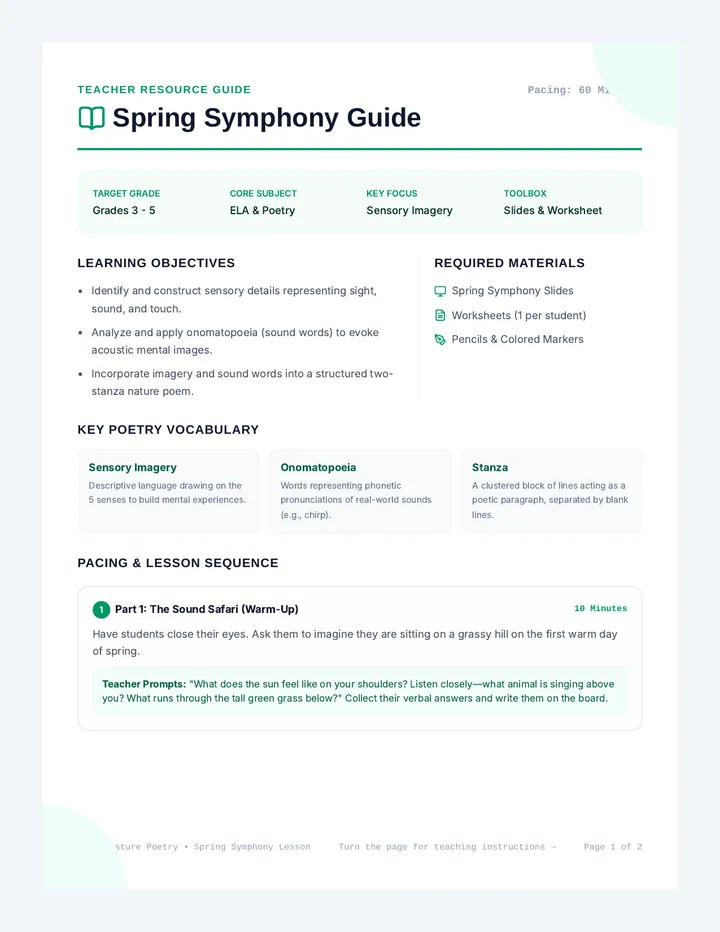
Spring Symphony Teacher Guide
Teacher Resource Guide
Spring Symphony Guide
Pacing: 60 Minutes
Target Grade Grades 3 - 5
Core Subject ELA & Poetry
Key Focus Sensory Imagery
Toolbox Slides & Worksheet
Learning Objectives
- Identify and construct sensory details representing sight, sound, and touch.
- Analyze and apply onomatopoeia (sound words) to evoke acoustic mental images.
- Incorporate imagery and sound words into a structured two-stanza nature poem.
Required Materials
- Spring Symphony Slides
- Worksheets (1 per student)
- Pencils & Colored Markers
Key Poetry Vocabulary
Sensory Imagery
Descriptive language drawing on the 5 senses to build mental experiences.
Onomatopoeia
Words representing phonetic pronunciations of real-world sounds (e.g., chirp).
Stanza
A clustered block of lines acting as a poetic paragraph, separated by blank lines.
Pacing & Lesson Sequence
1 Part 1: The Sound Safari (Warm-Up)
10 Minutes
Have students close their eyes. Ask them to imagine they are sitting on a grassy hill on the first warm day of spring.
Teacher Prompts: "What does the sun feel like on your shoulders? Listen closely—what animal is singing above you? What runs through the tall green grass below?" Collect their verbal answers and write them on the board.
Unit: Nature Poetry • Spring Symphony Lesson Turn the page for teaching instructions → Page 1 of 2
Direct Instruction & Writing
Pacing Part II & III
2 Part 2: Visual & Sound Guided Tour
15 Minutes
Display the Spring Symphony Slides. Progress through slide-by-slide:
- Slide 2 (Imagery): Highlight how imagery constructs vivid mental illustrations. Discuss how sensory adjectives can paint clear details (e.g., "warm golden rays" instead of "the sun").
- Slide 3 (Onomatopoeia): Guide student chanting of "Chirp", "Gurgle", and "Buzz". Encourage students to imitate these environmental noises with physical pacing and volume!
- Slide 4 & 5 (Structures): Introduce stanzas and explain why poems use blank spaces to give readers room to breathe. Review the writing criteria before distributing worksheets.
3 Part 3: Brainstorming & Canvas Drafting
25 Minutes
Distribute the . Let students complete Page 1's brain mapping individually or in pairs.