Lenny.com
Explore
Create
ActivitiesNewMathEnglish Language ArtsScience & EngineeringSocial StudiesGlobal LanguagesHealth & Physical EducationSpecial EducationCounseling & Life SkillsArts & CreativityESL
Lenny.com
Lenny.com
Explore
Create
ActivitiesNewMathEnglish Language ArtsScience & EngineeringSocial StudiesGlobal LanguagesHealth & Physical EducationSpecial EducationCounseling & Life SkillsArts & CreativityESL
Lenny.com
Lenny.com

Solutions

Lenny for EducatorsLenny for SchoolsLenny for Districts

Product

ExploreSign inCreateSupportAbout

Resources

Getting startedMTSS Acceleration Program

Newsletters

School Funding Newsletter

© 2026 Lenny Learning Inc.

TermsPrivacyAccessibility
LinkedInInstagramX
Lenny
English Language ArtsPhonics & Reading FoundationsLetter IdentificationLearn Letters A-ZLowercase and Uppercase LettersConsonants and VowelsLetter-Sound AssociationsLetter-Sound Associations: LowercaseLetter-Sound Associations: UppercaseBeginning and Ending SoundsRhymingBlending And SegmentingShort VowelsShort Vowel SoundsConsonant BlendsConsonant DigraphsBlends, Digraphs, and TrigraphsDigraphs, Blends, and Silent LettersLong Vowel SoundsLong Vowel PatternsShort and Long VowelsShort and Long Vowel PatternsSilent EVowel SoundsVowel TeamsR-Controlled VowelsDiphthongs: Oi, Oy, Ou, OwVariant VowelsVariant, Diphthong, And R Vowel PatternsSoft G And CSight WordsIrregular WordsWord RecognitionSyllablesSyllable TypesTwo-Syllable WordsMultisyllabic WordsPhoneme ManipulationDecodable TextsVocabularyAction WordsQuestion WordsNouns and AdjectivesClassify WordsCompound WordsSynonyms and AntonymsHomophonesHomophones and HomonymsShades of MeaningContext CluesPrefixes and SuffixesGreek and Latin RootsAnalogiesIdioms and AdagesForeign Words and ExpressionsWord Choice and UsageReference SkillsReading ComprehensionRead-Along Literary TextsRead-Along Informational TextsReality vs. FictionStory ElementsCharacterSequenceMain IdeaCause And EffectCompare And ContrastReading StrategiesText StructureAuthor's PurposeAuthor's Purpose And ToneAuthor's PerspectivePoint Of ViewThemeInference And ThemeInference And AnalysisPoetry ElementsLiterary DevicesAnalyzing LiteratureAnalyzing Informational TextsComparing TextsAudience, Purpose, And ToneBusiness DocumentsNovel StudyNonfiction Book StudyGrammar & MechanicsSentencesNounsVerbsAdjectivesPronounsCapitalizationPunctuationContractionsConjunctionsPrepositionsArticlesAdjectives And AdverbsVerb TypesVerb TensePronouns And AntecedentsPronoun TypesSubject-Verb AgreementDirect And Indirect ObjectsSentences, Fragments, And Run-OnsPhrases And ClausesCommasSemicolons, Colons, And CommasDashes, Hyphens, And EllipsesSpellingAbbreviationsFormattingVerb Tense And MoodMisplaced ModifiersWritingDescriptive DetailsCreative WritingOpinion WritingTopic SentencesOrganizing WritingLinking WordsSentence VarietyIntroductions And ConclusionsPersuasive And Opinion WritingExpository WritingPersuasive StrategiesDeveloping And Supporting ArgumentsTopic Sentences And Thesis StatementsSummarizingResearch SkillsEditing And RevisingActive And Passive Voice=Writing Clearly And ConciselyDebate & Public SpeakingPublic Speaking BasicsPersuasive TechniquesClaims and EvidenceTypes of ArgumentsReasoning TypesLogical FallaciesTopic ResearchOrganizing EvidenceDebate Speech OrganizationAttacking and Defending ArgumentsClash and EngagementImpact CalculusQuestioning and Cross-ExaminationCritical ThinkingInformal LogicFormal LogicInductive Reasoning

Sound Sleuths

A foundational phonics lesson exploring consonants, short and long vowels, consonant digraphs, and CVCe patterns. Students examine letter-sound relationships through engaging detective-themed decoding activities and multi-sensory word building.

KHKeisha Harris

Sound Sleuths

A foundational phonics lesson exploring consonants, short and long vowels, consonant digraphs, and CVCe patterns. Students examine letter-sound relationships through engaging detective-themed decoding activities and multi-sensory word building.

KHKeisha Harris

A. Write 1 Digraph word:

B. Write 1 Blend word:

C. Write 1 Magic 'e' word:

★

Sleuth Badge Check: All clues cracked and solved!

Mission Complete!

c a p

+ e

cape

Short /ă/ shifts to long /ā/.

h o p

+ e

hope

Short /ŏ/ shifts to long /ō/.

t u b

+ e

tube

Short /ŭ/ shifts to long /ū/.

5

Part 5: Mini Case File Reading Solutions

3 Points

Story Context: "Chad saw a big ship by the dock. A green frog jumped on a box. Inside was a shiny blue cape!"

A. Digraph Word:

ship (or Chad)

B. Blend Word:

frog (or green)

C. Magic 'e' Word:

cape (or inside)

Mastery (13–14 pts)

Decodes patterns independently; ready for two-syllable compound words.

Approaching (10–12 pts)

Minor vowel confusion. Review with Sound Cards Deck A for visual reinforcement.

Needs Practice (< 10 pts)

Provide multisensory Elkonin boxes and magnetic letter tiles during small group.

Sound Sleuths Simplified Key • Quick Diagnostic Grading Total Available Points: 14 Points

Digraph Words

Blend Words

Magic 'e' Words

B

Case Solved: Comprehension Questions

Answer in complete sentences.

1. Where was the key hidden, and who helped Chad find it?

2. What surprise was waiting inside the locked wooden chest?

Fluency & Accuracy Stamp

Read the story 3 times to earn your Master Sleuth Badge!

1st

Warm-up

2nd

Smooth

3rd

Master!

✓ Chad (ch)

✓ ship / thick (sh/th)

✓ dock / lock (ck)

Also accept: thin, chest.

Consonant Blends Any 3

✓ Spot (sp)

✓ frog / cliff (fr/cl)

✓ plums / black (pl/bl)

Also accept: spin, stick, steep, trees, flat, cracked.

Magic 'e' Words Any 3

✓ cape (c-ā-p)

✓ stone / pine (st-ō-n / p-ī-n)

✓ cave / glide (c-ā-v / gl-ī-d)

Also accept: safe, plate, five, ripe, code.

B

Comprehension Question Solutions

6 Points (3 pts each)

1. Where was the key hidden, and who helped Chad find it?

Exemplar Answer: "The key was hidden inside the quiet cave on a flat rock ledge, and Chad's dog Spot helped find the cave by digging beside a big stone."

Scoring criteria: 1.5 pts for location (cave / on a ledge / behind stone); 1.5 pts for helper (Spot / his dog).

2. What surprise was waiting inside the locked wooden chest?

Exemplar Answer: "Inside the chest was a detective feast with five ripe purple plums, black grapes, and a shiny sleuth medal (not stolen gold)."

Scoring criteria: Full credit for naming plums, grapes, fruit feast, or the sleuth medal.

Oral Reading Fluency Scoring Rubric

Target Rate: 45–65 WCPM for Grade 1–2

Level 3: Detective Master

Reads accurately (≥95%), observes punctuation, phrases words into meaningful chunks, reads dialogue with expression.

Level 2: Junior Sleuth

Reads 85–94% accurately. Frequently self-corrects after sound-tapping. Occasional word-by-word monotone reading.

Level 1: Sleuth in Training

Struggles with decoding (<85% accuracy). Requires teacher prompting on blends or magic 'e'. Pair for echo reading.

Secret Dock Decodable Reader • Teacher Answer Key & Fluency Rubric Total Activity Points: 17 Points

"Magic 'e' is silent at the end, but reaches over one consonant to make the vowel say its name!"

Sound Sleuths Lesson Plan • Instructional Pacing Part 1 See Guided Practice & Differentiation on Page 2 →

Sound Sleuths Lesson Plan Part 2: Guided Practice & Differentiation

Page 2 of 2

3 Guided Practice: "We Do" Whiteboard Decode (15 Mins)

Slide 6

Interactive Case Clues: Project Slide 6. Have student detectives whisper-read each clue. Ask: "What pattern is giving this word its sound power?" Call volunteers to circle digraphs or box magic 'e' on the interactive board.

Whiteboard Word Transformations: Call out word pairs: pin → pine, hop → hope, tub → tube. Students hold up whiteboards simultaneously on the cue: "Reveal the evidence!"

4 Independent & Paired Practice: "You Do" (20 Mins)

Worksheet & Reader

Tiered Independent Work:

Students work on the Sound Sleuths Practice Worksheet (Parts 1–4). Circulate with teacher answer key to perform quick formative checks and provide real-time reinforcement.

Paired Decodable Reading:

Partners take turns reading chapters in the Secret Dock Decodable Reader. Partner 1 reads Chapter 1 while Partner 2 listens for accurate vowel sounds, then switch for Chapter 2.

Multi-Tiered Differentiation Strategies

Tier 3: Intensive Support

  • Use 3-box Elkonin sound mats with physical felt tokens.
  • Limit word choices to CVC vs CVCe minimal pairs (mad/made).
  • Conduct whisper-phone echo reading during decodable passage.

Tier 2: Targeted Scaffolds

  • Color-code patterns: highlight digraphs in yellow, magic 'e' in green.
  • Provide tactile reference bookmarks with picture keywords (ship, thumb, kite).
  • Pre-teach decodable reader vocabulary before paired reading.

Tier 1+: Sleuth Extension

  • Compound word detective hunt (sunshine, backpack, campfire).
  • Have students write their own 2-sentence mystery clue containing at least 2 target patterns.
  • Introduce soft 'c' / soft 'g' with magic 'e' (face, stage).

Phase 5: Closure & Sleuth Badge Debrief (10 Mins)

Daily Exit Check

Detective Exit Ticket: Hand each student an index card. Write one mystery word on the board (e.g., chase). Students must: (1) underline the digraph, (2) put a dot under the long vowel, and (3) draw an arrow from magic 'e' to the vowel. Students hand in the card to earn their official Sound Sleuth Detective Badge!

Sound Sleuths Instructional Unit • Aligned to Science of Reading (SoR) Classroom-Ready Lesson Plan
whale • whip • white

"Gentle blowing breath"

Ending Digraph /k/

-ck

duck / lock

dock • rock • back

Follows 1 short vowel!

Blend (2 Sounds) /s/-/t/, /s/-/p/

st • sp

stop • Spot

stop • spin • step

Hear both /s/ and /t/!

Blend (2 Sounds) /b/-/l/, /c/-/l/

bl • cl

black • clap

black • clap • cliff

Slide sounds together!

Blend (2 Sounds) /g/-/r/, /f/-/r/

gr • fr

green • frog

green • frog • trip

Crisp /r/ blend roll

Ending Blend /m/-/p/, /n/-/d/

-mp • -nd

jump • sand

jump • sand • chest

Don't drop the nasal sound!

Sound Sleuths Full Set: 18 Printable Flash / Blending Cards Ready.

Deck Complete!

You might also like

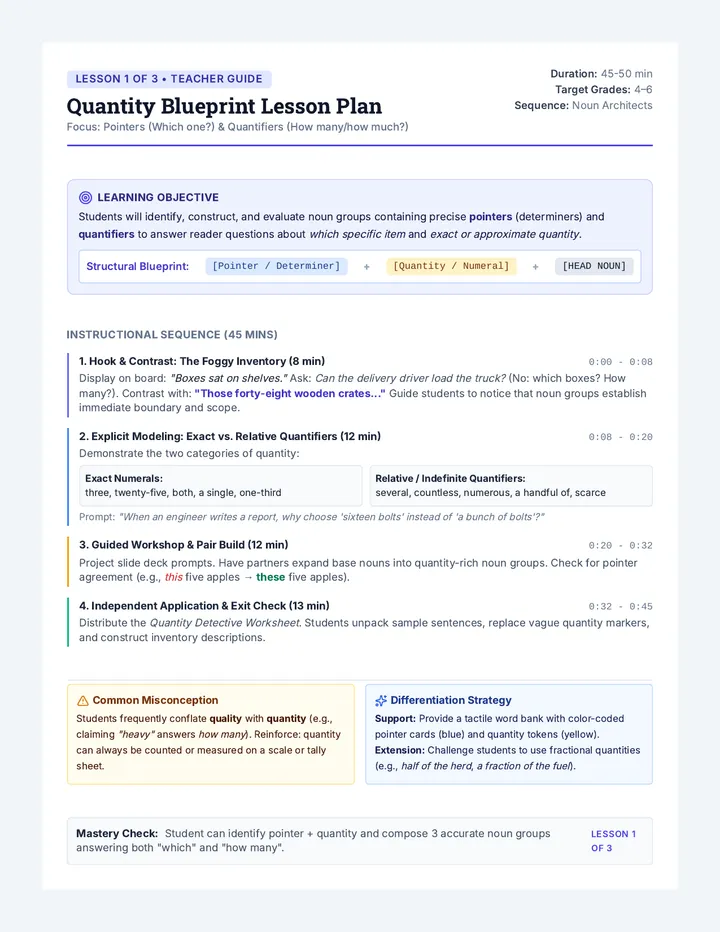
Quantity Blueprint Lesson Plan

Noun Group Architects

A three-part grammar and writing unit where students investigate, assemble, and refine precise noun groups. Learners progress from tracking quantity and pointer determiners to layering vivid qualities and specific classifiers for rich descriptive writing.

A

arlavoie-ridings

9
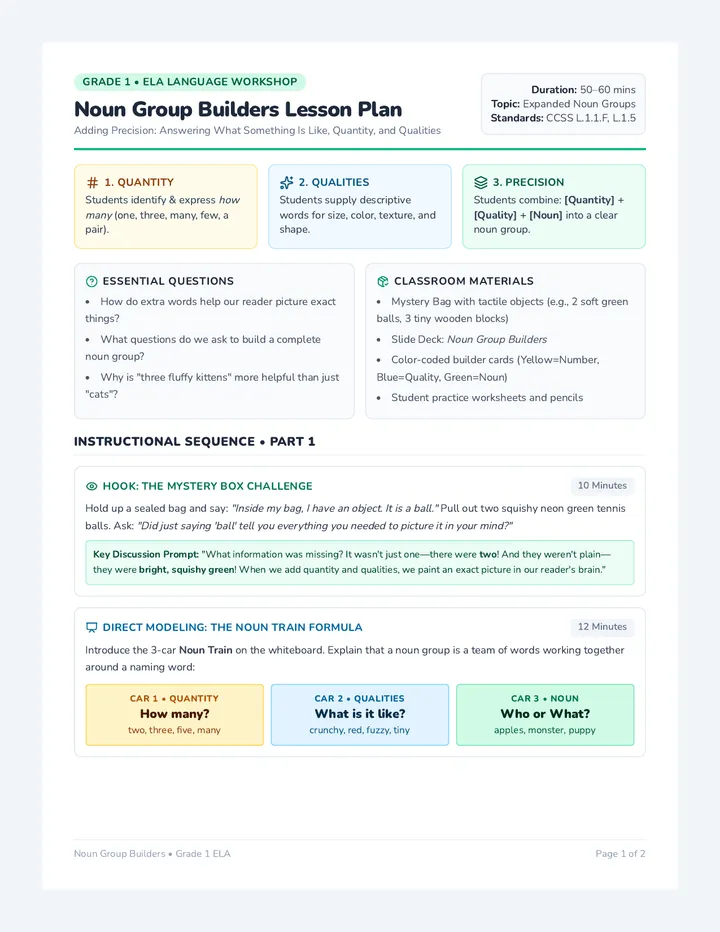
Noun Groups Lesson Plan

Noun Group Builders

A first-grade English language arts lesson introducing expanded noun groups. Students learn how to build precision by answering questions about quantity, qualities, and what something is like using descriptive words and nouns.

A

arlavoie-ridings

4
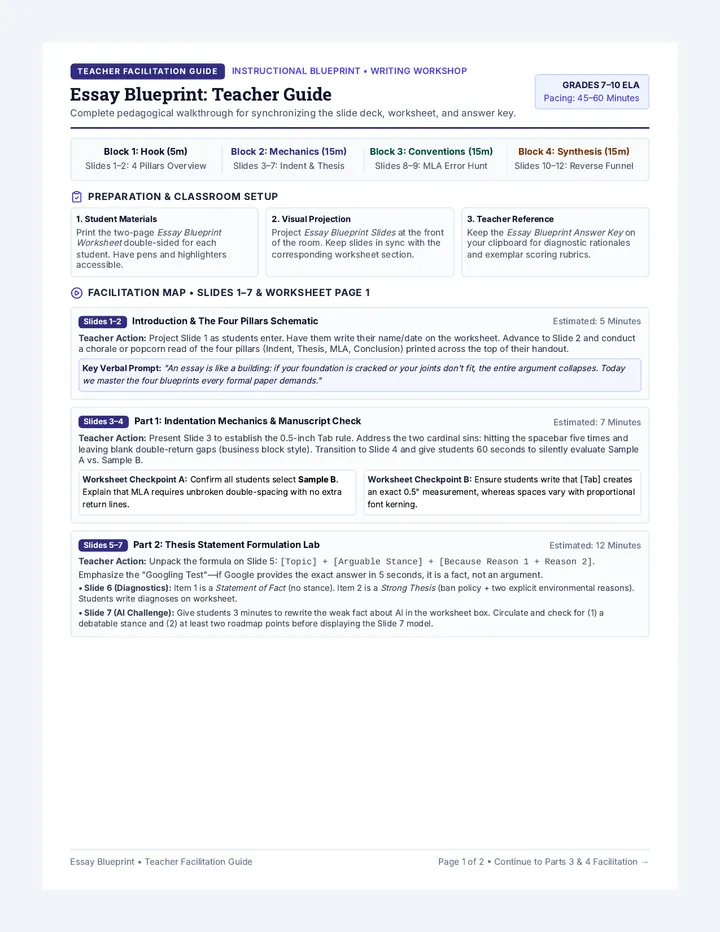
Essay Blueprint Teacher Guide

Essay Blueprint Teacher Guide

A comprehensive two-page teacher facilitation guide detailing lesson pacing, slide-by-slide choreography, worksheet integration prompts, common student misconceptions, differentiation scaffolds, and scoring protocols for the Essay Blueprint workshop.

T

timothy.nixon

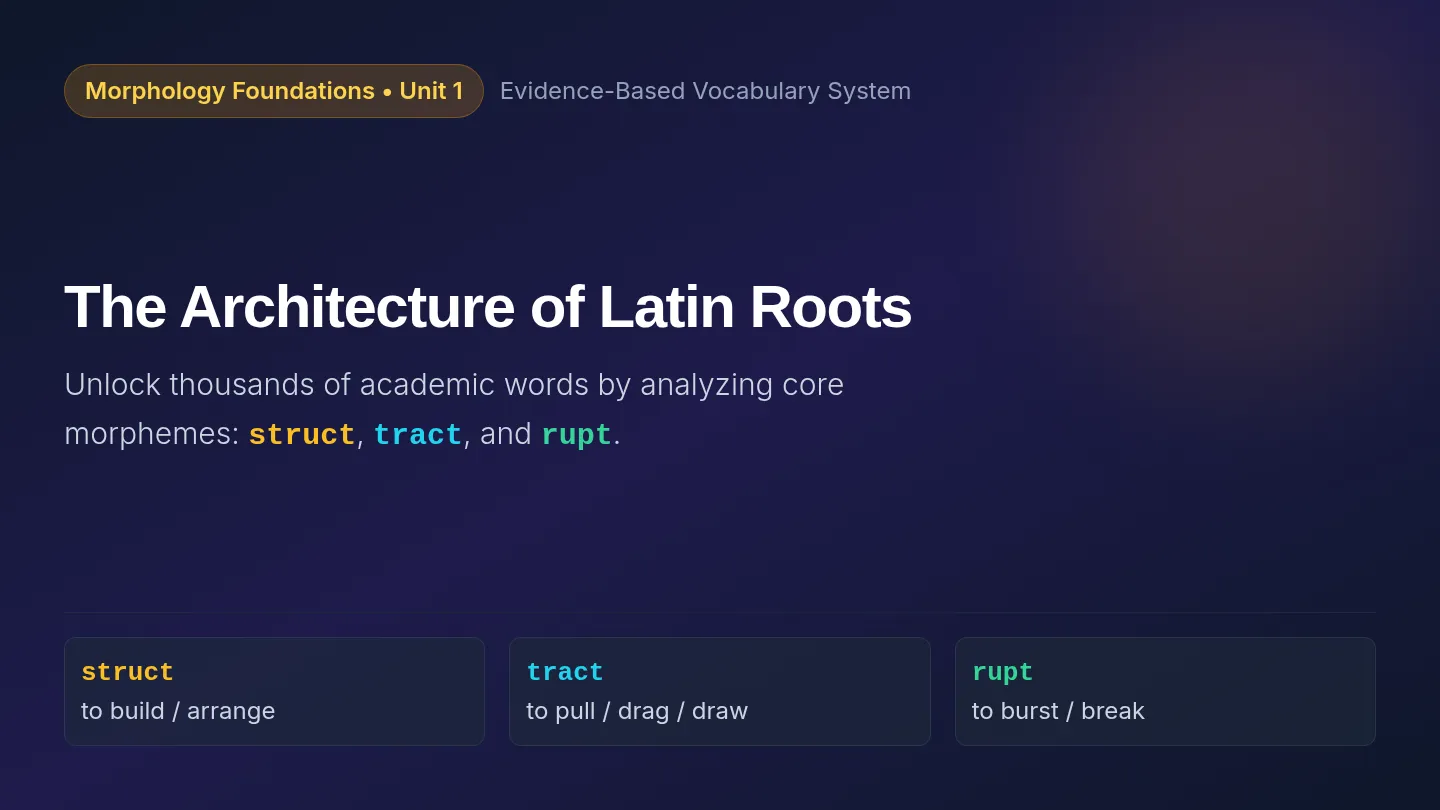
Latin Roots Slide Deck

Rooted Words Curriculum

A comprehensive, evidence-based morphology curriculum systematically teaching Latin roots, Greek combining forms, and prefix assimilation through word matrices, morpheme sums, and contextual decoding.

M

melissa.white

6
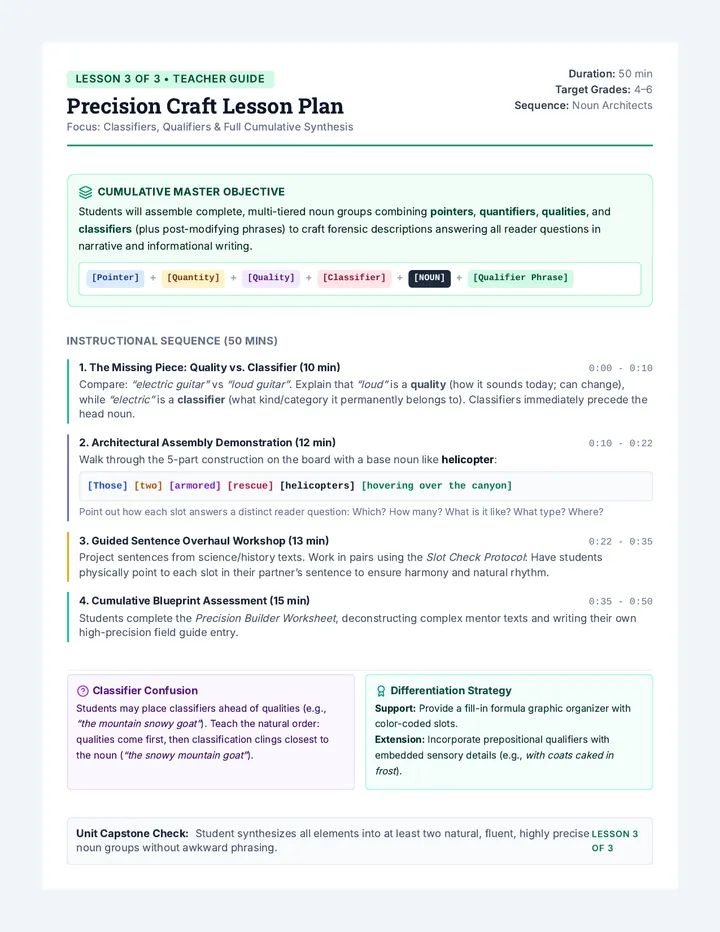
Precision Craft Lesson Plan

Precision Builders

Students synthesize quantity, quality, and classifiers into complete multi-layered noun groups with post-modifying phrases. They apply their cumulative skills to transform flat sentences into sharp, vivid descriptions.

A

arlavoie-ridings

3
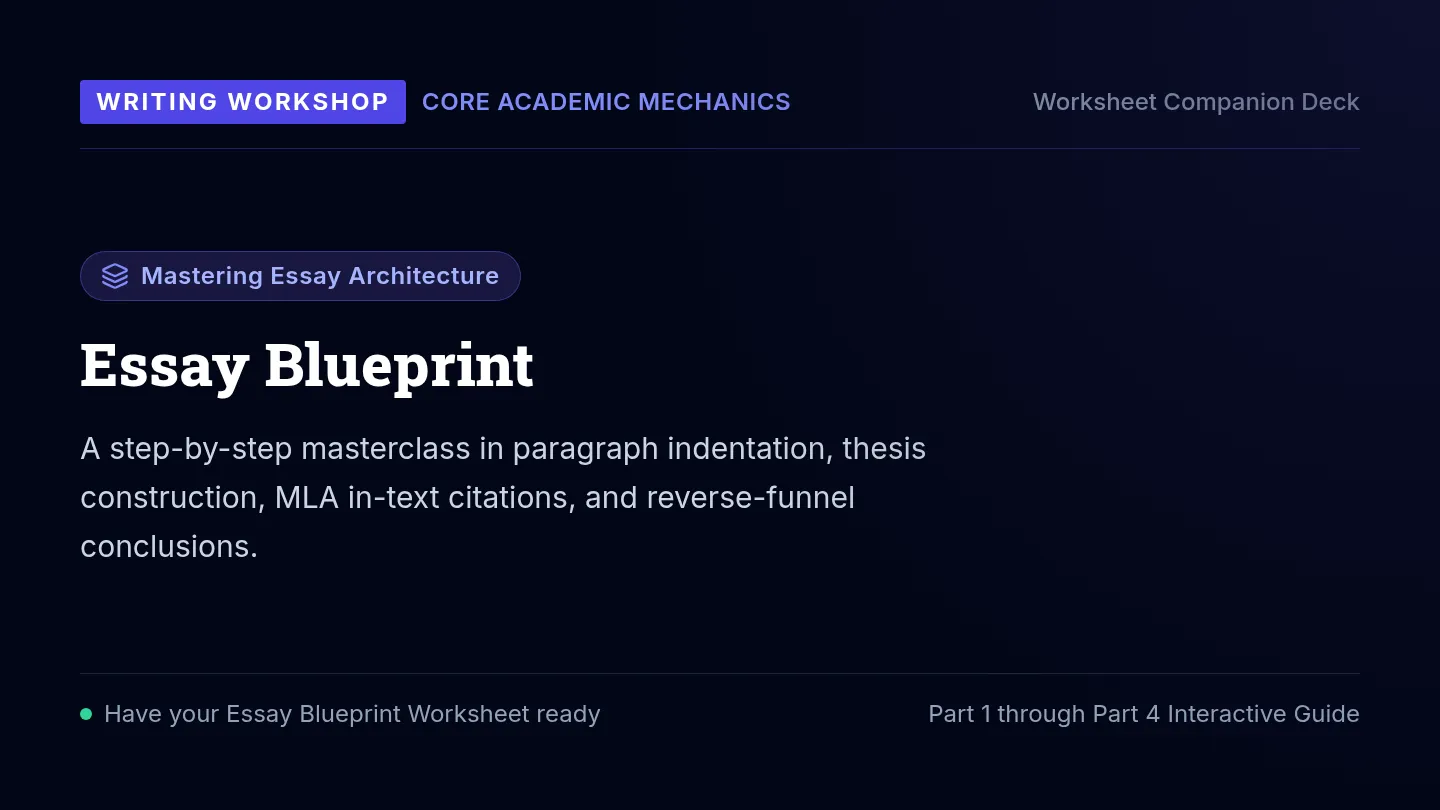
Essay Blueprint Slides

Essay Blueprint Slides

A 12-slide classroom presentation directly aligned with the Essay Blueprint worksheet, guiding students through paragraph indentation rules, thesis equations, MLA citation diagnostics, and reverse-funnel conclusions with clear visual models and live checkpoints.

T

timothy.nixon

Unit Architecture Overview Guide

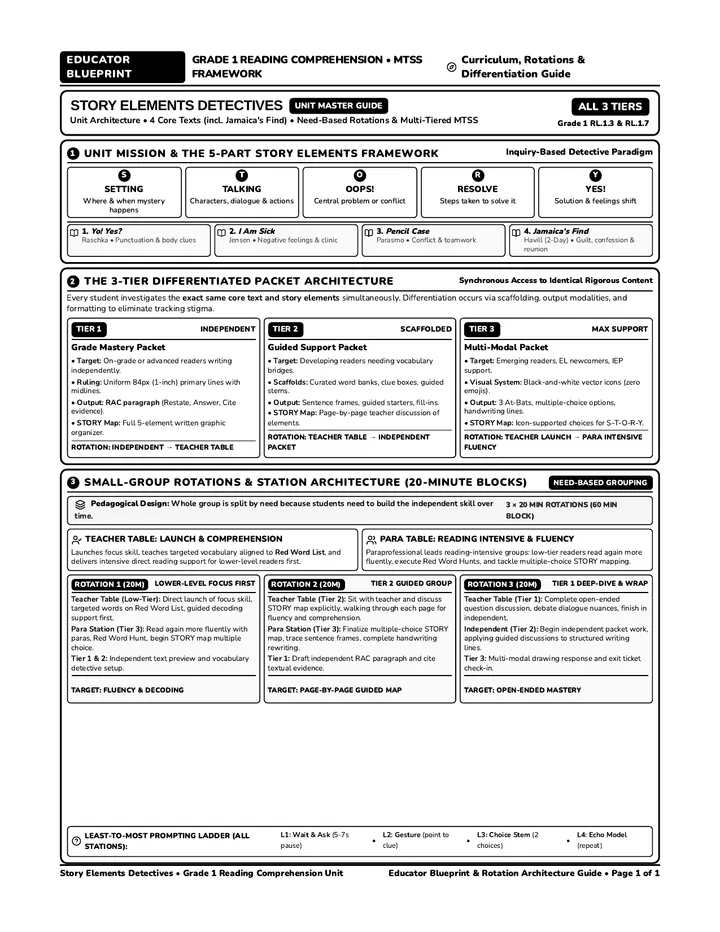
Story Elements Detectives

A Grade 1 reading comprehension unit teaching students how to identify character feelings, actions, dialogue, and problems using the STORY elements framework with multi-tiered differentiated packets and paraprofessional guides.

JE

jenn edwards

86
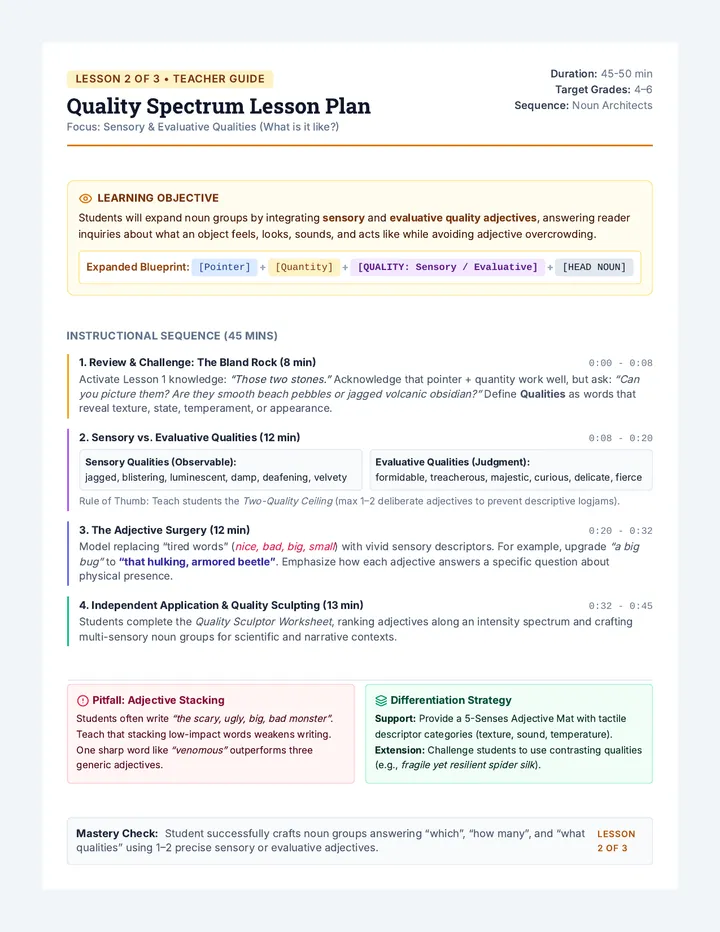
Quality Spectrum Lesson Plan

Quality Scouts

Students examine sensory and evaluative adjectives that clarify what something is like and what qualities it possesses. They learn to select precise physical and behavioral descriptors without cluttering their sentences.

A

arlavoie-ridings

3
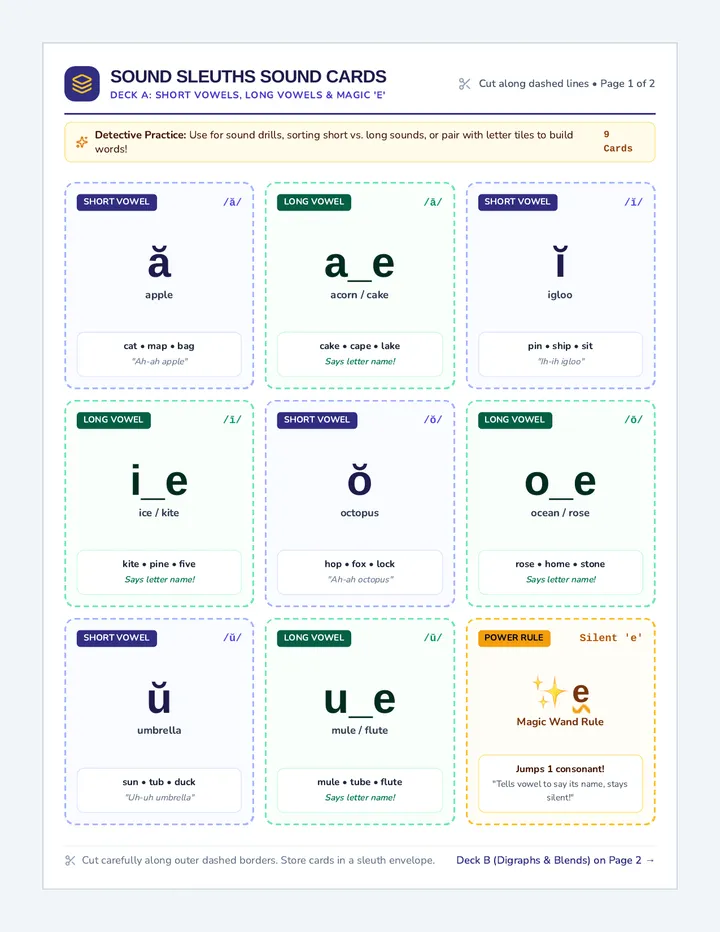
Sound Sleuths Sound Cards

Sound Sleuths Sound Cards

A printable two-page set of 18 detective-themed phonics sound cards covering short/long vowels, magic 'e', consonant digraphs, and blends. Formatted with dashed cut lines, phonetic cues, keyword anchors, and example decoding words for hands-on sorting and blending drills.

KH

Keisha Harris

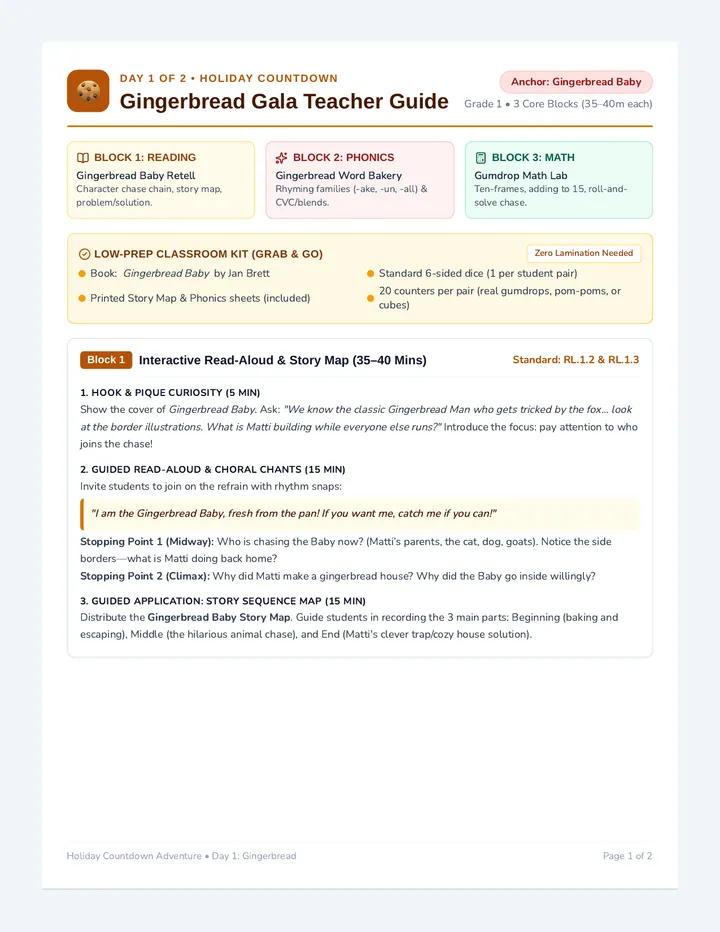
Gingerbread Gala Teacher Guide

Holiday Countdown Adventure

A two-day festive holiday countdown unit designed for the last two days before winter break. Day 1 centers on Jan Brett's Gingerbread Baby with a phonics word bakery and gumdrop math, while Day 2 celebrates Caralyn Buehner's Snowmen at Christmas with s-blend snow hunts and snowball math games.

K

KRISTEN.VANVLEET

8
Quantity Blueprint Lesson Plan

Quantity Counters

Students explore pointers and quantifiers in noun groups to answer precisely how many or which things are being described. They practice replacing vague counting words with exact numerals, fractions, and determiners.

A

arlavoie-ridings

3
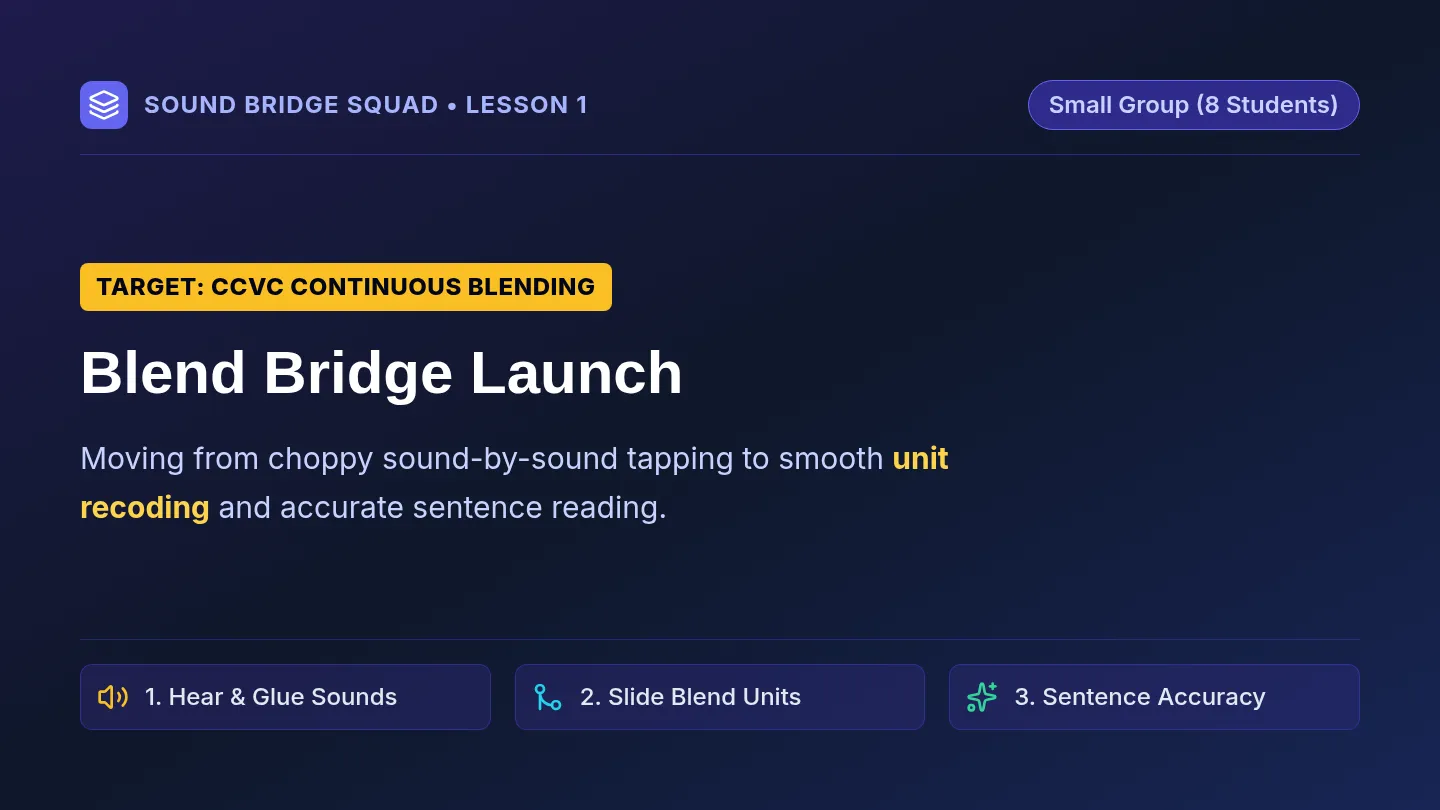
Blend Bridge Slides

Sound Bridge Squad

A 3-stage decoding and recoding intervention sequence for emerging readers. Students progress from consonant blends (CCVC) to digraphs and CVCe silent-e patterns, shifting from choppy letter-by-letter sounding to fluid unit recoding and sentence accuracy.

Lenny Avatar
Lenny
9