A comprehensive introduction to short 'a' word families (-at, -ap, -an, -am, -ad, -ag) through guided blending, hands-on center rotations, and independent practice.
A focused lesson on short 'a' and 'i' CVC words, featuring sound isolation, blending exercises, and a decodable story about two pet shop friends.
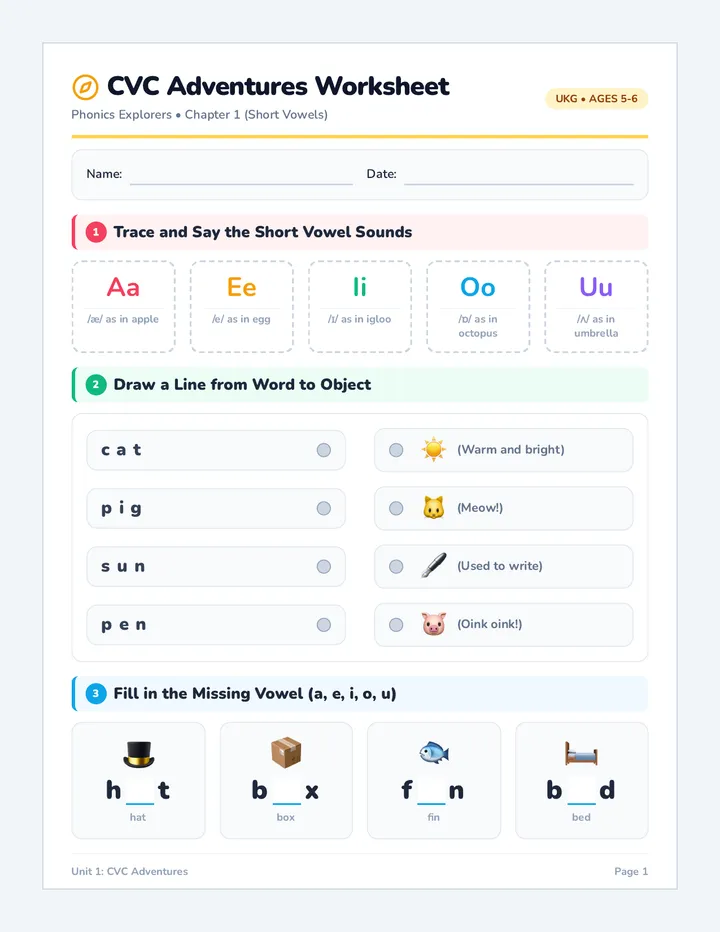
A foundational phonics lesson focused on identifying and reading CVC words with the short 'a' vowel sound through visual matching and word recognition.
A Monday morning writing routine where students reflect on their weekend activities through descriptive journaling. Students use open-ended prompts to develop their narrative writing skills and share personal experiences with their peers.
A final review and assessment where students independently construct, write, and check a complete sentence using all the skills learned.
Students practice organizing words in the correct order to make sense, working with scrambled sentences and visual word banks.
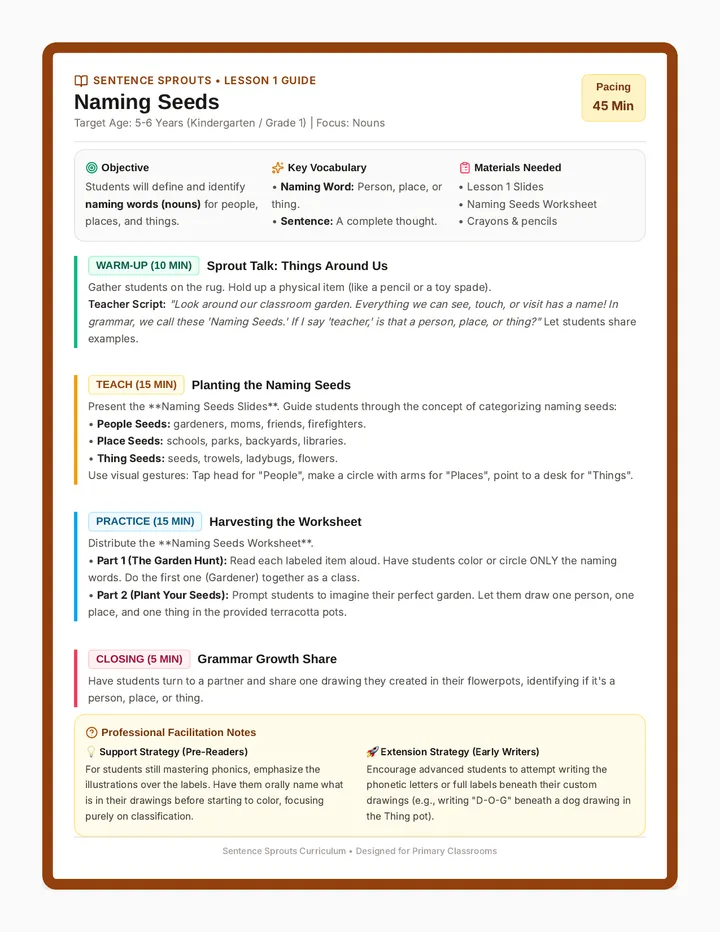
Focuses on sentence boundaries: starting with a capital letter and ending with a period. Students use the traffic light analogy (Green for Go, Red for Stop).
Teaches the importance of finger spaces between words to make writing readable. Students practice placing a "spaceman" or finger between word blocks.
Introduces the two core parts of a sentence: the naming part (Who) and the action part (Do). Students learn to combine these orally and in simple written forms using icons.
Focuses on reading and spelling CVC words by segmenting sounds and blending them together using visual and kinesthetic cues.
A lesson focused on analyzing the development of the theme of individuality and non-conformity in Munro Leaf's 'The Story of Ferdinand'. Students will track how Ferdinand stays true to himself despite external pressures.
A foundational phonics lesson focused on blending short vowels and common digraphs (sh, ch, th) using Elkonin boxes and visual matching activities.
A high-energy fluency lesson where students decode 'alien languages' (nonsense words) to master phonics patterns. Focuses on CVC and CVCe structures through guided modeling and small-group card games.
A collection of alphabet-themed activities featuring our caterpillar friend, designed to help early learners with letter recognition and sequencing.
The final mission where detectives apply all their skills to crack the ultimate code and earn their Phonics Detective Badge.
Detectives learn to break down big, multi-syllabic words and track down suffixes at the end of word 'trails'.
A mystery involving the Silent E and its team of vowels that change the 'identities' of words.
Detectives use blueprints to understand how consonants work together in blends and digraphs to create unique sounds.
Detectives investigate the 'Lineup of Sounds' to master individual letter sounds and build CVC words using vowel clues.