Sentence Stretchers Slides Grade 6 ENL • Writing Workshop
Unit: Descriptive Writing
Sentence Stretchers
Turn short, plain sentences into vivid, exciting stories using the 5 W's!
WHO?
Person / Thing
WHAT?
Action / Did
WHERE?
Place
WHEN?
Time
WHY?
Reason
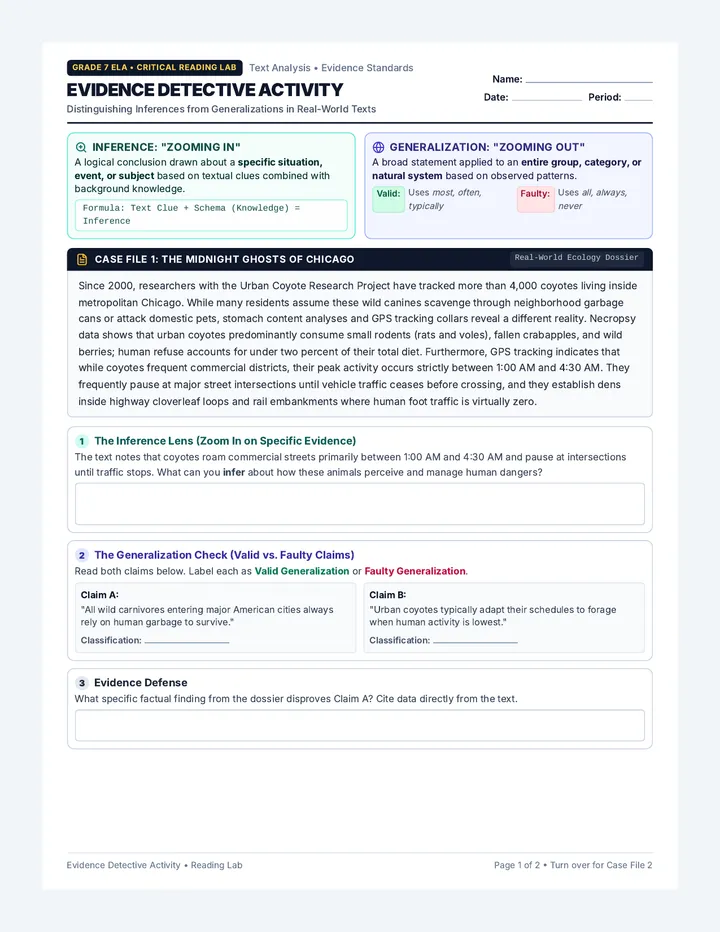
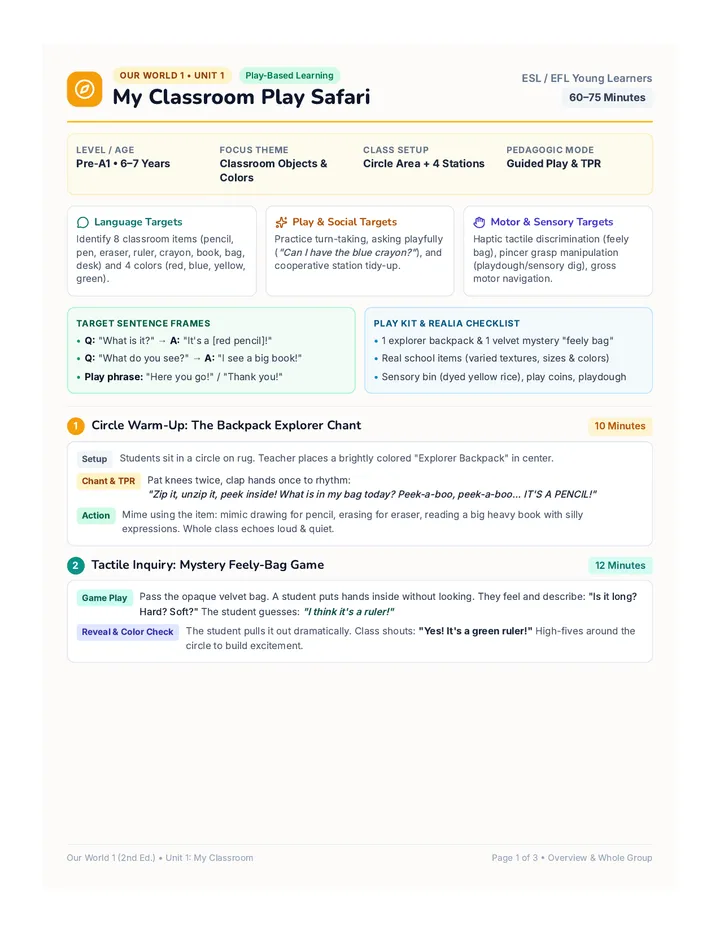
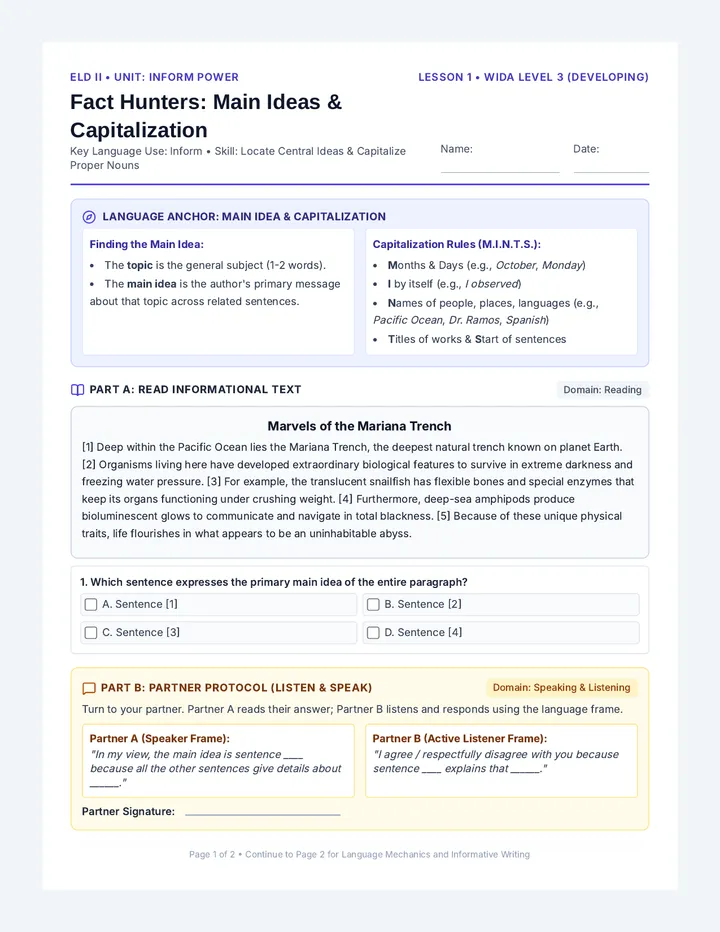
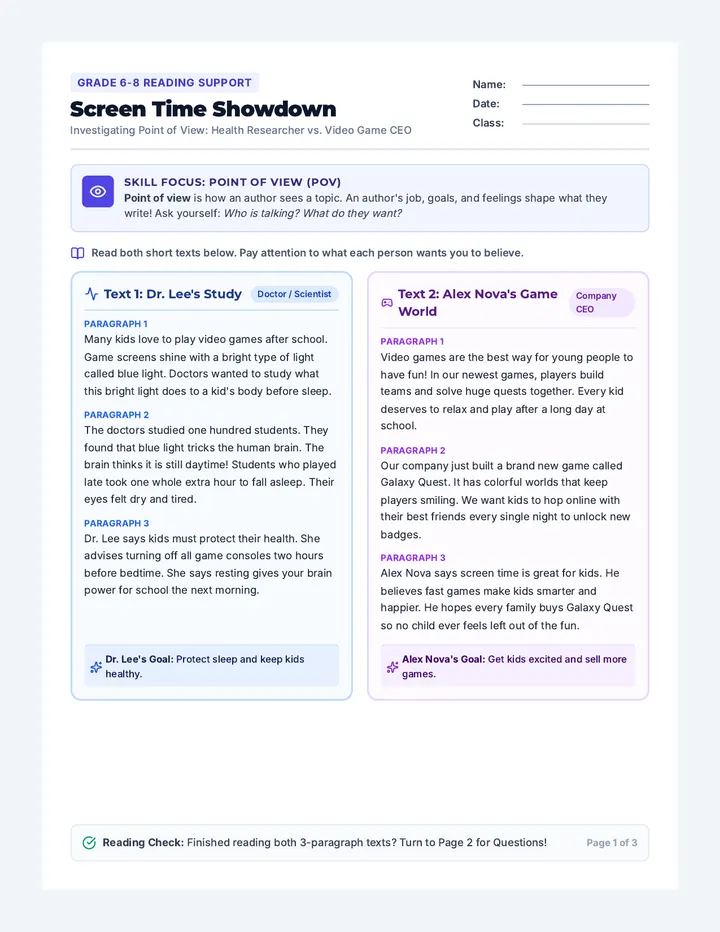
Compare These Sentences
Reader Mind-Check
Boring Sentence!
"The dog barked."
No details or visual clues
Leaves the reader wondering why
Feels plain and simple
Picture in mind: ☁️ Blurry & blank!
Supercharged Stretched Sentence!
"Yesterday afternoon, the excited puppy barked loudly in the park because he chased a gray squirrel."
Paints a vivid motion picture in mind
Answers all essential reader questions
Uses academic English structure
Picture in mind: 🎬 HD Movie Scene!
💡 Our Goal Today: Add details step-by-step so our writing comes alive!
The 5 W's Detective Toolkit
Use each clue to stretch!
WHO?
Person, animal, or character
e.g., the clever detective, my grandmother
Subject
WHAT?
The action or what happened
e.g., solved the code, baked fresh bread
Action / Verb
WHERE?
The place or location
e.g., in the school library, at the stadium
Location
WHEN?
The time or day
e.g., early this morning, during lunch
Time
WHY?
The reason or goal
e.g., to win the prize, because it was raining
Reason
Remember: A basic sentence only has WHO + WHAT . We stretch it by adding WHERE , WHEN , and WHY !
Watch the Sentence Grow!
Step-by-Step Model
Step 1
Start with the Kernel (Who + What)
The astronaut floated.
3 words
Step 2
Add WHERE (Place)
The astronaut floated inside the quiet space station.
7 words
Step 3
Add WHEN (Time)
During the mission, the astronaut floated inside the quiet space station.
10 words
Step 4
Add WHY (Reason)
During the mission, the astronaut floated inside the quiet space station to repair the radio antenna.
15 words! 🎉
✏️ Notice: When you start with WHEN , put a comma right after it! ("During the mission, ..." )
Let's Try Together! (Guided Practice)
Class Challenge
Base Kernel Sentence: "The chef cooked."
WHERE did he cook?
👉 Class idea: ____________________
WHEN did he cook?
👉 Class idea: ____________________
WHY did he cook?
👉 Class idea: ____________________
Build Your Stretched Sentence:
Class Collaboration
"[WHEN], the chef cooked [WHERE] [WHY]."
🗣️ Partner Frame: "I think we should add [where / when / why] because..."
Connecting Words Bank
Vocabulary Toolkit
WHERE Words
Prepositions of Place:
📍 in the classroom / library
📍 at the soccer field / park
📍 under the wooden bridge
📍 across the busy avenue
WHEN Words
Time Phrases:
⏰ Early this morning,
⏰ During lunch break,
⏰ After school yesterday,
⏰ At midnight,
WHY Words
Reason Connectors:
💡 because she wanted to learn
💡 so that he wouldn't forget
💡 in order to save time
💡 to prepare for the exam
💡 Tip: Try moving WHEN to the very beginning of your sentence for variety!
Your Mission: Sentence Workshop
Worksheet Time
1
Find the Kernel
Read the base sentence and circle the WHO (subject) and underline the WHAT (action).
🔍 Step 1 Check
2
Answer 3 Clues
Fill in the organizer boxes for WHERE , WHEN , and WHY using your word bank.
📋 Step 2 Plan
3
Write & Polish
Combine everything into a smooth, complete sentence. Remember your capital letter, comma, and period!
✨ Step 3 Polish
Capital letter at start
Comma after time opener
Period at the end
Sentence Stretchers Worksheet 5W
Sentence Stretchers
Grade 6 ENL • Descriptive Writing Workshop
Name:
Date:
Period:
1. WHO Person / Thing
2. WHAT Action / Did
3. WHERE Location
4. WHEN Time / Moment
5. WHY Reason / Goal
Part 1
Sentence Detective: Find the 5 W's!
Read the stretched sentence below. Find and write the phrase that answers each question.
"Yesterday morning, the curious scientist observed glowing rocks inside the mountain cave to test a new theory."
WHO?
WHAT?
WHERE?
WHEN?
WHY?
Part 2
Guided Stretcher Ladder: Build Step-by-Step
Follow the steps to expand the base sentence into a detailed, complete sentence.
Base Kernel Sentence: "The soccer player scored."
Step 1: Add WHERE Where? (e.g., at the stadium / in the final match )
Step 2: Add WHEN (Start with a time phrase + comma!) When? (e.g., Last night, / In the final minute, )
Step 3: Add WHY (The Full Stretched Masterpiece!) Why? (e.g., to win the championship / because time was running out )
Tip: A complete sentence starts with a capital letter and ends with punctuation (. or !). Page 1 of 2
5W
Sentence Stretchers Practice
Independent Workshop
Name:
Helpful Connector Bank
WHERE: in the..., at the..., inside the...
WHEN: Yesterday, Before lunch, During class,
WHY: because..., in order to..., so that...
Part 3
Plan & Stretch: Two Challenges
Kernel A: "The robot danced." Plan clues, then stretch
WHERE?
WHEN?
WHY?
Kernel B: "The artist painted." Plan clues, then stretch
WHERE?
WHEN?
WHY?
Part 4
Mega Stretcher: Your Own Creation
Choose your character & action!
Plan all 5 W's, then write your expanded sentence below.
WHO:
WHAT:
WHERE:
WHEN:
WHY:
Stretcher Self-Check Checklist:
Capital letter
Added 3+ W's
Comma after time
Period at end
Fantastic job stretching your sentences like an author! Page 2 of 2
Sentence Stretchers Teacher Guide TG
Sentence Stretchers • Teacher Guide & Answer Key
6th Grade ENL / MLL Writing Workshop • The 5 W's Strategy
Instructional Resource
Content Objective
Students will expand simple kernel sentences (subject + verb) by adding prepositional phrases and clauses answering Where, When, and Why .
Language Target (WIDA/ENL)
Students will produce complex sentences using prepositional openers ("During the mission, ..." ) and subordinating causal conjunctions (because, so that, in order to ).
Suggested Pacing Guide (45 Minutes)
00–10 Min Hook & Modeling
Slides 1–3: Compare boring vs. vivid sentences. Introduce the 5W detective cards.
10–20 Min Guided Stretch
Slides 4–6: Watch the astronaut sentence grow. Choral practice with "The chef cooked."
20–35 Min Worksheet Practice
Students complete Parts 1 & 2 individually or with a bilingual partner.
35–45 Min Share & Debrief
Whip-around sentence sharing. Self-check against checklist. Collect exit tickets.
Worksheet Answer Key & Model Exemplars
Part 1: Sentence Detective Key
WHO: the curious scientist
WHAT: observed glowing rocks
WHERE: inside the mountain cave
WHEN: Yesterday morning
WHY: to test a new theory
Part 2: Guided Stretcher Ladder Exemplars
Step 1 (+ Where): The soccer player scored at the crowded community stadium.
Step 2 (+ When): In the final minute, the soccer player scored at the crowded community stadium.
Step 3 (+ Why): In the final minute, the soccer player scored at the crowded community stadium to win the tournament championship.
Part 3: Independent Stretcher Model Responses
Robot A: Early this morning, the silver robot danced in the science lab because its battery was fully charged.
Artist B: During art class, the quiet artist painted on a large canvas to express her deep feelings.
Entering / Emerging (WIDA 1–2)
Allow students to use pre-cut clue strips to assemble sentences physically.
Accept single words or short phrases for the planner before writing.
Provide a structured cloze frame: "[When], [Who] [What] [Where] because [Why]."
Developing / Expanding (WIDA 3–5)
Encourage descriptive adjectives for the subject (e.g., the determined young scientist ).
Challenge students to vary sentence openers (e.g., begin with Because or While ).
Have students peer-audit for comma usage after introductory prepositional phrases.
Common ENL Misconceptions & Corrections
Missing Prepositions: "he played school" instead of "he played at school." Prompt with the Where word bank.
Comma Splices / Missing Commas: "Last night," ), pause and drop an anchor comma!
Run-On "And" Strings: "and... and..." , prompt them to use because , so that , or to .
Sentence Stretchers • Comprehensive Teacher Resource & Answer Key Classroom Guide