Fact Hunters Practice Worksheet ELD II • Unit: Inform Power Lesson 1 • WIDA Level 3 (Developing)
Fact Hunters: Main Ideas & Capitalization
Key Language Use: Inform • Skill: Locate Central Ideas & Capitalize Proper Nouns
Name:
Date:
Language Anchor: Main Idea & Capitalization
Finding the Main Idea:
The topic is the general subject (1-2 words).
The main idea is the author's primary message about that topic across related sentences.
Capitalization Rules (M.I.N.T.S.):
M onths & Days (e.g., October , Monday )I by itself (e.g., I observed )N ames of people, places, languages (e.g., Pacific Ocean , Dr. Ramos , Spanish )T itles of works & S tart of sentences
Part A: Read Informational Text
Domain: Reading
Marvels of the Mariana Trench
[1] Deep within the Pacific Ocean lies the Mariana Trench, the deepest natural trench known on planet Earth. [2] Organisms living here have developed extraordinary biological features to survive in extreme darkness and freezing water pressure. [3] For example, the translucent snailfish has flexible bones and special enzymes that keep its organs functioning under crushing weight. [4] Furthermore, deep-sea amphipods produce bioluminescent glows to communicate and navigate in total blackness. [5] Because of these unique physical traits, life flourishes in what appears to be an uninhabitable abyss.
1. Which sentence expresses the primary main idea of the entire paragraph?
A. Sentence [1] B. Sentence [2] C. Sentence [3] D. Sentence [4]
Part B: Partner Protocol (Listen & Speak)
Domain: Speaking & Listening
Turn to your partner. Partner A reads their answer; Partner B listens and responds using the language frame.
Partner A (Speaker Frame):
"In my view, the main idea is sentence ____ because all the other sentences give details about ______."
Partner B (Active Listener Frame):
"I agree / respectfully disagree with you because sentence ____ explains that ______."
Partner Signature:
Page 1 of 2 • Continue to Page 2 for Language Mechanics and Informative Writing
Inform Power • Lesson 1 Mechanics & Writing
Capitalization Practice & Informative Summary
Part C: Capitalization Diagnostic
Rewrite each informational sentence below. Correct all lowercase letters that should be capitalized (names, places, languages, titles, beginnings).
1. in july, dr. alvarez and her team explored the pacific ocean near japan.
2. both english and spanish scientists studied marine life in the gulf of mexico.
3. on tuesdays, the california science museum shows the documentary deep mystery.
Part D: Independent Informative Writing
Domain: Writing
Writing Prompt:
Write an informational summary (3-4 sentences) explaining how deep-sea creatures survive in the Mariana Trench. State the main idea clearly in your first sentence, provide supporting details, and correctly capitalize all proper nouns and sentence beginnings.
WIDA Level 3 Inform Self-Assessment
Stated main idea clearly Capitalized proper nouns Included 2 specific facts
Page 2 of 2 • High School ELD II • Inform Power Curriculum
Fact Hunters Answer Key ELD II • Teacher Resource Lesson 1 Answer Key & Scoring Guide
Fact Hunters: Teacher Answer Key
Focus: Main Idea in Related Sentences & Capitalization Mechanics (WIDA Level 3)
Answer Key
Part A: Reading Main Idea Key
Correct Answer: B (Sentence [2])
Teacher Rationale: Sentence [2] states the central umbrella claim: organisms have developed extraordinary biological features to survive deep-sea conditions. Sentences [3] and [4] provide specific evidence (snailfish organs, amphipod glows), and [5] concludes. Sentence [1] is merely setting the geographic location.
Part B: Oral Discourse Look-Fors
• Speaker: Expresses complete thought using "In my view, the main idea is sentence 2 because..."
• Listener: Uses polite agreement/disagreement frame and explains their reasoning.
• Scaffolding Tip: Prompt struggling pairs to point to evidence words like "for example" and "furthermore".
Part C: Capitalization Diagnostic Answers
1. Original: in july, dr. alvarez and her team explored the pacific ocean near japan.
Rules: Sentence start (In), Month (July), Title & Name (Dr. Alvarez), Proper Ocean/Country (Pacific Ocean, Japan).
2. Original: both english and spanish scientists studied marine life in the gulf of mexico.
Rules: Sentence start (Both), Nationalities/Languages (English, Spanish), Body of water (Gulf of Mexico).
3. Original: on tuesdays, the california science museum shows the documentary deep mystery.
Rules: Sentence start (On), Day (Tuesdays), Proper institution (California Science Museum), Title (Deep Mystery).
Part D: WIDA Level 3 Student Writing Exemplar
Meets Standards
"Deep-sea organisms in the Mariana Trench use unique physical adaptations to survive extreme cold and pressure. For example, snailfish have flexible bones that resist crushing weight in the Pacific Ocean. In addition, amphipods make glowing light to communicate in total darkness. Because of these traits, marine life survives in deep water."
Main Idea: Clear topic sentence summarizing adaptations.
Capitalization: Mariana Trench, Pacific Ocean, beginnings capitalized.
WIDA Scaffold: Connectors (For example, In addition, Because) link ideas.
Formative Feedback Strategy:
If students capitalize common nouns (e.g., Fish or Ocean when not part of a named ocean), review the M.I.N.T.S. acronym anchor chart. If they confuse a detail with the main idea, ask: "Does this sentence tell about the whole paragraph, or just one animal?"
Lesson 1 Teacher Key • Inform Power Sequence • High School ELD II
Bridge Builders Practice Worksheet ELD II • Unit: Inform Power Lesson 2 • WIDA Level 3 (Developing)
Bridge Builders: Relationship Connectors
Key Language Use: Inform • Skill: Connect Topics and Phenomena
Name:
Date:
Language Anchor: Connectors That Show Relationships
Cause & Effect
Shows why or what happened.
therefore, as a result, because, consequently
Contrast
Shows differences or surprises.
however, although, on the other hand, yet
Addition
Adds more facts or evidence.
furthermore, in addition, moreover, also
Sequence
Shows order in time or steps.
first, next, then, finally, meanwhile
Part A: Read Science Phenomenon
Domain: Reading
Volcanoes and Global Climate Change
When large volcanoes erupt, they eject massive clouds of ash and sulfur gas high into the stratosphere. First , heavy ash falls back to earth near the crater; however , microscopic aerosol particles remain suspended in the upper atmosphere for months. In addition , these pale aerosols reflect solar radiation back into space. Consequently , average global surface temperatures drop temporarily across multiple continents. Although eruptions appear purely destructive, they also demonstrate how planetary systems are interconnected.
1. Identify the relationship signaled by each bold word in the text:
"however" shows: relationship of ( circle: contrast / addition / cause )
"In addition" shows: relationship of ( circle: contrast / addition / sequence )
"Consequently" shows: relationship of ( circle: cause-effect / contrast / time )
"First" shows: relationship of ( circle: addition / contrast / sequence )
Part B: Phenomenon Dialogue (Listen & Speak)
Domain: Speaking & Listening
Work with a partner. Practice oral explanations of how volcanic eruptions affect Earth.
Partner A (Cause & Effect):
"Volcanoes release reflective aerosols. As a result , sunlight is blocked, and Earth gets cooler."
Partner B (Contrast & Addition):
"Many assume eruptions only cause heat. However , they lower temperatures. Furthermore , they affect rainfall."
Did your partner use at least two relationship connectors? [ ] Yes [ ] Working on it Partner Initials: _____
Page 1 of 2 • Continue to Page 2 for Connector Transformation and Explanatory Writing
Inform Power • Lesson 2 Application & Writing
Sentence Bridging & Phenomenon Report
Part C: Connect the Ideas
Choose the best connector from the word bank to complete each informational statement about phenomena.
[ therefore • however • in addition • first ]
1. Heavy rains saturate the mountain soil; ____________________, dangerous mudslides can occur suddenly.
Relationship: Cause and Effect
2. Solar energy creates zero carbon emissions. ____________________, solar panels take up little residential space.
Relationship: Addition
3. Wind power generates clean electricity; ____________________, strong wind turbines can occasionally disturb bird flight paths.
Relationship: Contrast
Part D: Independent Informative Writing
Domain: Writing
Prompt:
Explain how a natural phenomenon occurs (e.g., volcanic eruptions, rainstorms, or seasonal changes). Write 4-5 sentences informing the reader of the process. You must include at least two different types of connectors (such as in addition , however , or therefore ).
WIDA Level 3 Inform Self-Assessment
Stated the phenomenon Used cause/contrast connector Punctuated connectors accurately
Page 2 of 2 • High School ELD II • Inform Power Curriculum
Bridge Builders Answer Key ELD II • Teacher Resource Lesson 2 Answer Key & Scoring Guide
Bridge Builders: Teacher Answer Key
Focus: Relationship Connectors in Scientific Phenomenon Texts (WIDA Level 3)
Answer Key
Part A: Text Analysis Keys
• "however" : Signals contrast (ash falls near crater, but small aerosols stay suspended high up).
• "In addition" : Signals addition (adds another property: reflecting solar radiation).
• "Consequently" : Signals cause-effect (aerosols reflect sun → surface temperatures drop).
• "First" : Signals sequence (order of post-eruption events).
Part B: Oral Discourse Look-Fors
• Partner A: Accurately uses "As a result" to connect volcanic ash to global cooling.
• Partner B: Employs "However" for contrast and "Furthermore" for secondary effects.
• Listen For: Vocal pauses following transitional adverbs (e.g., "However, [pause]...").
Part C: Connector Selection Key
1. Answer: Heavy rains saturate the mountain soil; therefore , dangerous mudslides can occur suddenly.
Rationale: Saturated soil directly produces mudslides (Cause & Effect relationship).
2. Answer: Solar energy creates zero carbon emissions. In addition , solar panels take up little residential space.
Rationale: The second sentence introduces another positive attribute of solar energy (Addition relationship).
3. Answer: Wind power generates clean electricity; however , strong wind turbines can occasionally disturb bird flight paths.
Rationale: The second clause contrasts a clean energy benefit with an environmental drawback (Contrast relationship).
Part D: Student Writing Exemplar (Level 3 WIDA Inform)
Exemplar
"Volcanic eruptions significantly impact regional climate and ecosystems. First, volcanoes release dark ash clouds that block direct sunlight. In addition, explosive vents release sulfur gas that mixes with atmospheric moisture. Consequently, solar energy reflects away from Earth, and surface temperatures drop. However, over centuries, volcanic ash enriches surrounding soil with valuable plant minerals."
Connectors: Uses First, In addition, Consequently, However.
Punctuation: Correct semicolon or period with comma after connector.
Inform Content: Clear description of scientific phenomenon.
Common Misconceptions to Address:
Watch for students using "however" when they mean "because" . Remind students: "However" signals an obstacle, twist, or difference; "Therefore" or "Consequently" signals what happens next as a result.
Lesson 2 Teacher Key • Inform Power Sequence • High School ELD II
Clause Crafters Practice Worksheet ELD II • Unit: Inform Power Lesson 3 • WIDA Level 3 (Developing)
Clause Crafters: Compound Sentences
Key Language Use: Inform • Skill: Combine Independent Clauses with FANBOYS
Name:
Date:
Language Anchor: Coordinating Conjunctions (FANBOYS)
A compound sentence joins two complete thoughts (independent clauses) using a comma and a coordinating conjunction .
and
Adds similar information
but / yet
Shows unexpected contrast
or
Presents alternatives
so
Shows result or effect
Formula: [Independent Clause 1] , [FANBOYS] [Independent Clause 2].
Part A: Read Technical Information
Domain: Reading
Clean Energy Innovations
[1] Solar panels convert sunlight into direct electric current, and battery banks store that power for evening consumption. [2] Traditional fossil fuel plants produce greenhouse gases, but modern wind turbines create zero atmospheric pollution during operation. [3] Cities must invest in clean grid infrastructure today, or power grids will struggle to meet future climate targets. [4] Engineers improved battery storage efficiency, so electric vehicle sales increased worldwide.
1. Identify the coordinating conjunction in each sentence above and explain its purpose:
Sentence [1] uses and to: add related information
Sentence [2] uses but to: show contrast between energy sources
Part B: Sentence Combining Relay (Listen & Speak)
Domain: Speaking & Listening
Partner A reads two simple clauses. Partner B joins them orally with a conjunction (and, but, so). Then switch roles!
Prompt 1 (Partner A to B):
"Electric cars are quiet. They produce zero tailpipe emissions."
Response: "Electric cars are quiet, and they produce..."
Prompt 2 (Partner B to A):
"Solar panels are expensive to install. They save money over time."
Response: "Solar panels are expensive to install, but they..."
Did your partner say the comma pause and correct conjunction? [ ] Yes [ ] Check together Partner Signature: _____
Page 1 of 2 • Continue to Page 2 for Sentence Building and Explanatory Drafting
Inform Power • Lesson 3 Combining & Writing
Compound Synthesis & Technology Overview
Part C: Combine Into Compound Sentences
Combine each pair of simple informational sentences into one compound sentence. Remember to use a comma before the coordinating conjunction (and, but, or, so ).
1. Wind turbines generate power rapidly. High wind speeds can damage their mechanical rotors. (use: but )
2. Scientists engineered lighter solar cells. People can place them on fabric backpacks. (use: so )
3. Hydroelectric dams provide water for crops. They generate clean electricity for towns. (use: and )
Part D: Independent Informative Writing
Domain: Writing
Writing Prompt:
Write an informational paragraph (4-5 sentences) comparing two renewable energy sources (such as solar, wind, or hydro power). State the main idea, explain at least two benefits or challenges, and write at least two compound sentences using and , but , or so with correct comma placement.
WIDA Level 3 Inform Compound Checklist
2 complete clauses joined Comma placed before conjunction Used and, but, or, so accurately
Page 2 of 2 • High School ELD II • Inform Power Curriculum
Clause Crafters Answer Key ELD II • Teacher Resource Lesson 3 Answer Key & Scoring Guide
Clause Crafters: Teacher Answer Key
Focus: Compound Sentences & Coordinating Conjunctions (FANBOYS) (WIDA Level 3)
Answer Key
Part A: Reading Text Analysis
• Sentence [1]: Conjunction and joins two connected actions (solar collection + battery storage).
• Sentence [2]: Conjunction but contrasts fossil fuels (polluting) with wind power (clean).
• Sentence [3]: Conjunction or indicates an alternative/consequence of inaction.
• Sentence [4]: Conjunction so shows cause and effect (better batteries → higher sales).
Part B: Oral Combining Look-Fors
• Oral Comma Pause: Listen for a brief natural pause before and , but , or so .
• Complete Thoughts: Confirm student includes the subject in both clauses: "...quiet, and they produce..." (not just "...quiet and produce" ).
• Peer Verification: Check partner signature and oral validation.
Part C: Compound Sentence Combining Answers
1. Item: Wind turbines generate power rapidly. High wind speeds can damage their mechanical rotors. (use: but )
→ Wind turbines generate power rapidly, but high wind speeds can damage their mechanical rotors.
Criteria: Comma must precede 'but'; both clauses must retain complete subject-verb structure.
2. Item: Scientists engineered lighter solar cells. People can place them on fabric backpacks. (use: so )
→ Scientists engineered lighter solar cells, so people can place them on fabric backpacks.
Criteria: Comma before 'so' indicates cause resulting in new capability.
3. Item: Hydroelectric dams provide water for crops. They generate clean electricity for towns. (use: and )
→ Hydroelectric dams provide water for crops, and they generate clean electricity for towns.
Criteria: Comma before 'and' connects two complementary benefits.
Part D: Student Writing Exemplar (Level 3 WIDA Inform)
Exemplar
"Renewable energy technologies provide sustainable electricity without creating air pollution. Solar farms capture bright sunlight during daylight hours, and lithium batteries store that electricity for cloudy afternoons. Modern wind turbines generate tremendous mechanical power, but local communities must place them away from bird migration routes. Both systems produce zero greenhouse emissions, so many coastal cities are investing heavily in renewable clean energy."
Compound 1: Joined with , and
Compound 2: Joined with , but
Compound 3: Joined with , so
Grammar Alert: Comma Splices vs. Compound Sentences:
A frequent error at WIDA Level 3 is omitting the coordinating conjunction (writing a comma splice: "Wind turbines are fast, they make power" ). Remind students that a comma alone cannot glue two sentences together—it always needs a FANBOYS partner!
Lesson 3 Teacher Key • Inform Power Sequence • High School ELD II
Complex Thinkers Practice Worksheet ELD II • Unit: Inform Power Lesson 4 • WIDA Level 3 (Developing)
Complex Thinkers: Subordination
Key Language Use: Inform • Skill: Form Complex Sentences
Name:
Date:
Language Anchor: Subordinating Conjunctions (Complex Sentences)
A complex sentence combines an independent clause (complete thought) with a dependent clause (incomplete thought introduced by a subordinating conjunction).
Cause & Reason
because, since
Explains the motive or trigger.
Concession / Contrast
although, even though
Shows surprising facts.
Time & Condition
when, while, if
Shows timing or prerequisites.
Comma Rule:
When the dependent clause starts the sentence, use a comma: "Although it rains daily**,** desert plants thrive." No comma is needed if the dependent clause comes second.
Part A: Read Ecological Report
Domain: Reading
Life in the Amazon Canopy
Although tropical rainforests cover less than seven percent of Earth's surface, they sustain more than half of the planet's terrestrial biodiversity. When rain filters through the high tree canopy, specialized tree frogs lay eggs inside water trapped in bromeliad flowers. Many predators hunt at night because intense daytime temperatures exhaust their energy quickly. If deforestation continues at present rates, countless uncataloged plant species may disappear forever.
1. Identify the dependent clause in the first sentence above:
Dependent clause: "Although tropical rainforests cover less than seven percent of Earth's surface"
Part B: Complex Sentence Exchange (Listen & Speak)
Domain: Speaking & Listening
Practice completing complex thoughts orally with your partner. Listen for the subordinating conjunction and comma pause.
Partner A (Lead):
"Because the rainforest canopy is dense, _______________________."
Partner B completes: "...little sunlight reaches the forest floor."
Partner B (Lead):
"Although jaguars are powerful hunters, ___________________."
Partner A completes: "...they face threats from habitat loss."
Both partners completed a complex sentence: [ ] Verified Partner Signature: _____
Page 1 of 2 • Continue to Page 2 for Subordination Application and Informative Report
Inform Power • Lesson 4 Complex Sentences & Writing
Subordination Practice & Ecosystem Report
Part C: Combine Using Subordinating Conjunctions
Join the pairs of clauses into one complex sentence using the conjunction in parentheses. Remember comma placement when the dependent clause is first.
1. Temperatures rise rapidly in the desert. Many animals sleep underground during the day. (use: because at start)
2. Whales migrate thousands of miles. They need warmer waters to give birth to calves. (use: since in middle)
3. Cacti lack large leaves. They store large amounts of moisture inside thick stems. (use: although at start)
Part D: Independent Ecosystem Report
Domain: Writing
Prompt:
Write an informational paragraph (4-5 sentences) describing an ecosystem (e.g., desert, coral reef, tundra, or forest). Explain how animals or plants adapt to their environment. Include at least two complex sentences using because , although , when , or if .
WIDA Level 3 Complex Sentence Checklist
Used dependent + independent clause Used comma after starting clause Clearly explained an adaptation
Page 2 of 2 • High School ELD II • Inform Power Curriculum
Complex Thinkers Answer Key ELD II • Teacher Resource Lesson 4 Answer Key & Scoring Guide
Complex Thinkers: Teacher Answer Key
Focus: Subordinating Conjunctions & Complex Sentences (WIDA Level 3)
Answer Key
Part A: Text Clause Analysis Key
• Dependent Clause: "Although tropical rainforests cover less than seven percent of Earth's surface" (starts with subordinating conjunction; cannot stand alone).
• Independent Clause: "they sustain more than half of the planet's terrestrial biodiversity."
• Punctuation Note: The comma after "surface" is mandatory because the dependent clause comes first.
Part B: Oral Subordination Look-Fors
• Cause Completion: Partner B completes with a logical result: "...little sunlight reaches the ground."
• Concession Completion: Partner A acknowledges the contrast: "...they face serious threats from poaching or habitat loss."
• Intonation: Note rising pitch at the comma pause and falling pitch at the period.
Part C: Complex Sentence Transformation Answers
1. Item: Temperatures rise rapidly in the desert. Many animals sleep underground during the day. (use: because at start)
→ Because temperatures rise rapidly in the desert, many animals sleep underground during the day.
Criteria: Starts with 'Because'; requires a comma after 'desert'.
2. Item: Whales migrate thousands of miles. They need warmer waters to give birth to calves. (use: since in middle)
→ Whales migrate thousands of miles since they need warmer waters to give birth to calves.
Criteria: 'Since' appears in the middle; no comma before 'since'.
3. Item: Cacti lack large leaves. They store large amounts of moisture inside thick stems. (use: although at start)
→ Although cacti lack large leaves, they store large amounts of moisture inside thick stems.
Criteria: Starts with 'Although'; requires a comma after 'leaves'.
Part D: Student Writing Exemplar (Level 3 WIDA Inform)
Exemplar
"Although the Sonoran Desert receives minimal annual precipitation, diverse organisms have evolved specialized adaptations. For example, kangaroo rats can survive without drinking standing water because their kidneys extract all necessary moisture from dry seeds. When blistering summer heat arrives, nocturnal desert reptiles retreat deep inside cool underground burrows. If winter rains fall, dormant wildflower seeds sprout rapidly across the valley."
Complex 1: Although... [comma]
Complex 2: ...because... [no comma]
Complex 3: When... [comma]
Instructional Tip for Subordination:
Have students physically point to the subordinating conjunction. If their finger is at the beginning of the sentence, tell them: "Your finger is in front, so put a comma in the middle!" If the conjunction is in the middle, tell them: "The conjunction is the glue—no comma needed!"
Lesson 4 Teacher Key • Inform Power Sequence • High School ELD II
Time Chroniclers Practice Worksheet ELD II • Unit: Inform Power Lesson 5 • WIDA Level 3 (Developing)
Time Chroniclers: Simple Past Recount
Key Language Use: Inform • Skill: Recount Past Events with Regular & Irregular Verbs
Name:
Date:
Language Anchor: Past Tense for Informational Recounts
Regular Verbs (Base + -ed / -d):
discover → discovered
invent → invented
observe → observed
conduct → conducted
Irregular Verbs (Form Changes):
make → made • build → built
see → saw • write → wrote
grow → grew • become → became
take → took • find → found
Signal time markers: In 1928, during the experiment, last century, after several months...
Part A: Read Science History
Domain: Reading
The Accidental Discovery of Penicillin
In September 1928, Scottish biologist Dr. Alexander Fleming returned to his laboratory in London after vacation. While examining bacterial dishes, he noticed that green mold grew on a forgotten culture dish. Fleming looked closely under the microscope and saw that the mold destroyed surrounding staphylococcus bacteria. He isolated the substance and named it penicillin. Later, researchers Howard Florey and Ernst Chain purified the drug, which became the world's first modern antibiotic and saved millions of human lives.
1. Sort these verbs from the text into the correct category:
Regular Past Verbs:
returned, noticed, looked, isolated, named, purified, saved
Irregular Past Verbs:
grew, saw, became
Part B: History Timeline Interview (Listen & Speak)
Domain: Speaking & Listening
Partner interview: Partner A asks about the discovery timeline; Partner B answers using full past tense sentences.
Partner A (Interviewer):
"What did Alexander Fleming observe when he returned to his laboratory?"
Partner B (Historian):
"When he returned, he saw that mold grew on the dish and destroyed the bacteria."
Both past verb forms pronounced accurately: [ ] Yes [ ] Practice again Partner Signature: _____
Page 1 of 2 • Continue to Page 2 for Verb Drills and Invention Recount Writing
Inform Power • Lesson 5 Application & Writing
Past Verb Mastery & Invention Recount
Part C: Complete with Simple Past Forms
Fill in the blanks with the correct simple past form of the verb indicated in parentheses.
1. In 1879, Thomas Edison ____________________ (develop) a durable carbon filament light bulb after he ____________________ (conduct) hundreds of trials.
2. The Wright brothers ____________________ (build) their first motor airplane and ____________________ (fly) across the dunes of Kitty Hawk in 1903.
3. Dr. Charles Drew ____________________ (create) large-scale blood banks during World War II and ____________________ (save) countless wounded soldiers.
4. In 1969, astronauts ____________________ (travel) to the Moon, where Neil Armstrong ____________________ (take) historic first steps.
Part D: Independent Invention Recount
Domain: Writing
Prompt:
Write an informational recount (4-5 sentences) recounting a historical breakthrough or invention (e.g., penicillin, airplanes, telephone, printing press, or vaccines). Include dates/time markers and use at least two regular past verbs and two irregular past verbs .
WIDA Level 3 Past Recount Checklist
Included time markers (In 1928...) Used regular -ed verbs accurately Used irregular verbs accurately
Page 2 of 2 • High School ELD II • Inform Power Curriculum
Time Chroniclers Answer Key ELD II • Teacher Resource Lesson 5 Answer Key & Scoring Guide
Time Chroniclers: Teacher Answer Key
Focus: Regular & Irregular Verbs in Simple Past Informational Recounts (WIDA Level 3)
Answer Key
Part A: Verb Classification Key
• Regular Past Verbs (-ed): returned, noticed, looked, isolated, named, purified, saved. (Follow standard inflectional suffix rules).
• Irregular Past Verbs (vowel/stem changes): grew (base: grow), saw (base: see), became (base: become).
• Chronological Markers: "In September 1928", "While examining", "Later".
Part B: Oral Interview Look-Fors
• Question Formation: Student uses auxiliary "did" + base verb: "What did Alexander Fleming observe...?"
• Answer Formulation: Partner correctly produces the past tense without auxiliary did : "He saw that mold grew and destroyed..."
• Pronunciation: Check past -ed pronunciation (/t/ in looked, /d/ in returned).
Part C: Past Tense Conjugation Key
1. Edison: In 1879, Thomas Edison developed (regular) a durable carbon filament light bulb after he conducted (regular) hundreds of trials.
2. Wright Brothers: The Wright brothers built (irregular: build → built) their first motor airplane and flew (irregular: fly → flew) across Kitty Hawk in 1903.
3. Dr. Charles Drew: Dr. Charles Drew created (regular) large-scale blood banks during World War II and saved (regular) countless wounded soldiers.
4. Apollo 11: In 1969, astronauts traveled (regular) to the Moon, where Neil Armstrong took (irregular: take → took) historic first steps.
Part D: Student Writing Exemplar (Level 3 WIDA Inform)
Exemplar
"In 1796, English physician Edward Jenner created the world's first successful vaccine. He observed that dairy workers who contracted mild cowpox rarely caught deadly smallpox. Jenner took biological material from a blister and tested it on a young patient. The trial succeeded, and his discovery transformed modern public health."
Regular -ed: created, observed, tested, succeeded, transformed
Irregular: caught (catch), took (take)
Time Anchors: In 1796, modern public health
Instructional Tip for Multilingual Learners:
Watch for overgeneralization of -ed on irregular verbs (e.g., *builded*, *taked*, *growed*). Praise the student for recognizing the past tense concept, then guide them to the irregular past reference wall or anchor chart.
Lesson 5 Teacher Key • Inform Power Sequence • High School ELD II
Plural Explorers Practice Worksheet ELD II • Unit: Inform Power Lesson 6 • WIDA Level 3 (Developing)
Plural Explorers: Irregulars & Demonstratives
Key Language Use: Inform • Skill: Describe Objects with Irregular Plurals & Demonstratives
Name:
Date:
Language Anchor: Irregular Plurals & Demonstratives
Irregular Plural Nouns:
1 person → many people
1 child → many children
1 tooth → many teeth • 1 foot → many feet
1 mouse → many mice • 1 woman → many women
1 phenomenon → many phenomena
Demonstratives (this/that/these/those):
Near (Singular): this
Far (Singular): that
Near (Plural): these
Far (Plural): those
Part A: Read Museum Artifact Guide
Domain: Reading
Fossils of the Ancient Savanna
Welcome to the Hall of Paleontology. In this glass case right here, visitors can observe the fossilized teeth of an ancient carnivore. Each sharp tooth shows wear patterns from crushing bones. Look over there toward the far wall; those fossilized feet belonged to a juvenile mastodon. Centuries ago, groups of early people tracked these migrating animals across wetlands. Both men and women cooperated to defend their young children from predators in this ancient habitat.
1. Identify the irregular plural nouns used in the text:
List at least 4 irregular plurals found above: teeth, feet, people, men, women, children
Part B: Museum Docent Protocol (Listen & Speak)
Domain: Speaking & Listening
Roleplay a museum tour. Partner A points near; Partner B points far. Practice correct demonstratives and plural forms.
Partner A (Pointing Near):
"Notice these sharp teeth in this exhibit right beside us."
Partner B (Pointing Far):
"And look across the room at those fossilized feet on that giant mammoth."
Accurate demonstrative and irregular plural used: [ ] Verified Partner Signature: _____
Page 1 of 2 • Continue to Page 2 for Demonstrative Drills and Exhibit Label Writing
Inform Power • Lesson 6 Application & Writing
Demonstrative Mastery & Exhibit Description
Part C: Choose the Correct Demonstrative & Plural
Circle or fill in the correct demonstrative pronoun (this, that, these, those ) and the correct irregular plural form.
1. Look at ( this / these ) fossil skull in front of me; its ____________________ (tooth / teeth) are over four inches long.
2. Across the hallway, ( that / those ) dioramas illustrate how ancient ____________________ (person / people) gathered seeds.
3. In ( this / these ) display cases near our table, researchers examine ancient skeleton ____________________ (foot / feet).
4. Over by the main exit, ( that / those ) interactive screen teaches ____________________ (child / children) about fossil layers.
Part D: Independent Exhibit Catalog Entry
Domain: Writing
Prompt:
Write an informational museum catalog entry (4-5 sentences) describing an ancient archaeological or biological exhibit. Use at least two demonstratives (this, that, these, those ) and at least two irregular plural nouns (such as teeth , feet , people , or children ).
WIDA Level 3 Exhibit Label Checklist
Used this/that/these/those Used 2 irregular plurals accurately Described specimens informatively
Page 2 of 2 • High School ELD II • Inform Power Curriculum
Plural Explorers Answer Key ELD II • Teacher Resource Lesson 6 Answer Key & Scoring Guide
Plural Explorers: Teacher Answer Key
Focus: Irregular Plurals & Demonstratives (This/That/These/Those) (WIDA Level 3)
Answer Key
Part A: Text Extraction Key
• teeth: Irregular plural of tooth (internal vowel mutation: oo → ee).
• feet: Irregular plural of foot (internal vowel mutation).
• people: Irregular plural of person (suppletive stem).
• men / women: Irregular plurals of man / woman .
• children: Irregular plural of child (-ren suffix + vowel shift).
Part B: Oral Docent Look-Fors
• Near Gestures & Language: Partner A points nearby and correctly pairs "this" with singular or "these" with plural ("these teeth" ).
• Far Gestures & Language: Partner B points across the room and uses "that" or "those" ("those feet" ).
• Pronunciation: Voiced dental fricative /ð/ in this , that , these , those .
Part C: Demonstrative & Plural Drill Answers
1. Skull item: Look at this (near singular) fossil skull in front of me; its teeth (irregular plural) are over four inches long.
2. Dioramas item: Across the hallway, those (distant plural) dioramas illustrate how ancient people (irregular plural) gathered seeds.
3. Display cases item: In these (near plural) display cases near our table, researchers examine ancient skeleton feet (irregular plural).
4. Interactive screen item: Over by the main exit, that (distant singular) interactive screen teaches children (irregular plural) about fossil layers.
Part D: Student Writing Exemplar (Level 3 WIDA Inform)
Exemplar
"Museum curators designed this paleontology exhibit to educate visitors about ancient ice age predators. In these glass cases near the entrance, paleontologists display the enormous fossilized teeth of saber-toothed cats. Across the room, those massive skeletal feet show how mammoths walked across frozen tundra. Historically, early people tracked these herds, and both men and women crafted stone spears."
Demonstratives: this, these, those
Irregular Plurals: teeth, feet, people, men, women
Inform Structure: Clear topic, exhibit details, historical context
Physical / Spatial Kinesthetic Scaffold:
Have students use their physical hands when choosing demonstratives: touch desk = this (singular) / these (plural); point across classroom = that (singular) / those (plural). Remind students that irregular plurals do not take -s (e.g., avoid *peoples*, *feets*, *childrens*).
Lesson 6 Teacher Key • Inform Power Sequence • High School ELD II
Quantity Detectives Practice Worksheet ELD II • Unit: Inform Power Lesson 7 • WIDA Level 3 (Developing)
Quantity Detectives: Countable & Uncountable Nouns
Key Language Use: Inform • Skill: Quantify Objects with Some, Any, Much, Many
Name:
Date:
Language Anchor: Countable vs. Uncountable Nouns & Quantifiers
Countable Nouns (Can count with numbers):
rocks, astronauts, sensors, batteries, samples
Use many in questions and negatives: "Are there many sensors?"
Use some in affirmative statements: "We found some rocks."
Uncountable Nouns (Liquids, gases, abstract):
water, oxygen, equipment, ice, dust, information
Use much in questions and negatives: "There isn't much oxygen."
Use any in questions and negative statements: "Is there any water?"
Part A: Read Mission Briefing
Domain: Reading
Resources on the Red Planet
When planning a crewed mission to Mars, planetary engineers analyze available environmental resources. Liquid water does not exist on the frigid surface; however, rovers identified some sub-surface ice glaciers. The thin atmosphere contains much carbon dioxide, but astronauts cannot breathe any pure oxygen without extraction equipment. Fortunately, rovers carry many analytical instruments, though they do not have much backup fuel for long journeys.
1. Sort the nouns from the text into Countable vs. Uncountable:
Countable Nouns:
glaciers, rovers, astronauts, instruments, journeys
Uncountable Nouns:
water, ice, carbon dioxide, oxygen, equipment, fuel
Part B: Mission Resource Audit (Listen & Speak)
Domain: Speaking & Listening
Practice inquiring and reporting resource quantities with your partner using quantifier frames.
Partner A (Mission Controller):
"Is there any breathable air on Mars, and how many solar cells are operational?"
Partner B (Astronaut Specialist):
"There isn't any natural oxygen, but there is much solar radiation, and many panels are active."
Quantifiers matched count/uncount nouns accurately: [ ] Verified Partner Signature: _____
Page 1 of 2 • Continue to Page 2 for Quantifier Drills and Resource Report Writing
Inform Power • Lesson 7 Application & Writing
Quantifier Application & Mission Inventory Report
Part C: Select Some, Any, Much, or Many
Fill in each blank with the most accurate quantifier based on countability and sentence type.
1. Does the laboratory station have ____________________ (much / many) extra microscopes for student researchers?
2. The rover did not detect ____________________ (any / some) moisture inside the dry desert soil samples.
3. Although space probes require ____________________ (much / many) electricity, engineers installed ____________________ (some / any) efficient generators.
4. There are not ____________________ (much / many) days remaining before the next satellite launch.
Part D: Independent Resource Report
Domain: Writing
Prompt:
Write an informational paragraph (4-5 sentences) summarizing a space colony or science laboratory inventory. Inform the reader what supplies they have and what they lack. Use at least two countable nouns and two uncountable nouns , alongside some , any , much , or many .
WIDA Level 3 Quantifier Checklist
Differentiated count/uncount Used some/any/much/many accurately Clear informational structure
Page 2 of 2 • High School ELD II • Inform Power Curriculum
Quantity Detectives Answer Key ELD II • Teacher Resource Lesson 7 Answer Key & Scoring Guide
Quantity Detectives: Teacher Answer Key
Focus: Countable vs. Uncountable Nouns & Quantifiers (Some/Any/Much/Many) (WIDA Level 3)
Answer Key
Part A: Noun Classification Key
• Countable (Plural -s): glaciers, rovers, astronauts, instruments, journeys, samples, panels.
• Uncountable (Mass/Non-count): water, ice, carbon dioxide, oxygen, equipment, fuel, radiation.
• Key Rule: Uncountable nouns never take an indefinite article (a/an ) or a plural -s in English.
Part B: Oral Resource Audit Look-Fors
• Questions with "any": "Is there any breathable air...?" (uses singular verb with non-count air).
• Questions with "many": "How many solar cells are operational?" (plural verb with count noun).
• Negative Responses: "There isn't any..." vs. "There aren't many..." .
Part C: Quantifier Selection Answers
1. Microscopes: Does the laboratory station have many (correct: countable plural) extra microscopes for student researchers?
Rationale: 'microscopes' is plural count; 'much' cannot modify countable nouns.
2. Moisture: The rover did not detect any (correct: negative statement with non-count) moisture inside the dry desert soil samples.
Rationale: In negative sentences with 'did not', 'any' is required instead of 'some'.
3. Electricity & Generators: Although space probes require much electricity, engineers installed some efficient generators.
Rationale: 'electricity' is non-count ('much'); 'generators' is affirmative count ('some').
4. Days: There are not many (correct: countable days) days remaining before the next satellite launch.
Part D: Student Writing Exemplar (Level 3 WIDA Inform)
Exemplar
"The lunar research habitat maintains strict control over its life-support resources. Currently, the station has some water stored inside insulated backup tanks, but technicians do not have much oxygen remaining in reserve canisters. Furthermore, engineers brought many scientific tools to analyze lunar dust samples. However, there is not any spare electrical equipment if the primary solar array fails."
Non-Count + Quantifier: some water, much oxygen, any equipment
Count + Quantifier: many tools, tanks
Inform Content: Clear facility inventory assessment
Linguistic Transfer Tip (L1 to English):
Many languages treat words like information or equipment as countable. Explicitly teach students that in English, you cannot say *informations* or *equipments*; students should use "pieces of equipment" or "some information" .
Lesson 7 Teacher Key • Inform Power Sequence • High School ELD II
Skill Showcase Practice Worksheet ELD II • Unit: Inform Power Lesson 8 • WIDA Level 3 (Developing)
Skill Showcase: Modals & Gerund Profiles
Key Language Use: Inform • Skill: Abilities (Can/Can't) & Behaviors (Like/Love + -ing)
Name:
Date:
Language Anchor: Modals of Ability & Behavioral Preferences
Can / Can't (Ability & Possibility):
Followed by base verb without to : Subject + can / can't + base verb
can = has the capability ("Cheetahs can run up to 70 mph." )can't = lacks the capability ("Penguins can't fly in air." )
Like / Love + Verb-ing (Habits & Tendencies):
Use the gerund (-ing form) after like / love:
"Dolphins love swimming in pods." "Nocturnal owls like hunting during dusk."
Part A: Read Wildlife Profile
Domain: Reading
The Peregrine Falcon: Apex Aerial Hunter
The peregrine falcon is the fastest living creature on Earth. In high-speed dives called stoops, this raptor can reach speeds exceeding 240 miles per hour. Because its eyes have protective third eyelids, it can spot prey from thousands of feet in the air. However, it can't fly backwards like a hummingbird. Falcons love nesting on tall urban skyscrapers and steep mountain ledges, and they like perching in high wind gusts to conserve flight energy.
1. Identify the target structures from the text:
Abilities (can / can't): can reach, can spot, can't fly
Habits (love / like + -ing): love nesting, like perching
Part B: Creature Ability Exchange (Listen & Speak)
Domain: Speaking & Listening
Interview your partner about an animal or specialist. Alternate asking and answering using the target sentence stems.
Partner A (Inquire):
"What can a sea turtle do, and what habitat does it love exploring ?"
Partner B (Inform):
"It can hold its breath underwater for hours, and it loves swimming through coral reefs."
Used can/can't and like/love + verb-ing correctly: [ ] Verified Partner Signature: _____
Page 1 of 2 • Continue to Page 2 for Synthesis Drills and Capstone Informative Report
Inform Power • Lesson 8 Capstone Informative Writing
Capstone Profile: Species or Career Specialization
Part C: Complete the Informative Sentences
Complete each sentence using can , can't , or like / love + Verb-ing .
1. Marine biologists ____________________ (can / analyze) ocean chemistry, but they ____________________ (can't / predict) every storm.
2. Field researchers ________________________________________ (love / collect) new plant specimens in dense jungle areas.
3. Although robotic rovers ____________________ (can / withstand) freezing nights, they ____________________ (can't / repair) severed electrical cables.
4. Environmental scientists ________________________________________ (like / collaborate) with international universities on climate studies.
Part D: Capstone Informative Profile
Domain: Writing (Unit Capstone)
Capstone Prompt:
Write an informational profile (5-6 sentences) about a specialized professional (e.g., astronomer, surgeon, engineer) or a remarkable animal species. Clearly state the main idea. Incorporate: (1) can and can't , (2) like or love + Verb-ing , and (3) at least one connector or compound/complex sentence .
WIDA Level 3 Inform Capstone Rubric
Main idea stated can & can't used love/like + -ing used Connected clauses
Page 2 of 2 • High School ELD II • Inform Power Curriculum
Skill Showcase Answer Key ELD II • Teacher Resource Lesson 8 Capstone Answer Key & Rubric
Skill Showcase: Teacher Answer Key & Rubric
Focus: Modals (Can/Can't), Gerunds (Like/Love + -ing), & Informative Synthesis (WIDA Level 3)
Answer Key
Part A: Reading Text Analysis Key
• can reach / can spot: Expresses physiological capabilities of the falcon (speed & vision). Followed by base form without to .
• can't fly: Expresses physical limitation (cannot fly backwards).
• love nesting / like perching: Behavioral preferences followed by gerund (-ing form).
Part B: Oral Interview Look-Fors
• Modal Accuracy: Check that student does NOT insert "to" after can (e.g., student says "It can hold" , not *can to hold*).
• Gerund Accuracy: Student says "loves swimming" (not *loves swim*).
• Fluency: Audible partner communication using sentence frames.
Part C: Sentence Completion Key
1. Biologists: Marine biologists can analyze ocean chemistry, but they can't predict every storm.
2. Researchers: Field researchers love collecting new plant specimens in dense jungle areas.
3. Rovers: Although robotic rovers can withstand freezing nights, they can't repair severed electrical cables.
4. Scientists: Environmental scientists like collaborating with international universities on climate studies.
Part D: Capstone Informative Writing Exemplar (WIDA Level 3 Synthesis)
Exemplar
"Marine biologists are specialized scientists who investigate ocean ecosystems. These dedicated researchers can dive hundreds of feet into cold ocean trenches to collect biological samples, but they can't remain submerged indefinitely without pressurized oxygen equipment. In addition, marine biologists love tracking migrating humpback whales across open waters, and they like analyzing genetic data inside modern laboratories. Because climate change threatens coral reefs worldwide, their research protects marine biodiversity."
Modals: can dive, can't remain
Gerunds: love tracking, like analyzing
Unit Synthesis: Connectors (In addition, Because), compound sentences
Sequence Capstone Scoring Criteria (4-Point Scale):
4 - Advanced: Seamlessly combines compound/complex sentences; flawless modals & gerunds.
3 - Proficient: Clear main idea, correct can/can't, gerunds present, 1-2 minor comma slips.
2 - Emerging: Simple sentences predominate; inconsistent -ing after like/love; needs frames.
1 - Beginning: Incomplete thoughts; requires one-on-one linguistic teacher scaffolding.
Lesson 8 Teacher Key • Inform Power Sequence • High School ELD II
Blueprint Builders Organizer Worksheet ELD II • Writing Process: Step 1 (Prewriting) Lesson 9 • WIDA Level 3 (Developing)
Blueprint Builders: Informative Prewriting
Key Language Use: Inform • Skill: Brainstorm, Categorize & Organize Facts
Name:
Date:
Step 1: Choose Your Informative Report Topic
Select one high-interest topic from the options below or propose an approved scientific/historical topic:
Ocean Abyss Creatures Renewable Green Energy Mars Exploration Rovers
My Specific Topic:
Step 2: Informative Concept Web (3 Subtopic Pillars)
Graphic Organizer
Break down your central topic into three distinct informative categories (e.g., Physical Traits, Habitat, Unique Behaviors).
Central Topic & Main Claim
Subtopic Pillar 1
Focus: (e.g., Physical Traits)
Subtopic Pillar 2
Focus: (e.g., Environment / Habitat)
Subtopic Pillar 3
Focus: (e.g., Special Abilities / Impact)
Step 3: Oral Prewriting Rehearsal (Listen & Speak)
Domain: Speaking & Listening
Speaker Stems:
"My informative report is about _______. My three main subtopics are _______, _______, and _______."
Active Listener Feedback:
"Your subtopics are clear. A question I still have is: how does _______ relate to your main idea?"
Page 1 of 2 • Turn to Page 2 for Fact-Gathering Matrix & Vocabulary Vault
Inform Power • Writing Process (Step 1) Evidence & Vocabulary
Evidence Matrix & Academic Word Bank
Step 4: Factual Evidence Matrix
Record 2 verified factual details for each subtopic. Note connectors and grammar features you plan to use.
Subtopic Category
Verified Fact & Supporting Evidence
Target Language Feature
1. Traits / Features
[ ] irregular plurals
2. Habitat / Context
[ ] some/any/much/many
3. Functions / Abilities
[ ] can / can't
Step 5: Academic Vocabulary Vault (Informative Language)
Informative Verbs:
demonstrate, indicate, produce, adapt, survive, illustrate, require
Relationship Connectors:
consequently, furthermore, however, therefore, in addition, although
Analytical Nouns:
characteristics, environment, function, evidence, organisms, systems
Prewriting Gate Check (Ready to Draft?)
Topic narrowed & approved 3 subtopic pillars outlined Oral rehearsal completed
Page 2 of 2 • Blueprint Builders • Advance to Lesson 10 for Guided Drafting
Blueprint Builders Teacher Guide ELD II • Teacher Resource Writing Process: Lesson 9 Teacher Guide
Blueprint Builders: Teacher Facilitation Guide
Phase: Informative Prewriting & Graphic Organization (WIDA Level 3)
Teacher Guide
Instructional Focus
• Deconstruct broad topics into three logical informational subtopics.
• Distinguish between broad claims and specific factual evidence.
• Orally rehearse ideas using academic sentence frames before writing.
Recommended Pacing (50 min)
• 10 min: Topic Anchor & Modeling Concept Web
• 15 min: Independent Web & Subtopic Mapping
• 15 min: Partner Rehearsal & Evidence Matrix
• 10 min: Prewriting Readiness Gate Check
Teacher Model: Completed 3-Pillar Concept Web Exemplar Topic: The Mariana Snailfish
Pillar 1: Physical Traits
Flexible skeleton lacking hard bones
Translucent skin without scales
Target: irregular plurals & demonstratives
Pillar 2: Extreme Habitat
Mariana Trench at 26,000 feet depth
Freezing water pressure, zero light
Target: quantifiers (much pressure, no light)
Pillar 3: Adaptations
Can thrive under crushing force
Loves hunting tiny deep-sea crustaceans
Target: can / can't, like/love + -ing
Differentiated Linguistic Scaffolds for Prewriting
Support for Emerging Students:
Provide pre-printed fact cards that students can physically sort into the three pillars before writing on their organizer. Use bilingual glossary sheets for scientific nouns.
Extension for Expanding Students:
Require students to integrate at least two contrasting connectors (e.g., although, however ) directly into their evidence notes.
Oral Rehearsal Observational Protocol:
During Partner Talk (Step 3), circulate with a clipboard. Ensure students use complete sentences rather than one-word topic names. When students pause, prompt with: "Tell your partner why this fact matters..."
Lesson 9 Teacher Guide • Inform Power Sequence • High School ELD II
Draft Designers Writing Guide ELD II • Writing Process: Step 2 (Drafting) Lesson 10 • WIDA Level 3 (Developing)
Draft Designers: Informative Drafting (Part 1)
Drafting: Engaging Introduction & Body Section 1 with Evidence Frames
Name:
Date:
Informative Report Title & Working Thesis
Report Title:
Central Claim / Thesis Sentence Frame:
[Subject] is a fascinating [category] that [key action/trait] because [reason 1] and [reason 2].
Paragraph 1: Introduction (Hook & Roadmap)
Goal: 3-4 Sentences
Sentence 1 (Hook): "Have you ever wondered how...?" OR "In our world today, [Topic] plays a vital role..."
Sentence 2 (Background): "Scientists and researchers know that [Topic] is located in / known for..."
Sentence 3 (Thesis / Preview): "This report examines the physical characteristics, environment, and abilities of [Topic]."
Paragraph 2: Body Section 1 (Physical Features / Primary Traits)
Goal: 4-5 Sentences
Topic Sentence: "To begin with, [Topic] possesses remarkable physical characteristics."
Fact 1 + Language Frame: "For instance, [these/this] features allow it to..."
Fact 2 + Conjunction: "[Feature 1] functions effectively, and [Feature 2] helps..."
Page 1 of 2 • Turn to Page 2 to Draft Body Sections 2 & 3 and the Conclusion
Inform Power • Writing Process (Step 2) Drafting: Body & Conclusion
Draft Designers: Informative Drafting (Part 2)
Paragraph 3: Body Section 2 (Environment & Capabilities)
Goal: 4-5 Sentences
Transition + Topic Sentence: "In addition to its structure, [Topic] operates inside a challenging environment."
Ability Frame (can/can't): "Although it can [action], it can't [limitation] because..."
Behavior Frame (like/love + -ing): "Furthermore, it loves [verb-ing] when..."
Paragraph 4: Conclusion (Synthesis & Takeaway)
Goal: 3-4 Sentences
Restate Thesis (New Words): "In conclusion, [Topic] demonstrates how [key lesson/adaptation]..."
Summary of Points: "Because of its unique features and abilities, it continues to..."
Final Impact / Thought: "Ultimately, understanding [Topic] helps scientists / society to..."
Draft Completion Checklist
Intro has thesis Body 1 has facts Body 2 has can/can't Conclusion restates
Page 2 of 2 • Draft Designers • Proceed to Lesson 11 for Peer Revision & Sentence Expansion
Draft Designers Teacher Guide ELD II • Teacher Resource Writing Process: Lesson 10 Teacher Guide
Draft Designers: Teacher Facilitation Guide
Phase: Guided Multi-Paragraph Informative Drafting (WIDA Level 3)
Teacher Guide
Drafting Milestones
• Intro: Broad hook → context → roadmap thesis statement.
• Body 1 & 2: Subtopic sentences followed by evidence and connector transitions.
• Conclusion: Restated thesis, summary of findings, and broader impact takeaway.
Lesson Pacing (50 min)
• 10 min: Whole-group modeling of thesis and intro hooks
• 15 min: Drafting Introduction & Body Section 1
• 15 min: Drafting Body Section 2 & Conclusion
• 10 min: Self-audit using drafting checklist
Annotated WIDA Level 3 Model Draft: "The Mariana Snailfish" Full 4-Paragraph Structure
[Intro] Have you ever wondered what kinds of creatures survive miles beneath the surface of the ocean? Deep inside the Pacific Ocean, the Mariana snailfish thrives where few other organisms can exist. This report examines the extraordinary physical traits, extreme habitat, and survival abilities of this deep-sea fish.
[Body 1] To begin with, the snailfish possesses specialized physical characteristics. Unlike shallow fish, it does not have hard bones; instead, these translucent creatures have flexible cartilage that resists crushing water pressure. In addition, they do not possess any swim bladders, so their bodies never implode in the deep abyss.
[Body 2] Furthermore, the snailfish operates in a frigid and sunless environment. Although there is not much natural light, it can detect vibrations in the water to catch food. Snailfish love hunting small crustaceans, but they cannot swim fast over long distances.
[Conclusion] In conclusion, the Mariana snailfish demonstrates remarkable biological resilience. Because of its flexible body and sensory adaptations, it dominates the deepest ocean trench. Understanding these creatures helps scientists appreciate the extreme diversity of life on Earth.
On-the-Fly Teacher Conference Questions
If student writes fragmented intro:
"Read your thesis aloud. Does it name your 3 subtopics? Let's use the frame: 'This report examines...'"
If body paragraphs lack connectors:
"You have two great facts here. Which connector fits between them: 'In addition' or 'However'?"
Lesson 10 Teacher Guide • Inform Power Sequence • High School ELD II
Revision Refiners Workshop Packet ELD II • Writing Process: Step 3 (Revision) Lesson 11 • WIDA Level 3 (Developing)
Revision Refiners: Peer Review & Sentence Expansion
Phase: Peer Conference (Listen & Speak) & Sentence Combining Clinic
Author:
Reviewer:
Step 1: Peer Revision Conference Protocol (Listen & Speak)
Domain: Speaking & Listening
The Author reads their draft aloud. The Reviewer listens actively without interrupting, then provides feedback using the structured sentence stems below.
1. Praise (What is working well):
"One strength of your draft is _______ because your explanation of _______ is very clear."
2. Sentence Variety Suggestion:
"In paragraph ___, you have two short sentences. You could combine them using (and / but / because / although )."
Reviewer Signature: Date:
Step 2: Sentence Stretcher Clinic
Domain: Writing
Revise each pair of basic draft sentences below into a single, well-punctuated compound or complex sentence.
1. Draft: The creature has no eyes. It navigates using electrical sensors. (Use: Although )
Target: Start with 'Although', add comma after first clause.
2. Draft: Solar cells collect bright sunlight. Rechargeable batteries store the energy. (Use: and )
Target: Comma before coordinating conjunction 'and'.
3. Draft: Space rovers cannot travel through deep sand. Their wheels will get trapped. (Use: because )
Target: Connect with 'because' in the middle.
Page 1 of 2 • Turn to Page 2 for Author's Revision Log & Transition Upgrade Matrix
Inform Power • Writing Process (Step 3) Revision Plan & Upgrades
Author's Revision Plan & Transition Upgrades
Step 3: Replace Repetitive Transitions
Audit your draft. When you spot repetitive words like also or and , upgrade to stronger relationship connectors:
To Add More Evidence:
Furthermore,
To Introduce Contrast:
However,
To Show Cause or Effect:
Consequently,
Step 4: Author's Personal Revision Plan
Write down three specific sentences from your draft that you will revise and improve today:
1. Original Sentence in Draft:
My Revised / Expanded Sentence:
2. Original Sentence in Draft:
My Revised / Expanded Sentence:
Revision Quality Check (Ready for Final Editing?)
Added 2+ compound/complex sentences Varied transitional connectors Incorporated peer reviewer feedback
Page 2 of 2 • Revision Refiners • Proceed to Lesson 12 for CUPS Editing & Final Publishing
Revision Refiners Teacher Guide ELD II • Teacher Resource Writing Process: Lesson 11 Teacher Guide
Revision Refiners: Teacher Facilitation Guide
Phase: Peer Review Conference (Listen & Speak) & Sentence Clinic (WIDA Level 3)
Teacher Guide
Revision Milestones
• Conduct peer review with active listening and oral praise/coaching stems.
• Combine choppy sentences into compound (FANBOYS) and complex (subordinating) structures.
• Eliminate transition monotony by substituting academic connectors.
Pacing Breakdown (50 min)
• 10 min: Modeling active listening & sentence expansion
• 15 min: Structured peer review conference (7 min each)
• 15 min: Sentence Stretcher clinic & personal revision plan
• 10 min: Whole-class share-out of upgraded sentences
Step 2 Sentence Stretcher Clinic: Teacher Key Answers & Rules
1. Creature Eyes (Subordination with 'Although'):
→ Although the creature has no eyes, it navigates using electrical sensors.
Teacher Rule: Dependent clause begins with 'Although'; comma is required after 'eyes'.
2. Solar Cells (Coordination with 'and'):
→ Solar cells collect bright sunlight, and rechargeable batteries store the energy.
Teacher Rule: Comma precedes coordinating conjunction 'and' before the second independent clause.
3. Rovers in Sand (Causal Subordination with 'because'):
→ Space rovers cannot travel through deep sand because their wheels will get trapped.
Teacher Rule: 'Because' links the clauses in the middle; no comma is necessary.
Peer Conference Coaching for Multilingual Learners
For Reluctant Speakers:
Pair students with designated role cards (Speaker / Scribe). Model pointing to specific lines: "Right here in line 4, what connector could we add?"
Focusing on Meaning vs. Spelling:
Remind students: "Revision is for IDEAS and SENTENCE FLOW. Do not worry about spelling yet—that is for Step 4 (Publishing)!"
Lesson 11 Teacher Guide • Inform Power Sequence • High School ELD II
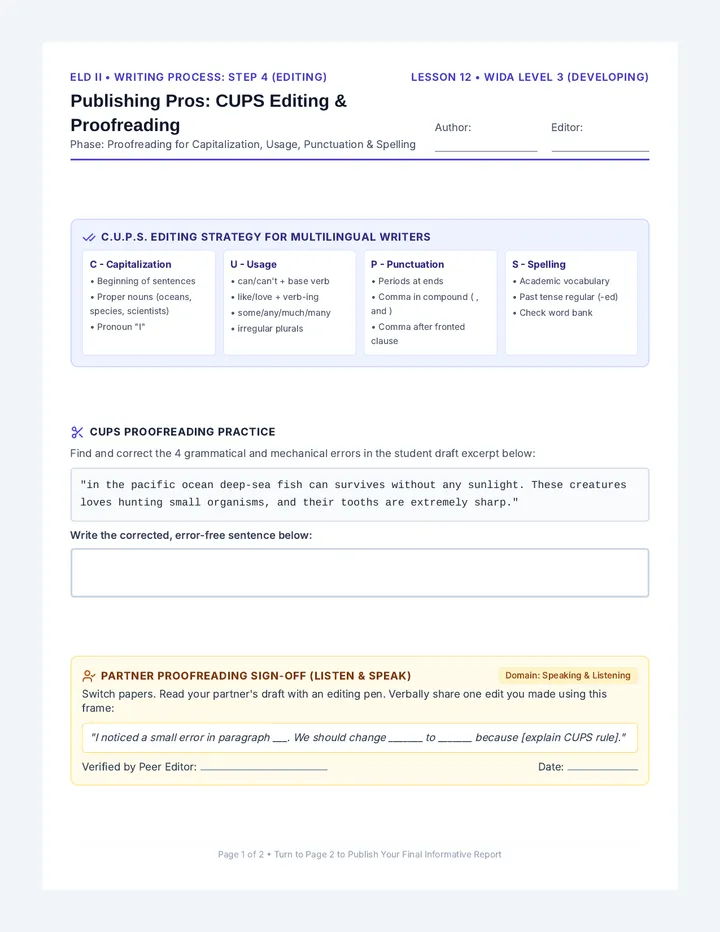
Publishing Pros Final Report ELD II • Writing Process: Step 4 (Editing) Lesson 12 • WIDA Level 3 (Developing)
Publishing Pros: CUPS Editing & Proofreading
Phase: Proofreading for Capitalization, Usage, Punctuation & Spelling
Author:
Editor:
C.U.P.S. Editing Strategy for Multilingual Writers
C - Capitalization
• Beginning of sentences
• Proper nouns (oceans, species, scientists)
• Pronoun "I"
U - Usage
• can/can't + base verb
• like/love + verb-ing
• some/any/much/many
• irregular plurals
P - Punctuation
• Periods at ends
• Comma in compound ( , and )
• Comma after fronted clause
S - Spelling
• Academic vocabulary
• Past tense regular (-ed)
• Check word bank
CUPS Proofreading Practice
Find and correct the 4 grammatical and mechanical errors in the student draft excerpt below:
"in the pacific ocean deep-sea fish can survives without any sunlight. These creatures loves hunting small organisms, and their tooths are extremely sharp."
Write the corrected, error-free sentence below:
Partner Proofreading Sign-Off (Listen & Speak)
Domain: Speaking & Listening
Switch papers. Read your partner's draft with an editing pen. Verbally share one edit you made using this frame:
"I noticed a small error in paragraph ___. We should change _______ to _______ because [explain CUPS rule]."
Verified by Peer Editor: Date:
Page 1 of 2 • Turn to Page 2 to Publish Your Final Informative Report
The Young Scientist Gazette • Informative Publication
Author byline: By • Class: ELD II • Period:
Final Polished Informative Article
Scientific Illustration / Diagram
[ Draw & Label Diagram ]
Caption:
About the Author
This author enjoys informing readers about...
Officially Published ELD II Informative Portfolio Piece Sequence Capstone Publication • Inform Power
Publishing Pros Teacher Guide ELD II • Teacher Resource Writing Process: Lesson 12 Teacher Guide
Publishing Pros: Teacher Evaluation Guide & Rubric
Phase: Final Editing (CUPS), Publication & Gallery Walk Presentation
Teacher Guide
CUPS Proofreading Practice: Answer Key Error Identification
Original with Errors:
"in the pacific ocean deep-sea fish can survives without any sunlight. These creatures loves hunting small organisms, and their tooths are extremely sharp."
Corrected Sentence:
"In the Pacific Ocean, deep-sea fish can survive without any sunlight. These creatures love hunting small organisms, and their teeth are extremely sharp."
C: In, Pacific Ocean
U (Modal): can survive (not *survives)
U (Plural): love hunting, teeth (not *tooths)
P: Comma after ocean
Publishing Showcase: Gallery Walk Protocol (Listen & Speak)
Students tape their published articles to classroom walls. Half the class acts as "Museum Curators" presenting their article; half acts as "Visiting Scholars" taking notes.
Curator Presentation Prompt:
"Welcome to my research report on _______. One remarkable fact is that _______ can _______ because _______."
Visiting Scholar Inquiry Frame:
"Thank you for sharing. How does the illustration in your diagram support your central main idea?"
Summative WIDA Level 3 Informative Writing Rubric
4 - Exemplary
Clear thesis; 3 body sections with seamless connectors; compound and complex sentences; flawless modals & irregular plurals.
3 - Proficient
Identifiable main idea; 2+ compound/complex sentences; appropriate connectors; minor CUPS errors that do not impede meaning.
2 - Developing
Basic topic stated; mostly simple sentences; limited transitional connectors; recurring errors in modals, plurals, or capitalization.
1 - Emerging
Incomplete paragraphs; fragments; heavy reliance on native language or teacher transcription; requires revision cycle.
Portfolio Archiving Note:
File the completed 4-stage packet (Prewriting Organizer → Scaffolded Draft → Peer Review Sheet → Published Article) in the student's ELD Growth Portfolio as concrete WIDA Level 3 Informative Writing artifacts.
Lesson 12 Teacher Guide • Inform Power Sequence • High School ELD II