Complex grammar structures, idiomatic expressions, and phrasal verbs. Strengthens reading and listening comprehension while building conversational fluency for varied social and professional settings.
Students create a mini-research poster on a topic of their choice. They apply their knowledge by including three facts and a correctly formatted, alphabetized bibliography with at least three sources. The lesson includes a gallery walk for peer feedback.
Students learn how to organize individual citations into a list, emphasizing alphabetical order. They practice formatting a simple bibliography page using citations generated in previous lessons. This prepares them for the final structural requirement of research papers.
A high-stakes simulated networking mixer where students must apply their knowledge of idioms, phrasal verbs, and social listening to complete specific "missions."
Students learn how to find citation information on websites, which is often harder to locate. They practice finding the URL, site name, and access date. Students compare the differences between book and website citations.
Students analyze how speakers use shorthand references to history, pop culture, and sports to convey complex ideas, and develop strategies for asking for clarification when references are missed.
Students handle physical books to locate the title page, author, publisher, and copyright date. They learn a simplified citation format and practice finding bibliographic data.
The final stage where students review citations, credit images, and finalize their bibliography for presentation.
Students synthesize their research notes into a cohesive draft, focusing on using attribution verbs and clear sentence structures.
Synthesizes learning through case studies of intentional vs. accidental plagiarism and concludes with an academic integrity pledge.
Teaches students how to compile individual citations into a cohesive, alphabetized reference list.
Focuses on extracting key facts and paraphrasing using keywords to avoid plagiarism and organize information effectively.
Students engage in a 'shadowing' technique, repeating audio immediately after hearing it to internalize the rhythm and flow of connected speech. This active processing reinforces their ability to predict and process sound streams.
Focusing on function words, this lesson tackles common reductions like 'gonna,' 'wanna,' and weak forms of auxiliary verbs. Students analyze unscripted interviews to catch these reductions in context.
Students learn how sounds influence their neighbors (e.g., 'hand bag' becoming 'hambag'). The lesson uses minimal pair discrimination and dictation exercises to train ears to recognize words despite phonological changes.
Students learn to find and validate credible sources using search strategies and a simplified evaluation checklist.
Students transition from broad topics to focused, open-ended research questions through a 'Wonder Wall' activity and peer review.
Focuses on the transition from formal to informal spoken English by identifying and decoding phrasal verbs in narrative segments.
A detailed student evidence log for the final podcast project, providing sections for analyzing intent, vocal forensics, and bias check.
A guide for the final project where students select a podcast episode, analyze its intent and bias, and present their findings, including a checklist and a performance rubric.
Slides for the final project launch, introducing the media critic mission, criteria for analyzing podcasts, and methods for citing audio evidence.
A cumulative exit ticket for the "Search Superstars" sequence, assessing student mastery of keywords, Boolean operators, text features, and database usage.
Final assessment for the Search Strategy Academy unit, covering keywords, Boolean operators, database use, and snippet analysis.
Answer key for the Lesson 4 worksheet on grammatical reductions.
A troubleshooting-focused worksheet that presents students with failed search scenarios and requires them to diagnose the error and rewrite the search string using effective strategies.
Answer key for the Lesson 3 worksheet on assimilation.
Student scavenger hunt log for Lesson 5, where students document their search strings and answers to obscure research questions.
Answer key for the Lesson 2 worksheet on elision.
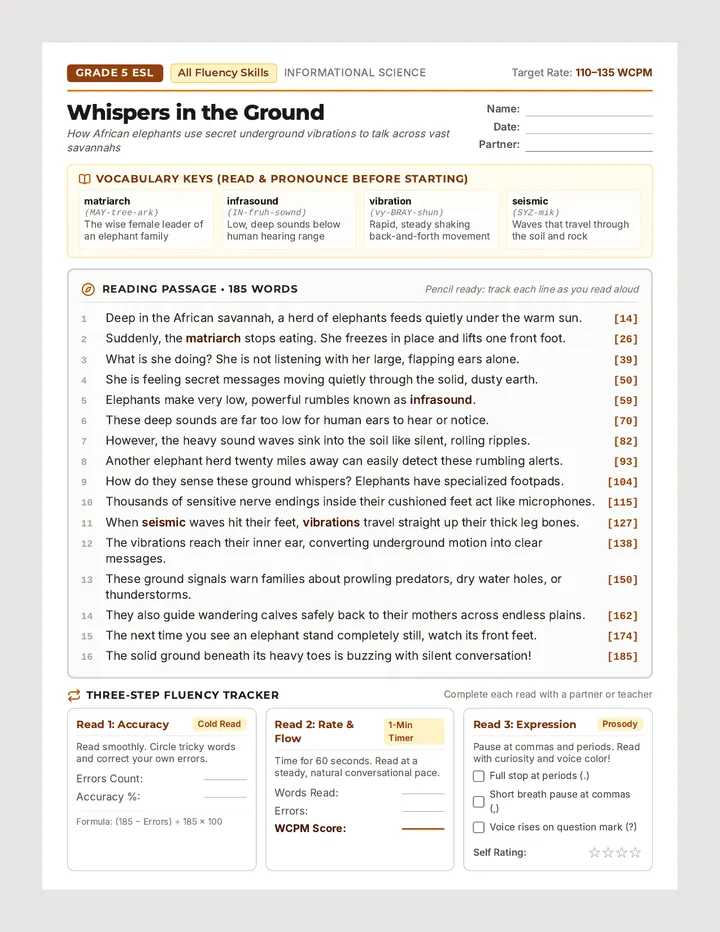
A visual guide for 5th grade ESL students on troubleshooting failed search attempts, focusing on identifying too-long sentences and overly specific terms as common causes of zero results.
Answer key for the Lesson 1 worksheet on linking and intrusion.
A comprehensive 5-lesson project-based sequence for 5th Grade ESL students to master the research cycle, from questioning to final publication. Students develop academic English skills through searching, evaluating, and synthesizing information on a chosen topic.
A 5-lesson sequence for 5th-grade ESL students focused on the ethics and mechanics of academic research. Students learn to distinguish between intellectual property and common knowledge, master the art of quoting and paraphrasing, and create simplified citations and bibliographies to maintain academic integrity.
A 5-lesson sequence for 5th Grade ESL students focused on developing academic English skills through paraphrasing and synthesizing information. Students progress from identifying main ideas to drafting complete summary reports using multiple sources and formal attribution.
A 5-lesson sequence for 5th-grade ESL students to develop media literacy and research skills. Students learn to distinguish author purpose, evaluate website credibility using the 5 W's, identify bias, and corroborate information across multiple sources.
A 5-lesson sequence for 5th Grade ESL students focused on the mechanics of finding information. Students move from basic keyword generation to using Boolean operators, navigating text features, utilizing academic databases, and refining failed searches to become efficient digital researchers.
A comprehensive workshop-style unit for 6th Grade ESL students focused on the linguistic mechanics of paraphrasing and synthesizing information. Students move from identifying core concepts to orally retelling information, transforming individual sentences, and finally weaving multiple sources into a single coherent paragraph without plagiarizing.
A 5-lesson unit for 6th-grade ESL students focused on transforming search habits from natural language questions to strategic keyword and Boolean operator techniques. Students move from basic vocabulary brainstorming to navigating academic databases and skimming snippets for relevance.
A comprehensive sequence for 6th Grade ESL students to develop critical research and information literacy skills. Students progress from distinguishing basic facts and opinions to applying professional evaluation frameworks like the CRAAP test to determine source credibility.
A comprehensive 5-lesson sequence designed for 7th-grade ESL students to master the art of synthesizing information. Students progress from organizing raw research notes to writing sophisticated, cohesive academic paragraphs using evidence from multiple sources.
A comprehensive 7th-grade ESL sequence focusing on the ethics of academic integrity, the mechanics of paraphrasing and summarizing, and the technical accuracy of MLA citations. Students transition from understanding intellectual property to performing independent 'plagiarism audits' on research samples.
A comprehensive sequence for intermediate ESL graduate students focused on mastering academic lecture comprehension, identifying discourse markers, filtering digressions, and implementing effective note-taking strategies.
A sequence for 7th-grade ESL students focusing on digital literacy, evaluating source credibility, and mastering search strategies for academic research. Students move from identifying misinformation to independently curating high-quality sources using databases and Boolean logic.
A comprehensive 4th-grade ESL project-based sequence on academic integrity and citation standards. Students transition from understanding the ethics of intellectual property to mastering the technical skills of citing books and websites, culminating in a mini-research project.