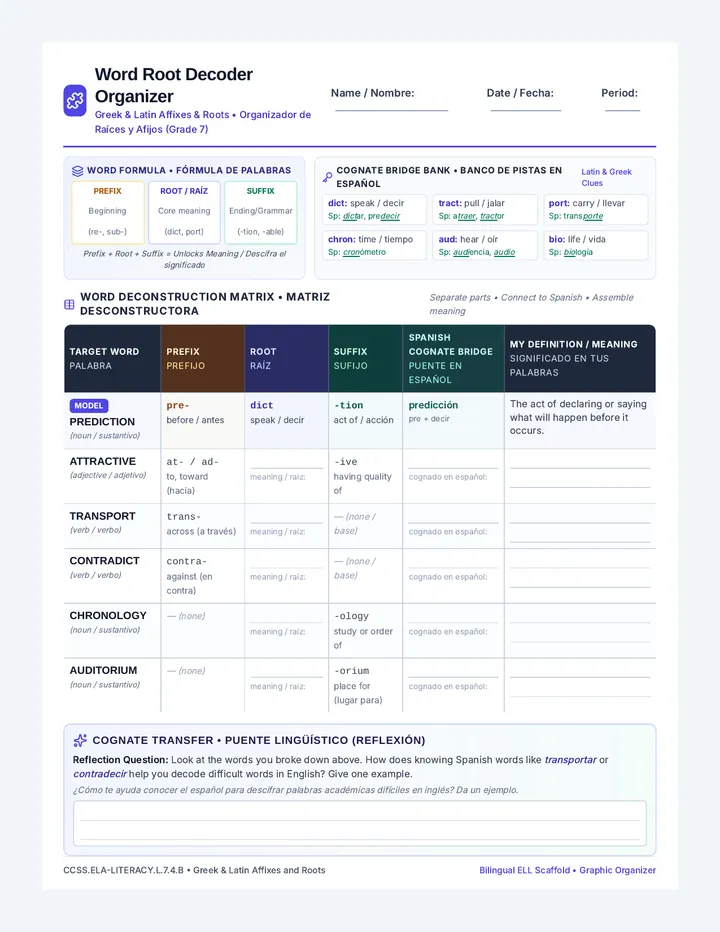
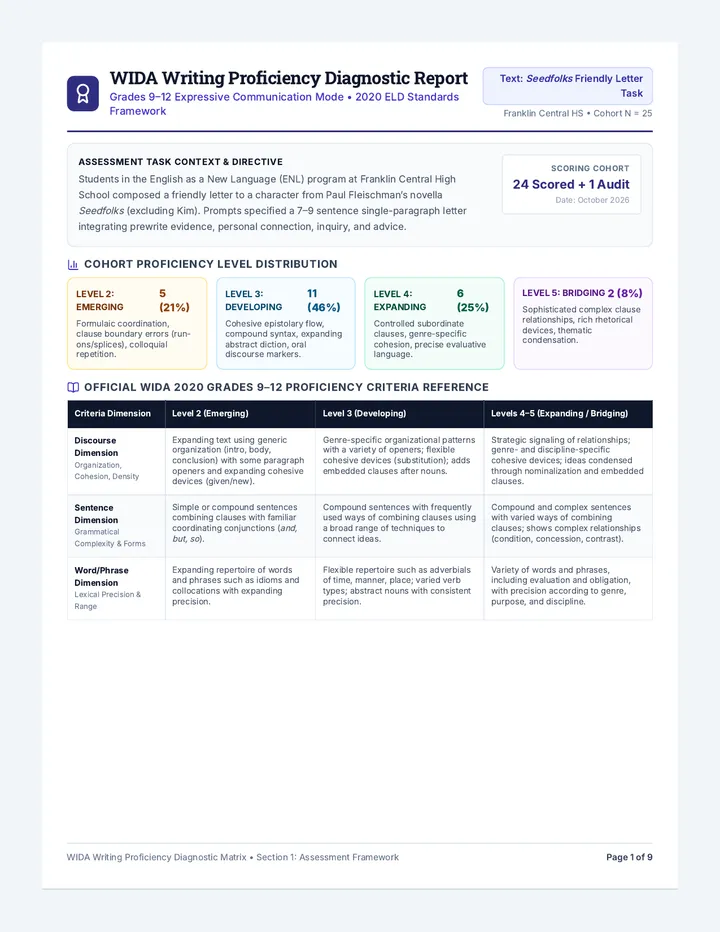
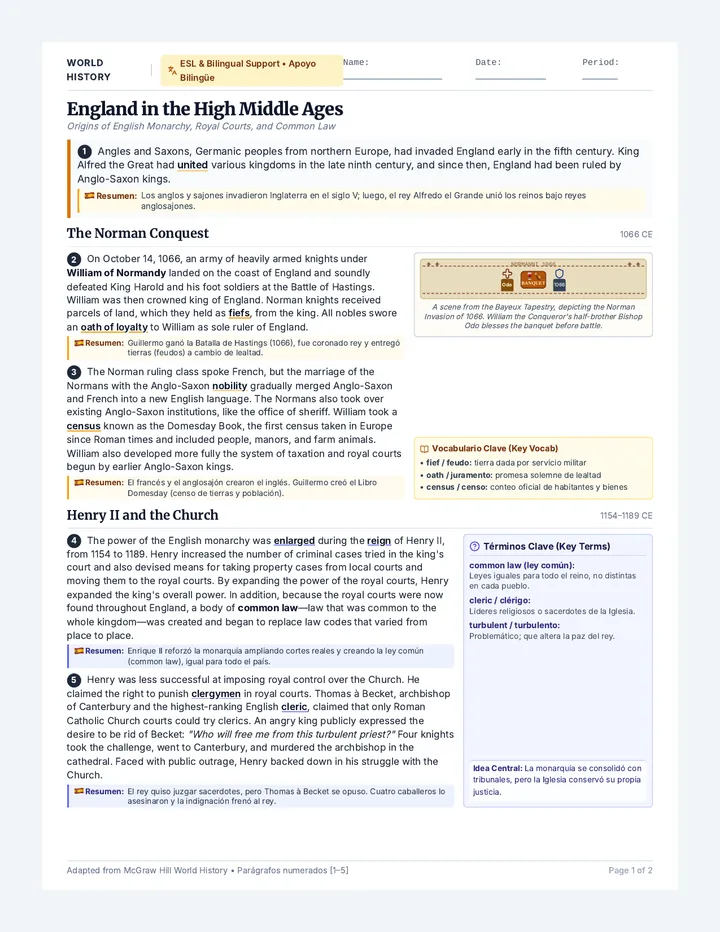
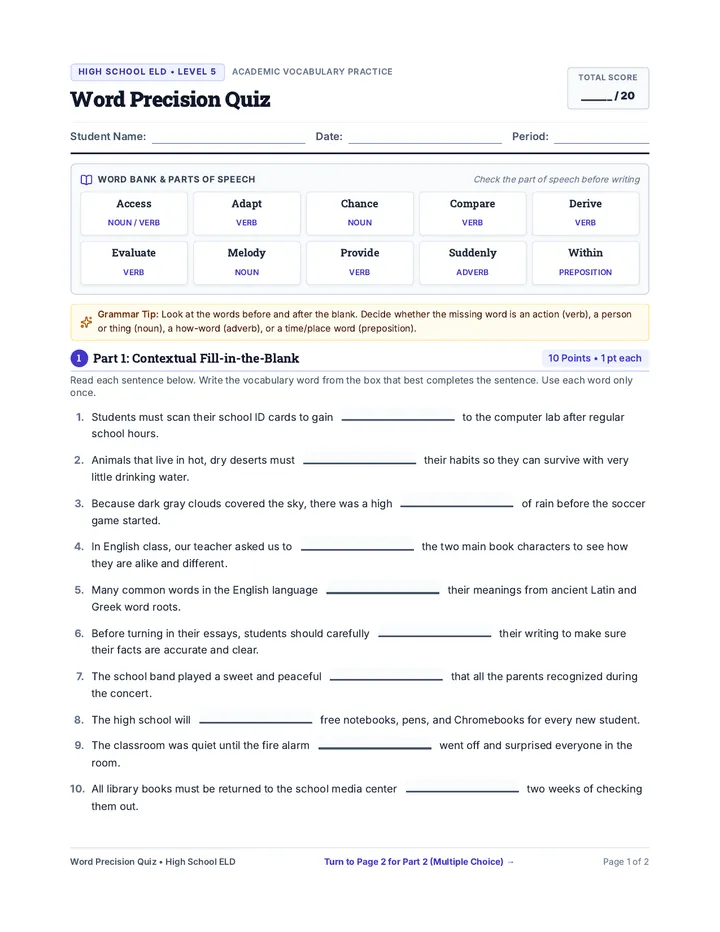
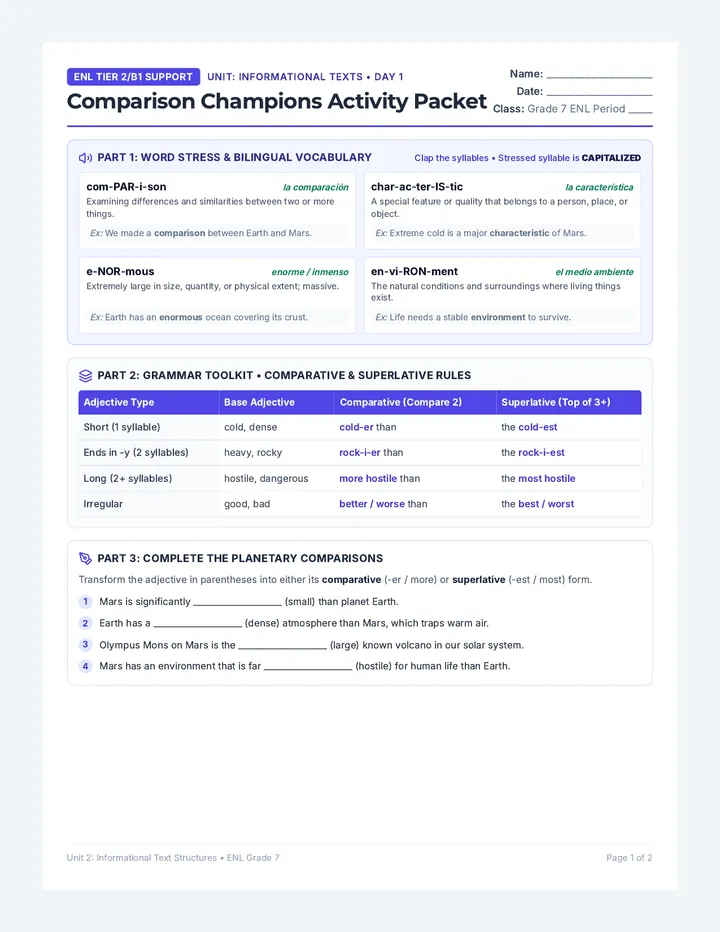
Specialized vocabulary and complex sentence structures across mathematics, science, and social studies. Develops the linguistic precision needed to analyze academic texts and participate in disciplinary discussions.
A high-stakes simulated networking mixer where students must apply their knowledge of idioms, phrasal verbs, and social listening to complete specific "missions."
Students analyze how speakers use shorthand references to history, pop culture, and sports to convey complex ideas, and develop strategies for asking for clarification when references are missed.
Students synthesize their evaluation skills to select the best resources for a hypothetical research scenario. They curate a small bibliography of trusted sources and justify their choices.
The culminating lesson where students apply all previous skills to write an original summary report based on an informational article.
This lesson teaches the strategy of verifying information by finding it in multiple reliable sources. Students engage in a 'Fact-Check Challenge' to confirm or debunk specific claims.
Students read and combine facts from two different texts on the same topic into a single, coherent paragraph.
Students examine texts to differentiate between objective facts and subjective opinions or bias. They practice highlighting emotive language and unsupported claims within informational texts.
Students learn and practice using academic reporting verbs and formal attribution to credit authors in their writing.
Learners study techniques for rewriting sentences while maintaining original meaning, focusing on vocabulary substitution and structural changes.
Learners apply the Who, What, Where, When, and Why framework to evaluate digital sources. The lesson introduces a simplified credibility checklist that students use to audit pre-selected websites, including 'hoax' sites.
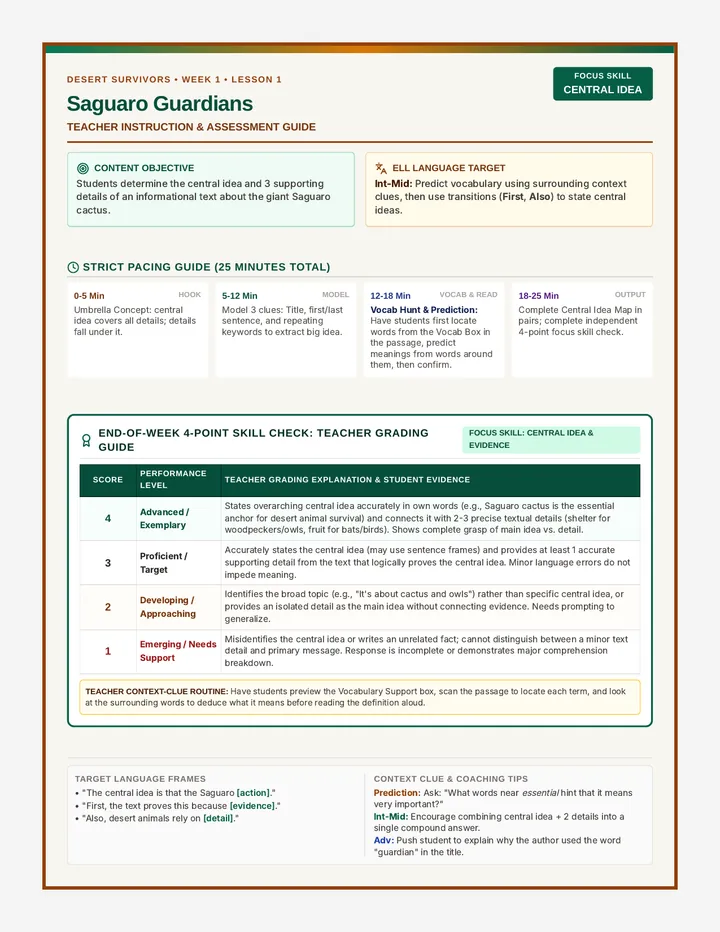
Students practice reading short informational passages to distinguish the central concept from the details using the 'Headline Game' and graphic organizers.
A detailed student evidence log for the final podcast project, providing sections for analyzing intent, vocal forensics, and bias check.
A guide for the final project where students select a podcast episode, analyze its intent and bias, and present their findings, including a checklist and a performance rubric.
Slides for the final project launch, introducing the media critic mission, criteria for analyzing podcasts, and methods for citing audio evidence.
Answer key for the Rhetorical Anatomy worksheet, providing the subtext and implied meaning for the final project's persuasive speech analysis.
A rhetorical analysis log for graduate students to deconstruct persuasive speeches by mapping tonal journeys, identifying strategic pauses, and evaluating effectiveness.
A certificate of completion (Digital Detective Badge) for students who have finished the sequence. Features a professional agency-style design with space for student name and date.
Teacher guide for "The Source Weaver" lesson. It outlines the synthesis process, provides a hook activity, transition words for ESL support, and a sample synthesized paragraph.
Final synthesis worksheet where students act as magazine editors to select the 3 most credible sources from a list of 6 on the topic of Mars exploration. Requires application of currency, authority, and objectivity criteria.
Final project worksheet for Lesson 5 where students read an informational passage about the Great Wall of China and write an original, synthesized summary paragraph with formal attribution.
Capstone student project for "The Source Weaver" lesson. Students analyze two short texts about Mars, take notes, and synthesize the information into a single coherent paragraph using their own vocabulary and sentence structures.
Review slide deck for Lesson 5, summarizing all skills learned in the sequence and providing clear instructions for the final Master Summary project.
A slide deck for graduate students focusing on identifying rhetorical strategies, tonal journeys, and the use of strategic pauses for emotional impact in persuasive speech.
A 5-lesson sequence for 5th Grade ESL students focused on developing academic English skills through paraphrasing and synthesizing information. Students progress from identifying main ideas to drafting complete summary reports using multiple sources and formal attribution.
A 5-lesson sequence for 5th-grade ESL students to develop media literacy and research skills. Students learn to distinguish author purpose, evaluate website credibility using the 5 W's, identify bias, and corroborate information across multiple sources.
A comprehensive workshop-style unit for 6th Grade ESL students focused on the linguistic mechanics of paraphrasing and synthesizing information. Students move from identifying core concepts to orally retelling information, transforming individual sentences, and finally weaving multiple sources into a single coherent paragraph without plagiarizing.
A 5-lesson sequence for graduate students to master idiomatic language, phrasal verbs, and cultural nuances in professional and academic networking environments. Students move from decoding literal meaning to applying figurative language in a high-stakes networking simulation.
This sequence for graduate ESL students explores the nuances of English beyond literal meaning. Students will master the ability to detect sarcasm, bias, contrastive stress, and professional register, equipping them for complex academic and professional communication.
A comprehensive 5-lesson sequence designed for 7th-grade ESL students to master the art of synthesizing information. Students progress from organizing raw research notes to writing sophisticated, cohesive academic paragraphs using evidence from multiple sources.
A graduate-level ESL listening sequence focused on the pragmatics of academic discourse. Students learn to navigate the subtleties of seminar discussions by identifying hedging, turn-taking signals, disagreement strategies, and multi-speaker argument threads.
A comprehensive sequence for intermediate ESL graduate students focused on mastering academic lecture comprehension, identifying discourse markers, filtering digressions, and implementing effective note-taking strategies.
A comprehensive workshop-style sequence for 4th Grade ESL students to master academic research skills. Students progress from navigating text features to note-taking, paraphrasing, summarizing, and ultimately synthesizing information from multiple sources while avoiding plagiarism.
This sequence equips intermediate ESL undergraduate students with the skills to navigate complex, multi-speaker environments like seminars and debates. Students progress from basic speaker identification to tracking complex argument evolution and detecting subtle bias markers.
This sequence guides intermediate ESL students through the nuances of pragmatic meaning in English. Students will learn to decode indirect speech, sarcasm, hedging language, and emotional undertones in academic and social contexts to improve their listening comprehension and communicative competence.
This sequence equips intermediate ESL students with the linguistic and cognitive tools needed to navigate university lectures. It covers discourse markers, hierarchy of information, identifying tangents, note-taking systems, and synthesizing long-form academic speech.