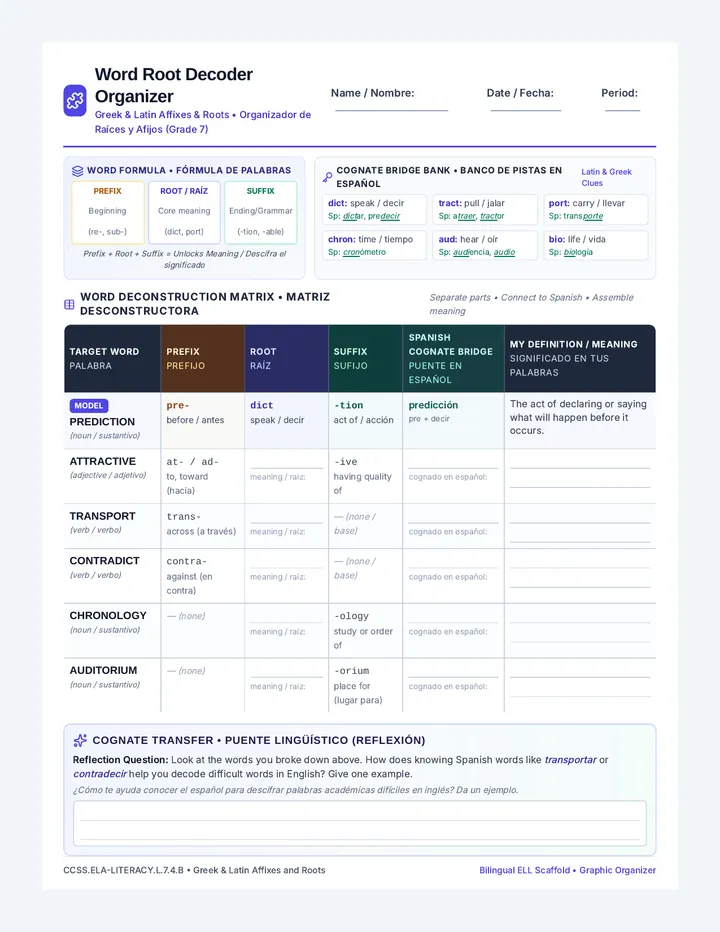
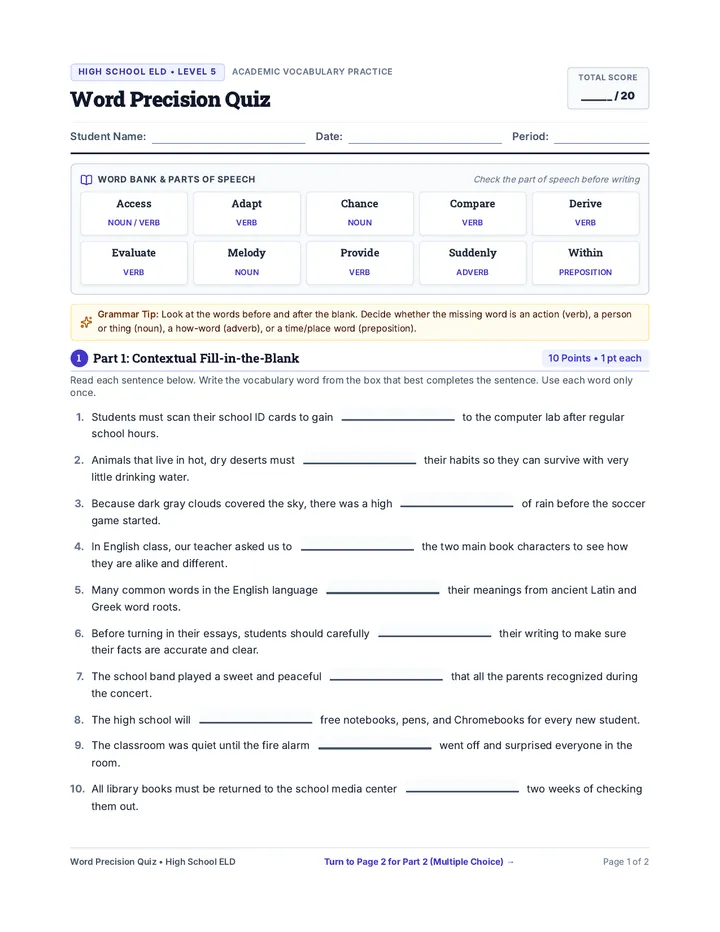
Specialized vocabulary across disciplines, research methodologies, and effective note-taking systems. Equips learners with information literacy skills and strategies for navigating standardized exams.
A high-stakes simulated networking mixer where students must apply their knowledge of idioms, phrasal verbs, and social listening to complete specific "missions."
Students analyze how speakers use shorthand references to history, pop culture, and sports to convey complex ideas, and develop strategies for asking for clarification when references are missed.
The final stage where students review citations, credit images, and finalize their bibliography for presentation.
Students synthesize their research notes into a cohesive draft, focusing on using attribution verbs and clear sentence structures.
Focuses on extracting key facts and paraphrasing using keywords to avoid plagiarism and organize information effectively.
Students learn to find and validate credible sources using search strategies and a simplified evaluation checklist.
Students transition from broad topics to focused, open-ended research questions through a 'Wonder Wall' activity and peer review.
Students participate in a university-style mini-lecture simulation. They apply all learned strategies—signpost identification, Cornell note-taking, and synthesis—to capture information and complete a formal assessment.
Students analyze search failures and practice iterative strategies to refine their inquiries when initial attempts don't yield the desired results.
The culminating lesson where students apply all previous skills to write an original summary report based on an informational article.
Students transition from open web searches to curated databases, comparing the reliability and organization of professional search tools.
A 5-lesson unit for 6th-grade ESL students focused on transforming search habits from natural language questions to strategic keyword and Boolean operator techniques. Students move from basic vocabulary brainstorming to navigating academic databases and skimming snippets for relevance.
This sequence helps 4th Grade ESL students master test-taking strategies focusing on time management and anxiety regulation. Students learn the 'traffic light' method for prioritization, the 'skip and return' technique for pacing, mindfulness strategies for stress, and mechanics for accurate bubbling.
A 5-lesson unit for 4th Grade ESL students focusing on test-taking strategies for reading comprehension. Students learn to use their 'detective tools' to find evidence, annotate effectively, and navigate passages with a focus on 'proving' their answers rather than guessing.
A comprehensive sequence for 4th Grade ESL students to master test-taking logic. Students learn the Process of Elimination (POE), identify extreme language red flags, categorize common distractor types, and evaluate the 'best' vs. 'correct' answers, culminating in a creative workshop where they design their own distractors.
A comprehensive 4th Grade ESL sequence focused on academic English test-taking strategies. Students learn to deconstruct question stems, identify negative qualifiers, isolate keywords, predict answers, and rephrase complex academic prompts into student-friendly language.
A 4th-grade ESL sequence focusing on academic reading efficiency through skimming for main ideas and scanning for specific details, using a 'Text Detective' theme.
A high-intensity workshop sequence designed for graduate students to master the reading demands of the GRE, GMAT, and TOEFL. Focuses on skimming, scanning, contextual vocabulary, and syntactic deconstruction for maximum efficiency.
This sequence trains graduate-level ESL students to analyze the psychometric logic of standardized test questions. Students learn to identify common distractor patterns—such as absolute language, irrelevant truths, and faulty inferences—transforming their approach from guessing to systematic logical elimination.
A comprehensive sequence designed for graduate ESL students to master the integrated writing and speaking tasks of high-stakes academic exams like TOEFL iBT and IELTS. The curriculum focuses on shorthand note-taking, identifying inter-source relationships, utilizing structural templates, and rapid synthesis under timed conditions.
A comprehensive 3rd-grade sequence focused on transition from passive to active reading for ESL students, mastering annotation, summarization, and visual analysis strategies.
This sequence equips 3rd-grade ESL students with logical strategies for multiple-choice tests, focusing on identifying and eliminating 'distractor' answers. Through a 'Detective Academy' theme, students move from spotting obvious errors to navigating nuanced traps and complex answer formats.
A 5-lesson unit for 3rd Grade ESL students focused on dissecting test questions, identifying academic verbs, and predicting answers to improve test-taking performance. Students act as 'Test Detectives' to uncover the requirements of various question types and provide evidence for their answers.
A detailed student evidence log for the final podcast project, providing sections for analyzing intent, vocal forensics, and bias check.
A guide for the final project where students select a podcast episode, analyze its intent and bias, and present their findings, including a checklist and a performance rubric.
Slides for the final project launch, introducing the media critic mission, criteria for analyzing podcasts, and methods for citing audio evidence.
Answer key for the Rhetorical Anatomy worksheet, providing the subtext and implied meaning for the final project's persuasive speech analysis.
A rhetorical analysis log for graduate students to deconstruct persuasive speeches by mapping tonal journeys, identifying strategic pauses, and evaluating effectiveness.
A certificate of completion (Digital Detective Badge) for students who have finished the sequence. Features a professional agency-style design with space for student name and date.
Teacher guide for "The Source Weaver" lesson. It outlines the synthesis process, provides a hook activity, transition words for ESL support, and a sample synthesized paragraph.
Final synthesis worksheet where students act as magazine editors to select the 3 most credible sources from a list of 6 on the topic of Mars exploration. Requires application of currency, authority, and objectivity criteria.
Final project worksheet for Lesson 5 where students read an informational passage about the Great Wall of China and write an original, synthesized summary paragraph with formal attribution.
Capstone student project for "The Source Weaver" lesson. Students analyze two short texts about Mars, take notes, and synthesize the information into a single coherent paragraph using their own vocabulary and sentence structures.
Review slide deck for Lesson 5, summarizing all skills learned in the sequence and providing clear instructions for the final Master Summary project.
A slide deck for graduate students focusing on identifying rhetorical strategies, tonal journeys, and the use of strategic pauses for emotional impact in persuasive speech.
In this final project-based lesson, students synthesize their learning by creating a "Research Credits" poster. They select a topic of interest, find three sources, summarize key information, and produce a perfectly formatted Works Cited section.
Students create a mini-research poster on a topic of their choice. They apply their knowledge by including three facts and a correctly formatted, alphabetized bibliography with at least three sources. The lesson includes a gallery walk for peer feedback.
Students learn the mechanics of in-text attribution, practicing how to introduce sources using "signal phrases" (e.g., 'According to...'). They understand how to bridge the gap between their own ideas and those of external experts.
Students learn how to organize individual citations into a list, emphasizing alphabetical order. They practice formatting a simple bibliography page using citations generated in previous lessons. This prepares them for the final structural requirement of research papers.
Students learn the benefits and risks of using digital citation tools. This lesson focuses on identifying common machine errors, such as capitalization issues and missing data, and emphasizes student accountability for final accuracy.
Students learn how to find citation information on websites, which is often harder to locate. They practice finding the URL, site name, and access date. Students compare the differences between book and website citations.
Students learn to identify and format the four core elements of an MLA citation: Author, Title, Publisher, and Date. They use color-coding to demystify the punctuation and structure of citations.
Students handle physical books to locate the title page, author, publisher, and copyright date. They learn a simplified citation format and practice finding bibliographic data.
Synthesizes learning through case studies of intentional vs. accidental plagiarism and concludes with an academic integrity pledge.
Teaches students how to compile individual citations into a cohesive, alphabetized reference list.