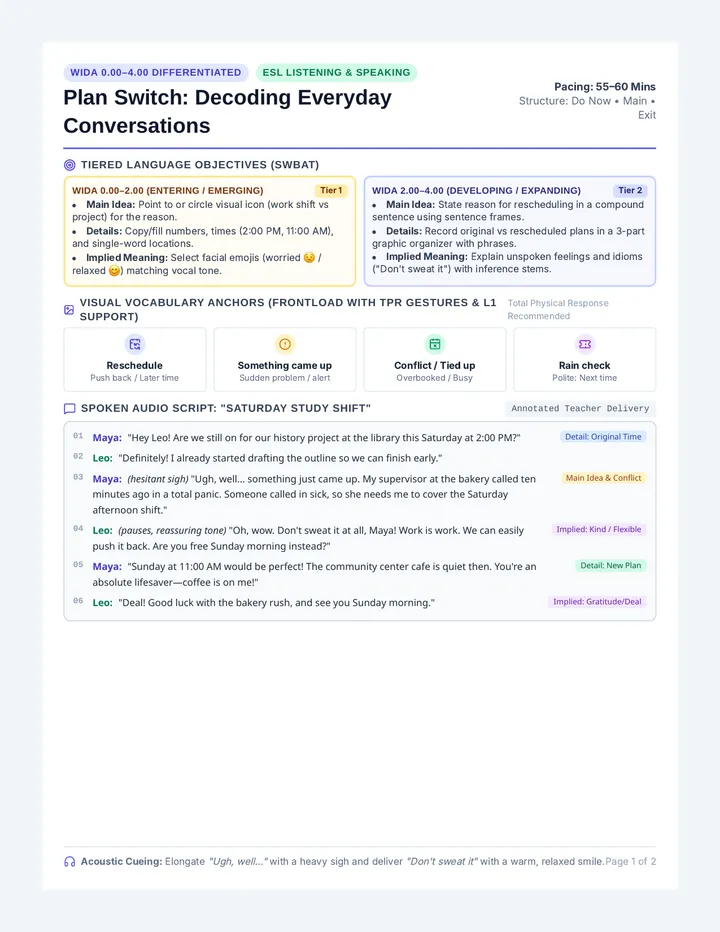
Strengthens comprehension of natural speech patterns, linking sounds, and idiomatic expressions in academic and social contexts. Targets identification of speaker intent, tone, and specific details within extended discourse.
A 5-lesson sequence for 5th Grade ESL students focused on the mechanics of finding information. Students move from basic keyword generation to using Boolean operators, navigating text features, utilizing academic databases, and refining failed searches to become efficient digital researchers.
A 5-lesson unit for 6th-grade ESL students focused on transforming search habits from natural language questions to strategic keyword and Boolean operator techniques. Students move from basic vocabulary brainstorming to navigating academic databases and skimming snippets for relevance.
A 5-lesson sequence for graduate students to master idiomatic language, phrasal verbs, and cultural nuances in professional and academic networking environments. Students move from decoding literal meaning to applying figurative language in a high-stakes networking simulation.
A comprehensive series for intermediate ESL graduate students focused on decoding natural, rapid English by mastering connected speech phenomena like linking, elision, and assimilation.
A comprehensive sequence for intermediate ESL graduate students focused on mastering academic lecture comprehension, identifying discourse markers, filtering digressions, and implementing effective note-taking strategies.
This sequence equips intermediate ESL undergraduate students with the skills to navigate complex, multi-speaker environments like seminars and debates. Students progress from basic speaker identification to tracking complex argument evolution and detecting subtle bias markers.
This sequence targets the mechanical difficulties of understanding natural, fast-paced English. Students explore phonological rules like linking, elision, and assimilation to decode authentic, fluid speech patterns found in campus social life.
This sequence guides intermediate ESL students through the nuances of pragmatic meaning in English. Students will learn to decode indirect speech, sarcasm, hedging language, and emotional undertones in academic and social contexts to improve their listening comprehension and communicative competence.
This sequence equips intermediate ESL students with the linguistic and cognitive tools needed to navigate university lectures. It covers discourse markers, hierarchy of information, identifying tangents, note-taking systems, and synthesizing long-form academic speech.
A 4th-grade ESL listening sequence that transforms students into 'Sound Detectives' to master narrative elements. Students learn to filter 'auditory fluff' for main ideas, analyze character traits through vocal cues, track plot sequences using signal words, and predict endings using foreshadowing.
A comprehensive ESL listening sequence for 4th graders focusing on natural speech patterns, emotional tone, idioms, and social registers. Students act as 'Ear Detectives' to decode the hidden meanings in how English is actually spoken vs. how it is written.
A comprehensive unit for 4th Grade ESL learners to master academic listening. Students transition from social conversation to processing informational texts by identifying signal words, capturing vocabulary definitions in context, using graphic organizers, and distinguishing fact from opinion to synthesize complex information.
A detailed student evidence log for the final podcast project, providing sections for analyzing intent, vocal forensics, and bias check.
A guide for the final project where students select a podcast episode, analyze its intent and bias, and present their findings, including a checklist and a performance rubric.
Slides for the final project launch, introducing the media critic mission, criteria for analyzing podcasts, and methods for citing audio evidence.
A cumulative exit ticket for the "Search Superstars" sequence, assessing student mastery of keywords, Boolean operators, text features, and database usage.
Final assessment for the Search Strategy Academy unit, covering keywords, Boolean operators, database use, and snippet analysis.
Answer key for the Lesson 4 worksheet on grammatical reductions.
A troubleshooting-focused worksheet that presents students with failed search scenarios and requires them to diagnose the error and rewrite the search string using effective strategies.
Answer key for the Lesson 3 worksheet on assimilation.
Student scavenger hunt log for Lesson 5, where students document their search strings and answers to obscure research questions.
Answer key for the Lesson 2 worksheet on elision.
A visual guide for 5th grade ESL students on troubleshooting failed search attempts, focusing on identifying too-long sentences and overly specific terms as common causes of zero results.
Answer key for the Lesson 1 worksheet on linking and intrusion.
Students engage in a 'shadowing' technique, repeating audio immediately after hearing it to internalize the rhythm and flow of connected speech. This active processing reinforces their ability to predict and process sound streams.
A high-stakes simulated networking mixer where students must apply their knowledge of idioms, phrasal verbs, and social listening to complete specific "missions."
Focusing on function words, this lesson tackles common reductions like 'gonna,' 'wanna,' and weak forms of auxiliary verbs. Students analyze unscripted interviews to catch these reductions in context.
Students analyze how speakers use shorthand references to history, pop culture, and sports to convey complex ideas, and develop strategies for asking for clarification when references are missed.
Students learn how sounds influence their neighbors (e.g., 'hand bag' becoming 'hambag'). The lesson uses minimal pair discrimination and dictation exercises to train ears to recognize words despite phonological changes.
Students participate in a university-style mini-lecture simulation. They apply all learned strategies—signpost identification, Cornell note-taking, and synthesis—to capture information and complete a formal assessment.
Students analyze search failures and practice iterative strategies to refine their inquiries when initial attempts don't yield the desired results.
Students transition from open web searches to curated databases, comparing the reliability and organization of professional search tools.
Students practice using text features like indices, headings, and sidebars to locate information quickly through skimming and scanning techniques.
Learners use Boolean operators like AND, OR, and quotation marks to narrow or broaden search results in a digital scavenger hunt.
Students learn to break down research questions into core concepts and generate synonyms, transforming natural language into effective search strings.