Linking and Intrusion Slides The Speech Lab
Lesson 1: Unsticking the Sound Stream
MECHANICS: LINKING & INTRUSION
The Acoustic Challenge
Why does textbook English sound different from real English?
You hear:
"lawrandaorder"
How many words is that?
1. Consonant to Vowel Linking
When a word ends in a **consonant** and the next starts with a **vowel**, they "stick" together.
Standard Form:
"Pick it up"
Acoustic Reality
/pɪ.kɪ.tʌp/
"pi-ki-tup"
2. Intrusive Sounds
Sometimes, speakers add a "bridge" sound between two vowels to make the transition easier.
/j/
"He is"
"He-yis"
/w/
"Go on"
"Go-won"
/r/
"Media event"
"Media-revent"
The Mechanics of Ease
English is a stress-timed language.
To maintain the rhythm between stressed syllables, we squeeze unstressed sounds together.
Efficiency
Musicality
Lab Experiment
Open your Unsticking Sounds Worksheet. We are going to analyze 3 clips from campus life.
1
Buying a textbook (C-V Linking)
2
Asking for directions (Intrusive /w/)
3
Coffee shop order (Intrusive /j/)
Unsticking Sounds Worksheet The Speech Lab
Lab Report: Unsticking Sounds
Researcher:
Date:
Objective
In today's lab, we will analyze authentic speech samples to identify how words connect through **Consonant-to-Vowel (C-V) Linking** and **Intrusive Sounds** (/j/, /w/, /r/). Your goal is to "unstick" the sound stream and reconstruct the original words.
1
The Mystery Phrase
Listen to the clip provided by your instructor. Write the "messy" sound you hear first, then try to parse it into individual words.
Acoustic Impression (What it sounds like)
[e.g., lawrandaorder]
Decoded Phrase (Individual words)
2
Audio Sample Analysis
Clip #1: The Bookstore
C-V Linking
Listen for: "Could I pick it up tomorrow?"
Transcribe the phonetic 'sticky' sound you hear (e.g., /kɪ.tʌp/):
How many distinct words are linked together here?
Clip #2: Asking Directions
Intrusive /w/
Listen for: "Go on towards the library."
Where does the "bridge" sound appear between two words?
Draw the link and the intrusive sound below:
[Go _ on]
Clip #3: Coffee Shop
Intrusive /j/
Listen for: "He is waiting at the counter."
Transcribe the "sticky" transition you hear:
Why did the speaker add a /j/ sound here instead of a /w/?
Lab Reflection
Based on your observations, what is the most difficult part of "unsticking" connected speech for your ears?
Speech Lab Teacher Guide The Speech Lab
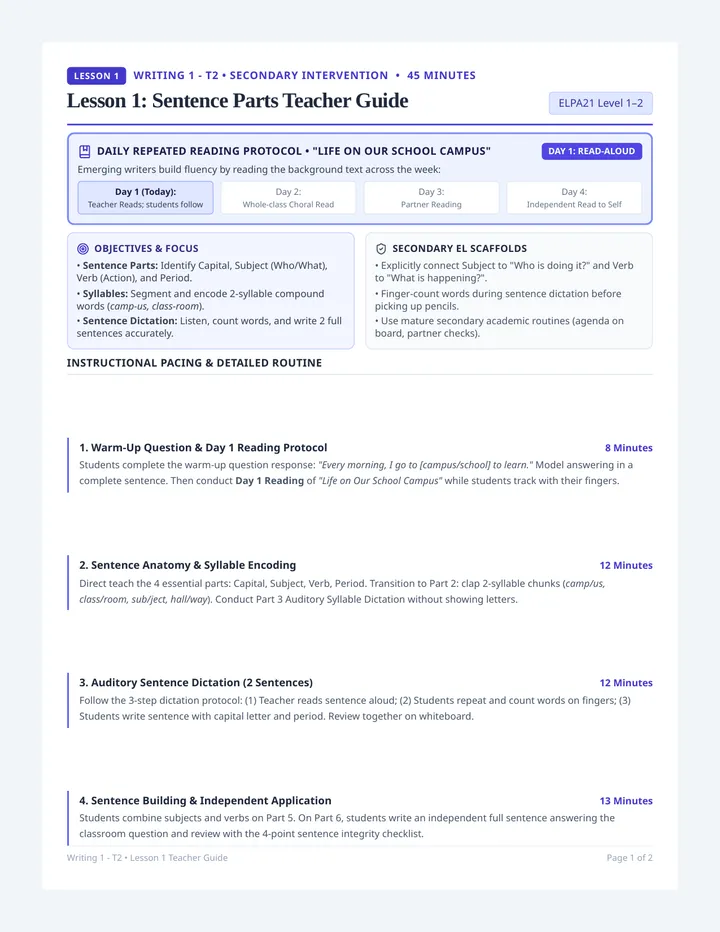
Teacher Facilitation Guide
UNIT: CONNECTED SPEECH
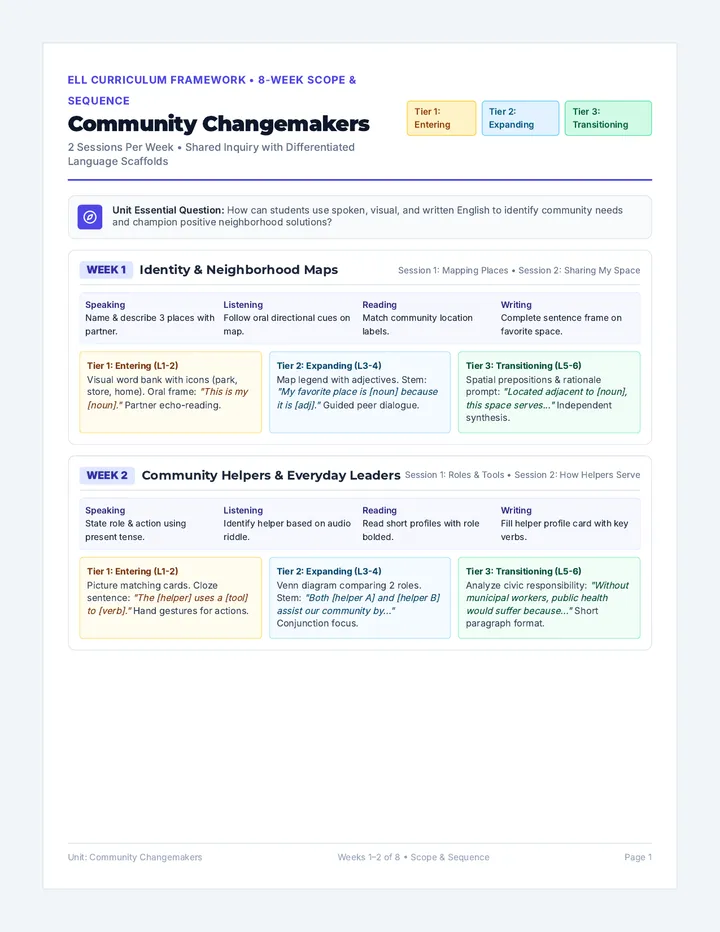
Sequence Overview
This 5-lesson sequence focuses on the **mechanics** of listening. Students often struggle not because they don't know the vocabulary, but because they can't parse the sound stream. This unit moves from individual mechanical rules (linking, elision, assimilation) to complex grammatical reductions and finally active shadowing.
Audio Scripts & Instructional Cues
Lesson 1: Linking & Intrusion
Hook: Play "lawrandaorder" (Law and Order). Ask: "What did you hear?" Students usually guess one word. Explain the /r/ intrusion.
Clip 1: "Could I pick it up tomorrow?" (Focus on k-i and t-u links).
Clip 2: "Go on towards the library." (Listen for the /w/ bridge between 'Go' and 'on').
Clip 3: "He is waiting at the counter." (Listen for the /j/ bridge between 'He' and 'is').
Lesson 2: Elision
Hook: Use a fast pop song (e.g., "Bad Blood" or "Rap God"). Focus on dropped final /t/ sounds.
Instructional Note: Emphasize the "Rule of Three"—the middle consonant in a cluster of three is the first to go.
Clip: "I don't know what to say to make you want to stay." (Spoken as: /aɪ doʊnoʊ wəts eɪ tə meɪk ju wɒnə steɪ/).
Lesson 3: Assimilation
Key Concept: Assimilation is the "Chameleon" effect. The mouth moves to the position of the *next* sound early to save effort.
Dictation Battle: Use phrases like "Green Park" (Greem Park) or "Bad boys" (Bab boys). Students will argue they hear an /m/ or /b/—that's the point!
Lesson 4: Reductions
Teaching Tip: Use the "Rubber Band" analogy. Content words stretch the band (long, loud); function words snap it back (short, weak).
The Schwa: Almost every reduced vowel becomes /ə/. Focus on 'to' /tə/, 'for' /fə/, and 'and' /ən/.
Pacing
Lessons 1-3: 45-60 mins each. Heavily mechanical/analytical.Lesson 4: 60 mins. Transition to grammatical context.Lesson 5: 60-90 mins. Performance-based mastery.
Differentiation
Support: Provide transcripts for all audio clips during the first listen.Challenge: Have students record themselves and use "Audacity" or "Praat" to visualize their own pitch/linking waves. Linking Answer Key Answer Key
Unsticking Sounds Worksheet
Part 1: The Mystery Phrase
Acoustic Impression
lawrandaorder
Decoded Phrase
Law and Order
Part 2: Audio Samples
Clip #1: Bookstore
"Could I pick it up tomorrow?"
Sticky Sound:
/pɪ.kɪ.tʌp/
Words Linked:
3 words (pick + it + up)
Clip #2: Directions
"Go on towards the library."
Analysis:
Bridge sound (/w/) between "Go" and "on" → **Go-won**.
Clip #3: Coffee Shop
"He is waiting at the counter."
Analysis:
Bridge sound (/j/) between "He" and "is" → **He-yis**. The /j/ appears because "He" ends in a high-front vowel /i/.
Elision Slides The Speech Lab
Lesson 2: Disappearing Acts
PHONOLOGY: ELISION
Where did it go?
In fast speech, some sounds are completely omitted to save time.
Formal Transcription:
"Next door"
Acoustic Reality:
"nexdoor"
The Usual Suspects
The sounds **/t/** and **/d/** are the most common victims of elision when they appear between two other consonants.
Rule of Three:
Consonant + /t/ or /d/ + Consonant
Sandwich "san-wich"
Must be "mus-be"
Grandfather "gran-father"
Lyric Challenge
Pop stars are masters of elision. Listen to this fast-paced clip and identify the "missing" sounds in the chorus.
"I ______ know what ______ say
Can you reconstruct the full grammatical forms?
Decoding Strategy
If a word sounds "incomplete," don't panic!
Look for consonant clusters.
Check if the meaning still makes sense without the /t/ or /d/.
Anticipate the next word.
Reconstruct
Use context to fill the gaps created by disappearing sounds.
Elision Detective Worksheet The Speech Lab
Lab Report: Elision Detective
Investigator:
Date:
Mission Objective
Sounds are disappearing! Your mission is to identify where speakers have omitted consonants (usually /t/ or /d/) in natural speech. Use your ears and your knowledge of "The Rule of Three" (Consonant + T/D + Consonant) to find the missing phonemes.
01
Pop Lyric Decoding
Listen to the fast-paced song clip. Transcribe what you hear phonetically, then write the full grammatical sentence.
"I ________ know what ________ say to make you ________ stay."
Acoustic Word 1
Acoustic Word 2
Acoustic Word 3
Full Decoded Sentence:
02
Field Observations
Phonological Environment What you heard Missing Sound "I'm the best man."
/t/ /d/
|
| "Send her the files." |
|
/t/ /d/
|
| "It must be cold." |
|
/t/ /d/
|
| "Grand piano" |
|
/t/ /d/
|
03
The Reconstruction Game
Below are sentences written as they are spoken . Rewrite them using full, standard English spelling.
"We stop for a san-wich at nex-door."
"Tha-was the las-time I saw him."
"The col-wind blew agains-the house."
Analysis Summary
Does elision happen more often in slow, careful speech or fast, casual speech? Why do you think speakers choose to "swallow" these sounds?
Elision Answer Key Answer Key
Elision Detective Worksheet
Part 1: Lyric Challenge
"I don't know what to say to make you want to stay."
Part 2: Field Observations
Phrase Acoustic Reality Missing Sound "I'm the best man." /bes mæn/ /t/ "Send her the files." /sen hə/ /d/ "It must be cold." /məs bi/ /t/ "Grand piano" /græn pi.æn.oʊ/ /d/
Part 3: Reconstruction
Clip 1
"We stop for a sandwich at next door."
Clip 2
"That was the last time I saw him."
Clip 3
"The cold wind blew against the house."
Assimilation Slides The Speech Lab
Lesson 3: Sound Collisions
PHONOLOGY: ASSIMILATION
What did you say?
Sometimes words change their sound completely when they bump into their neighbors.
You Hear
"Gatcha"
Real Words
"Got you"
Wait... where did the /t/ go?
Assimilation
The "Chameleon" Rule
A sound changes to become more like a neighboring sound to make speaking smoother and faster.
n
b
m
"Han**d** bag" → "Ha**m**bag"
Chemical Reactions
Reaction A
/n/ → /m/
Happens before /p/, /b/, or /m/.
"Ten boys"
/tem bɔɪz/
Reaction B
/s/ → /ʃ/
Happens before /j/ (y).
"This year"
/ðɪʃ jɪə/
Reaction C
/t/ → /tʃ/
Happens before /j/ (y).
"Don't you"
/doʊntʃu/
Ear Training
Can you hear the difference? Listen to the audio and choose which one the speaker said.
A
"Ten pens"
B
"Temp pens"
Spoiler: In fast speech, they often sound EXACTLY the same!
Lab Protocol
1. Dictation Battle
Write down exactly what you hear, phonetically first.
2. Reverse Engineering
Trace the assimilated sound back to its original letter.
3. Campus Scenarios
Identify assimilation in a real-world campus dialogue.
Assimilation Worksheet The Speech Lab
Lab Report: Morphing Sounds
Technician:
Batch ID:
Reaction Protocol
Assimilation occurs when sounds take on characteristics of their neighbors. In this lab, you will identify these "chemical reactions" in natural speech and reverse-engineer the original phrases.
R-1
Trace the Transformation
For each phrase, identify the "morphed" sound you hear and identify which neighbor caused the change.
Target Phrase
"Ten boys"
Sound Heard
/tem/
Why did /n/ turn into /m/?
Target Phrase
"Good girl"
Sound Heard
/gʊg/
The /d/ morphed because of the next sound:
Target Phrase
"This year"
Sound Heard
/ðɪʃ/
What happened to the /s/?
R-2
The "Gatcha" Challenge
Listen to the campus dialogue. Several common "fused" words appear. Identify the fused sound and reconstruct the original two words.
Fused Sound heard Original Word 1 Original Word 2 "Don'tcha"
|
| "Didja" |
|
|
| "Gatcha" |
|
|
| "Wouldja" |
|
|
R-3
Ear Discrimination
Circle the phrase you hear. Note: In natural speech, the two options may sound identical due to assimilation!
Set 1
A. Ten pens B. Temp pens
Set 2
A. Bad guys B. Bag guys
Set 3
A. Green park B. Greem park
Set 4
A. Nice shoe B. Night shoe
Conclusion
Why is assimilation helpful for the speaker, but potentially confusing for the listener?
Assimilation Answer Key Answer Key
Assimilation Worksheet
Part 1: Trace the Transformation
"Ten boys" → /tem bɔɪz/ /n/ before /b/ becomes /m/ (bilabial)
"Good girl" → /gʊg gɜːl/ /d/ before /g/ becomes /g/ (velar)
"This year" → /ðɪʃ jɪə/ /s/ before /j/ becomes /ʃ/ (palato-alveolar)
Part 2: The "Gatcha" Challenge
Fused Sound Word 1 Word 2 "Don'tcha" Don't you "Didja" Did you "Gatcha" Got you "Wouldja" Would you
Part 3: Ear Training
Note: Both often sound identical in fast speech due to assimilation.
Set 1: Either (usually **A**)
Set 2: Either (usually **A**)
Set 3: Either (usually **A**)
Set 4: Either (usually **A**)
Grammatical Reductions Slides The Speech Lab
Lesson 4: The Shrinking Sentence
Grammatical Reductions & Weak Forms
The Weight of Words
Content Words
Stressed & Full
Nouns
Main Verbs
Adjectives
"I **WENT** to the **STORE**."
Function Words
Unstressed & Reduced
Pronouns
Prepositions
Auxiliaries
"I went **t' th'** store."
Casual Fusions
going to
GONNA
want to
WANNA
have to
HAFTA
got to
GOTTA
The Power of /ə/
In casual speech, most function word vowels disappear into the **Schwa** (/ə/).
"To"
/tə/
"I need **t'** go."
"For"
/fə/
"It's **f'** you."
"And"
/ən/
"Red **'n'** blue."
Formal vs. Casual
The News Anchor (Formal)
"I am going to investigate the situation for you."
The YouTuber (Casual)
"I'm gonna 'nvestigate th' situation f'ya."
Interview Analysis
Unscripted Street Interview
Open your Reduction Decoder Worksheet. We're going to hunt for 5 common reductions in this 2-minute clip.
Grammatical Reductions Worksheet The Speech Lab
Reduction Decoder
Researcher:
Clip ID:
Decoder Mission
In unscripted conversation, function words are often reduced to their "weak forms." Your goal is to identify these reductions and translate them back into their full, formal versions.
A
The Weak Form Audit
Listen to the sentences below. Circle the reduced sound you hear and write the full word.
"Give it **t'** him."
/tə/ /tu/
Full Word
"Bread **'n'** butter."
/æn/ /ən/
Full Word
"Wait **f'** me!"
/fɔː/ /fə/
Full Word
B
Street Interview Scan
Listen to the unscripted interview clip. Identify 5 instances of reduction (gonna, wanna, hafta, gotta, etc.) and write the sentence context.
Reduction Heard
Full Sentence Context
1
2
3
4
C
Reverse Transcription
Rewrite the following formal sentences as they would sound in casual, rapid campus speech. Use phonetic spellings (gonna, hafta, etc.) or omit letters to show the weak forms.
Formal Statement 1
"I am going to have to talk to him for a minute."
Formal Statement 2
"What are you going to do and where are you going to go?"
Listener Strategy
If 60-70% of function words are reduced in casual speech, which words should you focus on to understand the speaker's main message? Why?
Reduction Answer Key Answer Key
Reduction Decoder Worksheet
Part A: The Weak Form Audit
"Give it t' him" /tə/ → **To**
"Bread 'n' butter" /ən/ → **And**
"Wait f' me" /fə/ → **For**
Part C: Compression Challenge
Formal 1: "I am going to have to talk to him for a minute."
"I'm gonna hafta go talk t' 'im f' r' minute."
Formal 2: "What are you going to do and where are you going to go?"
"Whatcha gonna do 'n' whereya gonna go?"
Shadowing Slides The Speech Lab
Lesson 5: The Ultimate Shadow
Mastery: Shadowing & Rhythm
Lip-Sync Battle
Can you match the exact timing of a native speaker?
The Challenge:
Watch the clip. Mouth the words. No sound. Perfect rhythm.
Recording
Shadowing Technique
Shadowing is repeating audio immediately after you hear it—like an echo.
Why it works:
Trains your brain to process sounds faster.
Forces you to follow natural rhythm.
Reinforces linking and reductions.
The Timing
Speaker:
You:
Gap: 0.2 - 0.5 seconds
The Music of English
Pitch
The high and low notes of your voice used to signal meaning.
Tempo
The speed variations—fast through reductions, slow on content.
Stress
The volume and length of the most important words.
Mastery Checklist
As you shadow the next 3 campus dialogues, focus on:
1
Linking vowel-consonant bridges
2
Swallowing the /t/ and /d/ sounds
3
Using weak forms for function words
Shadowing Log
Final Assessment
Open your Shadowing Mastery Guide. We will shadow three increasingly difficult clips from campus life.
Shadowing Mastery Guide The Speech Lab
Shadowing Mastery Guide
Master:
Level: Advanced Mastery
Mastery Protocol
Shadowing is the ultimate test of your ability to decode and reproduce connected speech. You will listen to three clips. For each, you will:
01
Level 1: The Library Ask
Consonant-Vowel Linking
Transcript (Mark up the links!)
"Could I check it out for a week or is it only available overnight?"
Self-Assessment Checklist
Connected "Check it out" (/tʃe.kɪ.taʊt/)
Linked "For a week" (/fə.rə.wiːk/)
Matched native tempo
Technician Notes
02
Level 2: Cafeteria Gossip
Elision & Assimilation
Transcript (Cross out missing sounds!)
"I don't know, he said he must be at the grand opening of the student union this year."
Self-Assessment Checklist
Omitted /t/ in "don't know" and "must be"
Omitted /d/ in "grand opening"
Assimilated "This year" (/ðɪʃ jɪə/)
Technician Notes
03
Level 3: The Project Panic
Total Reduction & Prosody
Transcript (Mark EVERYTHING!)
"I'm gonna have to go talk to him because I wanna know what we're gotta do for the final project."
How did your mouth feel during this final, high-speed shadow? Which part was the most difficult to "stick"?
Mastery Score
__/10
Final Reflection
Now that you've completed The Speech Lab, how has your listening strategy changed? When you hear a "messy" stream of sound in the real world, what is the first thing your brain does now?