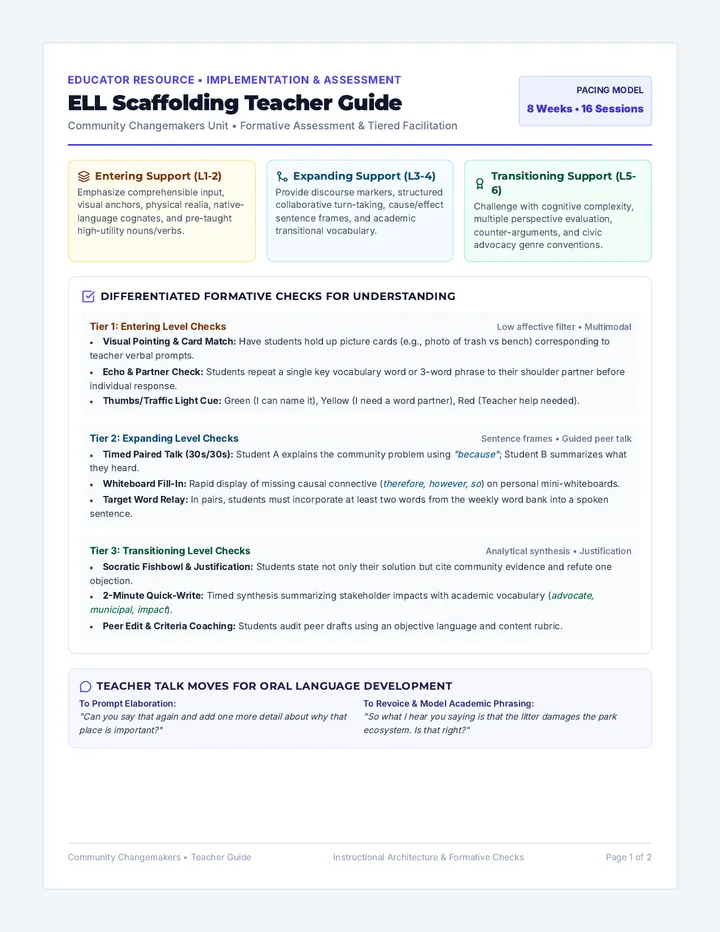
Community Changemakers Weekly Plans
ELL Curriculum Framework • 8-Week Scope & Sequence
Community Changemakers
2 Sessions Per Week • Shared Inquiry with Differentiated Language Scaffolds
Tier 1: Entering Tier 2: Expanding Tier 3: Transitioning
Unit Essential Question: How can students use spoken, visual, and written English to identify community needs and champion positive neighborhood solutions?
WEEK 1
Identity & Neighborhood Maps
Session 1: Mapping Places • Session 2: Sharing My Space
Speaking Name & describe 3 places with partner.
Listening Follow oral directional cues on map.
Reading Match community location labels.
Writing Complete sentence frame on favorite space.
Tier 1: Entering (L1-2)
Visual word bank with icons (park, store, home). Oral frame: "This is my [noun]." Partner echo-reading.
Tier 2: Expanding (L3-4)
Map legend with adjectives. Stem: "My favorite place is [noun] because it is [adj]." Guided peer dialogue.
Tier 3: Transitioning (L5-6)
Spatial prepositions & rationale prompt: "Located adjacent to [noun], this space serves..." Independent synthesis.
WEEK 2
Community Helpers & Everyday Leaders
Session 1: Roles & Tools • Session 2: How Helpers Serve
Speaking State role & action using present tense.
Listening Identify helper based on audio riddle.
Reading Read short profiles with role bolded.
Writing Fill helper profile card with key verbs.
Tier 1: Entering (L1-2)
Picture matching cards. Cloze sentence: "The [helper] uses a [tool] to [verb]." Hand gestures for actions.
Tier 2: Expanding (L3-4)
Venn diagram comparing 2 roles. Stem: "Both [helper A] and [helper B] assist our community by..." Conjunction focus.
Tier 3: Transitioning (L5-6)
Analyze civic responsibility: "Without municipal workers, public health would suffer because..." Short paragraph format.
Unit: Community Changemakers Weeks 1–2 of 8 • Scope & Sequence Page 1
ELL Curriculum Framework • Module 2
Needs Identification & Local Evidence
Sessions 5–8
Pedagogical Anchor: Moving students from concrete naming into observational evidence and cause-and-effect language structures using visual anchors.
WEEK 3
Identifying Community Challenges
Session 1: Noticing Problems • Session 2: Cause & Effect
Speaking Point out a challenge using photo cue.
Listening Identify problem soundscape & description.
Reading Read photo captions & simple charts.
Writing Complete cause-and-effect graphic organizer.
Tier 1: Entering (L1-2)
Visual problem cards (litter, broken bench, traffic). Fill-in: "The park has [problem]." Point & state strategy.
Tier 2: Expanding (L3-4)
Cause/effect connector bank (so, because, since). Stem: "There is litter because there are no trash cans."
Tier 3: Transitioning (L5-6)
Complex clause construction: "Consequently, the lack of public maintenance impacts resident safety by..."
WEEK 4
Investigating Local Evidence (Field Study)
Session 1: Recording Evidence • Session 2: Data Synthesis
Speaking Report observations to small group.
Listening Transcribe peer observation tallies.
Reading Interpret neighborhood observation logs.
Writing Draft 2-3 evidence statements with tallies.
Tier 1: Entering (L1-2)
Checklist with tally marks and emojis. Oral frame: "I saw [number] [item]." Concrete counting cards.
Tier 2: Expanding (L3-4)
Comparative summary stems: "We observed more [noun] than [noun] near the [location]." Bar chart interpretation.
Tier 3: Transitioning (L5-6)
Data synthesis report: "The empirical data collected reveals a significant pattern regarding..." Evaluative vocabulary.
Unit: Community Changemakers Weeks 3–4 of 8 • Scope & Sequence Page 2
ELL Curriculum Framework • Module 3
Community Voices & Solution Design
Sessions 9–12
Language Target Focus: Shifting students into questioning, active interpersonal listening, and proposing modal solutions (could, should, must).
WEEK 5
Interviews & Community Perspectives
Session 1: Interview Stems • Session 2: Roleplay & Notes
Speaking Ask 2 questions with polite intonation.
Listening Note partner's key response keyword.
Reading Follow structured interview script.
Writing Record quotes using quotation marks.
Tier 1: Entering (L1-2)
Question cards with picture cues: "What do you like about our school?" Record 1-word answers with partner.
Tier 2: Expanding (L3-4)
Open-ended question starter bank (How, Why, In what way). Reporting frame: "According to [Name], the main issue is..."
Tier 3: Transitioning (L5-6)
Interview protocol with follow-up probes: "Could you elaborate on why that policy proved ineffective?" Paraphrased summaries.
WEEK 6
Brainstorming & Proposing Solutions
Session 1: Solution Lab • Session 2: Weighing Pros & Cons
Speaking Propose ideas using "We should..."
Listening Evaluate feasibility of peer solutions.
Reading Read problem-solution sample cards.
Writing Write a 2-step proposed action plan.
Tier 1: Entering (L1-2)
Visual action verbs (paint, plant, clean, install). Model frame: "We can [action verb] the [location]." Draw & label solution.
Tier 2: Expanding (L3-4)
Modal verbs (could, should, must). Stem: "To solve this problem, community members should..." Simple pros/cons chart.
Tier 3: Transitioning (L5-6)
Proposal formulation with counter-arguments: "While some may argue [X], implementing [Y] yields greater long-term..."
Unit: Community Changemakers Weeks 5–6 of 8 • Scope & Sequence Page 3
ELL Curriculum Framework • Module 4
Civic Action & Community Showcase
Sessions 13–16
WEEK 7
Action Campaign Media (Posters & Letters)
Session 1: Campaign Creation • Session 2: Peer Review
Speaking Rehearse slogan & poster talking points.
Listening Provide 1 warm & 1 cool feedback point.
Reading Read advocacy posters and peer slogans.
Writing Produce poster copy or formal civic letter.
Tier 1: Entering (L1-2)
Visual advocacy poster template. Fill-in headline: "Save Our [place]! Please [action]." Paired slogan rehearsal.
Tier 2: Expanding (L3-4)
Persuasive letter template with transition frames (First, Furthermore, Therefore). Audience-specific vocabulary support.
Tier 3: Transitioning (L5-6)
Formal petition or address to school/community leaders: "We urge stakeholders to prioritize [issue] in order to..."
WEEK 8
Showcase & Metacognitive Reflection
Session 1: Live Presentation • Session 2: Portfolio Debrief
Speaking Deliver 1-2 min project presentation.
Listening Listen attentively to gallery walk talks.
Reading Read self-assessment growth rubric.
Writing Complete final learning reflection log.
Tier 1: Entering (L1-2)
Show-and-tell presentation cue card with pictorial script. Reflection stem: "I learned [word]. I am proud of [work]."
Tier 2: Expanding (L3-4)
Guided slide or cue-card talking points. Reflection stem: "My English improved when I [verb], and next I want to practice..."
Tier 3: Transitioning (L5-6)
Unscripted oral defense with audience Q&A. Self-reflection essay connecting language acquisition to community civic agency.
Recommended 2-Session Weekly Pacing Model (45–60 Mins Each)
Session A: Shared Input & Concept Modeling Anchor text/visual immersion (15m) • Tiered vocabulary instruction (15m) • Paired oral rehearsal & structured practice (20m) • Formative exit check (10m).
Session B: Collaborative Application & Writing Reactivation & sentence stem routine (10m) • Tiered student worksheet investigation (25m) • Peer share & gallery review (15m) • Self-monitoring rubric check (10m).
Unit: Community Changemakers Weeks 7–8 of 8 • Scope & Sequence Page 4
Community Action Student Worksheet
Community Changemakers • Student Investigation
Our Neighborhood Action Project
Name:
Date:
Shared Case Study: Riverside Park & Community Garden
Riverside Park is an important gathering space for families, children, and elderly neighbors. Recently, neighbors noticed three major issues: overflowing trash bins near the playground, broken wooden garden benches, and dim lighting along the evening walking path. Our mission as community changemakers is to investigate the evidence and propose actionable solutions.
1 Step 1: Evidence Observation (All Levels)
Examine the observations recorded during the neighborhood walk.
Observation A
6 garbage cans are completely full. Plastic bottles and snack wrappers are scattered on the grass.
Observation B
3 wooden benches have loose boards and peeling paint. Grandparents cannot sit comfortably.
Observation C
Two streetlight bulbs are burned out near the garden path, making the walkway very dark at 6:30 PM.
2 Step 2: Choose One Challenge to Investigate
Check one box below to select your team's focus area for this investigation:
Challenge A: Waste & Litter
Challenge B: Broken Benches
Challenge C: Dark Walkway
Initial Observation Note (Write 1-2 words or sentences about why this challenge matters):
Community Changemakers • Student Worksheet Investigation & Evidence Gathering Page 1 of 3
Step 3: Differentiated Solution Labs
Tiered Response Worksheets
Complete the section assigned by your teacher.
Tier 1 • Entering Level (L1-2) Visual Labeling & Sentence Frames
Helpful Word Bank:
trash can recycle paint bench repair wood new light safe park clean grass
A. Draw your solution below and label at least 2 items using the word bank:
B. Complete the sentences below using words from the word bank:
1. The park has a problem with .
2. We can help by adding a new .
3. This will make our neighborhood .
Tier 2 • Expanding Level (L3-4) Cause-and-Effect Solution Organizer
Transition Words to Use: because • therefore • as a result • in order to • however
1. Describe the cause of the problem using "because" or "since":
2. Propose a two-step solution using "First... and then we can...":
Community Changemakers • Student Worksheet Tier 1 & Tier 2 Task Activities Page 2 of 3