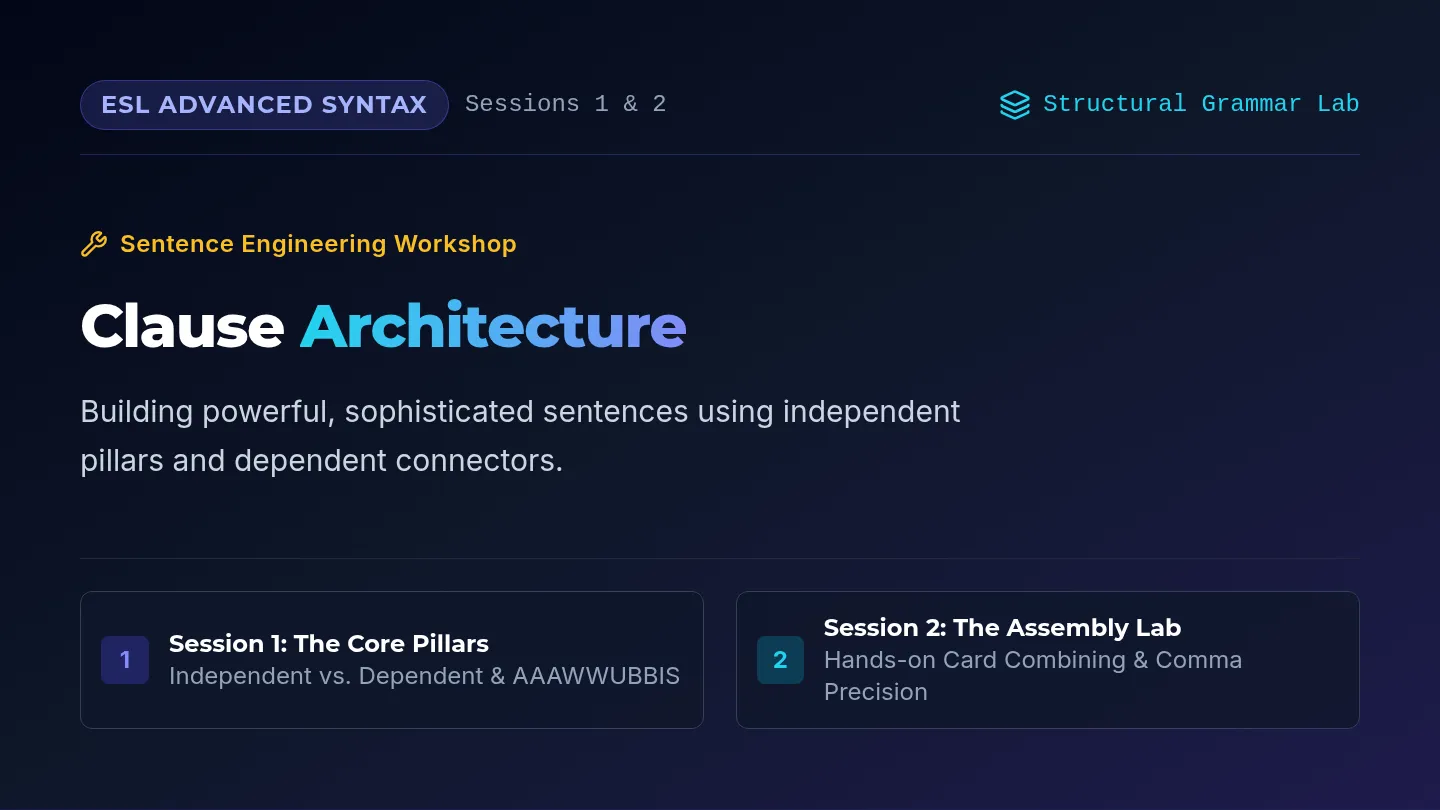
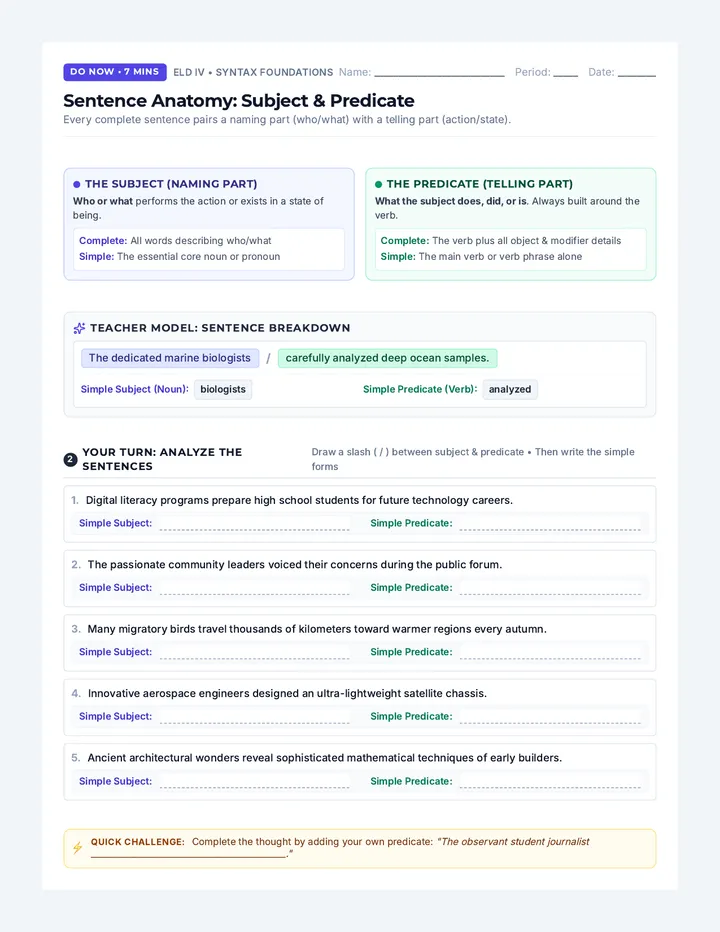
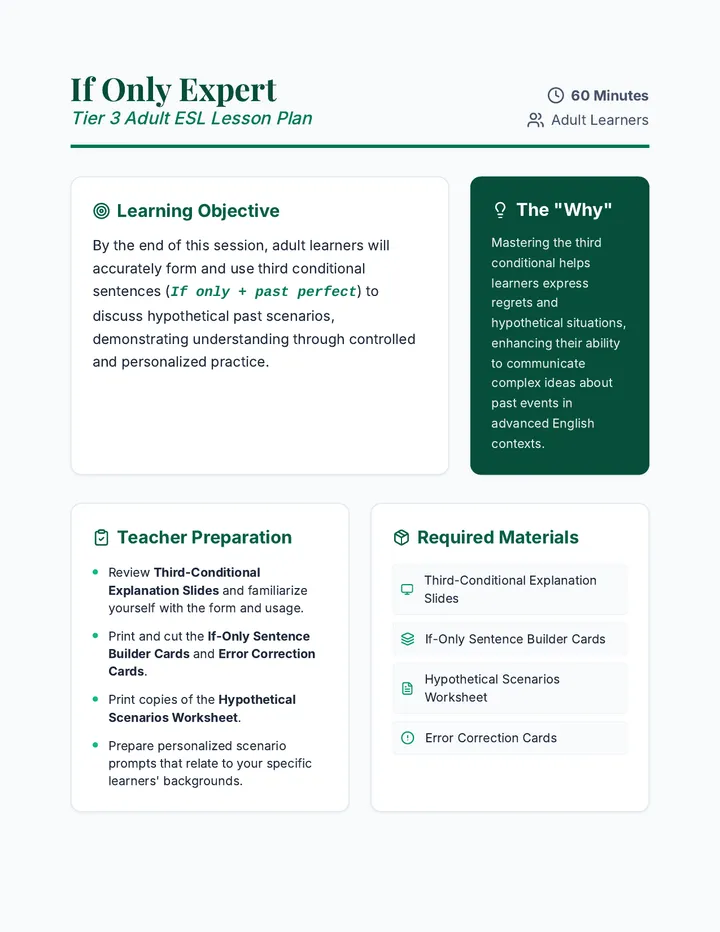
Complex sentence structures, the subjunctive mood, and inversion for high-level linguistic precision. Addresses nuanced usage of advanced conditionals and passive voice variants across academic and professional contexts.
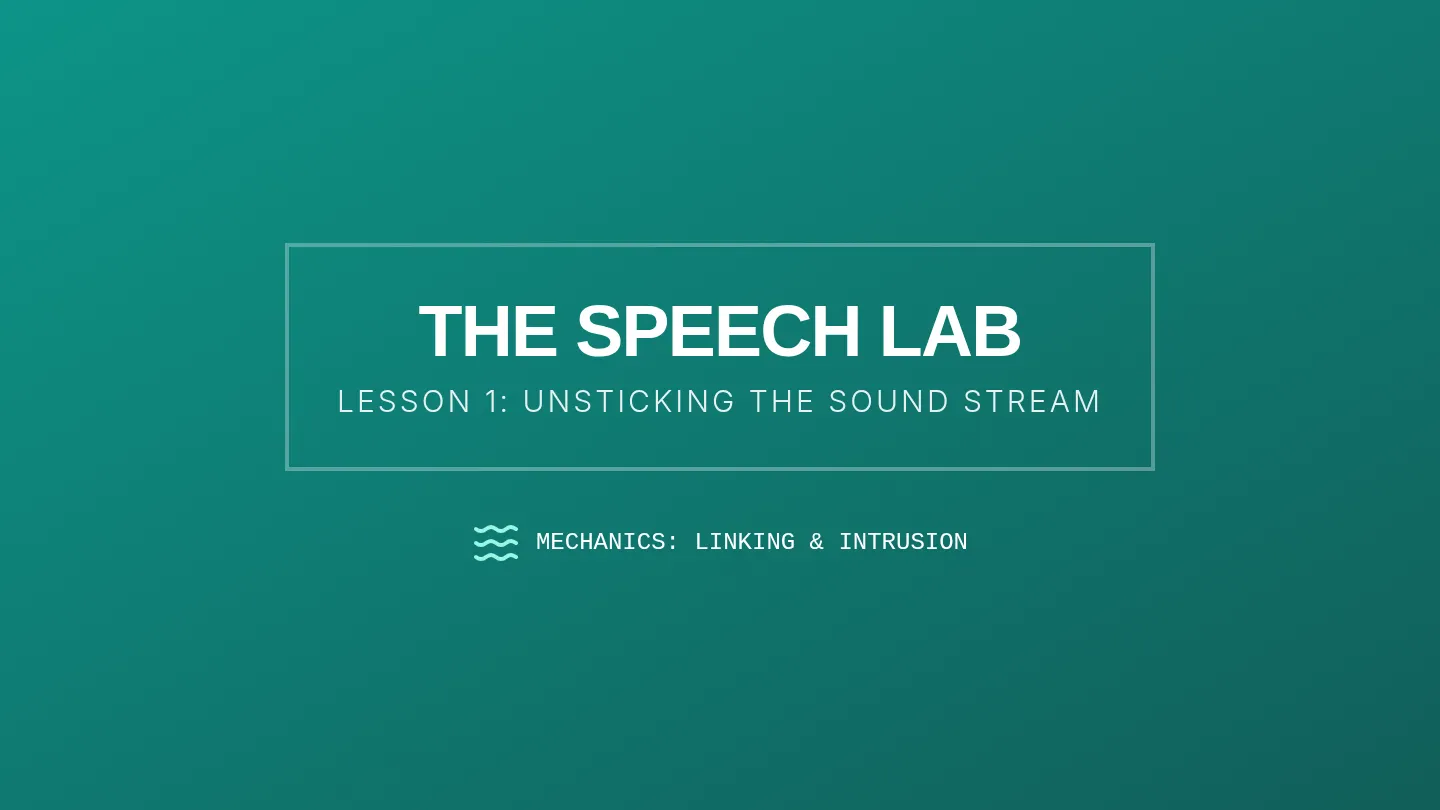
This sequence targets the mechanical difficulties of understanding natural, fast-paced English. Students explore phonological rules like linking, elision, and assimilation to decode authentic, fluid speech patterns found in campus social life.
A 5-lesson sequence for 12th-grade ESL students focused on interpreting tone, intent, and implicit meaning in professional settings like job interviews and negotiations.
A high-intensity workshop sequence designed for graduate students to master the reading demands of the GRE, GMAT, and TOEFL. Focuses on skimming, scanning, contextual vocabulary, and syntactic deconstruction for maximum efficiency.
This sequence trains graduate-level ESL students to analyze the psychometric logic of standardized test questions. Students learn to identify common distractor patterns—such as absolute language, irrelevant truths, and faulty inferences—transforming their approach from guessing to systematic logical elimination.
A comprehensive sequence designed for graduate ESL students to master the integrated writing and speaking tasks of high-stakes academic exams like TOEFL iBT and IELTS. The curriculum focuses on shorthand note-taking, identifying inter-source relationships, utilizing structural templates, and rapid synthesis under timed conditions.
A comprehensive sequence designed to help 10th-grade ESL students master academic test-taking by analyzing question stems, evaluating answer choice logic, and applying prediction strategies. Students move from basic identification of keywords to complex synthesis of strategies across various question types.
A comprehensive 5-lesson unit for 11th-grade ESL students focused on deconstructing complex academic test prompts. Students transition from identifying instructional verbs to parsing syntax, distinguishing inference from literal recall, and mastering advanced strategies like prediction and handling negative constraints.
A comprehensive 11th Grade ESL sequence focused on mastering multiple-choice tests through the 'Test Detective' framework. Students learn to identify distractor patterns like scope errors, verbatim traps, and absolute language to improve academic reading comprehension and test performance.
A comprehensive unit for high school seniors focused on deconstructing the logic of standardized English exams. Students learn to identify question components, categorize common distractors, and apply process-of-elimination techniques to improve performance on tests like TOEFL, IELTS, and SAT.
A comprehensive sequence for 12th Grade ESL students focused on mastering the writing sections of high-stakes English proficiency exams. Students learn formulaic yet effective strategies for prompt analysis, outlining, introductory structure, body paragraph development, and rapid proofreading to maximize scores under strict time limits.
A high-level ESL sequence designed to prepare 11th-grade students for university lectures. It covers macro-structures like signposting, micro-skills like hedging and rhetorical appeals, and ends with a full lecture synthesis seminar.
A high-level ESL sequence focusing on sophisticated argumentative structures, rhetorical strategies, and formal debate for graduate students. Students move from complex grammar to high-stakes persuasion.
Answer key for the Lesson 4 worksheet on grammatical reductions.
Answer key for the Lesson 3 worksheet on assimilation.
Answer key for the Lesson 2 worksheet on elision.
Answer key for the Lesson 1 worksheet on linking and intrusion.
A comprehensive teacher guide for the Speech Lab sequence, including audio scripts, instructional cues, pacing, and differentiation strategies.
A student mastery guide for practicing shadowing techniques with transcript analysis of complex campus dialogues.
A slide deck for Lesson 5 on shadowing techniques, prosody, and the final mastery assessment of connected speech patterns.
A student worksheet for identifying and translating grammatical reductions and weak forms in unscripted interviews.
A slide deck for Lesson 4 focusing on grammatical reductions and weak forms, using a high-contrast visual style to highlight the difference between formal and casual speech.
A student worksheet for identifying and reverse-engineering assimilated sounds in natural speech patterns.
A slide deck for Lesson 3 introducing assimilation, showing how sounds change based on their neighbors using a "chemical reaction" theme.
A student worksheet for identifying and reconstructing elided sounds (/t/ and /d/) in common phrases and lyrics.
Students engage in a 'shadowing' technique, repeating audio immediately after hearing it to internalize the rhythm and flow of connected speech. This active processing reinforces their ability to predict and process sound streams.
Focusing on function words, this lesson tackles common reductions like 'gonna,' 'wanna,' and weak forms of auxiliary verbs. Students analyze unscripted interviews to catch these reductions in context.
Students learn how sounds influence their neighbors (e.g., 'hand bag' becoming 'hambag'). The lesson uses minimal pair discrimination and dictation exercises to train ears to recognize words despite phonological changes.
This lesson covers the phenomenon of elision, where sounds (particularly /t/ and /d/) disappear in rapid speech. Students practice listening to high-speed dialogues to identify words that have been 'swallowed' by the speaker.
Students investigate how words flow together in natural speech, specifically focusing on consonant-vowel linking and intrusive sounds (/r/, /w/, /j/). They analyze audio samples to 'unstick' connected words.
Students apply listening skills to interpret complex interview questions and behavioral prompts.
Students evaluate emotional cues and de-escalation techniques in conflict resolution scenarios.
Students identify conditional language and tone shifts in negotiation simulations to spot willingness to compromise.
Learners decode indirect language and 'polite' workplace communication to find the underlying message.
Students analyze advertisements and workplace pitches to identify speaker goals and persuasive techniques.
Integrating all previous strategies under strict time constraints with a focus on meta-cognitive monitoring.
Breaking down convoluted academic sentences into core S-V-O components and identifying ignorable modifying clauses.