Anatomy of a Question Slides Test Detective
Case File #1: The Anatomy of a Question
Top Secret: Internal Use Only
EVIDENCE • EVIDENCE • EVIDENCE
The "Blind Test" Challenge
I have a secret text hidden in this folder. You cannot see it. But based only on these options, which one is the most likely answer?
A
All mammals living in the ocean breathe air through lungs rather than gills.
B
Fish are never capable of surviving in freshwater environments for long periods.
C
Whales have evolved specific physiological adaptations that allow them to thrive in deep-sea conditions.
D
The ocean is big.
Think like a detective: Why does option C look more "professional" than the others?
Anatomy of a Suspect
1. The Stem
The question itself or the problem you are asked to solve.
2. The Key
The correct answer. The truth hidden among lies.
3. The Distractors
Incorrect options designed to look attractive and "trick" you.
Case Profile Chart
The Psychology of Distraction
Impulse
We choose the first thing that looks "sort of" right.
Focus Drift
We forget what the Stem actually asked for.
Word Matching
We see a word from the text and assume it's the answer.
"Our goal is not to find the right answer, but to prove the wrong ones are guilty."
Mission Briefing
Grab your Anatomy Worksheet . We are going to dissect three "Cold Case" questions and label their parts.
Current Objective:
Analyze the relationship between the Stem and the Key.
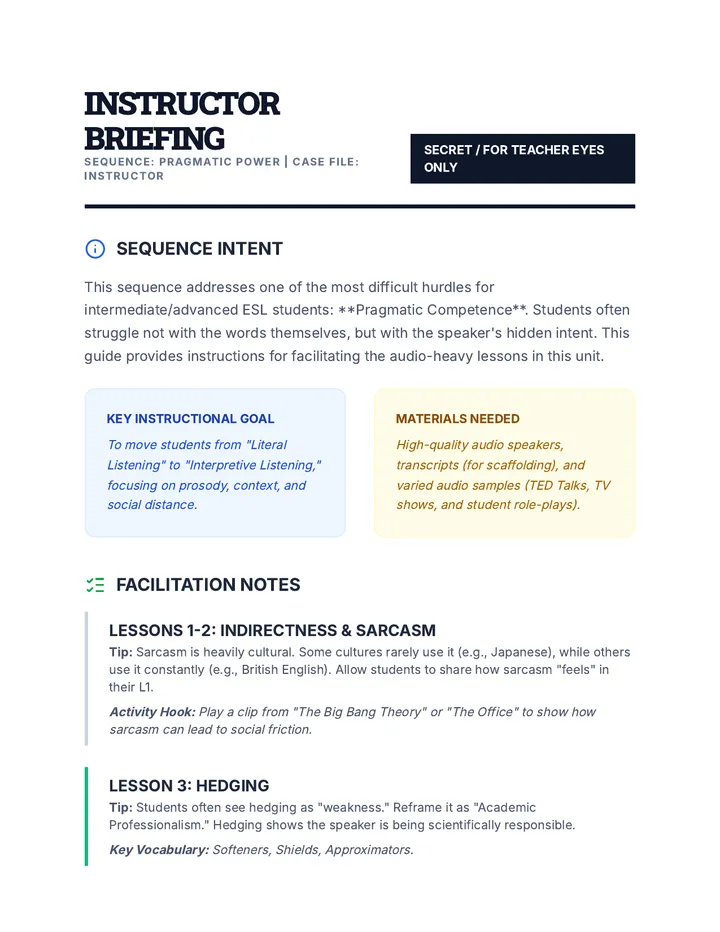
Anatomy of a Question Teacher Guide Case File Guide
Lesson 1: Anatomy of a Question
Level
11th ESL
Learning Objective
Students will define and identify the structural components of a multiple-choice question: the Stem , the Key , and the Distractors .
Materials Needed
Anatomy of a Question Slides
Student Anatomy Worksheet
Highlighters (3 colors per student)
Instructional Flow
1
The Blind Hook (10 mins)
Show Slide 2. Explain that in academic testing, the "best" answer often follows a specific logic. Ask students to pick an answer without the text.
Teacher Logic:
"C is the key because it uses complex, academic language ('physiological adaptations') and avoids absolute words like 'All' (A) or 'Never' (B). D is too informal for an 11th-grade test."
2
Terminology Briefing (15 mins)
Use Slides 3-4 to introduce Stem , Key , and Distractor . Emphasize that distractors are not "stupid" answers—they are designed to look like the key to someone who hasn't fully understood the text.
3
Dissection Practice (20 mins)
Distribute the Anatomy Worksheet . Students work in pairs to label the parts of the "Cold Case" questions. Walk around and check for common misconceptions (e.g., misidentifying the key).
Common Misconceptions
"The longest answer is always right."
While often true in lower levels, advanced distractors are frequently long to hide inaccuracies. Teach students to look for meaning, not length.
"Distractors are random."
Every distractor has a "purpose" (to match a keyword, to generalize, etc.). This sequence will uncover those purposes.
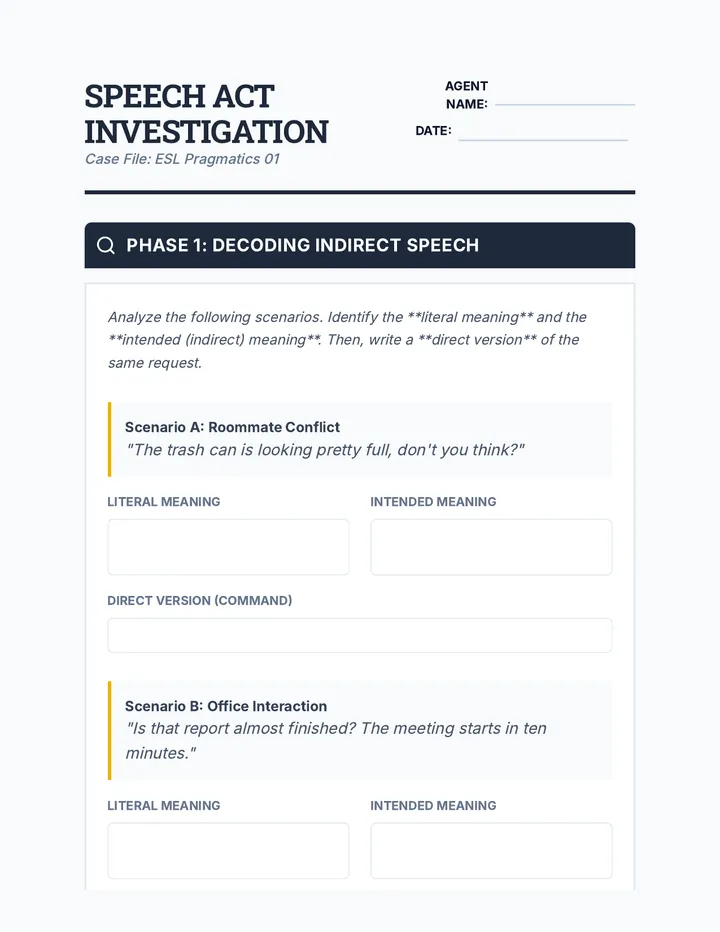
Anatomy of a Question Worksheet Anatomy of a Question
Detective Activity • Case File #1
Name:
Date:
Phase 1
Identify the Components
Based on our briefing, match the term to its detective definition.
THE STEM
The incorrect options designed to tempt you away from the truth.
THE KEY
The central problem or question presented in the exam.
DISTRACTORS
The single correct answer that is supported by the evidence.
Phase 2
Cold Case Dissection
Examine the following SAT-style question. Label the components and answer the analysis questions below.
Case ID: R-3042
Based on the passage, what is the primary reason the author mentions the "underground root systems" of desert plants?
A
To provide a technical definition of xerophytic botany.
B
To illustrate how specific biological structures facilitate survival in arid climates.
C
To list all the different types of plants found in the Sahara desert.
D
Because the author likes gardening.
Identify the Stem:
Identify the Key:
Which distractor (A, C, or D) is the most "dangerous" and why?
Phase 3
Field Notes
"Detectives don't just look for what's there; they look for what's missing. If the Key isn't immediately obvious, start by proving the Distractors are wrong."
Scope Errors Slides Scope Errors
Case File #2: The Goldilocks Principle
Finding the Perfect Fit
The Headline Challenge
Article: "Local bakery 'Sweet Treats' has started using solar panels to power its ovens, reducing its carbon footprint by 40%."
Headline A
"Humanity Struggles with Global Energy Crisis and Climate Change."
Goldilocks
Headline B
"Local Bakery Goes Green with Solar-Powered Baking."
Headline C
"Bakery Owner Mr. Smith Bought Six Shiny New 100-Watt Solar Panels."
Defining Scope
Too Broad
"The Telescope Error"
Covers the whole world when the text only covers one city.
Perfect Fit
"The Key"
Matches the specific boundaries of the author's argument.
Too Narrow
"The Microscope Error"
Focuses on one tiny detail and ignores the main message.
Case Study: The Desert Text
"While many imagine deserts as lifeless wastelands, they are actually home to a diverse array of nocturnal animals, such as the fennec fox and various scorpion species, which have adapted to extreme temperature shifts."
Distractor 1:
All living creatures must adapt to their environment to survive.
Type: Too Broad
Distractor 2:
The fennec fox is one animal found in the desert.
Type: Too Narrow
THE KEY:
Deserts support a variety of life forms specialized for harsh conditions.
Type: Just Right
Detection Drill
In your next activity, you must sort headlines like a detective. Don't be fooled by a headline that is true but doesn't fit the scope.
1
Check for Generalizations (Broad)
2
Check for Minor Details (Narrow)
Scope Errors Teacher Guide Case File Guide
Lesson 2: Identifying Scope Errors
Focus
Scope
Summary
This lesson addresses one of the most common reasons students miss multiple-choice questions: choosing an answer that is technically "true" based on their general knowledge, but either goes beyond the scope of the text (Too Broad) or focuses on a minor detail instead of the main idea (Too Narrow).
The Headline Hook (10 mins)
Display Slide 2. Use the following prompts to guide student thinking:
"Why is Headline A 'Too Broad'?"
Answer: It talks about all of humanity and climate change, but the text is just about one local bakery.
"Why is Headline C 'Too Narrow'?"
Answer: It mentions the number of panels and the owner's name, which are minor details. It misses the 'why' (powering the ovens/going green).
Worksheet Answer Key
Case # Option A Option B Option C 1 (Bees) Too Broad Key (Goldilocks) Too Narrow 2 (Mars) Too Narrow Too Broad Key (Goldilocks) 3 (Jazz) Key (Goldilocks) Too Narrow Too Broad
The "Safe" Answer Trap
Explain to students that Too Broad answers often feel "safer" because they are universally true (e.g., "The environment is important"). However, on a reading test, "safe" doesn't mean "correct." The answer must be supported by that specific text , not just by reality.
Goldilocks Headlines Worksheet Goldilocks Headlines
Scope Analysis • Case File #2
Name:
Date:
Detective Mission:
For each mini-text, analyze the three headline options. Label each one as Too Broad , Too Narrow , or Goldilocks (The Key).
Case #1
The Bee Crisis
"Bee populations in North America have declined by 23% over the last decade. Research suggests that the overuse of pesticides in corn and soy farming is the primary culprit, though habitat loss also plays a significant role."
LABEL HERE
A. Human activity is destroying the delicate balance of Earth's ecosystems.
LABEL HERE
B. Pesticides and habitat loss are driving the decline of North American bees.
LABEL HERE
C. Corn and soy farmers are the only ones responsible for environmental issues.
Case #2
The Mars Mission
"NASA's Perseverance rover successfully collected its first rock core sample from Mars' Jezero Crater. Scientists believe the crater was once a river delta, making it the ideal spot to search for signs of ancient microbial life."
LABEL HERE
A. The Jezero Crater was once filled with water.
LABEL HERE
B. Space exploration is the final frontier for all human curiosity.
LABEL HERE
C. Perseverance is searching for ancient life in Mars' Jezero Crater delta.
The Detective's Log
In your own words, why is it dangerous to pick a "Too Broad" answer even if it is a "good" or "true" statement about the world?
Verbatim Trap Slides The Verbatim Trap
Case File #3: Matching Words vs. Matching Meaning
DANGER: FOOL'S GOLD
Spot the Fake
Original Evidence:
"The witness described a man in a dark blue jacket running away from the scene."
Suspect A
A man in a dark blue jacket was walking toward the scene.
Uses exact words from text!
Suspect B
A person wearing navy-colored clothing was fleeing the location.
The Key (Paraphrased)
The Verbatim Trap
A distractor that uses exact words from the passage to make you think it's right...
BUT THE MEANING IS WRONG.
The Trap Strategy
They hope you are just "word hunting" instead of reading for meaning.
The Key Strategy
Correct answers often paraphrase (use synonyms) to test your actual understanding.
How they trap you
The Reversal
Uses the same words but flips the logic (e.g., "increase" becomes "decrease" in context).
False Connection
Connects two words from different sentences that don't belong together.
Partial Truth
Uses 90% exact words from the text but adds one tiny incorrect detail at the end.
The Detective's Shield
"If the answer looks exactly like the text, be suspicious. If it says the same thing in different words, it's likely the truth."
Same Words = Suspect
New Words = Safe
Verbatim Trap Teacher Guide Case File Guide
Lesson 3: The Verbatim Trap
Focus
Evidence
Instructional Rationale
Students often struggle with "word matching," a lower-level reading strategy. In academic tests like the SAT, TOEFL, or IELTS, test-makers exploit this by creating distractors that use exact phrasing from the text but describe a situation that didn't happen. Correct answers, meanwhile, often use high-level synonyms.
Facilitating the "Spot the Fake" (10 mins)
Display Slide 2. Ask students to identify which option feels more like the text at first glance.
The Breakdown:
• Original: Dark blue jacket + running AWAY.
• Suspect A: Dark blue jacket (MATCH) + walking TOWARD (TRAP).
• Suspect B: Navy-colored clothing (SYNONYM) + fleeing (SYNONYM).
Key takeaway: The "lazy" reader picks A because of the jacket. The "detective" picks B because the meaning holds up.
Worksheet Key: The Paraphrase Detective
Case # Original Text Detail The Verbatim Trap The Key (Paraphrase) 1 "Gradual erosion" Option B (Exact Words) Option A (Slow wearing away) 2 "Economic stimulus" Option A (Exact Words) Option C (Financial growth support) 3 "Urban sprawl" Option C (Exact Words) Option B (Expansion of cities)
The Synonym Bank
Encourage students to keep a "Detective Synonym Bank" on the back of their worksheet. For every correct answer they find, ask them to write down the word from the text and its synonym from the key.
Verbatim Trap Worksheet Paraphrase Detective
Case File #3: The Verbatim Trap
Name:
Date:
WANTED: The Key
"Beware of distractors that match the passage word-for-word. They are often 'traps' set by the test-maker. Real truth usually hides behind synonyms and paraphrasing."
Case #301
Topic: Geology
"The canyon walls show evidence of gradual erosion caused by centuries of wind and river movement."
A
The rock formations were formed by the slow wearing away of the landscape.
B
The canyon's height is a result of gradual erosion in high-altitude areas.
Identify the Key: ______________ | Explain the Trap in the other option: _________________________________
Case #302
Topic: Economics
"The government implemented a new economic stimulus package to prevent a recession."
A
Recessions can be caused by a lack of economic stimulus.
B
The government failed to pass the stimulus package on time.
C
Lawmakers provided financial growth support to stabilize the economy.
Identify the Key: ______________ | What words were swapped for synonyms in the Key?
The Synonym Safe
Record your evidence here. Match words from the text to the synonyms used in the correct answers.
Text:
gradual
Synonym:
slow
Text:
Synonym:
Text:
Synonym:
Text:
Synonym:
Absolute Language Slides Absolute Language
Case File #4: The Power of the Hedge
Identifying Extreme Claims
The Claim Sorting Game
Which of these claims is impossible to prove wrong?
Claim A
"Drinking coffee always prevents heart disease in everyone."
Absolute Claim
Claim B
"Some studies suggest that coffee consumption may be linked to a reduced risk of heart disease."
Academic Hedging
The "Red Flag" Vocabulary
Absolute Language
Words that leave no room for exceptions. In academic tests, these are almost always wrong .
Always Never Only Must All Impossible
The Logic Bomb
If there is even one exception in the entire world, an absolute answer is guilty .
The "Hedge" Strategy
Quantity
Some, many, most, often
Probability
Likely, possibly, perhaps
Modality
May, might, could, can
"Academic writers are careful. They don't make big promises they can't keep. The Key is usually a careful answer."
The Hedge Fund
Open your Hedge Fund Worksheet . You will audit claims and rewrite them to be academic and "safe."
Eliminate Extreme Language
Absolute Language Teacher Guide Case File Guide
Lesson 4: Absolute Language vs. Hedging
Focus
Logic
The Logic of Extremes
Standardized tests prioritize defensible answers. An answer containing "always" or "never" is only correct if the text explicitly states there are zero exceptions. Since most academic texts deal with complexity, the "hedged" answer (using words like likely or some ) is statistically much more likely to be the Key.
The Claim Sorting Game (10 mins)
Display Slide 2. Challenge students to "break" Claim A.
Teacher Prompt:
"Can anyone think of a single person in the history of the world who drank coffee but still got heart disease? If yes, Claim A is officially a lie. Claim B, however, says 'suggests' and 'may be linked'—it's impossible to prove wrong because it doesn't make a total promise."
The Hedge Fund: Answer Key
Problem 1: "Video games always cause children to become violent."
Hedged Version: Research suggests that some video games may be linked to increased aggression in certain children.
Problem 2: "Nobody enjoys studying for standardized tests."
Hedged Version: Many students find studying for standardized tests to be a stressful or unpleasant experience.
Problem 3: "Electric cars will completely eliminate air pollution by 2050."
Hedged Version: Electric cars could significantly reduce levels of air pollution by the middle of the century.
Detective Rule #4: The 1% Rule
If an answer is 99% true but 1% false, it is 100% wrong. Absolute words (all, never) make answers easy to destroy. Hedged words (some, often) make answers impossible to kill.
Absolute Language Worksheet The Hedge Fund
Qualifier Analysis • Case File #4
Name:
Date:
Phase 1
Red Flag Audit
Circle the Absolute Language in each distractor below. Then, briefly explain why the claim is dangerous.
"The implementation of the new law will entirely eliminate poverty in urban areas."
Detective Analysis:
"Experts all agree that solar energy is the only solution for climate change."
Detective Analysis:
Phase 2
The Hedge Bank
MAY / MIGHT
OFTEN / MANY
SUGGESTS / LIKELY
Rewrite the following "Logic Bombs" using words from the Hedge Bank to make them academic and defensible.
Claim: "Social media use is always harmful to teenagers."
Claim: "Rainforests will never recover from deforestation."
Detective's Summary
Why do test-makers use "Absolute Language" in distractors? Why don't they just make the wrong answers obviously stupid? Write your conclusion here.
Student Created Distractors Slides The Test Maker
Case File #5: Reverse Engineering the Exam
Mastering the Distractor Logic
The Ultimate Challenge
"Can you build a question so difficult—but so fair—that half your classmates get it wrong?"
To catch a criminal, you must think like one. To beat the test, you must learn to write the test.
Analyze Evidence
Set the Trap
Draft the Key
Challenge Peers
The Test Maker's Toolkit
Distractor Recipes:
The Telescope: Make it too broad.
The Microscope: Focus on one tiny detail.
The Verbatim: Use exact words but lie.
The Absolute: Use "always" or "never."
"A good distractor must be tempting. It should look right to someone who is in a hurry or only half-reading."
The Construction Phase
1
Select a Text
Choose a paragraph that has both a main idea and several specific details.
2
Draft the Key
Write the perfect, hedged, paraphrased main idea answer first.
3
Plant the Traps
Use your toolkit to build three unique distractors that mimic the text's words or logic.
Mission Launch
You are now the examiner. Open your Vault Blueprint and begin your construction. Your classmates are waiting...
The Truth Is In Your Hands
Student Created Distractors Teacher Guide Project Guide
Lesson 5: Student-Created Distractors
Type
PBL
Project Overview
In this final lesson, students move from analysis to synthesis. They will select a short academic passage and construct a 4-option multiple-choice question. The catch: they must be able to justify exactly why each of their distractors is incorrect based on the categories learned (Scope, Verbatim, Absolute).
Suggested Pacing
15 Mins:
Review the "Distractor Toolkit" (Slide 3) and distribute the Vault Blueprint .
25 Mins:
Individual or pair work constructing the question, key, and distractors.
20 Mins:
The Playtest: Students swap blueprints and try to solve each other's questions. They must label the distractors they find.
Success Rubric
3: Distinguished
Key is perfectly paraphrased.
Distractors use all 3 categories correctly.
Justification is clear and logical.
2: Proficient
Key is correct but slightly literal.
Distractors use 2 categories correctly.
Justification is mostly accurate.
1: Emerging
Key is too similar to distractors.
Distractors are "random" or too easy.
Lacks justification for logic.
The Peer Review Question
"When you trade questions, ask your partner: 'Which answer was the most tempting, and why?' If they picked your Verbatim Trap, your trap worked!"
Student Created Distractors Blueprint The Vault Blueprint
Final Assessment • Case File #5
Name:
Date:
Step 1
The Text Evidence
Paste or write your chosen short academic passage (3-5 sentences) here.
Step 2
The Stem
Step 3
The Key
Step 4
The Distractor Vault
Distractor A: The Scope Trap
Is this Too Broad or Too Narrow?
Distractor B: The Verbatim Trap
Which exact words are you using to lie?
Distractor C: The Absolute Trap
Which "Red Flag" word did you use?
The Detective's Oath
"I certify that my Key is supported by the evidence and that all my Distractors follow a logical pattern of error. I have created a fair challenge for my peers."
Agent Signature