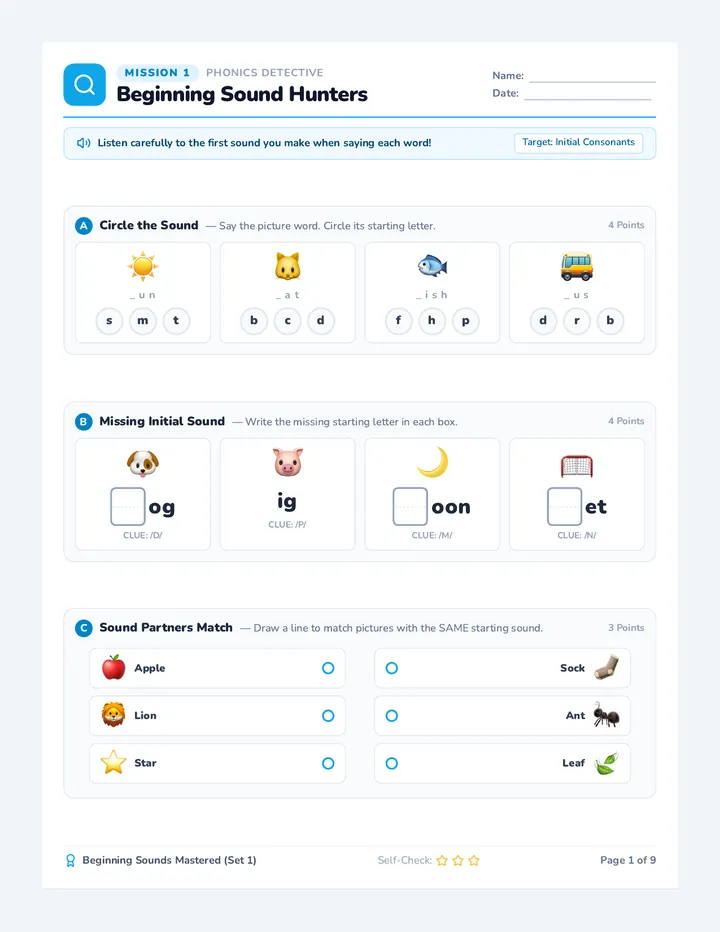
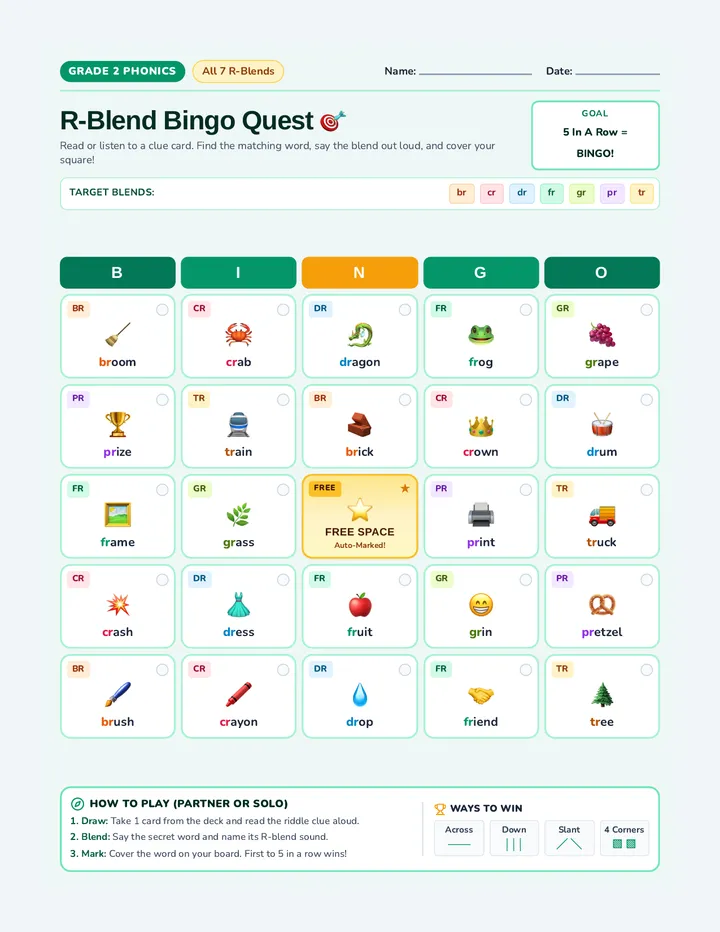
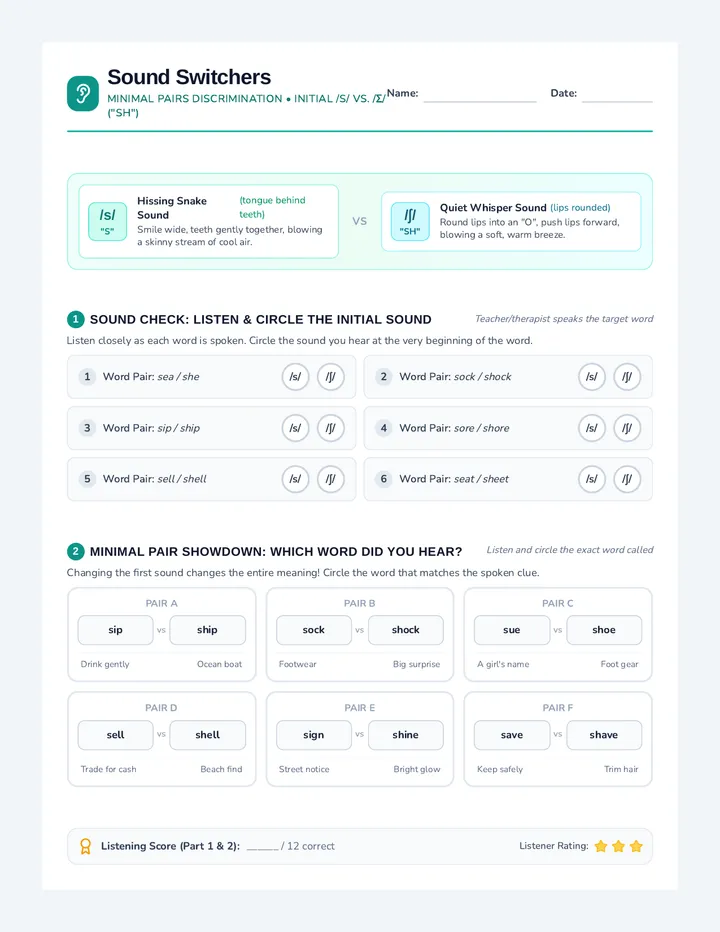
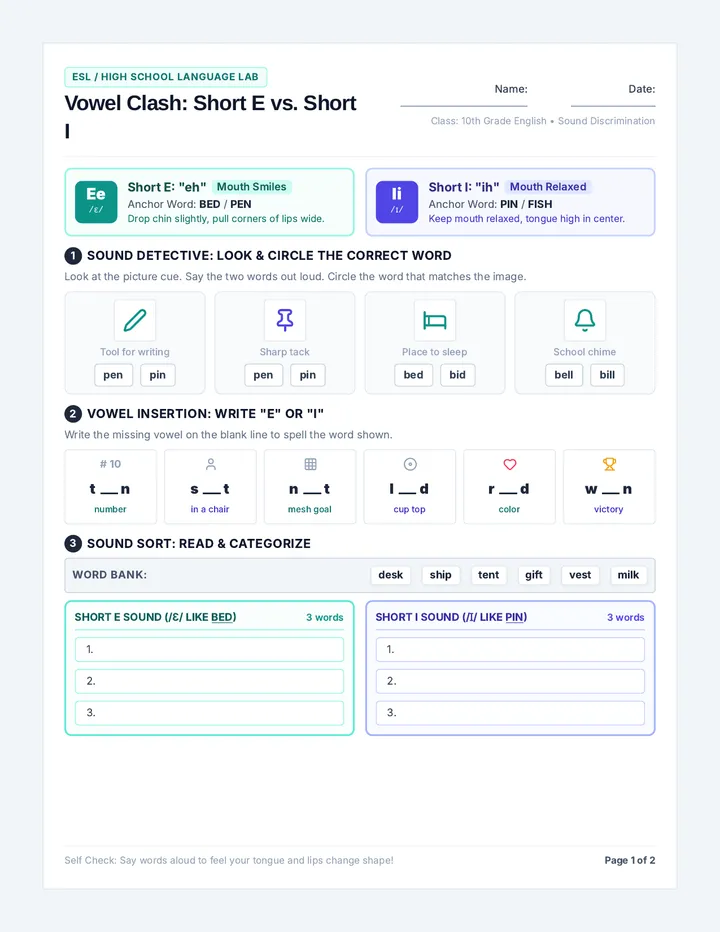
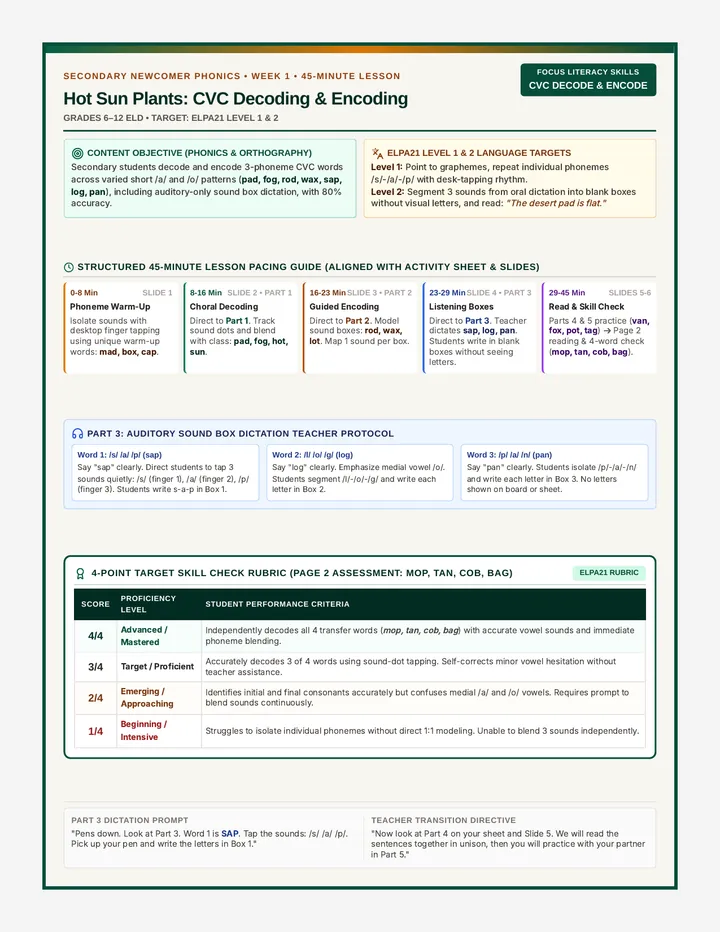
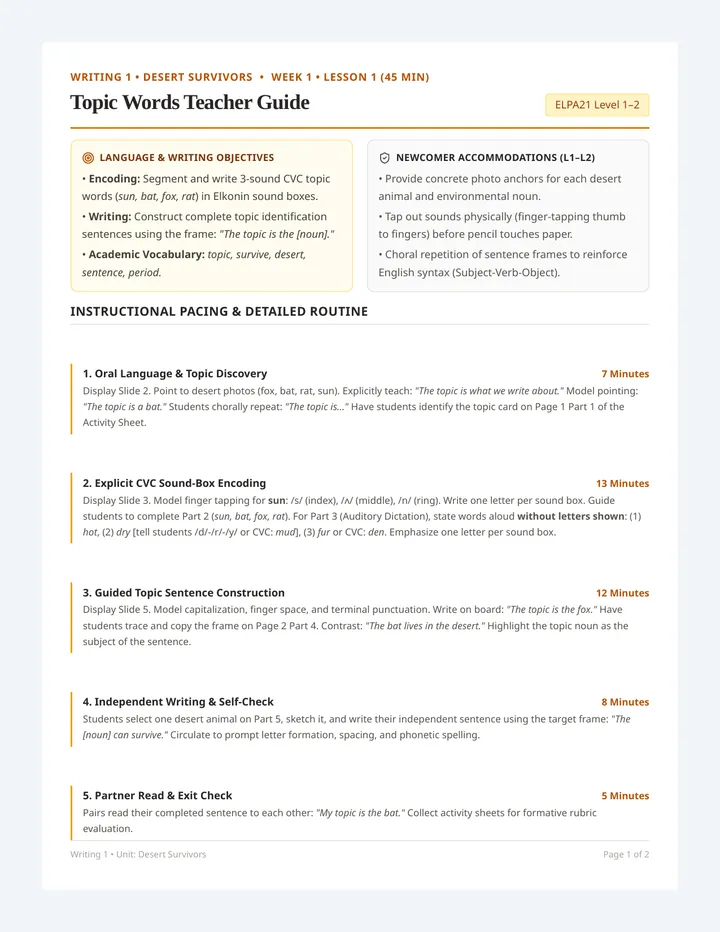
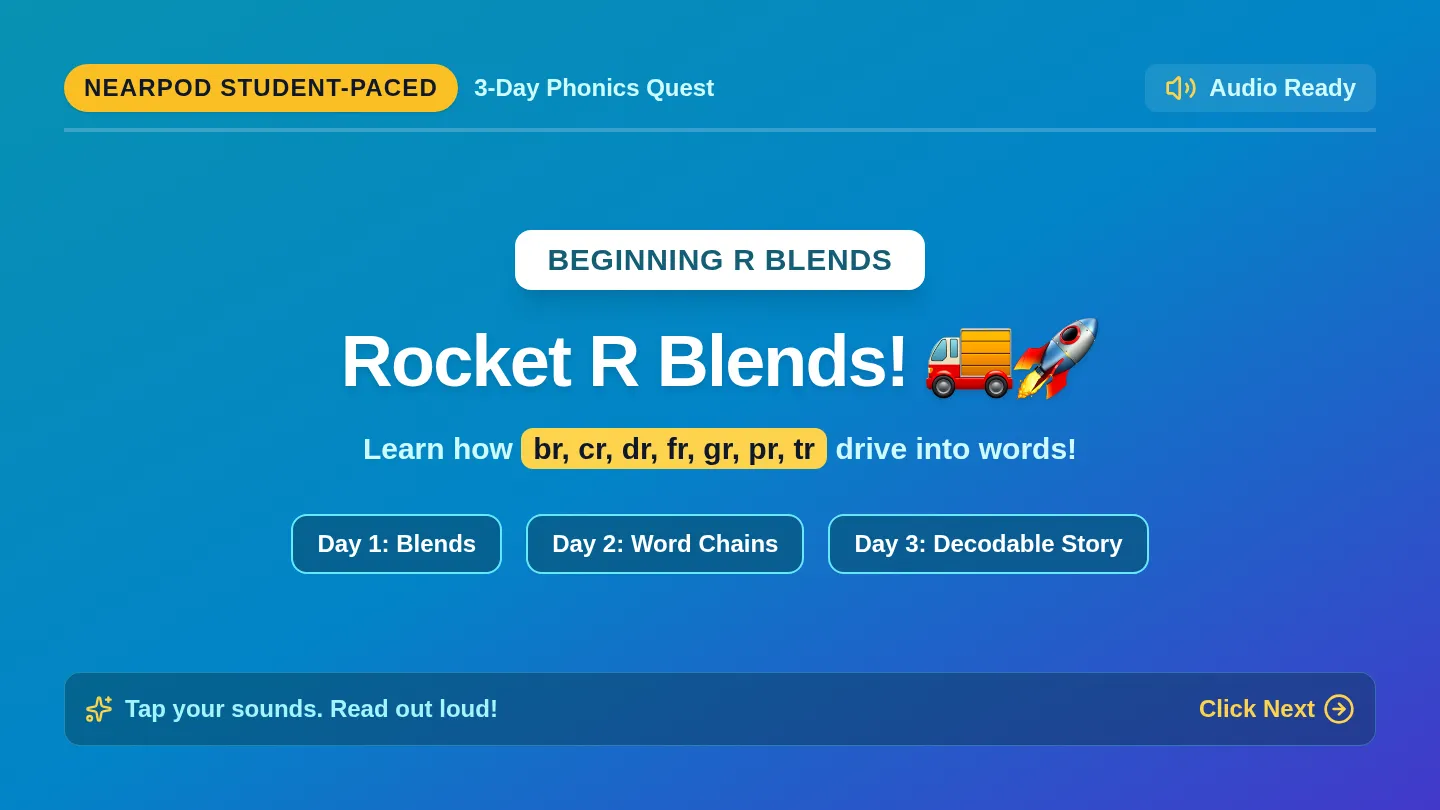
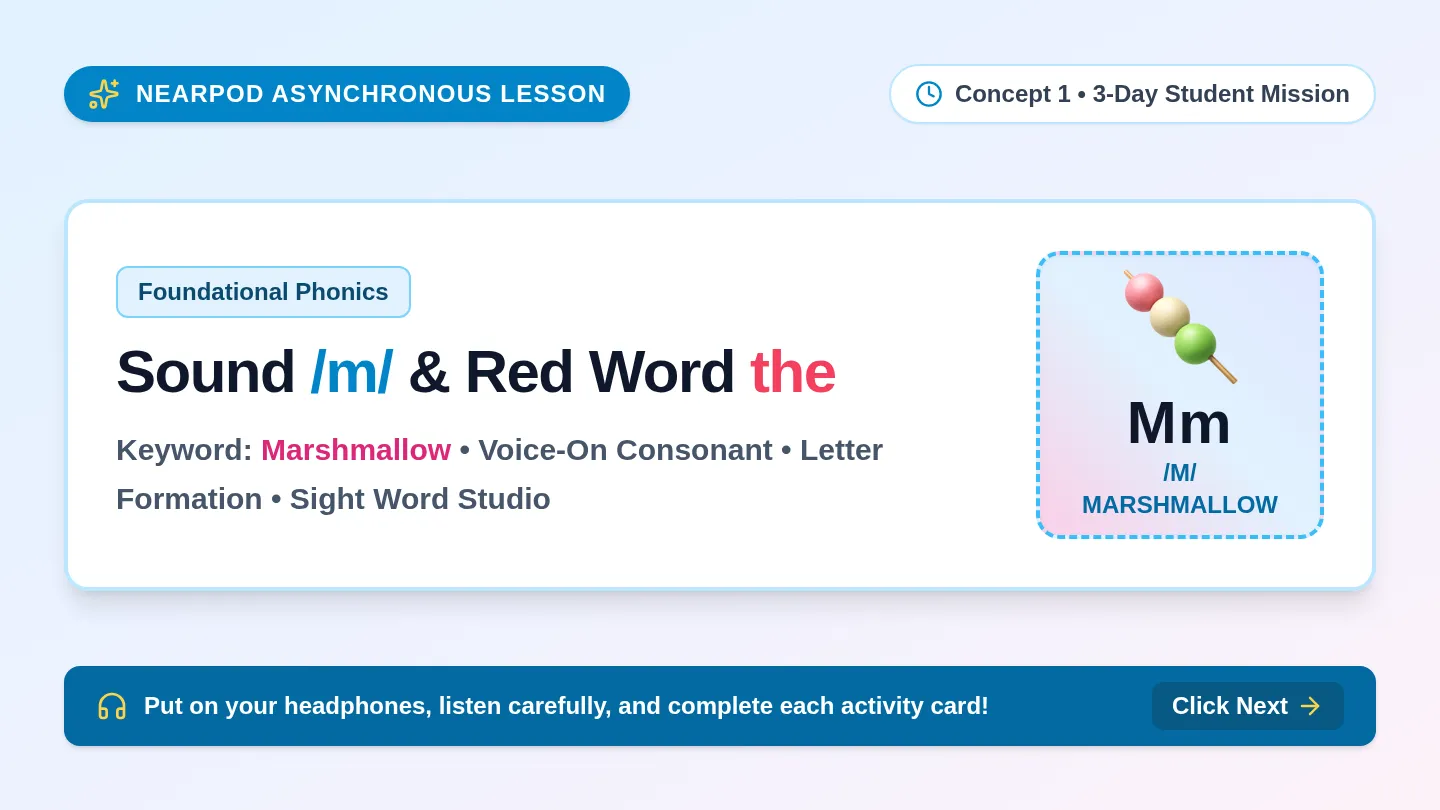
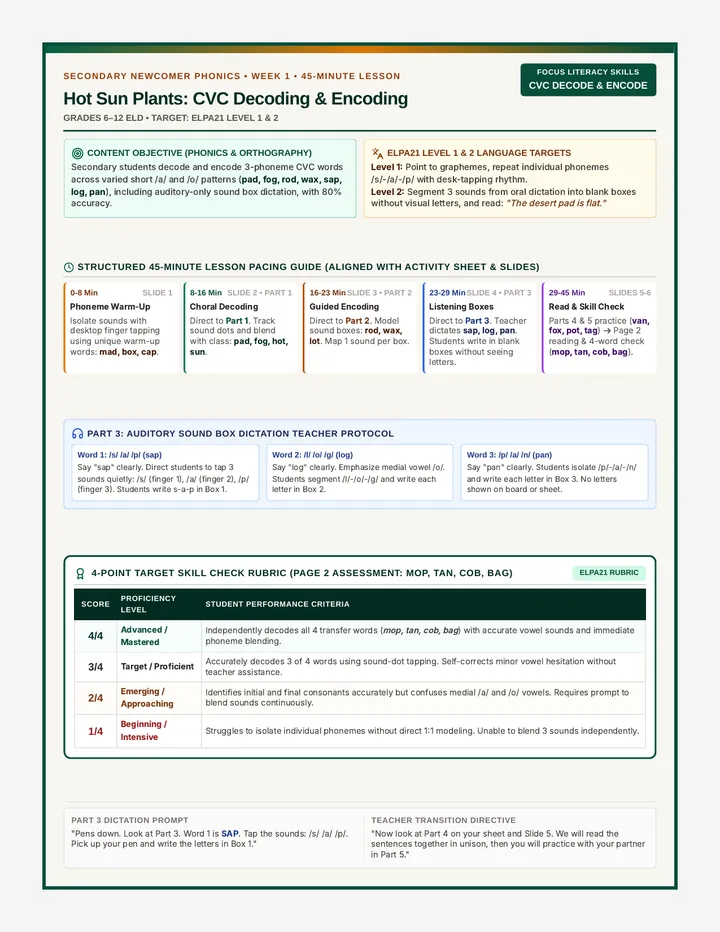
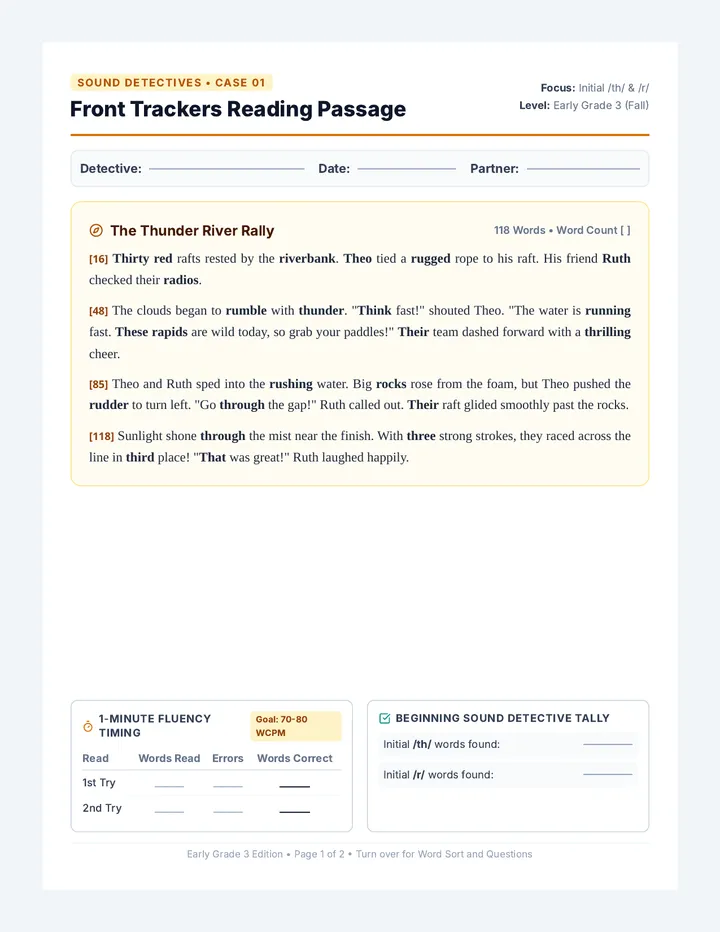
High-frequency vocabulary, simple greetings, and classroom commands for non-native speakers. Develops recognition of individual sounds, numbers, and basic conversational patterns.
A workshop-style workshop sequence for 3rd grade ESL students focusing on note-taking and paraphrasing. Students learn to extract information without plagiarizing using strategies like keyword highlighting, visual sketching, and the 'Read-Cover-Write' method.
A comprehensive ESL listening sequence for 4th graders focusing on natural speech patterns, emotional tone, idioms, and social registers. Students act as 'Ear Detectives' to decode the hidden meanings in how English is actually spoken vs. how it is written.
This sequence helps 4th Grade ESL students master listening skills by focusing on multi-step directions, sequence markers, spatial prepositions, and clarification strategies. Students progress from identifying simple transition words to navigating complex maps and completing an auditory scavenger hunt.
A 2nd-grade ESL sequence focused on academic discourse, teaching students to state opinions, cite evidence, and engage in respectful debate using structured sentence frames.
A comprehensive ESL sequence for 1st graders focusing on the academic language of spatial relationships, directional movement, and map literacy within a Social Studies context. Students progress from basic positional words to navigating and creating their own maps.
A 5-lesson sequence for 3rd-grade ESL students focused on the academic language of mathematics. Students learn to define operations, sequence multi-step processes, justify their reasoning, use comparative geometry language, and participate in collaborative mathematical discussions.
A 5-lesson sequence for 4th Grade ESL students focusing on the mechanics of spoken English: intonation, stress, pacing, and pronunciation, culminating in a recorded newscast.
A 5-lesson inquiry-driven unit where 4th-grade ESL students become 'Grammar Detectives' to master modal verbs of deduction (must, might, can't) and reported speech. Students use these tools to solve mysteries, interview witnesses, and write investigative reports.
A comprehensive 5-lesson sequence designed for 8th-grade academic support, focusing on building visualization skills through the metaphor of a 'Mind Movie.' Students progress from identifying sensory triggers in text to using visualization as a metacognitive tool for self-monitoring comprehension.
This 5th-grade sequence guides students through the 'Mind\'s Eye' technique, moving from simple object visualization to multi-sensory mental movies and storyboarding. It uses scaffolded workshops to build reading retention and comprehension for students requiring academic support.
A Kindergarten sequence focused on visual literacy to teach prediction and inference. Students use picture clues from book covers and wordless stories to anticipate what happens next, developing critical thinking and observation skills through a 'Picture Detective' theme.
Teacher guide for Lesson 5. Features category sorting challenges, instructional tips for using graphic organizers, and a summary of the Research Ranger sequence.
A student graphic organizer for sorting informational facts into categories (Habitat, Diet, Appearance, Interesting Info). Features a bank of elephant facts for sorting practice.
Educational slides for teaching students how to organize information into categories using a graphic organizer. Includes a sorting hook and visual guide for the 'Fact Sorter' activity.
Teacher reference guide for Lesson 5, providing the auditory scripts for all mission stages and the final secret word solution for the Culminating Hunt.
A multi-part student activity sheet for the culminating lesson, requiring students to synthesize sequence, spatial, and visualization skills to solve an 'Auditory Scavenger Hunt'.
Teacher guide for Lesson 4. Features kid-speak translation challenges, exemplar paraphrased sentences, and instructional tips for using sentence starters effectively.
A student worksheet for practicing sentence construction using sentence starters and keywords. Features three structured practice areas and a self-check rubric.
Introductory slides for Lesson 5 focusing on the mission briefing and rules for the final Auditory Scavenger Hunt. Includes visual cues for mission readiness.
Teacher guide for Lesson 5: Hidden Meanings. Contains a multi-layered script and a synthesis answer key to assess student mastery of all Ear Detective skills.
Capstone worksheet for Lesson 5: Hidden Meanings. Students perform a final synthesis by analyzing a complex audio clip for subtext, tone, idioms, and register.
Educational slide deck for teaching students how to use sentence starters and kid-speak translation to paraphrase information. Includes a bank of starters and guided transformation examples.
Teacher reference guide for Lesson 4, providing the auditory scripts for confusion scenarios and an assessment rubric for monitoring student clarification strategies.
In this culminating activity, students solve a series of puzzles where the clues are delivered via audio recordings. Success depends on synthesizing sequence markers, spatial details, and specific vocabulary.
Students are given intentionally vague or rapid instructions and must use specific question structures to ask for repetition or clarification. The class analyzes which questions yield the best information.
Using a grid map, students follow oral directions to navigate from a starting point to a destination. The lesson introduces compass directions and landmarks as key listening anchors.
Students listen to descriptions of a room or scene and draw what they hear, focusing on prepositions of place. They compare their drawings to the original image to identify listening gaps.
Students organize loose facts into logical categories using a graphic organizer. They learn to group information by topic to prepare for structured writing.
Using keywords and visual notes, students use sentence frames to construct complete sentences in their own voice. They 'translate' complex text into simpler language.
Students learn the 'Read-Cover-Write' strategy to prevent plagiarism. They practice reading a sentence, covering it, and writing what they remember in their own words.
Students take notes using only drawings and symbols to bypass language barriers and prevent copying. They practice oral retelling by explaining their sketches to a partner.
Students practice reading short paragraphs and highlighting only the most important words (nouns and verbs). They use the 'Expensive Telegram' game to learn how to summarize with a strict word limit.
In this capstone lesson, students analyze subtext and speaker relationships through role-play and synthesis of tone and content.
Students compare formal and informal English registers to understand how social context dictates speech patterns and vocabulary.
Students use context clues and speaker tone to deduce the meaning of common English idioms without relying on literal translation.