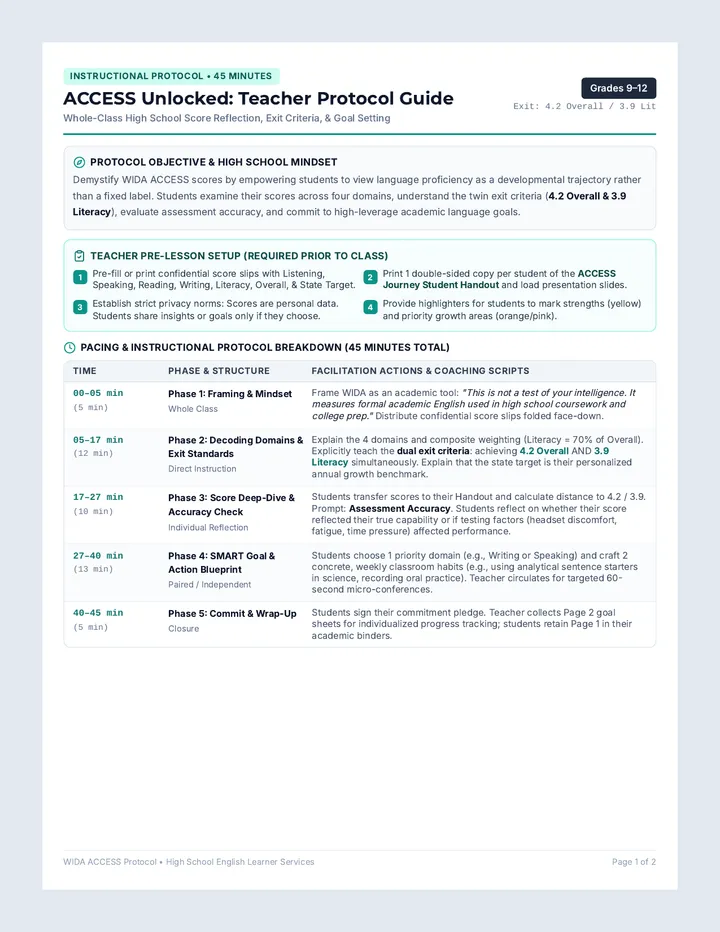
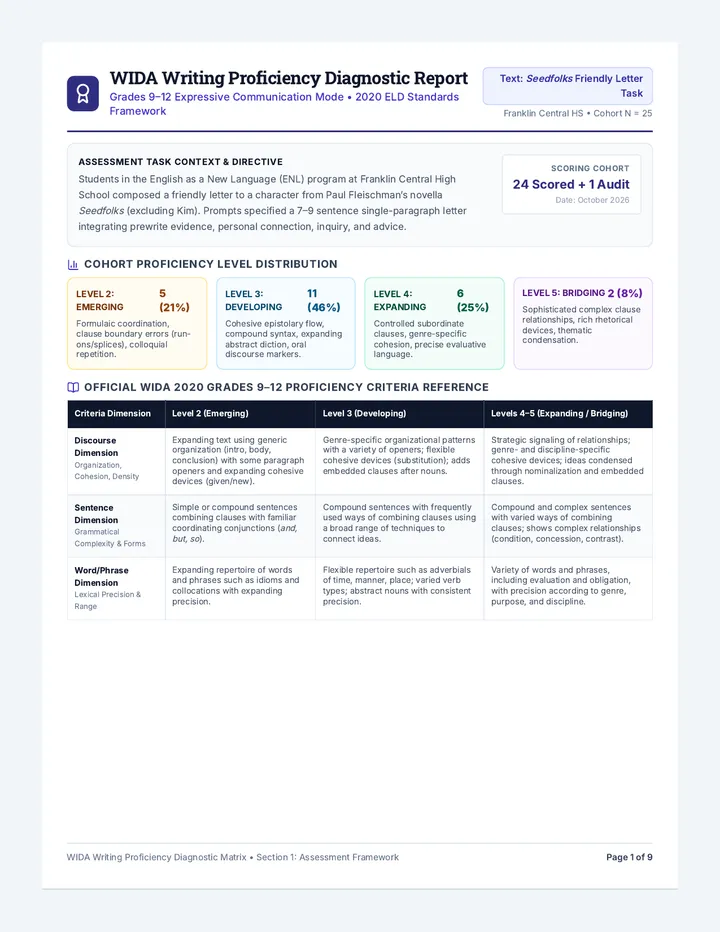
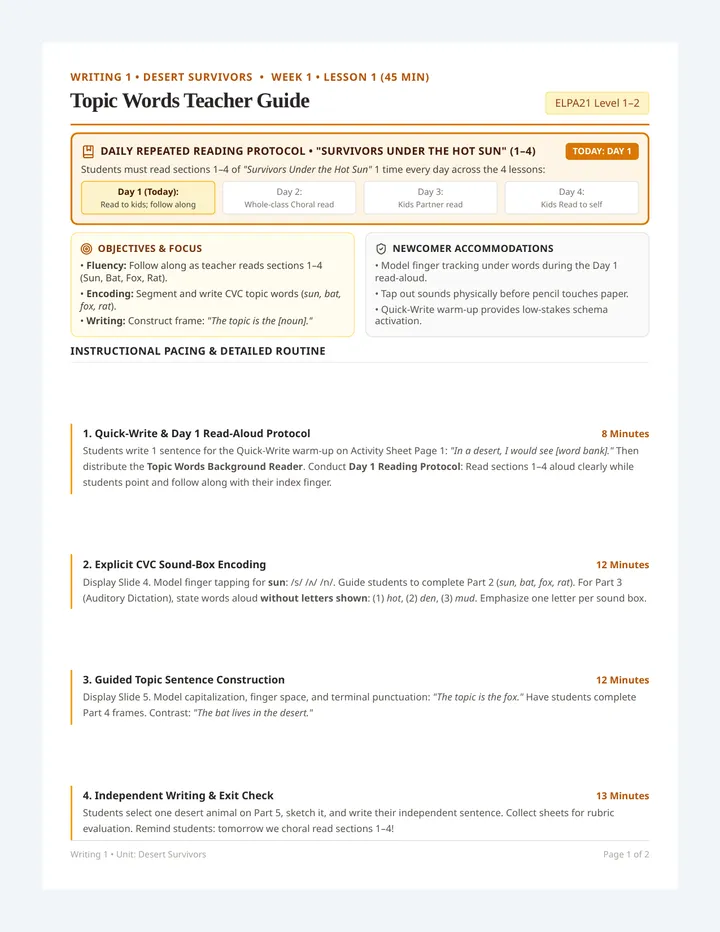
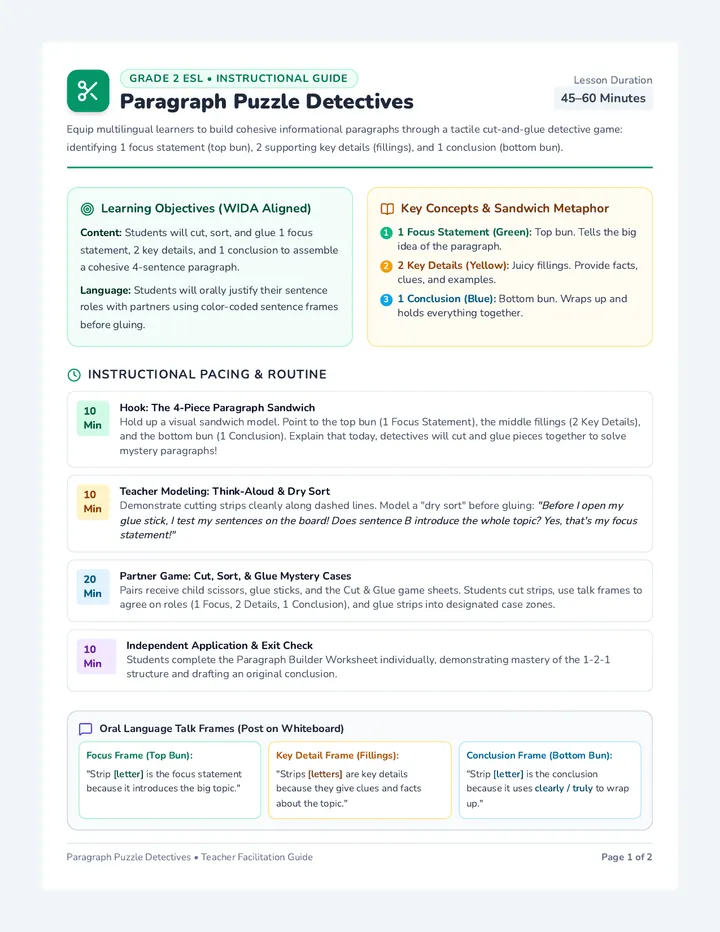
A 5-week foundational phonics and early literacy unit (2 lessons weekly, 10 lessons total) for secondary newcomer English learners (ELPA21 Level 1-2), centered on desert wildlife and systematically building from CVC decoding and blends to silent e, r-controlled vowels, vowel teams, diphthongs, and inflected endings.
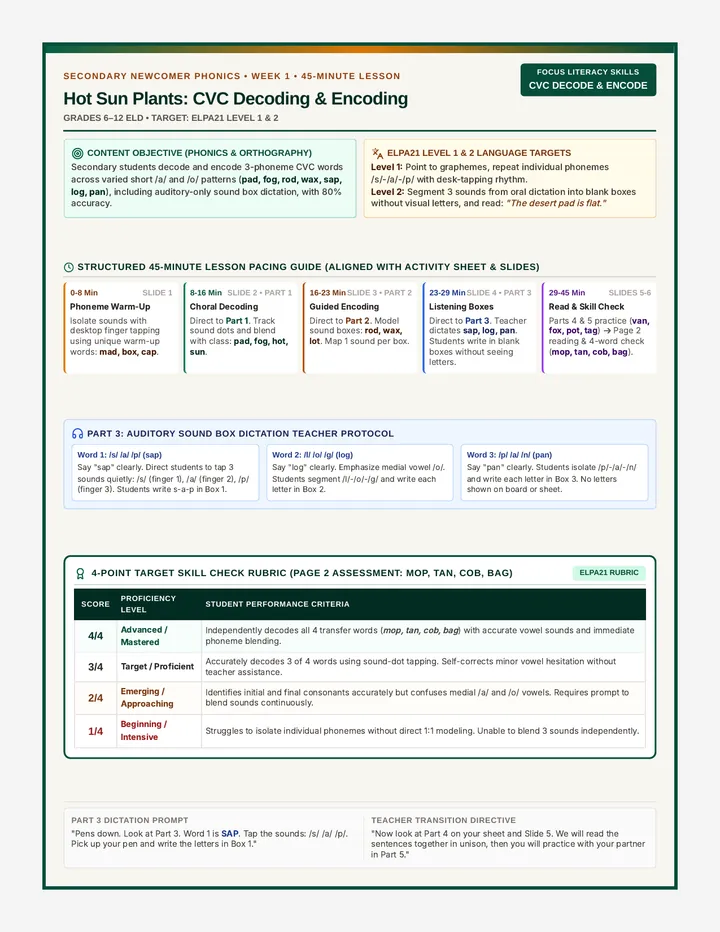
Universal 45-Minute Lesson Architecture (Aligned to Materials)
Repeated Every Lesson
0–8 Min Slide 1
Phoneme Warm-Up
Desk sound tapping. Isolate 3–4 phonemes using novel warm-up words.
Kinesthetic routine
8–16 Min Slide 2 • Part 1
Choral Decoding
Students track sound dots on Activity Sheet Part 1. Whole-class choral blend.
Low-anxiety decoding
16–23 Min Slide 3 • Part 2
Guided Encoding
Teacher models Elkonin mapping. Students map 1 sound per box with guidance.
Orthographic mapping
23–29 Min Slide 4 • Part 3
Auditory Dictation
Teacher dictates 3 words orally. Students encode in blank boxes without seeing letters.
Daily formative check
29–45 Min Slides 5-6 • P. 2-3
Fluency & Transfer
Partner sentence reading, 4-word transfer check, and Page 3 text comprehension.
Cumulative application
Educator Implementation Keys for Older English Learners
Predictable Routines: Keep pacing and visual layout consistent across all 10 lessons so cognitive energy is devoted to phonics, not deciphering task formats.
Total Physical Response: Use finger-tapping against the desk for sound isolation. Tactile feedback accelerates phoneme-grapheme binding for non-native speakers.
Low Affective Filter: Whole-class choral decoding precedes partner and individual reading. Never cold-call a Level 1 newcomer to read aloud unfamiliar words in isolation.
Secondary Newcomer Phonics • Master Assessment System
Decodes all 4 transfer words with automatic phoneme blending and accurate vowel phonation.
Accurately encodes all 3 dictated words in sound boxes without letter omissions.
Reads decodable sentence fluently. Answers text questions in full sentences (Level 2).
3/4
Proficient (Target)
Decodes 3 of 4 words using sound dots. Self-corrects minor hesitation independently.
Accurately encodes 2 of 3 words; initial/final consonants solid, minor vowel slip.
Reads with 1-2 prompts. Answers comprehension questions with single words or phrases.
2/4
Approaching (Emerg.)
Decodes 2 of 4 words. Identifies outer consonants but struggles to blend target vowel.
Encodes 1 of 3 words correctly. Requires finger-tapping scaffold to isolate middle sound.
Matches target words to pictures (Level 1). Needs choral support to read passage lines.
1/4
Beginning (Intensive)
Decodes 0-1 word. Inability to blend sounds into a whole word without direct 1:1 modeling.
Leaves sound boxes empty or writes arbitrary graphemes unrelated to dictated phonemes.
Silent period or non-alphabetic background. Requires Tier 2 tactile Elkonin intervention.
Diagnostic Decision Tree
Score 3 or 4 (Proficient / Mastered): Transition student to Page 3 independent reading and comprehension questions. Pair with an approaching peer for collaborative echo-reading of the desert passage.
Score 1 or 2 (Approaching / Intensive): Deploy immediate 8-minute small-group station: 1) Physical sound chips in Elkonin boxes; 2) Minimal pair vowel contrasts (e.g., tap vs tape, pot vs port); 3) Re-dictate 2 target words.
Differentiated Assessment Modalities
Level 1 (Early Newcomers / Silent Period): Accept non-verbal pointing to target words upon oral prompt. Allow letter tiles instead of pencil encoding if fine motor/orthography is emerging. Prioritize sound-to-dot tracking.
Level 2 (Developing Newcomers): Require written encoding in Elkonin boxes. Expect oral reading of decodable sentences with self-correction. Student generates complete decodable sentences using target phonics patterns.
5-Week Progress Monitoring Checkpoints
Cumulative Growth Targets
Week 1 Check 80% CVC decoding across all 5 short vowels
Week 2 Check Accurate 4-phoneme blend mapping (initial & final)
Week 3 Check VCe long vowel transformation rule mastery
Week 4 Check R-controlled and vowel team pattern distinction
Week 5 Check Full unit passage reading: 35+ WPM decodable fluency
Student Performance Criteria
4/4
Advanced / Mastered
Independently decodes all 4 transfer words (fit, men, cup, rib) with immediate blending and correct short vowel phonology.
3/4
Target / Proficient
Accurately decodes 3 of 4 words using sound-dot tapping. Self-corrects minor vowel hesitation without teacher assistance.
2/4
Emerging / Approaching
Identifies initial and final consonants accurately but confuses medial /e/, /i/, or /u/ vowels. Needs prompt to blend sounds continuously.
1/4
Beginning / Intensive
Struggles to isolate individual phonemes without direct 1:1 modeling. Unable to blend 3 sounds independently.
Part 3 Dictation Prompt
"Look at Part 3 on your sheet. Word 1 is WET. Tap the sounds: /w/ /e/ /t/. Write the letters in Box 1."
Teacher Transition Directive
"Now look at Part 4 on your sheet and Slide 5. We will read the sentences together in unison, then you will practice with your partner in Part 5."
4 It finds safe shelter inside a deep hollow pit before midday heat arrives.
Focus Skill Check: 4 Target Words
Read each transfer word aloud to the teacher.
Teacher Score: [ 4/4 • 3/4 • 2/4 • 1/4 ]
Word 1
f i t
•••
Word 2
m e n
•••
Word 3
c u p
•••
Word 4
r i b
•••
Secondary Phonics • Week 1 • Lesson 2 • Page 3
Independent Practice & Reading Comprehension
Independent Work
Part A: Sound Sort (Sort each word by vowel sound) 4 Words • Short i vs. Short u
d i g m u d p i n b u g
Short /i/ Words
Short /u/ Words
Part B: Read the Story (A Desert Woodpecker's Nest) 8 Sentences
1 A desert woodpecker has a bright red patch on its head.
2 Strong claws grip the cactus stem so each leg holds tight.
3 The sharp beak can dig a round hole into the pulp.
4 The bird hunts for an insect or crawling bug inside.
5 A spider spins a sticky web near the entrance hole.
6 After rain, damp mud rests at the base of the plant.
7 The deep cactus hole stays cool when midday heat strikes the sand.
8 Desert birds rely on safe hollows to nest and raise healthy young.
Part C: Comprehension Questions (Answer all 4 questions) Score: ___ / 4
1. What color patch is on the desert woodpecker's head?
A bright red patch A blue patch A yellow patch
2. How does the woodpecker dig a hole in the cactus?
With heavy stones With its sharp beak With desert wind
3. What does the bird hunt for inside the cactus hole?
A crawling insect or bug Fresh fish Green grass leaves
4. Write to explain: Why is the cactus hole a good nest?
Sentence frame:
The cactus hole is a good nest because it stays .
Teacher dictates: Word 1 (wet), Word 2 (pit), Word 3 (rug)
Listen to teacher ➔ Tap 3 sounds ➔ Write in Activity Sheet Part 3! Slide 4 of 6
Activity Sheet Page 1 • Parts 4 & 5
Part 4 Sentences & Part 5 Practice Check
Pairs
29 - 37 Min
Part 4: Choral Sentence Reading
1. The woodpecker taps on a dry plant stem.
2. The bird can dig a safe pit for shelter.
3. I see a small bug rest on the wet mud.
Part 5: 4-Point Practice Check
Practice with your assigned partner on your Activity Sheet:
✔️ Task A: Read 2 words to partner (rip, tub)
✔️ Task B: Write 2 words from dictation (hen, lid)
Score your partner: [ 4 • 3 • 2 • 1 ]
Work with your partner to complete Part 5 at the bottom of Page 1! Slide 5 of 6
Activity Sheet Page 2
Passage & Focus Skill Check
Assessment
37 - 45 Min
Page 2: 3-Step Reading Routine
1. Teacher Model: Track words with finger.
2. Choral Read: Read in unison with class.
3. Partner Read: Whisper read to your peer.
Target Skill Check: 4 Words
Read these 4 transfer words aloud to your teacher:
f i t
m e n
c u p
r i b
Turn to Page 2 of your Activity Sheet to read the passage and take the check! Slide 6 of 6
Score
Proficiency Level
Student Performance Criteria
4/4
Advanced / Mastered
Independently decodes all 4 transfer blend words (frog, stem, flag, dust) without omitting consonants or inserting extraneous vowels.
3/4
Target / Proficient
Accurately decodes 3 of 4 words using sound-dot tapping. Retains both consonants in each blend cluster with minimal teacher prompting.
2/4
Emerging / Approaching
Deletes one consonant in the blend cluster (e.g. reads "fog" for "frog" or "sem" for "stem"). Requires phoneme tapping prompt to blend all 4 sounds.
1/4
Beginning / Intensive
Unable to isolate or blend 4-phoneme words without direct 1:1 modeling.
Part 3 Dictation Prompt
"Look at Part 3 on your sheet. Word 1 is SLIP. Tap 4 sounds: /s/ /l/ /i/ /p/. Write the letters in Box 1."
Teacher Transition Directive
"Now look at Part 4 on your sheet and Slide 5. We will read the sentences together in unison, then you will practice with your partner in Part 5."
3 Silent wings let the miniature hunter swoop and drop down toward crawling beetles.
4 It moves so remarkably fast that nocturnal prey cannot react in time.
Focus Skill Check: 4 Target Words
Read each transfer word aloud to the teacher.
Teacher Score: [ 4/4 • 3/4 • 2/4 • 1/4 ]
Word 1
f r o g
••••
Word 2
s t e m
••••
Word 3
f l a g
••••
Word 4
d u s t
••••
Secondary Phonics • Week 2 • Lesson 3 • Page 3
Independent Practice & Reading Comprehension
Independent Work
Part A: Blend Sort (Sort each word by its initial blend) 4 Words • fl- vs. sp-
f l a p s p o t f l a t s p i n
Words starting with "fl-"
Words starting with "sp-"
Part B: Read the Story (Night Flight of the Elf Owl) 8 Sentences
1 The small elf owl rests inside its cactus nest at dawn.
2 Warm winds drop as the bright afternoon sun begins to set.
3 When dusk falls, the owl takes a cautious step onto a dry twig.
4 Its round eyes can spot small beetles crawling over stones.
5 The bird will flap soft wings without making any noise.
6 It drops down fast through the quiet dusk to seize its prey.
7 The tiny hunter glides back up to its snug tree cavity.
8 Silent flight helps desert owls survive and hunt in peace.
Part C: Comprehension Questions (Answer all 4 questions) Score: ___ / 4
1. Where does the elf owl rest during the day?
Inside its cactus nest Under cold river mud On open hot asphalt
2. When does the owl step onto a dry twig?
When dusk falls At bright noon During heavy snow
3. How do the owl's wings flap as it hunts?
Without making any noise With heavy splashing With sharp whistles
4. Write to explain: Why is silent flight useful for the owl?
Sentence frame:
Silent flight helps the owl because prey cannot .
Listen to Teacher Dictation:
Word 1:
Word 2:
Word 3:
Teacher dictates: Word 1 (slip), Word 2 (trap), Word 3 (snug)
Listen to teacher ➔ Tap 4 sounds ➔ Write in Activity Sheet Part 3! Slide 4 of 6
Activity Sheet Page 1 • Parts 4 & 5
Part 4 Sentences & Part 5 Practice Check
Pairs
29 - 37 Min
Part 4: Choral Sentence Reading
1. The little elf owl leaves its snug cavity at dusk.
2. The bird will flap silent wings in flight.
3. It can spot insects crawling on a branch.
Part 5: 4-Point Practice Check
Practice with your assigned partner on your Activity Sheet:
✔️ Task A: Read 2 words to partner (drop, spin)
✔️ Task B: Write 2 words from dictation (fast, trip)
Score your partner: [ 4 • 3 • 2 • 1 ]
Work with your partner to complete Part 5 at the bottom of Page 1! Slide 5 of 6
Activity Sheet Page 2
Passage & Focus Skill Check
Assessment
37 - 45 Min
Page 2: 3-Step Reading Routine
1. Teacher Model: Track words with finger.
2. Choral Read: Read in unison with class.
3. Partner Read: Whisper read to your peer.
Target Skill Check: 4 Words
Read these 4 transfer words aloud to your teacher:
f r o g
s t e m
f l a g
d u s t
Turn to Page 2 of your Activity Sheet to read the passage and take the check! Slide 6 of 6
Teacher dictates: Word 1 (sunbat), Word 2 (nutmeg), Word 3 (dustpan)
Listen to teacher ➔ Tap chunks ➔ Write in Activity Sheet Part 3! Slide 4 of 6
Activity Sheet Page 1 • Parts 4 & 5
Part 4 Sentences & Part 5 Practice Check
Pairs
29 - 37 Min
Part 4: Choral Sentence Reading
1. The hot sun sets across the vast expanse.
2. The bat, red bird, and owl hunt at night.
3. All organisms interact in the desert web.
Part 5: 4-Point Practice Check
Practice with your assigned partner on your Activity Sheet:
✔️ Task A: Read 2 compound words (bobcat, mudpit)
✔️ Task B: Write 1 compound word (sunlamp)
Score your partner: [ 4 • 3 • 2 • 1 ]
Work with your partner to complete Part 5 at the bottom of Page 1! Slide 5 of 6
Activity Sheet Page 2
Passage & Focus Skill Check
Assessment
37 - 45 Min
Page 2: 3-Step Reading Routine
1. Teacher Model: Track words with finger.
2. Choral Read: Read in unison with class.
3. Partner Read: Whisper read to your peer.
Target Skill Check: 4 Words
Read these 4 transfer compound words aloud to your teacher:
sun • up
bed • bug
red • cap
cat • nip
Turn to Page 2 of your Activity Sheet to read the passage and take the check! Slide 6 of 6
Score
Proficiency Level
Student Performance Criteria
4/4
Advanced / Mastered
Independently decodes all 4 transfer words (gate, pine, rope, tube) with accurate long vowel sounds and immediate recognition of silent 'e'.
3/4
Target / Proficient
Accurately decodes 3 of 4 words using vowel-jump tracing. Self-corrects any initial short vowel slip without teacher assistance.
2/4
Emerging / Approaching
Decodes initial and final consonants but pronounces short vowels instead of long (e.g., /r/-/o/-/p/ instead of /r/-/ō/-/p/). Requires visual prompt to spot final 'e'.
1/4
Beginning / Intensive
Attempts to pronounce silent 'e' aloud as /eh/. Unable to apply VCe rule independently without direct 1:1 modeling.
Part 3 Dictation Prompt
"Pens down. Look at Part 3. Word 1 is SAFE. The 'a' says its name /ā/ because silent 'e' is at the end. Pick up your pen and write s-a-f-e in Box 1."
Independent Page 3 Transition
"Turn to Page 3. You will sort CVC vs. VCe words in Part A, read the 8-sentence passage about sidewinder snakes in Part B, and answer all 4 comprehension questions independently."
3 Far below the surface, a burrowing mole rests in deep shade until dark.
4 Tough protective scales keep the hunting predator completely safe on hot gravel ground.
Focus Skill Check: 4 Target Words
Read each VCe word aloud to the teacher.
Teacher Score: [ 4/4 • 3/4 • 2/4 • 1/4 ]
Word 1
g a t e
/ā/ sound
Word 2
p i n e
/ī/ sound
Word 3
r o p e
/ō/ sound
Word 4
t u b e
/ū/ sound
Secondary Phonics • Week 3 • Lesson 6 • Page 3
Independent Practice & Reading Comprehension
Independent Work
Part A: Word Pattern Sort (Short Vowel CVC vs. Long Vowel VCe) 4 Words • CVC vs. VCe
m a d m a d e r i p r i p e
Short Vowels (CVC)
Long Vowels (VCe with Silent E)
Part B: Read the Story (Horned Sidewinders of the Sand Dunes) 8 Sentences
1 A horned sidewinder snake glides softly across the open sand dune.
2 The reptile uses a sideways winding wave to ascend the steep sandy slope.
3 Fierce sunshine warms the barren ridges throughout the dry afternoon.
4 To avoid extreme heat, the snake will hide its body beneath fine silt.
5 Only two small horn-like scales remain visible above the surface.
6 When an unsuspecting desert rodent runs past, the hunter strikes fast.
7 Its venomous bite quickly captures a nutritious meal.
8 Specialized scales keep the predator safe on hot desert sand.
Part C: Comprehension Questions (Answer all 4 questions) Score: ___ / 4
1. Where does the horned sidewinder glide?
Across the open sand dune Through deep ocean water Over frozen winter snow
2. Why does the snake hide beneath fine silt?
To build a wooden nest To avoid extreme heat To drink fresh river water
3. What stays visible above the sand while the snake is hidden?
Two small horn-like scales Its long striped tail Wide bird wings
4. Write to explain: How do specialized scales help the snake?
Sentence frame:
Specialized scales help the snake because they keep it .
23 - 29 Min
Listening Challenge Routine:
1. Listen closely as your teacher dictates each word.
2. Notice the long vowel sound (says its name).
3. Remember: every word ends with silent 'e'!
4. No letters on screen — trust your ears!
Listen to Teacher Dictation:
Word 1:
Word 2:
Word 3:
Teacher dictates: Word 1 (safe), Word 2 (bite), Word 3 (home)
Listen to teacher ➔ Write 4 letters across the boxes in Activity Sheet Part 3! Slide 4 of 6
Activity Sheet Page 1 • Parts 4 & 5
Part 4 Sentences & Part 5 Practice Check
Pairs
29 - 37 Min
Part 4: Choral Sentence Reading
1. The snake can glide up the steep sand dune.
2. It will hide under loose dust to escape heat.
3. A mouse walks past, and the hunter strikes here.
Part 5: 4-Point Practice Check
Practice with your assigned partner on your Activity Sheet:
✔️ Task A: Read 2 words to partner (wave, ride)
✔️ Task B: Write 2 words from dictation (bone, cute)
Score your partner: [ 4 • 3 • 2 • 1 ]
Work with your partner to complete Part 5 at the bottom of Page 1! Slide 5 of 6
Activity Sheet Pages 2 & 3
Passage & Focus Skill Check
Fluency & Mastery
37 - 45 Min
Page 2: 3-Step Reading Routine
1. Teacher Model: Track words with finger.
2. Choral Read: Read in unison with class.
3. Partner Read: Whisper read to your peer.
Target Skill Check: 4 Words
Read these 4 transfer words aloud to your teacher:
g a t e
p i n e
r o p e
t u b e
Turn to Page 2 & 3 to read the passage and complete independent practice! Slide 6 of 6
ELPA21 Rubric
Score
Proficiency Level
Student Performance Criteria
4/4
Advanced / Mastered
Independently blends all 4 transfer words (farm, corn, perk, yard) using proper R-controlled pronunciation without segmenting the vowel from 'r'.
3/4
Target / Proficient
Accurately decodes 3 of 4 words. May hesitate briefly on /er/ vs. /ar/ but successfully self-corrects after prompt.
2/4
Emerging / Approaching
Pronounces the short vowel followed by a hard 'r' consonant sound separately (e.g., /c/-/o/-/r/-/n/) rather than blending into /or/.
1/4
Beginning / Intensive
Cannot decode R-controlled syllables independently. Omits vowel sound or requires direct 1:1 choral modeling.
Part 3 Dictation Prompt
"Pens down. Look at Part 3. Word 1 is DARK. The /ar/ chunk stays together in the middle box: /d/ - /ar/ - /k/. Pick up your pen and write d-ar-k in Box 1."
Independent Page 3 Transition
"Turn to Page 3. Sort the R-controlled words by vowel sound in Part A, read the 8-sentence passage about desert thorns in Part B, and answer all 4 comprehension questions independently."
2 Far below the ridge, a hardy desert fern grows in a shaded spring wash.
3 Swirling dust clouds roll across the plains as the afternoon turns dark before night.
4 A sudden desert wind storm tests the tough endurance of every living creature.
Focus Skill Check: 4 Target Words
Read each Bossy R word aloud to the teacher.
Teacher Score: [ 4/4 • 3/4 • 2/4 • 1/4 ]
Word 1
f a r m
/ar/ sound
Word 2
c o r n
/or/ sound
Word 3
p e r k
/er/ sound
Word 4
y a r d
/ar/ sound
Secondary Phonics • Week 4 • Lesson 7 • Page 3
Independent Practice & Reading Comprehension
Independent Work
Part A: R-Controlled Vowel Sort (Sort each word by its Bossy R sound) 4 Words • /ar/ vs. /or/
b a r k t h o r n p a r k h o r n
Words with /ar/
Words with /or/
Part B: Read the Story (Armor of Desert Thorns) 8 Sentences
1 Long sharp spines cover the tall cactus stem like needles.
2 Each rigid thorn deters hungry animals seeking water.
3 Thick gray bark shields the base of the plant from dry winds.
4 A swift desert kit fox walks quietly through the dry brush.
5 A sudden dust storm sweeps across the rocky desert wash.
6 A grazing herd steers clear of cactus stems to avoid injury.
7 Pointed spines also create small shadows that keep the plant cool.
8 This thorny armor helps desert vegetation survive in difficult conditions.
Part C: Comprehension Questions (Answer all 4 questions) Score: ___ / 4
1. What covers the desert cactus stem like needles?
Long sharp spines and thorns Soft green flower petals Cold river mud
2. What does the thick gray bark protect the plant from?
Deep ocean waves Dry winds and heat Winter ice storms
3. Why does the grazing herd avoid the cactus stems?
To avoid injury from thorns Because the plant is too cold To sleep in high branches
4. Write to explain: How do spines help the plant stay cool?
Sentence frame:
Spines help the plant stay cool by creating .
23 - 29 Min
Listening Challenge Routine:
1. Listen closely as your teacher dictates each word.
2. Identify the R-controlled vowel sound (/ar/, /or/, /er/).
3. Write vowel + r together in the middle box!
4. No letters on screen — trust your ears!
Listen to Teacher Dictation:
Word 1:
Word 2:
Word 3:
Teacher dictates: Word 1 (dark), Word 2 (storm), Word 3 (term)
Listen to teacher ➔ Write sounds in Activity Sheet Part 3! Slide 4 of 6
Activity Sheet Page 1 • Parts 4 & 5
Part 4 Sentences & Part 5 Practice Check
Pairs
29 - 37 Min
Part 4: Choral Sentence Reading
1. The sharp thorn will protect the desert cactus.
2. Thick gray bark shields the trunk from harsh wind.
3. A grazing herd will not eat sharp spines.
Part 5: 4-Point Practice Check
Practice with your assigned partner on your Activity Sheet:
✔️ Task A: Read 2 words to partner (mark, fork)
✔️ Task B: Write 2 words from dictation (barn, torch)
Score your partner: [ 4 • 3 • 2 • 1 ]
Work with your partner to complete Part 5 at the bottom of Page 1! Slide 5 of 6
Activity Sheet Pages 2 & 3
Passage & Focus Skill Check
Fluency & Mastery
37 - 45 Min
Page 2: 3-Step Reading Routine
1. Teacher Model: Track words with finger.
2. Choral Read: Read in unison with class.
3. Partner Read: Whisper read to your peer.
Target Skill Check: 4 Words
Read these 4 transfer words aloud to your teacher:
f a r m
c o r n
p e r k
y a r d
Turn to Page 2 & 3 to read the passage and complete independent practice! Slide 6 of 6
1 Buried root systems patiently wait beneath dry canyon silt for seasonal moisture.
2 Storm clouds gather over the mountain crest as cool water sinks deep into the arid earth.
3 Sprouting desert bushes turn vibrant green across every sandy hillside.
4 Parched desert washes begin to soak up pooled stream water before blazing heat returns.
Focus Skill Check: 4 Target Words
Read each vowel team word aloud to the teacher.
Teacher Score: [ 4/4 • 3/4 • 2/4 • 1/4 ]
Word 1
r o a d
/oa/ sound
Word 2
m e e t
/ee/ sound
Word 3
t r a i n
/ai/ sound
Word 4
b e a k
/ea/ sound
Secondary Phonics • Week 4 • Lesson 8 • Page 3
Independent Practice & Reading Comprehension
Independent Work
Part A: Vowel Team Word Sort (Sort each word by its vowel team spelling) 4 Words • ee vs. ai
s e e d r a i n f e e d w a i t
Words with 'ee' (/ee/)
Words with 'ai' (/ai/)
Part B: Read the Story (Life Awakens After Rain) 8 Sentences
1 Tiny desert seeds wait under dry dust for many long weeks.
2 Suddenly, storm clouds roll in and cool rain pours across the canyon rock.
3 Precious water sinks deep into sandy washes where plant roots wait.
4 A bright green leaf shoots upward toward the morning sunlight.
5 A burrowing spadefoot toad awakens from a resting state in the damp mud.
6 Small desert birds dip each sharp beak into pooled rainwater along the stream bed.
7 Plants must blossom rapidly before summer heat dries the upper soil layer.
8 This rapid surge of desert life proves that every living creature needs water.
Part C: Comprehension Questions (Answer all 4 questions) Score: ___ / 4
1. Where do the tiny seeds wait before the storm arrives?
Under dry dust for many weeks Inside deep ocean waters On top of frozen mountain peaks
2. What sinks deep into the sandy washes where roots wait?
Precious rainwater Hard white stones Dry brushwood piles
3. What awakens from resting in the damp mud?
A spadefoot toad A swimming dolphin A giant forest bear
4. Write to explain: Why must desert plants bloom rapidly after the storm?
Sentence frame:
Plants must bloom fast before summer .
ELPA21 Rubric
Score
Proficiency Level
Student Performance Criteria
4/4
Advanced / Mastered
Independently blends all 4 transfer words (road, meet, train, beak) producing true long vowel phonemes without attempting to sound out both vowel letters separately.
3/4
Target / Proficient
Accurately decodes 3 of 4 words. May hesitate briefly on /ai/ vs. /ea/ but self-corrects into the correct long vowel sound upon visual prompt.
2/4
Emerging / Approaching
Attempts to decode both vowels sequentially (e.g., /b/-/e/-/a/-/k/ instead of /b/-/ea/-/k/) or produces a short vowel sound.
1/4
Beginning / Intensive
Cannot decode vowel team syllables independently. Requires full choral modeling and explicit finger-tapping assistance.
Part 3 Dictation Prompt
"Pens down. Look at Part 3. Word 1 is SOAK. The 'oa' team makes the long /o/ sound: /s/ - /oa/ - /k/. Pick up your pen and write s-oa-k in Box 1."
Independent Page 3 Transition
"Turn to Page 3. Sort the vowel team words into the ee and ai columns in Part A, read the 8-sentence story about desert life awakening in Part B, and complete all 4 questions."
23 - 29 Min
Listening Challenge Routine:
1. Listen closely as your teacher dictates each word.
2. Identify the long vowel sound (/oa/, /ee/, /ea/).
3. Write both vowels together in the highlighted box!
4. No letters on screen — trust your ears!
Listen to Teacher Dictation:
Word 1:
Word 2:
Word 3:
Teacher dictates: Word 1 (soak), Word 2 (green), Word 3 (heat)
Listen to teacher ➔ Write sounds in Activity Sheet Part 3! Slide 4 of 6
Activity Sheet Page 1 • Parts 4 & 5
Part 4 Sentences & Part 5 Practice Check
Pairs
29 - 37 Min
Part 4: Choral Sentence Reading
1. When desert rain falls, dry ground begins to soak.
2. A tiny seed sends roots deep down to drink water.
3. A bright green leaf helps the plant grow.
Part 5: 4-Point Practice Check
Practice with your assigned partner on your Activity Sheet:
✔️ Task A: Read 2 words to partner (meet, road)
✔️ Task B: Write 2 words from dictation (feed, coat)
Score your partner: [ 4 • 3 • 2 • 1 ]
Work with your partner to complete Part 5 at the bottom of Page 1! Slide 5 of 6
Activity Sheet Pages 2 & 3
Passage & Focus Skill Check
Fluency & Mastery
37 - 45 Min
Page 2: 3-Step Reading Routine
1. Teacher Model: Track words with finger.
2. Choral Read: Read in unison with class.
3. Partner Read: Whisper read to your peer.
Target Skill Check: 4 Words
Read these 4 transfer words aloud to your teacher:
r o a d
m e e t
t r a i n
b e a k
Turn to Page 2 & 3 to read the passage and complete independent practice! Slide 6 of 6
1 A stealthy coyote pack moves silently across the cold desert ground.
2 The animals travel toward the open basin facing the rocky south ridge.
3 Their thick brown fur coats blend smoothly with dry desert brush.
4 Each canine points a keen sensitive snout upward into the wind to detect prey.
Focus Skill Check: 4 Target Words
Read each diphthong word aloud to the teacher.
Teacher Score: [ 4/4 • 3/4 • 2/4 • 1/4 ]
Word 1
r o u n d
/ou/ sound
Word 2
t o w n
/ow/ sound
Word 3
j o i n
/oi/ sound
Word 4
c o y
/oy/ sound
Secondary Phonics • Week 5 • Lesson 9 • Page 3
Independent Practice & Reading Comprehension
Independent Work
Part A: Diphthong Word Sort (Sort each word by its spelling pattern) 4 Words • ou vs. ow
l o u d h o w l s o u n d b r o w n
Words with 'ou' (/ou/)
Words with 'ow' (/ow/)
Part B: Read the Story (Coyotes of the Desert Hills) 8 Sentences
1 As darkness spreads over the valley, desert coyotes begin their nightly hunt for food.
2 Pack members raise their pointed muzzles and unleash a long piercing howl.
3 The ringing vocal calls echo loud through sandstone canyons to mark territory.
4 Hungry coyotes prowl between rocky mounds and prickly cactus clusters.
5 They lower each sensitive snout toward the dusty soil to track rodents.
6 Their thick brown coats insulate them from the freezing desert night air.
7 When a jackrabbit dashes across the clearing, the pack springs forward with agility.
8 Intelligent cooperation and sharp senses ensure these wild canines survive in the arid wilderness.
Part C: Comprehension Questions (Answer all 4 questions) Score: ___ / 4
1. Why do coyote pack members howl together at night?
To mark territory across canyons To build underground nests To call for winter snow
2. What do coyotes lower toward the soil to track rodents?
Their sensitive snout Their heavy tail Their sharp back claws
3. What keeps the coyotes warm in the cold night air?
Their thick brown fur coats Warm cactus leaves Deep river mud
4. Write to explain: How do coyotes succeed as nighttime hunters?
Sentence frame:
Coyotes succeed because their teamwork and sharp senses help them .
ELPA21 Rubric
Score
Proficiency Level
Student Performance Criteria
4/4
Advanced / Mastered
Independently articulates all 4 transfer words (round, town, join, coy), producing true gliding diphthong phonemes without separating the individual letters.
3/4
Target / Proficient
Accurately decodes 3 of 4 words. May pause briefly on /oi/ vs. /oy/ or /ou/ vs. /ow/ but self-corrects accurately with gesture cue.
2/4
Emerging / Approaching
Attempts to decode both vowels sequentially (e.g., /j/-/o/-/i/-/n/) or confuses /ow/ with short /o/.
1/4
Beginning / Intensive
Cannot produce diphthong sounds independently. Requires teacher choral modeling and exaggerated mouth positioning cues.
Part 3 Dictation Prompt
"Pens down. Look at Part 3. Word 1 is MOUTH. Listen to the glide: /m/ - /ou/ - /th/. The 'ou' shares the middle box. Write m-ou-th in Box 1."
Independent Page 3 Transition
"Turn to Page 3. Sort the diphthong words into 'ou' and 'ow' columns in Part A, read the 8-sentence story about desert coyotes in Part B, and answer all 4 comprehension questions."
Listen & Write
23 - 29 Min
Listening Challenge Routine:
1. Listen closely as your teacher dictates each word.
2. Identify the gliding sound (/ou/, /oi/, /ow/).
3. Write both letters together in the highlighted cell!
4. No letters on screen — trust your listening!
Listen to Teacher Dictation:
Word 1:
Word 2:
Word 3:
Teacher dictates: Word 1 (mouth), Word 2 (point), Word 3 (down)
Listen to teacher ➔ Write sounds in Activity Sheet Part 3! Slide 4 of 6
Activity Sheet Page 1 • Parts 4 & 5
Part 4 Sentences & Part 5 Practice Check
Pairs
29 - 37 Min
Part 4: Choral Sentence Reading
1. They raise pointed muzzles to call out with a howl.
2. Desert canines let out a loud bark that echoes around.
3. A hungry pack begins to prowl over dry gravel soil.
Part 5: 4-Point Practice Check
Practice with your assigned partner on your Activity Sheet:
✔️ Task A: Read 2 words to partner (south, coin)
✔️ Task B: Write 2 words from dictation (town, moist)
Score your partner: [ 4 • 3 • 2 • 1 ]
Work with your partner to complete Part 5 at the bottom of Page 1! Slide 5 of 6
Activity Sheet Pages 2 & 3
Passage & Focus Skill Check
Fluency & Mastery
37 - 45 Min
Page 2: 3-Step Reading Routine
1. Teacher Model: Track words with finger.
2. Choral Read: Read in unison with class.
3. Partner Read: Whisper read to your peer.
Target Skill Check: 4 Words
Read these 4 transfer words aloud to your teacher:
r o u n d
t o w n
j o i n
c o y
Turn to Page 2 & 3 to read the passage and complete independent practice! Slide 6 of 6
3-Step Reading Protocol (Check each box as completed)
1
Teacher Model
Track words with finger
2
Choral Read
Read in unison with class
3
Partner Read
Read aloud to a peer
Reading Passage: Desert Hunters on the Move Decodable Text
1 A coyote pack roams across the rocky canyon wash as dawn begins.
2 The canines keep tracking fresh scent marks over dry brushwood ridges.
3 A sharp-eyed hawk spotted slight movement among the green cactus stems.
4 Cooperative hunting allows agile desert predators to feed and raise healthy young.
Focus Skill Check: 4 Target Words
Read each inflected word aloud to the teacher.
Teacher Score: [ 4/4 • 3/4 • 2/4 • 1/4 ]
Word 1
w a i t i n g
base: wait + -ing
Word 2
b a r k e d
base: bark + -ed
Word 3
s t e p s
base: step + -s
Word 4
l a n d e d
base: land + -ed
Secondary Phonics • Week 5 • Lesson 10 • Page 3
Independent Practice & Reading Comprehension
Unit Capstone
Part A: Suffix Sort (Sort each word by its inflected ending) 4 Words • -ed vs. -ing vs. -s
h u n t s r e s t e d j u m p i n g l o o k e d
Suffix: -s (Habit)
Suffix: -ed (Past)
Suffix: -ing (Now)
Part B: Read the Story (How Desert Animals Thrive) 8 Sentences
Instantly identifies the base word and blends the suffix cleanly on all 4 words (waiting, barked, steps, landed) without hesitation or syllable distortion.
3/4
Target / Proficient
Accurately decodes 3 of 4 words. May pause to segment the base word from the suffix before blending the full word smoothly.
2/4
Emerging / Approaching
Struggles with past-tense -ed pronunciation (pronouncing /ed/ literally instead of /t/ or /d/) or drops the suffix when reading.
1/4
Beginning / Intensive
Cannot decode base word or suffix independently. Requires teacher to cover suffix and guide full choral blending.
Part 3 Dictation Prompt
"Pens down. Look at Part 3. Word 1 is HOWLS. Base word is /h/-/ow/-/l/, suffix is /s/. Write 'howl' in Box 1 and 's' in Box 2."
Unit Capstone Celebration
"Congratulations on reaching Lesson 10! Complete Page 3's suffix sort, read the story about desert animals thriving, and finish the 4 questions to conclude Unit 1."
Listen & Write
23 - 29 Min
Listening Challenge Routine:
1. Listen closely as your teacher dictates each word.
2. Identify the base root word.
3. Identify the suffix ending (-s, -ed, -ing).
4. Write base word in Box 1 and suffix in Box 2!
Listen to Teacher Dictation:
Word 1:
Word 2:
Word 3:
Teacher dictates: Word 1 (howls), Word 2 (barked), Word 3 (flapping)
Listen to teacher ➔ Write base + suffix in Activity Sheet Part 3! Slide 4 of 6
Activity Sheet Page 1 • Parts 4 & 5
Part 4 Sentences & Part 5 Practice Check
Pairs
29 - 37 Min
Part 4: Choral Sentence Reading
1. Every desert hawk hunts across the dry canyon ridges.
2. A tired kit fox rested inside its shaded den.
3. A kangaroo rat is jumping over loose gravel rocks.
Part 5: 4-Point Practice Check
Practice with your assigned partner on your Activity Sheet:
✔️ Task A: Read 2 words to partner (crawling, tracks)
✔️ Task B: Write 2 words from dictation (hunted, calls)
Score your partner: [ 4 • 3 • 2 • 1 ]
Work with your partner to complete Part 5 at the bottom of Page 1! Slide 5 of 6
Activity Sheet Pages 2 & 3
Passage & Unit Capstone Mastery
Fluency & Mastery
37 - 45 Min
Page 2: 3-Step Reading Routine
1. Teacher Model: Track words with finger.
2. Choral Read: Read in unison with class.
3. Partner Read: Whisper read to your peer.
Target Skill Check: 4 Words
Read these 4 transfer words aloud to your teacher:
w a i t i n g
b a r k e d
s t e p s
l a n d e d
Turn to Page 2 & 3 to finish the capstone reading and unit questions! Slide 6 of 6