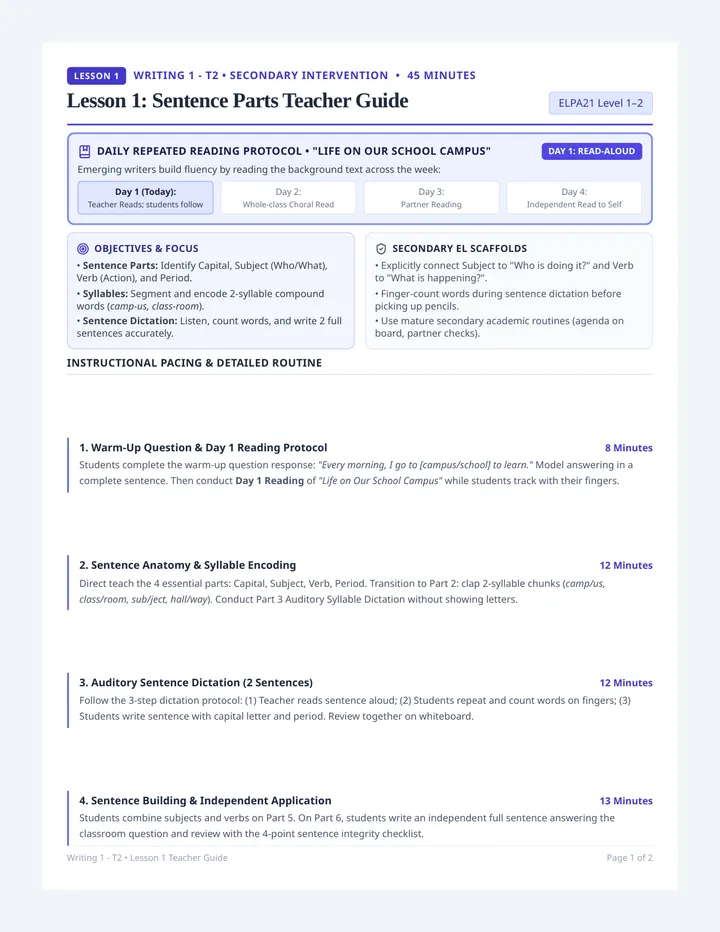
Lesson 1 • Part 4, 5 & Cloze
Activity Sheet Page 2 & Reader Page 2
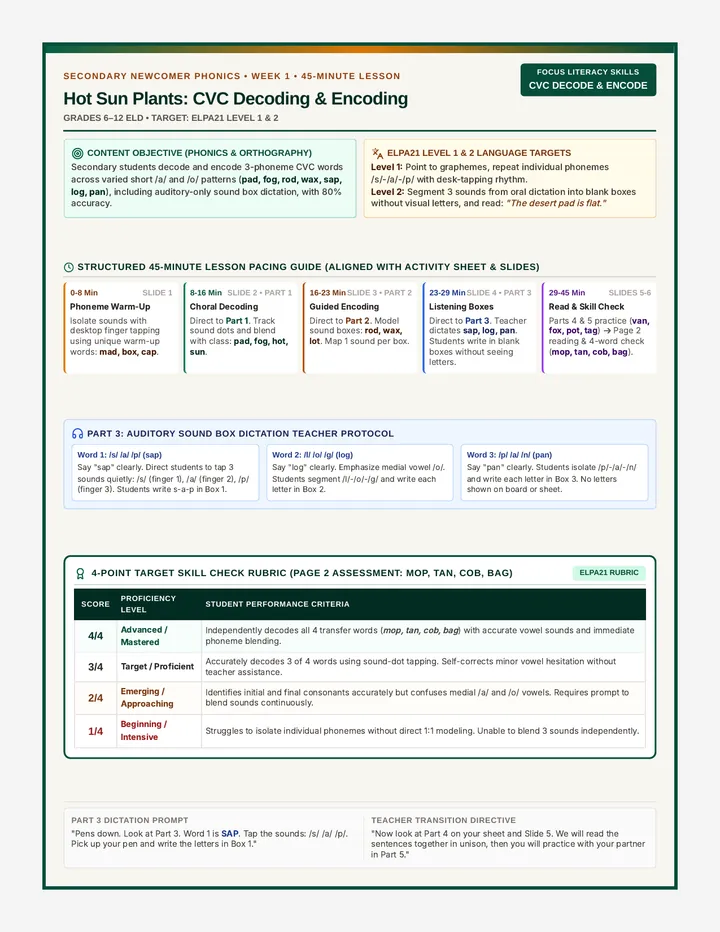
Part 4 & 5: Topic Sentence Model:
The topic is the [fox]. A [bat] lives in the desert.
Reader Page 2: 5-Word Cloze Bank:
1. sun 2. bat 3. fox 4. den 5. rat
Read the connected passage and write each word on the numbered blank.
Checklist: Capital letter, spaces, topic word, period! Slide 6 of 31
Lesson 2 • Part 0: Warm-Up (5 Min)
Activity Sheet: Top of Page 1
Prompt: "Would you like to visit a desert? Why or why not?"
Quick-Write Word Bank:
hot sand animals see fun
Sentence Starter:
"I would like to visit a desert because [reason]."
Write your 1 warm-up sentence on Page 1! Slide 7 of 31
Daily Reading Protocol • Day 2 of 4
Survivors Under the Hot Sun
All voices read together in unison! Keep a steady pace. Point to each word as we read sections 1–4.
Section 1 & 2:
"The big sun shines all day in the blue sky... The desert bat does not like the hot sun. It flies out at night."
Section 3 & 4:
"The desert fox rests deep inside an underground den... The kangaroo rat eats dry seeds and never drinks water."
Choral reading builds confidence and reading speed! Slide 8 of 31
Lesson 2 • Part 2: Phonics Encoding
Activity Sheet: Part 2
Tap 4 fingers. Each sound gets its own box:
1. sand (CVCC) /s/ /æ/ /n/ /d/
s
a
n
d
2. trap (CCVC) /t/ /r/ /æ/ /p/
t
r
a
p
3. spot (CCVC) /s/ /p/ /ɒ/ /t/
s
p
o
t
4. nest (CVCC) /n/ /ɛ/ /s/ /t/
n
e
s
t
Notice: 4 sounds = 4 boxes. Write them in Part 2! Slide 9 of 31
Lesson 2 • Part 3 & Part 4
Activity Sheet: Part 3 & 4
Part 3 Auditory Dictation (Tap 4 sounds):
Teacher reads: 1. swim | 2. fast | 3. trap
Part 4 Expansion Formula:
The [fox] runs on the [sand].
Combine a topic from Lesson 1 with an action and a blend setting word!
Complete the expansion frames on Page 2! Slide 10 of 31
Lesson 2 • Part 5 & Cloze
Reader Page 2
Part 5 Independent Sentence:
"The bat rests in a dry nest."
Lesson 2 Cloze Word Bank (5 Blend Words):
fast sand nest spot swim
Open Background Reader Page 2 and write each blend word in the story blanks.
Checklist: Capital letter, spaces, topic, blend word, period! Slide 11 of 31
Lesson 3 • Part 0: Warm-Up (5 Min)
Activity Sheet: Top of Page 1
Prompt: "Which desert animal would you like to meet? Why?"
Quick-Write Word Bank:
fox bat rat fast cool
Sentence Starter:
"I would like to meet the [animal] because it is [reason]."
Write your 1 warm-up sentence on Page 1! Slide 12 of 31
Daily Reading Protocol • Day 3 of 4
Survivors Under the Hot Sun
Sit with your reading partner. Point to words together and switch sections:
Partner A Reads:
• Section 1: The Desert Sun
• Section 2: The Desert Bat
Partner B points and listens carefully!
Partner B Reads:
• Section 3: The Desert Fox
• Section 4: The Kangaroo Rat
Partner A points and listens carefully!
Say to your partner: "Good job reading!" Slide 13 of 31
Lesson 3 • Part 2: Phonics Encoding
Activity Sheet: Part 2
Digraph Rule: sh, ch, and th make ONE sound together. Put both letters in ONE box!
1. fish /f/ /ɪ/ /ʃ/
f
i
sh
2. shed /ʃ/ /ɛ/ /d/
sh
e
d
3. chin /tʃ/ /ɪ/ /n/
ch
i
n
4. rich /r/ /ɪ/ /tʃ/
r
i
ch
Write the digraph words in Part 2 boxes! Slide 14 of 31
Lesson 3 • Part 3 & Part 4
Activity Sheet: Part 3 & 4
Part 3 Auditory Dictation (Digraph in 1 Box):
Teacher reads: 1. rich | 2. shed | 3. that
Part 4 Opinion Frame:
"In my opinion, the [bat] is best because it [flies at night]."
Connect your personal opinion to a factual reason using "because"!
Complete the opinion frames on Page 2! Slide 15 of 31
Lesson 3 • Part 5 & Cloze
Reader Page 2
Part 5 Independent Opinion & Reason:
"I like the fox because it is fast."
Lesson 3 Cloze Word Bank (5 Digraph Words):
shed that dark rich fish
Open Background Reader Page 2 and fill in the 5 story blanks.
Checklist: Opinion starter, animal, reason with because, period! Slide 16 of 31
Lesson 4 • Part 0: Warm-Up (5 Min)
Activity Sheet: Top of Page 1
Prompt: "What happens if you touch a desert cactus?"
Quick-Write Word Bank:
sharp spines hurt poke ouch
Sentence Starter:
"If I touch a cactus, it will [poke / hurt]."
Write your 1 warm-up sentence on Page 1! Slide 17 of 31
Daily Reading Protocol • Day 4 of 4
Survivors Under the Hot Sun
Today, you are ready to read all 4 sections independently! Read silently or in a quiet whisper-voice at your own pace.
Independent Fluency Goals:
4 days of repeated reading = reading mastery! Slide 18 of 31
Lesson 4 • Part 2: Phonics Encoding
Activity Sheet: Part 2
Silent 'e' Rule: The 'e' at the end is silent. It jumps over the consonant to make the vowel say its name!
1. safe /s/ /eɪ/ /f/ + silent e
s
a
f
e
2. hole /h/ /oʊ/ /l/ + silent e
h
o
l
e
3. pine /p/ /aɪ/ /n/ + silent e
p
i
n
e
4. cave /k/ /eɪ/ /v/ + silent e
c
a
v
e
Write 3 sounds + silent 'e' in the dotted box! Slide 19 of 31
Lesson 4 • Part 3 & Part 4
Activity Sheet: Part 3 & 4
Part 3 Auditory Dictation (VCe Words):
Teacher reads: 1. cave | 2. bite | 3. hole
Part 4 Plant Opinion Frame:
"In my opinion, the [cactus] is best because it [holds water]."
Give factual evidence from the reading to support your plant opinion!
Complete the opinion and reason frames on Page 2! Slide 20 of 31
Lesson 4 • Part 5 & Cloze
Reader Page 2
Part 5 Independent Plant Opinion:
"I think the bush is strong because it has deep roots."
Lesson 4 Cloze Word Bank (5 Plant Words):
cactus water safe hole roots
Open Background Reader Page 2 and write each plant word in the story blanks.
Checklist: Capital letter, plant name, reason with because, period! Slide 21 of 31
Culminating Workshop (45 Minutes) Lesson 5: Showcase
Culminating Showcase:
Synthesize everything you have written into a complete 3-to-4 sentence published piece!
Choice: Opinion on Visiting OR Informational Summary Slide 22 of 31
Showcase • Warm-Up (5 Min)
Project Sheet: Top of Page 1
Warm-Up Prompt: "What is the most exciting thing you learned about desert survivors?"
Sentence Starter:
"I learned that desert survivors can [action / fact]."
🦊 Foxes run on hot sand
🦇 Bats fly in the cool night
🌵 Cacti hold gallons of water
Write your warm-up sentence on Page 1! Slide 23 of 31
Showcase • Step 1: Choose Your Path
Project Sheet: Step 1
Pathway A
Would you like to visit a desert? Write your opinion and give reasons why or why not.
"In my opinion, I would (or would not) like to visit because..."
Pathway B
What do you know about the desert? Write factual sentences about animals and plants.
"Desert animals and plants have special ways to survive..."
Circle Pathway A or B on your project sheet! Slide 24 of 31
Showcase • Step 2: Vocabulary
Project Sheet: Step 2
🐾 Animals & Plants:
fox, bat, rat, owl, cactus, bush, plant
⚡ Actions & Adaptations:
runs, flies, digs, rests, water, spines, roots
🌵 Descriptors:
hot, dry, fast, safe, cool, sharp, deep
🔗 Linking Words:
because, in my opinion, also, but
Circle 3 or 4 target words you will use in your piece! Slide 25 of 31
Showcase • Step 3: Planning
Project Sheet: Step 3
1
1. Main Idea Sentence:
State your opinion (Pathway A) or name your desert topic (Pathway B).
2
2. Reason / Detail 1:
Give a fact using because (animal action or plant water storage).
3
3. Reason / Detail 2 or Concluding Sentence:
Add an extra detail with also or write a strong closing sentence.
Fill out the 3 lines on Step 3 of Page 1! Slide 26 of 31
Showcase • Drafting Session
Project Sheet: Page 2
Model A (Opinion on Visiting):
"In my opinion, I would love to visit the desert. I want to visit because I can see a kit fox run on the sand. Also, I want to see a giant cactus holding water. The desert is a wonderful place."
Model B (Informative Summary):
"Desert survivors have amazing bodies. The bat flies at night when the air is cool. The saguaro cactus has sharp spines to protect its water. These plants and animals survive the heat."
Turn to Page 2, draw your scene, and write your 3–4 sentences! Slide 27 of 31
Showcase • Cloze Reading Practice
Showcase Reader: Page 2
5 Target Words for Showcase Cloze:
1. heat 2. fox 3. night 4. cactus 5. survive
Open Showcase Background Reader Page 2. Read the summary story and write each word in the numbered blanks to complete your reading practice.
Cross off each word as you fill in the blank! Slide 28 of 31
Assessment & Self-Check
Project Sheet: Bottom of Page 2
1
Start every sentence with a capital letter.
2
Use words from your cumulative word bank.
3
Use "because" to explain your thought.
4
End every sentence with a period.
Score 4 = Capital + Spaces + Word Bank + Reason + Periods! Slide 29 of 31
Teacher Evaluation Guide
Teacher Guide: Page 2
4 - Adv
3–4 complete sentences with clear topic/opinion, reasons with "because", accurate word bank usage, and correct mechanics.
3 - Prof
2–3 connected sentences stating an opinion or facts; uses 2–3 bank words; mostly correct capitals and periods.
2 - Dev
1–2 simple sentences or frames completed; relies heavily on word bank copying; inconsistent punctuation.
1 - Beg
Draws picture and writes isolated letters or words without sentence structure.
Teacher records score (1–4) on the scoring strip at the bottom of Page 2! Slide 30 of 31
Unit Celebration Writers Workshop Complete
🎉 🏜️ 📚
Stand up and share your desert writing piece with the class! You can encode words, read informational text, and write academic English sentences.
You are officially published Desert Authors!
Writing 1 • Unit: Desert Survivors Complete Slide 31 of 31
Cloze Reading Self-Check:
Used all 5 words Spelled words correctly Read sentences aloud
Writing 1 • Desert Survivors • Lesson 1 Resource Page 2 of 2
Showcase Summative Rubric (L5) 3 Domains
| Score | Proficiency Band | Observable Student Performance | Teacher Feedback & Next Action |
|---|---|---|---|
| 4 | Advanced / Expanding | 100% encoding accuracy; independently writes 3–4 complete sentences with clear details, capitals, and periods. | Praise vocabulary variety; prompt compound sentences with second detail. |
| 3 | Proficient (Target) | Minor vowel/blend slips; completes sentence frame or writes 2–3 connected sentences with mostly correct punctuation. | Validate clear content; target 1 specific edit (finger spacing or final period). |
| 2 | Developing | Initial consonants reliable but medial vowels confused; copies frame partially; requires heavy word-bank pointing. | Reteach phoneme tapping with counters; provide pre-cut sentence strips. |
| 1 | Beginning / Emergent | Isolated letters or random strings; relies on drawing without completing the sentence frame structure. | 1-on-1 dictation conference: student shares orally, teacher scribes, student traces. |
Actionable Feedback Loop: Score directly on the bottom strip of each student sheet (1–4). Always provide 1 specific praise point and 1 targeted mechanics next step.
Quick Turnaround
Writing 1 • Desert Survivors • Complete Intervention Curriculum & Assessment Framework Page 1 of 1
Instructional Scripts & Assessment
Lesson 2 Guide
Read each word three times clearly. Remind students: "Tap 4 fingers. Each box gets one letter. Do not look at your neighbor."
Word 1: swim "Fish swim in the desert pond." Sounds: /s/ /w/ /ɪ/ /m/
Word 2: fast "The desert fox runs fast." Sounds: /f/ /æ/ /s/ /t/
Word 3: trap "Spiders set a sand trap." Sounds: /t/ /r/ /æ/ /p/
| Score | Blend Encoding (4-Phoneme Boxes) | Sentence Building & Review Application |
|---|---|---|
| 4 - Adv | Encodes all 4 guided and 3 dictated blend words with 100% 4-phoneme accuracy. | Writes complete expanded sentence combining topic + verb + blend setting with correct mechanics. |
| 3 - Prof | Accurately encodes 5–6 of 7 blend words; minor vowel or final blend slip. | Expands sentence with correct topic and blend word; minor spacing or punctuation omission. |
| 2 - Dev | Drops second consonant in blend (e.g. fat for fast); needs finger-tap prompting. | Fills in sentence blanks but struggles to independently copy the complete expanded sentence. |
| 1 - Beg | Encodes only 1–2 initial sounds; unable to segment 4 phonemes independently. | Copies isolated words without sentence structure or syntactic connection. |
Writing 1 • Unit: Desert Survivors Page 2 of 2
In rare desert water holes, tiny pupfish (5) together in warm springs and survive!
Cloze Reading Self-Check:
Used all 5 blend words Spelled words correctly Read sentences aloud
Writing 1 • Desert Survivors • Lesson 2 Resource Page 2 of 2
Writing 1 • Unit: Desert Survivors Page 1 of 2
Instructional Scripts & Assessment
Lesson 3 Guide
Read each word three times clearly. Remind students: "A digraph has 2 letters that work together to make 1 sound. Put both letters inside the sound box."
Word 1: rich "The cactus soil is rich." Phonemes: /r/ /ɪ/ /tʃ/ (ch in 1 box)
Word 2: shed "Snakes shed dry skin." Phonemes: /ʃ/ (sh in 1 box) /ɛ/ /d/
Word 3: that "I like that fast animal." Phonemes: /ð/ (th in 1 box) /æ/ /t/
| Score | Digraph Encoding (Elkonin Boxes) | Opinion Sentence Writing & Mechanics |
|---|---|---|
| 4 - Adv | Encodes all 4 guided and 3 dictated digraph words placing sh, ch, th correctly in single sound boxes. | Writes complete opinion statement and supporting reason using academic frame with correct mechanics. |
| 3 - Prof | Accurately encodes 5–6 digraph words; occasionally splits digraph into two boxes. | Writes complete opinion sentence using frame; reason is simple but logically connected to reading. |
| 2 - Dev | Confuses digraph pairs (e.g. sh for ch); requires teacher modeling for auditory dictation. | Fills in opinion noun but omits opinion frame starter (writes only "bat best"). |
| 1 - Beg | Writes single initial consonants only; cannot identify digraph phonemes. | Copies isolated words without expressing a recognizable opinion or sentence structure. |
Writing 1 • Unit: Desert Survivors Page 2 of 2
Used all 5 words Spelled words correctly Read sentences aloud
Writing 1 • Desert Survivors • Lesson 3 Resource Page 2 of 2
Writing 1 • Unit: Desert Survivors Page 1 of 2
Instructional Scripts & Assessment
Lesson 4 Guide
Read each word three times clearly. Remind students: "The vowel says its name because silent 'e' sits at the end. Write the 3 sounds, then write the silent 'e' in the special box."
Word 1: cave "Bats sleep in a cave." Sounds: /k/ /eɪ/ /v/ + silent e
Word 2: bite "Snakes bite to catch food." Sounds: /b/ /aɪ/ /t/ + silent e
Word 3: hole "Rats dig a deep hole." Sounds: /h/ /oʊ/ /l/ + silent e
| Score | VCe Phonics Encoding | Opinion & Factual Reason Construction |
|---|---|---|
| 4 - Adv | Encodes all 4 guided and 3 dictated VCe words with 100% accuracy including the silent final e. | Writes two complete sentences: clear opinion and factual reason connected with because. Correct mechanics. |
| 3 - Prof | Encodes 5–6 of 7 VCe words accurately; occasional omission of silent e on dictated words. | Writes an opinion and a reason using the scaffolded frame; minor punctuation or capitalization slip. |
| 2 - Dev | Consistently drops silent e; struggles to differentiate short CVC from long VCe. | Fills in opinion noun but leaves reason incomplete or copies isolated words from word bank. |
| 1 - Beg | Encodes initial sound only; unable to segment vowel sounds. | Draws plant illustration but unable to write connected words or complete sentence frames. |
Writing 1 • Unit: Desert Survivors Page 2 of 2
Cloze Reading Self-Check:
Used all 5 plant words Spelled words correctly Read sentences aloud
Writing 1 • Desert Survivors • Lesson 4 Resource Page 2 of 2
Teacher Rubric
| Score | Content & Idea Development | Vocabulary & Word Bank Use | Syntax & Mechanics |
|---|---|---|---|
| 4 - Adv | Writes 3–4 coherent sentences with a clear topic/opinion and 2+ factual reasons or details. | Accurately uses 4+ words from cumulative bank (CVC, blend, digraph, or VCe). | Consistent capital letters, finger spaces, correct periods, and appropriate use of because. |
| 3 - Prof | Writes 2–3 connected sentences stating an opinion or basic facts about desert life. | Uses 2–3 words from word bank with phonetically accurate spelling. | Mostly correct capital letters and periods; sentences are legible with minor spacing slips. |
| 2 - Dev | Writes 1–2 simple sentences or sentence starters with minimal detail. | Copies 1–2 isolated words from bank; requires teacher assistance to place into context. | Inconsistent capitalization and end punctuation; some words run together without spaces. |
| 1 - Beg | Draws illustration and copies isolated letters or fragmented words. | Copies random letters without phonemic awareness or word meaning. | No sentence boundary markers (no capitals, no periods); emergent print concepts only. |
For Opinion Writers:
• "Do you want to see the hot desert? Why or why not?"
• "Tell me: 'I want to visit because...' What word from our bank can you use?"
For Informational Writers:
• "What animal or plant did you choose? What does it do to stay alive?"
• "Point to the word for where it lives. Can we add that to your sentence?"
Record the student's final score (1 to 4) directly on the bottom scoring strip of Page 2 on their Showcase Writing Project sheet. Provide one praise point and one actionable next step (e.g. "Great reason with 'because'!" or "Remember your final period.").
Writing 1 • Desert Survivors • Culminating Showcase Page 2 of 2
Cloze Reading Self-Check:
Used all 5 words Spelled words correctly Read sentences aloud
Writing 1 • Desert Survivors • Showcase Resource Page 2 of 2