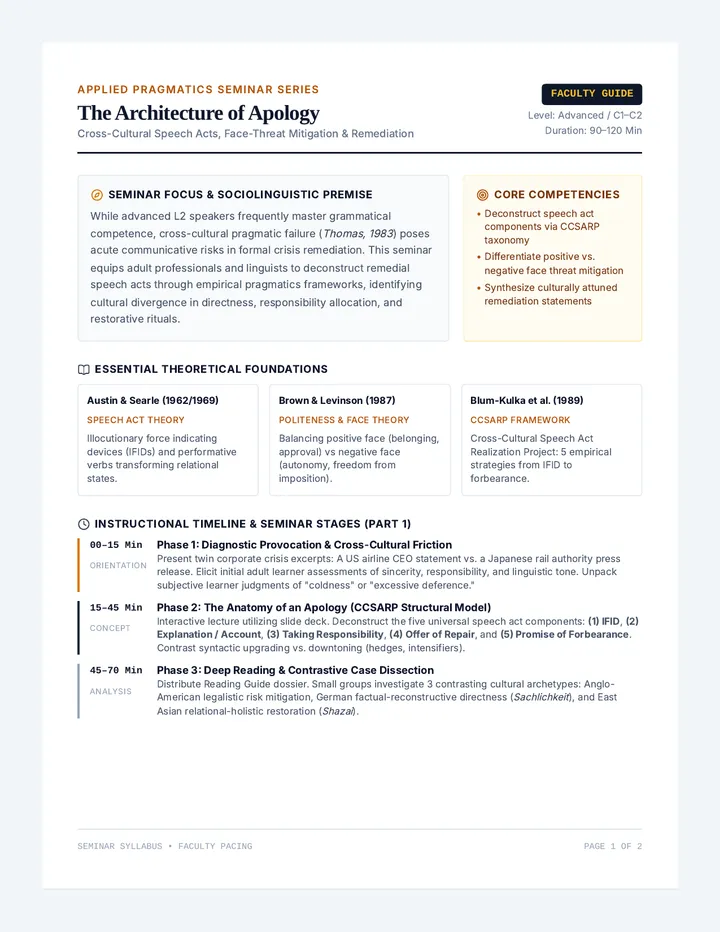
An applied pragmatics seminar for advanced adult foreign language learners examining speech act realization, cross-cultural politeness theories, and formal remediation across linguistic contexts.
The basic desire for personal autonomy, non-imposition, and freedom of decision and movement.
Remedial Focus:
Minimizing imposition, respecting procedural rights, and offering objective restitution.
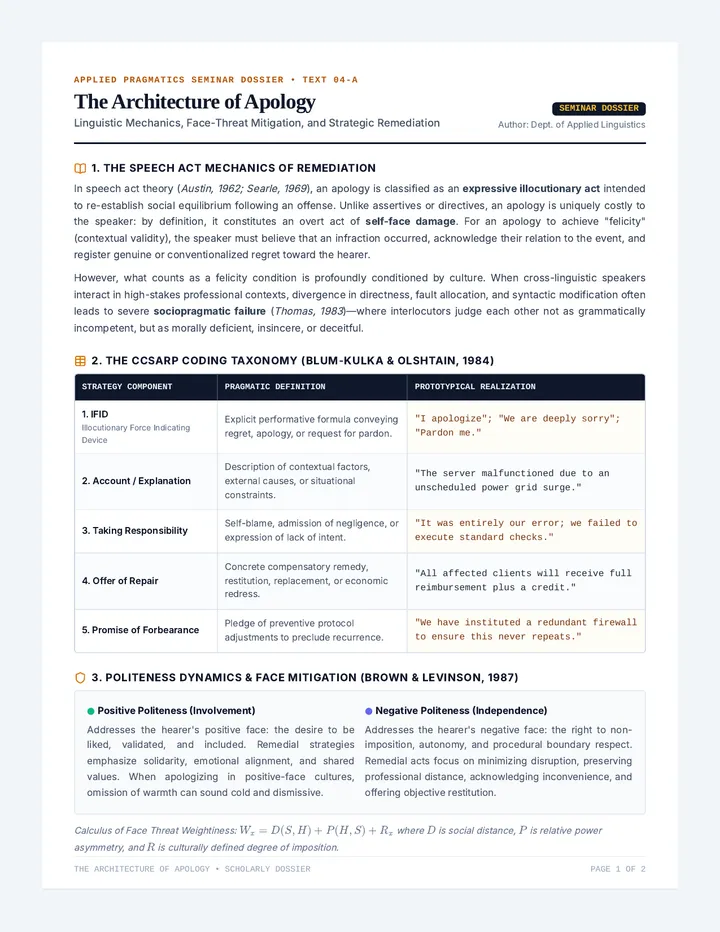
An apology is inherently an act of self-face damage to rehabilitate the interlocutor's face. Weightiness = D + P + R
Contrastive Pragmatics Cultural Stances
Cultural Paradigms of Formal Remediation
Anglo-American
Contractual & Legalistic
• Strict liability demarcation
• Non-agentive regret favored
• Transactional redress
• Risk avoidance paramount
"We regret any inconvenience."
Germanic / Continental
Factual & Systemic
• High Sachlichkeit (matter-of-fact)
• Technical root-cause transparency
• Low emotional drama
• Pragmatic corrective engineering
"The fault has been verified & fixed."
East Asian
Relational & Moral
• High-context social harmony
• Ritual subordination & humility
• Deep personal responsibility
• Explanations seen as excuses
"We offer our humble repentance."
Pragmatic transfer errors occur when applying one cultural schema to another context. Avoid Pragmatic Failure
Workshop Protocol Hands-on Application
Your Turn: Deconstruct & Recalibrate
01
Speech Act Coding
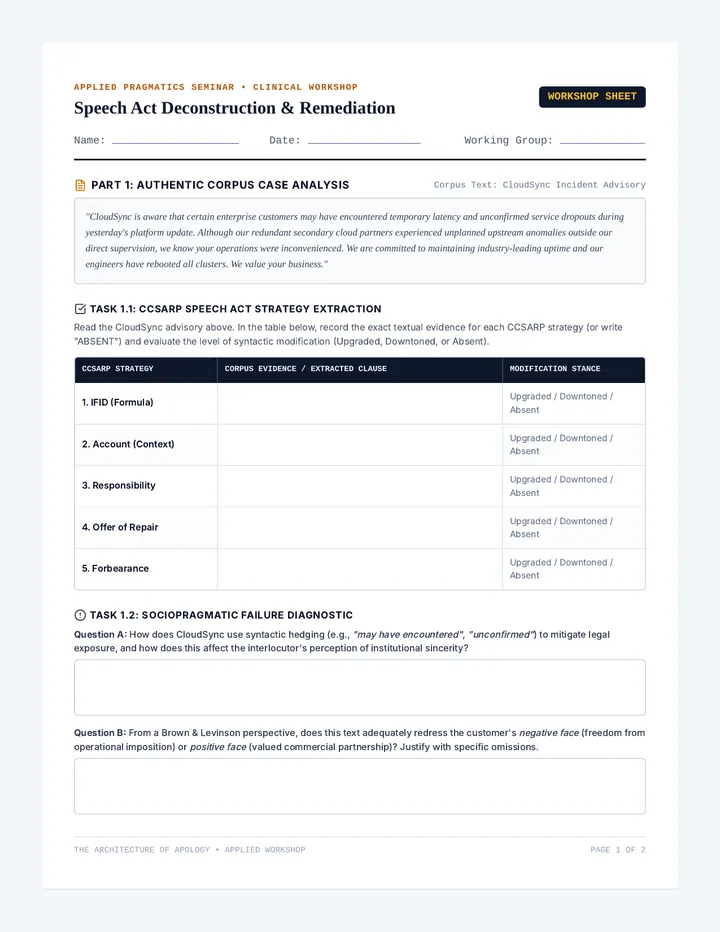
Extract the 5 CCSARP strategies from the crisis briefing. Bracket IFID, Account, Responsibility, Repair, and Forbearance.
02
Pragmatic Diagnostic
Diagnose face threats, missing elements, and cultural mismatches that sparked public backlash.
03
Transcultural Recalibration
Draft an authentic remedial statement tailored specifically to your designated cultural and organizational target.
"Mastering language is not just syntax; it is knowing how to repair human reality." Open Activity Sheet
Positive Politeness (Involvement)
Addresses the hearer's positive face: the desire to be liked, validated, and included. Remedial strategies emphasize solidarity, emotional alignment, and shared values. When apologizing in positive-face cultures, omission of warmth can sound cold and dismissive.
Negative Politeness (Independence)
Addresses the hearer's negative face: the right to non-imposition, autonomy, and procedural boundary respect. Remedial acts focus on minimizing disruption, preserving professional distance, acknowledging inconvenience, and offering objective restitution.
Calculus of Face Threat Weightiness: \(W_x = D(S,H) + P(H,S) + R_x\) where \(D\) is social distance, \(P\) is relative power asymmetry, and \(R\) is culturally defined degree of imposition.
THE ARCHITECTURE OF APOLOGY • SCHOLARLY DOSSIER PAGE 1 OF 2
Part II: Contrastive Institutional Corpora Empirical Discourse Analysis
Examine how differing sociopragmatic norms govern real-world crisis communications. Note how lexical choice, syntactic agency (active vs. passive), and strategy omission signal competing communicative priorities:
CASE A Anglo-American Legalistic Stance (Risk Mitigation)
Aviation Operational Meltdown
"Global Air deeply regrets the significant inconvenience caused to travelers affected by recent cancellations resulting from severe winter weather events and FAA mandated air-traffic constraints. Our customer relations team is actively reviewing eligible passenger claims pursuant to carrier contract tariff rules."
Linguistic Breakdown: Replaces explicit IFID ("We apologize") with non-agentive sorrow ("regrets the inconvenience"). Heavily weighted toward external Account (weather, FAA). Deflects legal fault; repair is framed conditionally ("pursuant to contract").
CASE B Germanic / Continental Factual Stance (Sachlichkeit)
Telecommunications Outage
"Wir bitten die betroffenen Kunden um Entschuldigung für die dreistündige Netzunterbrechung am 14. Oktober. Ein Konfigurationsfehler in Router-Cluster 4C führte zum Ausfall. Das fehlerhafte Softwaremodul wurde isoliert und durch Patch v4.2 ersetzt. Ein Weiterbetrieb ist sichergestellt."
Linguistic Breakdown: Clear, direct performative formula ("bitten um Entschuldigung") combined with clinical, transparent technical accountability. Devoid of emotive melodrama; prioritizes exact causal diagnosis and verified technical forbearance.
CASE C East Asian Relational Stance (Shazai & Social Harmony)
High-Speed Transit Collision
"We bow before our passengers and society in agonizing repentance for our unforgivable oversight and the profound anxiety inflicted. We offer no excuses. Our management team accepts unreserved personal culpability for having betrayed the public's sacred trust."
Linguistic Breakdown: Maximum syntactic upgrading through extreme self-effacement and moral affect. Deliberate, total omission of explanatory mitigation ("no excuses"). Focuses on restoring relational harmony through voluntary self-humiliation.
Seminar Analytical Prompts
The Perils of Direct Translation: If Case C is rendered verbatim into a North American legal context, what civil liability liabilities does it trigger? Conversely, why would Case A be received as offensive callousness in Tokyo?
The Agency Game: Trace the use of nominalizations ("cancellations resulting from..." vs. "we cancelled..."). How does grammar serve as a pragmatic shield?
The Dignity Paradox: Does public apology elevate or destroy institutional authority? Under what cultural conditions does an apology increase consumer trust?
THE ARCHITECTURE OF APOLOGY • SCHOLARLY DOSSIER PAGE 2 OF 2
Target Track B (East Asian Relational / Positive Face & Humility): Emphasize unreserved institutional responsibility, profound regret for breach of trust, complete omission of vendor-blaming, and executive pledge of forbearance.
Target Selected: [ ] Track A [ ] Track B Register: Formal Executive Crisis Remediation
Part 3: Peer Pragmatic Audit Matrix (Exchange Sheets)
Review your peer's drafted remediation against the four pragmatic criteria below (Score 1–4):
Pragmatic Dimension
Diagnostic Evaluation Criterion
Score (1–4)
1. IFID Calibration
Appropriate performative verb selection without unintended legal exposure or insincere detachment.
/ 4
2. Agency & Account
Causal explanations clarify without appearing evasive or deflecting core institutional accountability.
/ 4
3. Face-Threat Redress
Successfully targets the hearer's positive face (harmony) or negative face (procedural restitution).
/ 4
4. Actionable Repair
Offers tangible restitution and believable systemic safeguards against recurrence (forbearance).
/ 4
THE ARCHITECTURE OF APOLOGY • APPLIED WORKSHOP PAGE 2 OF 2