Stress Secrets Slides Stress Secrets
The Power of Emphasis in Spoken English
Meaning Mechanics: Lesson 1
One Sentence, Seven Meanings
"I never said she stole my money."
1
I never said she stole my money. (Someone else did.)
2
I never said she stole my money. (I deny it completely.)
3
I never said she stole my money. (She stole someone else's.)
How do the other 4 change?
The "Music" of English
Content Words
Nouns, verbs, adjectives, adverbs. These carry the message.
Car Run Blue
Function Words
Prepositions, articles, pronouns. These are the grammar glue.
The At He
Stress = Higher, Louder, Longer
"English is a stress-timed language."
Contrastive Stress
Correcting mistakes or highlighting differences.
Person A: "Did you buy the red shoes?"
Person B: "No, I bought the BLUE shoes."
Person A: "Are we meeting at 5:00?"
Person B: "No, we're meeting at SIX o'clock."
Listen & Locate
I will read three sentences. Your job is to identify which word is stressed and what it tells us about the speaker's intent.
"I can't help you today."
Meaning: A hard refusal or impossibility.
Listen to version 2...
Listen to version 3...
Get your "Stress Shifts" Worksheet ready!
Stress Shifts Worksheet Stress Shifts Worksheet
Lesson 1: Meaning Mechanics
Name:
Date:
Part 1: Detecting Intent
Listen as your teacher reads the sentence "I never said she stole my money" in different ways. Circle the word that receives the strongest stress and explain the hidden meaning.
I never said she stole my money.
Implied Meaning:
I never said she stole my money.
Implied Meaning:
I never said she stole my money.
Implied Meaning:
Part 2: The Correction Game
Read the prompt from Person A. Decide which word in Person B's response needs the contrastive stress to correct the mistake. Underline it.
1. Person A: "Did you take the bus to school?"
Person B: "No, I took the TRAIN to school."
(Example)
2. Person A: "Is your brother coming to the party?"
Person B: "No, my SISTER is coming to the party."
3. Person A: "I heard you bought a new bike."
Person B: "Actually, I bought a USED bike."
Part 3: Meaning Maker
Write a short sentence of your own. Then, choose two different words to stress and explain how the meaning changes for each.
Your Sentence:
Version A Stress Word:
New Meaning:
Version B Stress Word:
New Meaning:
Stress Secrets Teacher Guide Teacher Guide
Lesson 1: Sentence Stress Secrets
Meaning Mechanics Sequence
Duration: 50-60 Minutes
Lesson Overview
This lesson introduces students to the concept of sentence stress as a tool for conveying meaning beyond literal word choice. Students will move from identifying stress in a single sentence to practicing contrastive stress in natural dialogue.
Learning Objectives
Identify content words vs. function words in spoken English.
Differentiate between implied meanings based on sentence stress.
Produce contrastive stress to correct misinformation in a conversation.
Materials Needed
Stress Secrets Slides
Stress Shifts Worksheet
Audio playback device
Instructional Steps
1
The Hook: Seven Ways (10 mins)
Project Slide 2. Read the sentence "I never said she stole my money" seven times, each time emphasizing a different word. After each reading, ask students: "Who did it?" or "What actually happened?"
Tip: Over-exaggerate the stress initially (higher pitch, longer vowel) to help students hear the difference.
2
Direct Instruction: Content vs. Function (15 mins)
Use Slides 3 and 4 to explain why we stress certain words. Explain that content words (nouns, verbs) usually get stress, while function words (the, of, and) are reduced.
Introduce Contrastive Stress : We break the "rules" of stress to correct someone or show a specific choice.
3
Guided Practice: Listen & Locate (15 mins)
Hand out the Stress Shifts Worksheet . Perform the auditory prompts for Part 1. For example, stress "stole" and have students write that the person might have just borrowed the money.
Walk around as they complete Part 2, ensuring they identify the word that contrasts with the previous speaker's error.
4
Assessment & Closure (10 mins)
Students complete Part 3 independently. Have volunteers read their sentences aloud for the class to "guess" the intended meaning based on the stress.
Differentiation Strategies
Scaffolding (Emerging)
Provide a list of possible "meanings" for Part 1 of the worksheet for students to match rather than generate.
Extension (Advanced)
Have students record themselves reading a paragraph twice: once with neutral stress and once with "expressive" stress.
Flow & Figures Slides Flow & Figures
Connected Speech and Hidden Meanings
Meaning Mechanics: Lesson 2
The Literal Trap
"Hitting the books"
Does it mean physically punching a textbook?
"Spilling the beans"
Is there a messy kitchen involved?
Why does it sound so FAST?
Consonant to Vowel
"Read a book" → /ree-duh-book/
Consonant to Consonant
"Best friend" → /bes-frend/
The Secret: Reductions
Going to → GONNA
Want to → WANNA
Kind of → KINDA
Dialogue Detective
A
"Hey, what are you gonna do for the break? I'm kinda bored."
B
"I don't know, maybe hang out at the park? Whatcha think?"
Identify the chunks!
Your Turn!
We're going to dive into some authentic audio clips. Get ready to spot the linking, find the reductions, and decode the idioms!
Open: The Chunking Challenge
Chunking Challenge Worksheet The Chunking Challenge
Lesson 2: Decoding Flow & Figures
Student:
Date:
Part 1: Reduction Radar
Listen to the sentences read at natural speed. Write the full words for the reduced "chunks" you hear.
01
"I'm gonna head out to the store."
Full words:
going to
02
"I wanna see that new movie tonight."
Full words:
03
"It's kinda cold in this room, isn't it?"
Full words:
04
"You oughta ask your teacher for help."
Full words:
Part 2: Linking Lines
Draw a "link" symbol ( ◡ ) between words that sound connected in the phrase below.
an◡apple
stopit
readabook
fillupthetank
Part 3: Idiom Interpreter
Read the conversation. Based on the context clues , what do you think the underlined idiom means? Then, check the dictionary definition.
"I was so nervous for the audition, but my coach told me to just go out there and break a leg. I ended up getting the lead role!"
My Guess:
Actual Meaning:
Idiom Sketchpad Activity Idiom Sketchpad
Lesson 2: Figurative Language
Artist:
Date:
The Challenge
English idioms are "locked" phrases where the meaning of the whole is different from the meaning of the individual words. For each idiom below, draw the Literal (word-for-word) meaning on the left, and the Figurative (actual) meaning on the right.
1 "Hitting the Books"
Literal Drawing
Figurative Drawing
2 "Spilling the Beans"
Literal Drawing
Figurative Drawing
3 "Piece of Cake"
Literal Drawing
Figurative Drawing
Tone & Truth Slides Tone & Truth
Decoding Sarcasm and Social Cues
Lesson Three
The Great Mismatch
Silent Clip
Watch the facial expressions and gestures. What are they saying? How do they feel?
Audio Clip
"Oh, great. This is EXACTLY what I wanted."
Wait... did they mean it?
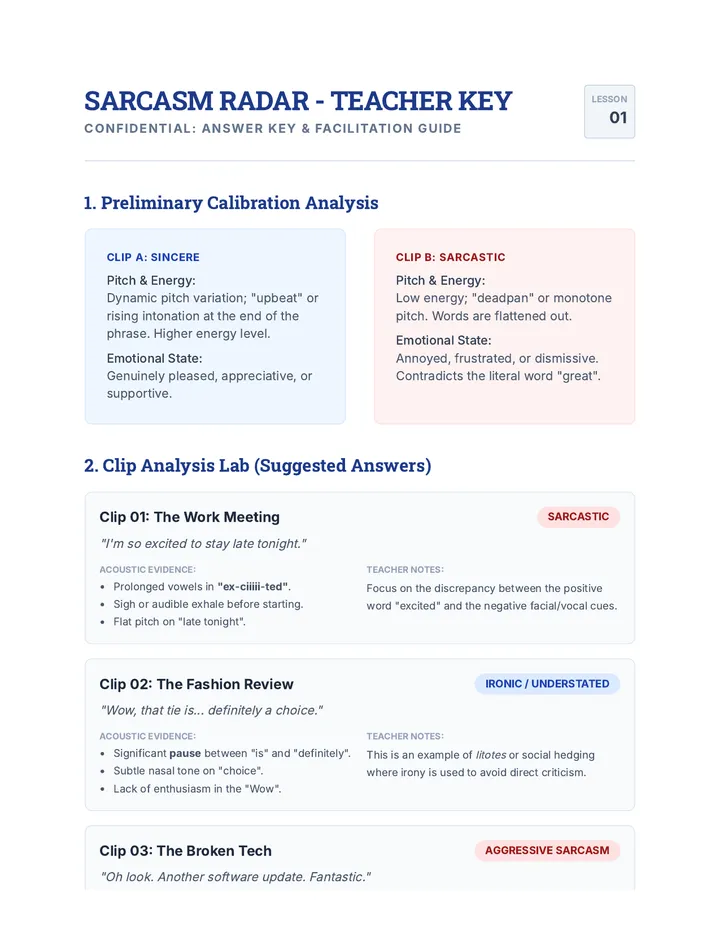
Sarcasm: The Vocal Wink
Pitch Change
Often a very flat or exaggerated high-to-low pitch drop.
Elongation
Words like "reeeeeally" or "suuuuuure" get stretched out.
Contrast
The words are positive, but the tone is negative (or vice versa).
Tone Color Palette
Anger
Fast, loud, sharp vowel sounds.
Doubt
Rising pitch at the end, slow pace.
Excitement
High pitch, fast, wide pitch range.
Fear
Higher pitch, breathy, irregular rhythm.
Ear Training
I'm going to say the word "Thanks" in five different ways. Your job is to match the tone to the feeling on your worksheet.
Get ready for the Tone Tracker!
Tone Tracker Worksheet The Tone Tracker
Lesson 3: Decoding Attitude
Analyzer:
Timestamp:
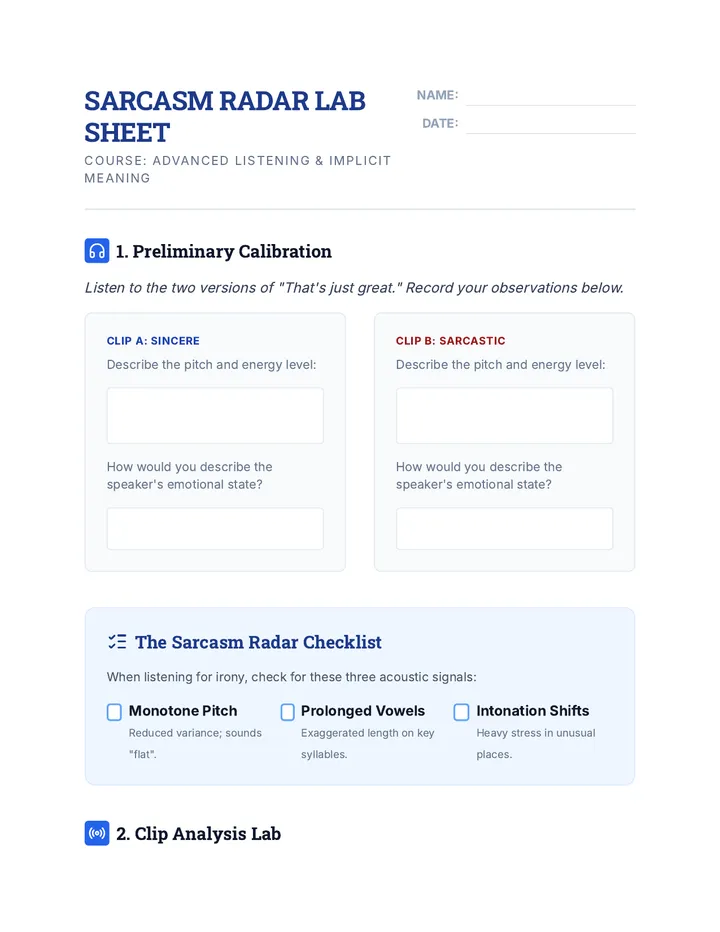
Part 1: The "Thanks" Test
Listen to your teacher say the word "Thanks" five times. Match each version to the correct intended emotion .
1
2
3
4
5
Options:
Grateful Sarcastic Relieved Surprised Angry
Part 2: Subtext Sleuth
Listen to the short dialogue. Identify the clues that reveal the speaker's true intent.
"Oh, sure. I'd love to stay late and clean up everyone's mess. It's not like I have anything else to do."
Literal Meaning:
Actual Meaning (Subtext):
Auditory Clues (What did you hear?):
Part 3: The Response Lab
If someone speaks with a sarcastic tone, how should you respond to avoid a misunderstanding?
Signpost Signals Slides Signpost Signals
Navigating the Roadmap of Academic Lectures
Meaning Mechanics: Lesson 4
Lost in the Clouds
"Fold the paper in half. Crease the edges. Open it back up. Fold the top corners to the middle. Tuck the bottom flap under. Twist the left side."
Wait! When do I do each step? How do they connect?
Imagine listening to a 10-minute lecture with zero transition words.
Auditory GPS
Structure
Words that tell you where the speaker is in the presentation.
Emphasis
Words that tell you what is most important to remember.
Without signposts, a lecture is just a "wall of noise."
The Signpost Library
Sequencing
First...
Next...
Finally...
Contrast
However...
On the other hand...
Unlike...
Example
For instance...
To illustrate...
In particular...
Summary
In conclusion...
To sum up...
Basically...
Lecture Logic
Time to put your GPS to the test. Listen to the lecture and map the main ideas using the Graphic Organizer.
Start Mapping
Lecture Logic Organizer Lecture Logic
Mapping Academic Speech with Signposts
Scholar:
Subject:
How Bees Communicate
Wait for...
Introduction
Listen for...
Main Points
Note the...
Examples
End with...
Conclusion
1
Introduction & Thesis Signal words: Today I will discuss... Primarily...
2
Major Point 1 Signal words: First of all... The key factor...
Supporting Details / Examples:
3
A Change in Direction Signal words: However... On the other hand...
4
Summary & Final Thought Signal words: In conclusion... To sum up... Detective Simulation Slides Listening Detectives
Case #104: The Mystery of the Missing Notebook
Final Simulation
Exhibit A
"Hey... it's Leo. Listen, I never saw your notebook in the library. I mean, why would I be there anyway? I was... busy. Suuuuure, check the security cameras if you want. See ya."
Stress? Sarcasm? Connected Speech?
Analyze the Cues
What is Leo's true intent? Is he telling the truth?
Your Mission
1. Interview
Speak with 3 suspects. Listen carefully to how they emphasize their words.
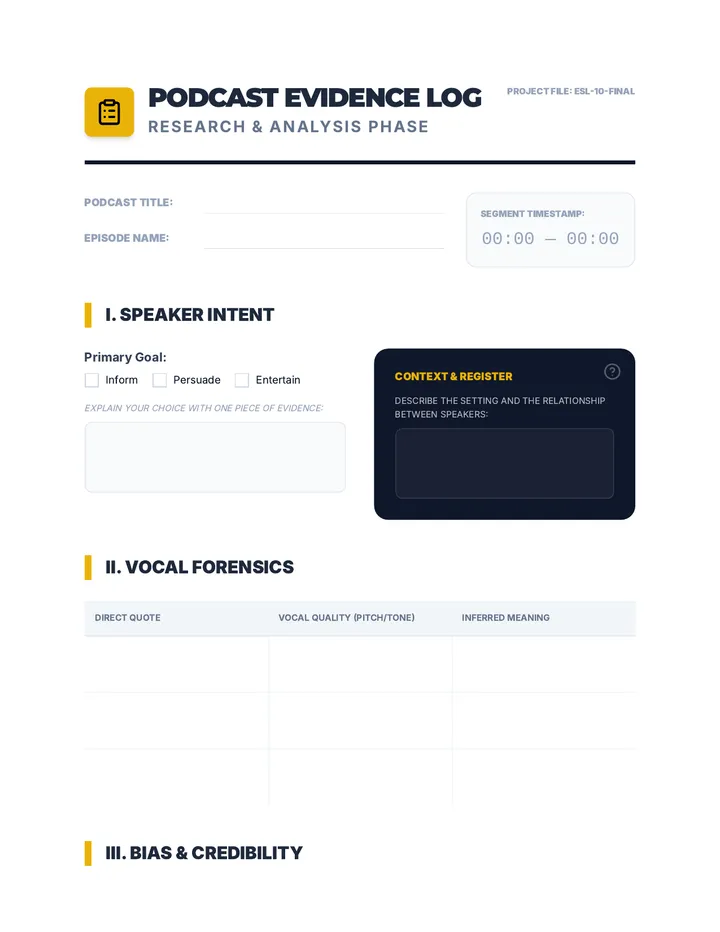
2. Evidence Log
Record idioms, tone changes, and signposts that structure their story.
3. Verdict
Synthesize everything to determine who took the notebook and why.
The Lineup
Suspect #1
"The Nervous Neighbor"
Suspect #2
"The Over-Eager Artist"
Suspect #3
"The Sarcastic Scholar"
Case Assigned
Detectives, your notebooks are ready. Trust your ears, not just the words.
Good Luck
Mystery Dossier Worksheet Mystery Dossier
Case File: #104 - The Missing Notebook
Agent:
Badge #:
Audio Evidence: Leo's Voicemail
Key Sentence Stress Clues:
Tone/Sarcasm Detection:
Interrogation Notes
01
Suspect Name:
Idioms Used (Figurative Language):
02
Suspect Name:
Signpost Signals Identified:
The Final Verdict
Synthesize all your listening clues (Stress, Flow, Tone, Signposts) to solve the case.
Who took the notebook?
What was their motive?
Evidence Summary (Auditory Clues):