POE Power Slides POE Power
The Secret to Doubling Your Luck
Detective Training: Unit 1
Would You Rather...
Take a guess with
4
Possible Choices?
OR
2
Possible Choices?
Which one gives you a better chance to win?
What is POE?
Process of Elimination
Cross out the answers you know are wrong.
The Goal
Leave only the best choices behind.
Multiple Choice Question:
A) The Correct Answer
B) Obviously Wrong Answer
C) Maybe? Let me think...
Practice: Trivia Challenge
Question: Which of these animals can live for more than 100 years?
A
The Golden Hamster
B
The Galapagos Tortoise
C
The House Fly
D
The Butterfly
CAN YOU ELIMINATE 3?
Detective Rules
1
Read every answer choice first.
2
Slash
the ones that are clearly impossible.
3
Compare what is left.
Ready to start the Elimination Challenge?
Elimination Challenge Worksheet Elimination Challenge
Test Detective Agency: Level 1
AGENT:
DATE:
Mission Instructions
Don't just pick an answer! Use your POE Slash to cross out the answers you know are wrong. Once you slash the "impossible" ones, choose the best one remaining.
Example Training
Question: Which of these foods is usually served hot?
A) Ice Cream Cone
B) Bowl of Soup
1
Which of these animals can fly?
A) Elephant
B) Shark
C) Eagle
D) Turtle
Reflect: Which answer did you slash first? Why?
2
Which of these is a primary color?
A) Purple
B) Orange
C) Green
D) Red
3
What is the capital city of France?
A) London
B) Paris
C) Tokyo
D) New York
Remember: Every slash increases your chance of winning!
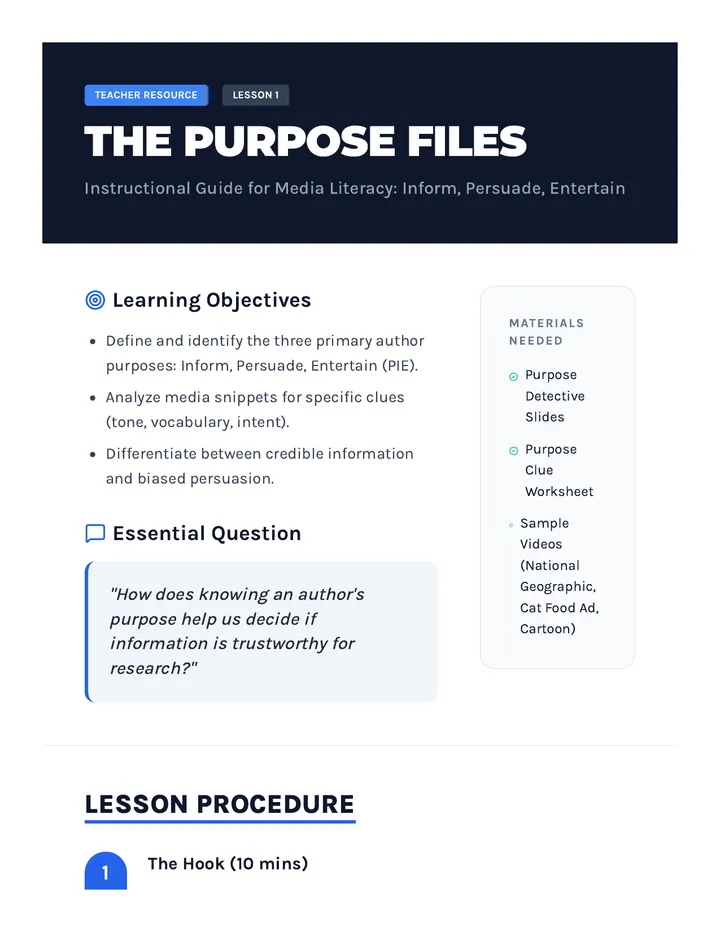
POE Intro Teacher Guide Teacher Resource
POE Power Launch Guide
Lesson 1: Introduction to Process of Elimination
Target Grade
4th Grade ESL
Objective
Students will use logical reasoning to eliminate incorrect answers, increasing their statistical chance of selecting the correct option.
Pacing
45-60 Minutes
15m: Hook/Slides
25m: Practice Challenge
10m: Reflection
Key Vocab
Eliminate Probability Process Logic
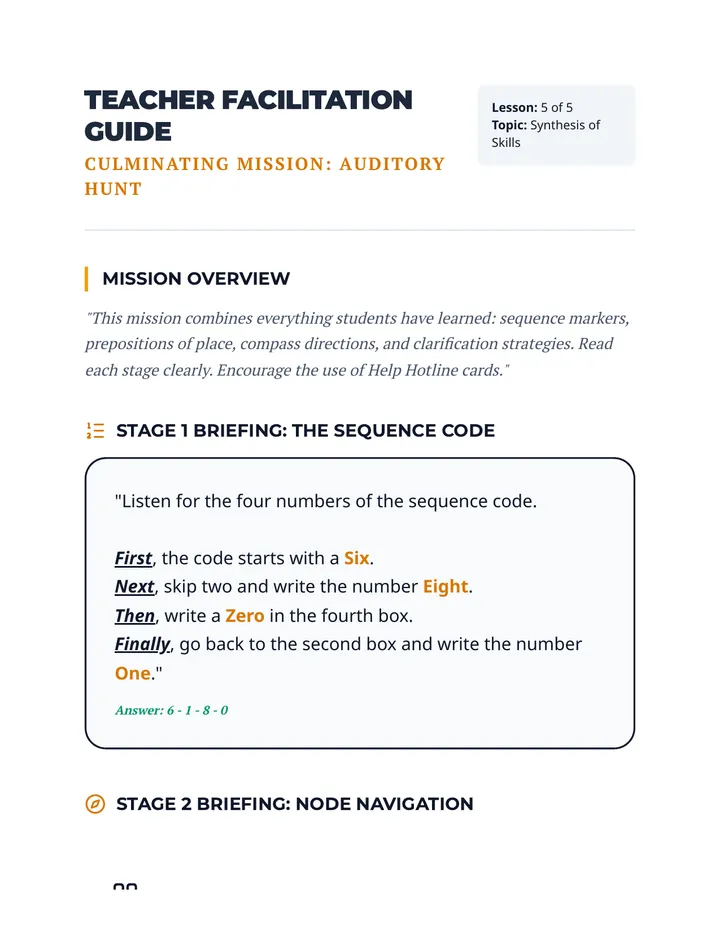
1 The Hook: The Gambling Game
Ask: "If you have to guess on a test, would you rather have a 1 in 4 chance of winning, or a 1 in 2 chance?"
Teacher Note: Draw a circle divided into 4 pieces vs. 2 pieces on the board to visualize probability for ESL learners.
2 Slide Guided Instruction
Use POE Power Slides to model the "Slash" technique. Emphasize that we are looking for what is wrong first, rather than what is right.
During the Trivia Slide, have students vote on which answers they would "slash" first. Ask them to explain why in simple English (e.g., "A hamster only lives 3 years, not 100").
3 Elimination Challenge
Hand out the Elimination Challenge Worksheet . Students must show their slashes for every question.
Differentiation Support
Level 1 (Entering): Allow students to draw small pictures next to the options to help them identify "impossible" choices.
Level 3 (Developing): Require students to write one sentence for at least one question explaining their slash.
4 Reflection/Debrief
Ask: "Does POE guarantee the right answer?" (No, but it makes guessing much smarter). Encourage the phrase: "I slashed it because..."
Red Flag Words Slides Red Flag Words
Spotting the Extreme Language Traps
Which one is TRUE?
"It NEVER rains in the desert."
Extreme
"It RARELY rains in the desert."
Soft
One word changes the whole truth. Can you see it?
The "Always" & "Never" Trap
Danger Words
ALWAYS
NEVER
EVERYONE
ALL / NONE
These words are usually LIES on a test.
Why? Because it's hard to be right 100% of the time!
The "Maybe" Words
These words are SAFER.
They leave room for exceptions. Test-makers love these!
Safe Words
OFTEN
SOMETIMES
MANY
MOST
Ready to hunt for Red Flags?
If a sentence says "all," "every," or "never," it's probably a trap! Slash it!
Absolute Language Detective Worksheet Red Flag Hunt
Test Detective Agency: Level 2
AGENT:
DATE:
Extreme Red Flags (Warning!)
Always Never Everyone Only None
Nuanced Words (Safe)
Sometimes Often Many Usually Some
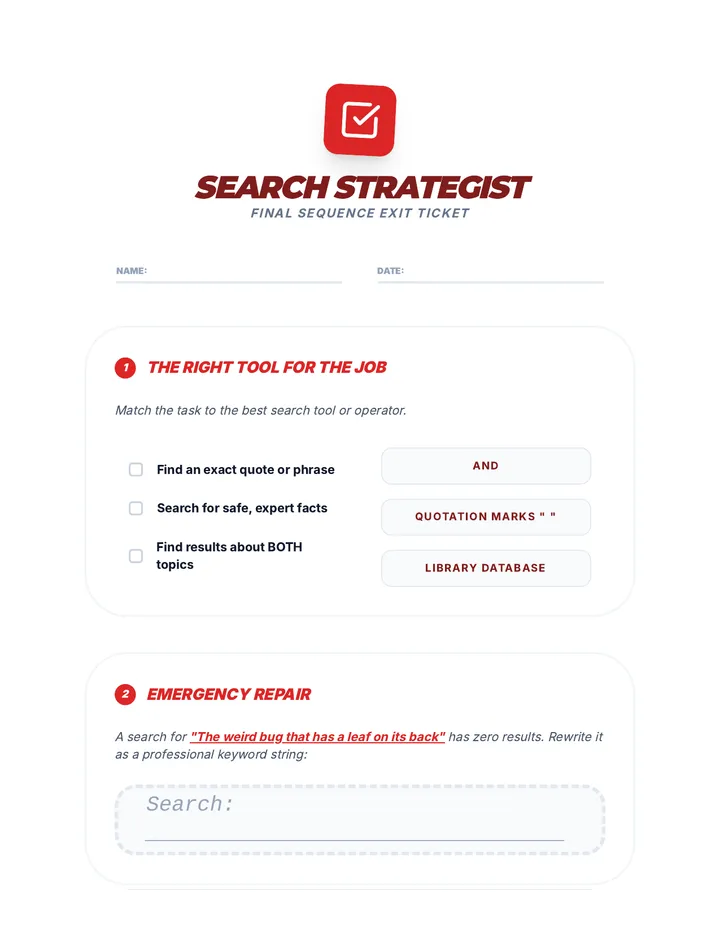
1 Circle the Red Flag words in these sentences.
"Everyone loves to eat pizza for lunch every day."
"Birds always fly south for the winter."
"Sharks are never friendly to other fish."
"You should only drink water when you are thirsty."
2 Check the box for the sentence that is more likely to be TRUE.
A) All cats are afraid of water.
B) Many cats are afraid of water.
A) It often snows in Canada during January.
B) It always snows in Canada during January.
3 Detective Thinking
Why is the word "ALWAYS" usually a trap on a test? Write your thinking below.
Absolute Language Answer Key Answer Key
Absolute Language Detective
Teacher Only
Part 1: Hunt for Red Flags
1. "Everyone loves to eat pizza for lunch every day."
2. "Birds always fly south for the winter."
3. "Sharks are never friendly to other fish."
4. "You should only drink water when you are thirsty."
Part 2: The Truth Test
Correct Choice: B
"Many cats are afraid of water" is more likely because some cats (like tigers or specific breeds) actually like water.
Correct Choice: A
"It often snows" is correct because there could be a warm January where it doesn't snow, or a specific day with no snow.
Part 3: Detective Thinking
Expected Student Answer (Look for):
"Always is a trap because there is usually an exception. One counter-example makes the whole sentence false. Nuanced words like 'often' are safer because they allow for exceptions."
Trap Gallery Slides Trap Gallery
How Test-Makers Try to Trick You
Detective Training: Unit 3
The Distractor
A Distractor is a wrong answer that looks right.
Test-makers don't want you to guess easily. They set traps using common mistakes!
"It looks like it belongs here..."
"I remember seeing that word!"
1 The Look-Alike
It uses fancy words or phrases from the reading passage.
It feels familiar, so you want to click it. But it's a trap!
The Passage
"The rocket traveled to the moon."
Look-Alike Distractor:
"The rocket landed on Mars."
(Both have 'rocket' and 'landed', but the place is wrong!)
2 The Off-Topic
It is a TRUE fact, but it doesn't answer the question.
It's true in real life, but the text didn't talk about it.
The Question
"What did Sarah eat for breakfast?"
Off-Topic Distractor:
"Pizza is a delicious dinner."
(True fact! But Sarah ate cereal.)
Know Your Enemies
Look-Alike
Uses same words, but the meaning is wrong.
Off-Topic
True fact, but irrelevant to the story.
The Opposite
Says the exact reverse of the truth.
Distractor Detective Handout Distractor Detective
Test Detective Agency: Level 3
AGENT:
DATE:
Case Study: The Morning Race
"Ben woke up early to practice for the big track race. He put on his red sneakers and ran three miles around the local park. His dog, Sparky, chased him the whole way. By the time they finished, Ben was exhausted but ready for the race."
Question: Why did Ben wake up early?
A) To practice for his track race.
✓ Correct Answer
B) He woke up late and missed the race.
Label the Trap:
C) Dogs are excellent pets for families.
Label the Trap:
D) Ben ran three miles at the track race.
Label the Trap:
Agent Reflection
Which trap was the hardest to spot? Why did it almost trick you?
The Look-Alike
The Off-Topic
The Opposite
Distractor Types Teacher Reference Distractor Cheat Sheet
Lesson 3: Identifying Common Distractors
Teacher Guide
1. The Look-Alike
Definition: Uses specific words or numbers from the passage but changes the context or fact slightly.
"It looks correct because the student remembers seeing the words 'three miles' or 'red sneakers' and stops reading."
2. The Off-Topic
Definition: A statement that is true in real life but is not mentioned in the text or does not answer the specific question.
"ESL students often pick this because they recognize a 'True' fact and think that makes it the right answer."
3. The Opposite
Definition: States the exact reverse of a detail in the passage.
"This tests reading comprehension and attention to detail (e.g., 'early' vs 'late')."
Answer Key: The Morning Race
B
The Opposite
The story says Ben woke up early. The choice says he woke up late.
C
The Off-Topic
It is true that dogs are good pets, but the story is about Ben's race, not "pet advice."
D
The Look-Alike
The story mentions "three miles," but he ran them at the park, not at the race itself.
Trophy Choice Slides The Trophy Choice
Finding the BEST Answer (even when two look good!)
The "Two Truths" Problem
"The solar system has eight planets. Mars is known as the Red Planet."
Question: What is a fact about the solar system?
A
It has eight planets.
TRUE
B
Mars is red.
TRUE
WAIT! Which one wins the trophy?
How to Pick the Winner
Is it the Main Idea?
Does it answer the Specific Question?
Is it Most Complete?
The Evidence Face-Off
Sometimes a "good" answer is just a tiny detail. The "best" answer covers the whole topic.
"Don't fall for the 'partial truth' trap!"
Evidence Faceoff Worksheet Evidence Face-Off
Test Detective Agency: Level 4
AGENT:
DATE:
Case Study: Forest Engineers
"Beavers are known as nature's engineers. They build large dams using sticks and mud to create ponds. These ponds provide a safe home for the beavers and also help other animals. For example, ducks and frogs often live in the still water of a beaver pond. Beavers have very sharp teeth that they use to cut down trees."
Question: What is the main reason beavers build dams?
A
Beavers have very sharp teeth.
Is this true?
YES
NO
B
To create ponds for a safe home.
Is this true?
YES
NO
The Trophy Winner
Both answers might be true! Which one wins the trophy for answering the specific question? Why?
BEST ANSWER:
BECAUSE:
Best Answer Answer Key Answer Key
Evidence Face-Off: Lesson 4
Teacher Guide
True vs. Best Evaluation
Choice A: "Beavers have very sharp teeth."
IS IT TRUE? Yes. The text explicitly mentions this.
WHY NOT BEST? This is a physical description. It doesn't answer why they build dams.
Choice B: "To create ponds for a safe home."
IS IT TRUE? Yes. The text links the building to creating ponds for safety.
WHY IS IT BEST? It directly answers the question's focus on the reason for building.
The Trophy Winner: Choice B
Expected Teacher Feedback:
"Students should recognize that while both facts are in the story, Choice B explains the purpose (the 'why'). Choice A is just a detail. Encourage students to re-read the question carefully to see what it is actually asking for."
Distractor Doctor Slides Distractor Doctor
Now YOU are the test-maker!
Final Mastery Workshop
Your Medical Mission
1
Start with a Reading Passage.
2
Write a Correct Answer.
3
"Prescribe" 3 Distractor Traps!
The Distractor Pharmacy
Look-Alike
"Take a word from the text, but use it to tell a lie."
Off-Topic
"Write something true, but unrelated to the question."
The Opposite
"Say the exact reverse of what the author wrote."
Doctor's Expert Tip
"The best distractors are the ones that make people stop and think: 'Wait, I remember that word!'"
READY TO OPERATE?
Grab your Prescription Form and let's build some traps!
Doctor Prescription Project Prescription Form
Workshop: Distractor Doctor
DOCTOR:
DATE:
Step 1: Write a 2-3 sentence story
Step 2: Write your question
Step 3: Write your choices
A
The Correct Answer
B
Trap #1: The Look-Alike
C
Trap #2: The Off-Topic
D
Trap #3: The Opposite
Final Task: Trade with a partner and see if they can use POE to find your correct answer!
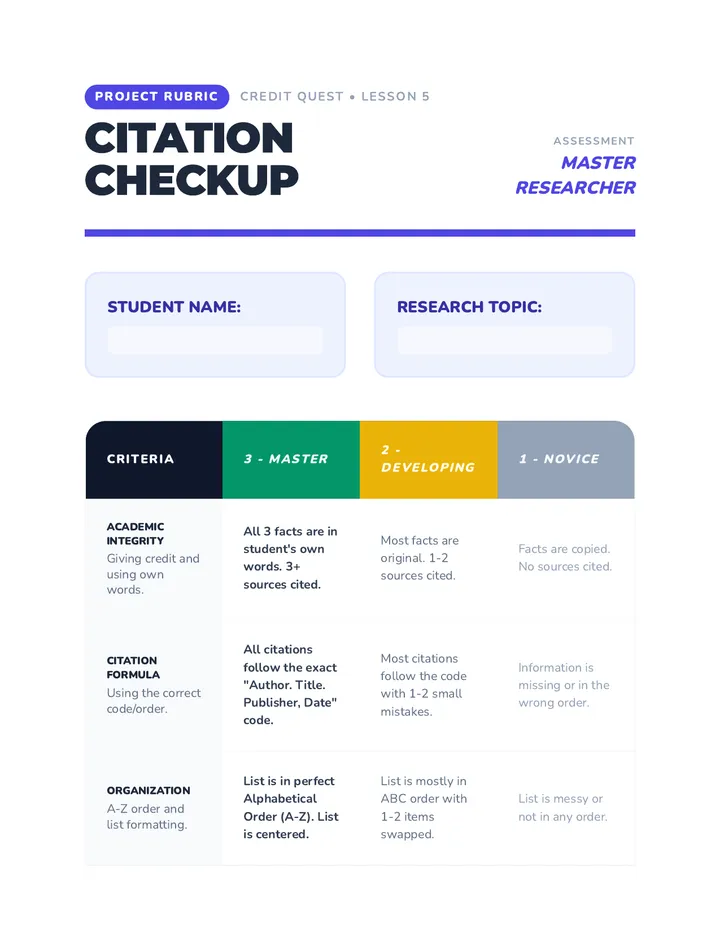
Distractor Doctor Rubric Distractor Doctor Rubric
Mastery Assessment
Grading Guide
Criteria 3 - Master Doctor 2 - Practitioner 1 - Resident Reading Passage Passage is clear, makes sense, and has enough detail for a question. Passage is 1-2 sentences but lacks some detail. Passage is very short or difficult to understand. Correct Answer The answer is 100% true based on the passage evidence. The answer is mostly true, but slightly confusing. The answer is not supported by the passage. Trap Logic All 3 traps (Look-Alike, Off-Topic, Opposite) are perfectly matched to their types. 2 out of 3 traps are correctly matched to their types. Traps are random and do not match the assigned types. Complexity The traps are high-quality and would definitely trick a careless reader! The traps are okay, but some are too obviously wrong. The question is too simple; no logic is needed.
Feedback Note for ESL Students:
Focus on the student's ability to categorize their logic. Even if grammar is imperfect, award full points if they correctly identified the "Look-Alike" vs. "Opposite" logic in their distractors.