Academic Ears Lesson Plan Listen Up
Academic Ears Lesson Plan
Grade: 10th Grade
Duration: 60 Minutes
Objective
Students will be able to identify main ideas and key details from a variety of spoken academic English contexts, enhancing their comprehension and information retention skills.
Why this matters
Mastering academic listening prepares students for college lectures, seminars, and professional settings where active engagement is key to understanding complex information.
Preparation
Review slide deck and audio scripts.
Check speaker and projector functionality.
Print Note-Taking Templates (1 set per student).
Materials
Art of Listening Slide Deck
Audio Scripts/Clips
Note-Taking Templates
Pens & Paper
Lesson Sequence
Time Phase Activities & Teacher Guidance 10 min Warm-up Listen and Draw: Play a descriptive passage (e.g., a forest scene). Students draw what they hear without looking at others.Discussion: How did drawings differ? Why is listening active? 15 min Direct Instruction The Art of Listening: Use Slide Deck to cover Active Listening, Purpose, and Signal Words. Introduce the 3 note-taking templates (Cornell, T-Chart, Map).20 min Guided Practice Note-Taking Drill: Play Audio Clip 1 (Biology). Students use the template of their choice. Pause periodically to model identifying signal words like "Furthermore" or "In contrast."10 min Independent Practice Independent Listening: Play Audio Clip 2 (History). Students independently synthesize information onto templates.5 min Closure Review: Small group comparison of notes. Quick class wrap-up: What was the biggest challenge?
Art of Listening Slides Listen Up
Academic Ears
Transforming your learning through active listening
What is Active Listening?
It's not just hearing—it's engaging with the message.
Paying Full Attention Focusing on the speaker and their message.
Understanding Processing info to grasp the deeper meaning.
Responding Asking clarifying questions and nodding.
Remembering Retaining info for future application.
"Listening is being able to be changed by the other person."
Why Academic Listening?
Lecture Success
Grasp complex theories and high-level concepts shared in class.
Precision
Following multi-step instructions without missing critical details.
Collaboration
Participating effectively in seminars and group discussions.
Foundation for Future Learning & Success!
Note-Taking: Your Secret Weapon
Cornell Notes
Divide paper into Cues, Notes, and Summary.
Outlining
Hierarchical organization with bullets and indents.
Concept Mapping
Visual web of ideas and connections.
T-Charts
Compare two categories (e.g., Main Idea vs. Details).
Listen for: Main Ideas, Key Details, Definitions, & Examples
Inferencing
Reading between the lines (or sounds!)
1
What is it? Using clues to figure out unstated information.
2
How to do it? Pay attention to tone, context, and implied meanings.
3
Why it matters? Unlocks the speaker's true intent and deeper message.
Speaker's Purpose: Why are they talking?
Inform
Facts, data, explanations, tutorials.
Persuade
Arguments, opinions, calls to action.
Entertain
Stories, anecdotes, drama, humor.
Identify the goal to prioritize your focus!
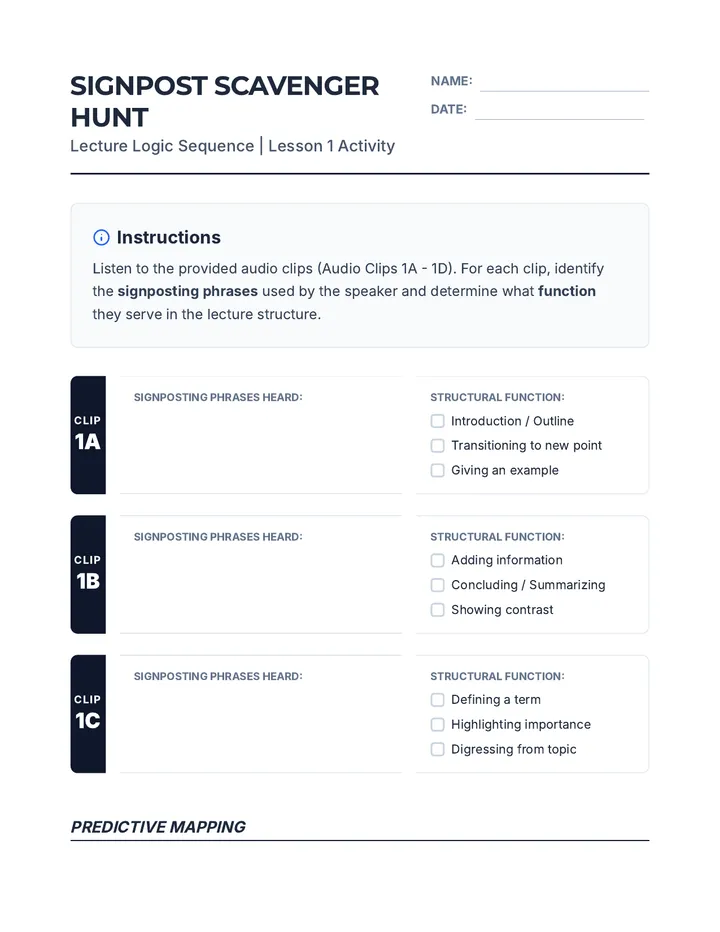
Signal Words: Your Audio Map
Introduction
"Today we'll discuss...", "First..."
Adding Info
"Also...", "Furthermore...", "In addition..."
Cause & Effect
"Because...", "Therefore...", "As a result..."
Examples
"For instance...", "Such as...", "To illustrate..."
Conclusion
"In summary...", "Finally...", "To conclude..."
Listen for these markers to navigate the lecture!
Practice Makes Permanent!
Repeat
Reflect
Apply
Every lecture and discussion is an opportunity to improve. You've got this!
Audio Clips Activity Academic Ears
Listening Practice Activity
Name:
Date:
Instructions
As you listen to the audio clips, use your Note-Taking Templates to capture the important information. After the audio finishes, use this worksheet to synthesize your findings and respond to the specific reflection questions.
Audio Clip 1:
Biology — The Chemistry of Photosynthesis
1. What were the main ideas presented in this clip?
2. What key details or examples supported those main ideas?
3. Did you notice any signal words that helped you follow the lecture?
Audio Clip 2:
History — Origins of the Great Depression
1. Summarize the main topic of this clip in one or two sentences.
2. List at least three important facts or concepts mentioned.
3. What do you infer about the speaker's stance or opinion on the topic?
Post-Listening Reflection
Which note-taking strategy (Cornell, T-Chart, or Concept Map) worked best for you during these clips, and why?
Note-Taking Templates Worksheet Note-Taking Templates
Style 01: Cornell Notes
Name:
Topic:
Cues & Keywords
Questions, main ideas, or keywords to help you review.
Lecture Notes
Record facts, details, and examples. Use bullets and abbreviations.
Summary
After the lecture, summarize the main points in 2-3 sentences.
Note-Taking Templates
Style 02: T-Chart (Main Idea & Details)
Topic: __________________________________
Main Ideas
The primary concepts or arguments being discussed.
Supporting Details
Specific facts, examples, evidence, or statistics.
Note-Taking Templates
Style 03: Concept Map (Visual Brainstorm)
Start with the central topic in the middle. Branch out with circles, arrows, and keywords.
Central Topic
Use arrows to show connections between ideas.
Use circles or boxes for key terms.
Listening Scripts Teacher Guide Listening Scripts
Teacher Facilitation Guide
How to use these scripts:
Read these scripts aloud to the class, or record them ahead of time. Use a steady, academic lecture pace, emphasizing the signal words (bolded) for students.
Warm-Up: The Whispering Forest
"Deep in the heart of the valley lies a forest unlike any other. The trees here are not green, but a shimmering shade of violet, their leaves paper-thin and translucent. In the center of the clearing stands a single, ancient oak with silver bark that glows in the twilight. From its branches hang glowing blue orbs that pulse like fireflies. A winding stream of golden liquid flows around the tree's roots, disappearing into a hidden cave to the east."
Discussion Goal: Students draw this scene. Compare differences in how they visualized "shimmering violet" or the "golden liquid."
Audio Clip 1: Photosynthesis
"Today we will discuss the fundamental process of photosynthesis. First , we must understand that plants are autotrophs, meaning they create their own food using sunlight. In addition to light, the process requires water and carbon dioxide. Furthermore , this chemical reaction occurs specifically within the chloroplasts of the plant cells. As a result of this reaction, the plant produces glucose—a sugar used for energy—and releases oxygen as a byproduct. To illustrate , think of the leaf as a biological factory where solar energy is converted into chemical bonds. Finally , it is important to note that without this process, life on Earth as we know it would not exist."
Key Details
Autotrophs create own food
Inputs: Light, water, CO2
Location: Chloroplasts
Outputs: Glucose and oxygen
Signal Words Used
Today we will discuss, First, In addition to, Furthermore, As a result, To illustrate, Finally.
Audio Clip 2: The Great Depression
"In summary of our previous lesson, the 1920s were a time of great economic boom. However , by 1929, the global economy faced a catastrophic shift known as the Great Depression. One major cause was the stock market crash in October, but it was not the only factor. For instance , agricultural overproduction led to falling prices that devastated rural farmers. Therefore , when the banks began to fail, millions of Americans lost their life savings overnight. Consequently , unemployment rates skyrocketed to nearly twenty-five percent. , the Depression was a complex crisis caused by a combination of market volatility, banking instability, and deep-rooted industrial issues."