Traffic Light Slides Traffic Light
Pacing
Test Power Tactics: Lesson 1
The Test Highway
Imagine you are driving to a fun party. The test is your highway.
What happens if you stay at a Red Light for 20 minutes?
You'll be late for the party!
Green = GO!
Easy for you! You know the answer right away.
Fast! It takes less than 30 seconds.
Low Brain Power. You don't have to think hard.
Strategy: Answer these FIRST!
Yellow = CAUTION
Slow Down. You might need to re-read.
Work Required. You have to do math or look in the text.
I know it, but... It will take 1-2 minutes.
Strategy: Circle Yellow and do these NEXT.
Red = STOP & SKIP
Confusing! You don't know what to do at all.
Time Eater. It will take way too long.
STUCK! You've spent 2 minutes and have no answer.
Strategy: Tag Red and SAVE FOR LAST.
Tagging Practice
What is \( 12 \times 12 \)?
G
Y
R
Read this 3-page story and...
G
Y
R
Don't Answer! Just Tag!
Mission Starts Now
In your practice booklet, you will see 10 questions.
DO NOT answer the questions yet.
Your Goal:
Categorize every question as Green, Yellow, or Red in less than 2 minutes.
Traffic Light Tagging Worksheet Traffic Light Tagging
Agent Name
Mission Date
PRACTICE BOOKLET 1.A
Test Power Tactics Sequence
Mission Briefing
Your goal is not to answer these questions yet! Look at each question. How hard is it for you? Tag it with a color. You have 2 minutes to tag all 10 questions.
Green = Easy/Fast
Yellow = Needs Work
Red = Very Hard / Skip
01
What is \( 5 + 5 \)?
G
Y
R
02
Read the first paragraph of "The Space Explorer" and find the ship's name.
(The paragraph is 8 sentences long)
G
Y
R
03
Solve for \( x \): \( 142 + x = 3,456 - 12 \)
G
Y
R
04
Which word is a synonym for enormous?
G
Y
R
05
List three cities shown in the map of the Northern Region.
G
Y
R
06
Identify the main idea of the passage on page 4.
G
Y
R
07
Calculate the area of a circle with a radius of \( 4.5 \) cm. (Formula: \( A = \pi r^2 \))
G
Y
R
08
Write three sentences about your favorite animal.
G
Y
R
09
What color is the sky on a sunny day?
G
Y
R
10
Analyze the relationship between characters in Chapter 5 of "Bridge to Terabithia".
G
Y
R
Mission Complete?
Once you have tagged all 10, wait for the signal to start answering the Green questions.
Traffic Light Teacher Guide Teacher Facilitation Guide
Traffic Light Pacing
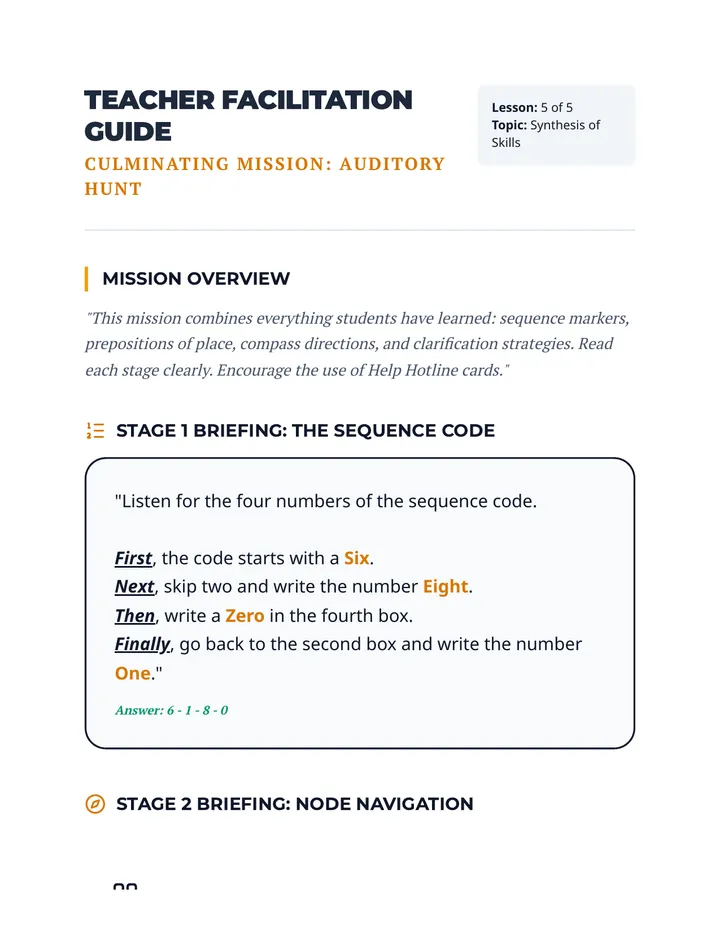
Lesson 1 of 5
Time: 45 Minutes
Learning Objective
Students will be able to categorize test questions into three levels of difficulty (Green, Yellow, Red) based on personal confidence and estimated time required, in order to prioritize tasks during high-stakes exams.
Key ESL Vocabulary
Prioritize Pacing Categorize Efficient Skip
Materials Needed
Traffic Light Slides
Tagging Worksheet (1 per student)
Colored Highlighters (Optional)
Timer/Stopwatch
Lesson Flow
05
Mins
The Hook: The Test Highway
Use Slides 1-2. Ask students: "What happens if a driver stays at a red light for 20 minutes?" Relate this to a test. Explain that "Red questions" stop our progress, and we need to learn how to drive around them.
"Class, today we aren't just students, we are high-speed drivers. Our goal is to reach the finish line of the test without getting stuck."
15
Mins
Direct Instruction: G-Y-R Definitions
Use Slides 3-5 to define the types. Emphasize that difficulty is personal . What is Green for one student might be Yellow for another.
Green: "I know this!" (30 seconds or less)
Yellow: "I can do this, but I need to work." (1-2 minutes)
Red: "I'm lost" or "This is too long." (Skip for now)
15
Mins
Guided & Independent Practice
Distribute the Traffic Light Tagging Worksheet . Set a timer for 2 minutes. Students MUST NOT solve. They only circle G, Y, or R.
Debrief Questions:
Which question was a 'Red' for you? Why?
Did anyone mark Question 3 as Green? Why? (Show different perspectives)
10
Mins
Exit Strategy
Students now have 5 minutes to solve only their Green questions. This builds immediate success and confidence.
ESL Differentiation & Support
Scaffolding
Use physical traffic light cards (colored construction paper) that students can hold up to show their status during group work.
Visuals
Point to the icons on the worksheet frequently. Model "Thinking Aloud" while looking at a question to show the decision-making process.
Skip and Return Slides Skip &
Return
Test Power Tactics: Lesson 2
Beware the "Stuck Monster"
The Stuck Monster wants you to spend 10 minutes on ONE question.
If you get stuck, you lose time for the easy questions at the end.
Don't let him win! Keep moving!
Time Is Running Out!
The 30-Second Rule
30 Seconds
Read the question.
If you don't know how to start after 30 seconds...
SKIP IT!
Wait... how do I skip safely?
How to Skip Safely
DO THIS:
Circle the question number on your booklet.
Leave it blank on the answer sheet.
Check that the NEXT question matches the bubble.
AVOID THIS:
❌ Bubbling the wrong line! (This is a disaster).
❌ Guessing immediately without trying later.
❌ Feeling bad for skipping.
Fast Lane Challenge
We are going to answer 10 questions.
If you get stuck for 30 seconds, you MUST skip.
The winner is the student who gets the most Green questions right before the timer ends.
Fast Lane Challenge Worksheet Fast Lane Challenge
Lesson 2: Skip & Return Strategy
Time Limit
5:00
Driver Name
Mission Status
Ready
In Progress
Finished
The Rules of the Road
Work as fast as you can.
If you get stuck for 30 seconds, you MUST SKIP .
If you skip, circle the question number and check the "SKIPPED" box.
Only return to skipped questions if you have time at the end!
01
What is \( 10 + 20 \)?
Skipped
02
How many seconds are in 4.5 days?
Skipped
03
Which month comes after June?
Skipped
04
A triangle has how many sides?
Skipped
05
Who was the 14th President of the USA?
Skipped
06
Solve for \( x \): \( 3x + 5 = 20 \)
Skipped
07
What color are most leaves in the summer?
Skipped
Score Card
Check your performance after the challenge.
Correct
Safe Skips
Skip and Return Teacher Guide Teacher Facilitation Guide
Skip and Return
Lesson 2 of 5
Time: 45 Minutes
Learning Objective
Students will apply the "30-Second Rule" to identify and skip questions that cause cognitive fatigue, while practicing safe marking techniques to ensure bubbling accuracy on answer sheets.
Key ESL Vocabulary
Safe Skipping Bubbling Error Marking Return Stuck
Materials Needed
Skip and Return Slides
Fast Lane Worksheet (1 per student)
Timer/Stopwatch
Sample Bubble Sheets
Lesson Flow
05
Mins
The Hook: The Stuck Monster
Use Slides 1-2. Tell the story of a student who was a "genius" but only finished 5 questions because the Stuck Monster grabbed them. Ask students: "Is it better to get 1 hard question right, or 10 easy ones?"
10
Mins
The 30-Second Rule & Safe Skipping
Introduce Slide 3. Teach students to look at a clock or count in their head. Demonstrate "Safe Skipping" (Slide 4):
Step 1: Circle the number in the test booklet so you can find it later.
Step 2: Point with your finger to the blank line on the bubble sheet.
Step 3: Move to the next question and check the number again.
20
Mins
Fast Lane Challenge
Distribute the Fast Lane Challenge Worksheet . Explain that points are given for correct answers AND for correctly marking a skip on a hard question.
Teacher Tip: Some questions (like #2 and #5) are designed to be too hard for 4th grade. This is intentional! Watch for students who try to solve them for too long and whisper "30 seconds is up!"
10
Mins
Reflective Debrief
Ask: "How did it feel to skip a question? Was it hard to let go?" Emphasize that skipping is a power move , not a failure.
ESL Support Strategies
Total Physical Response (TPR)
Use a physical "skipping" motion (jumping) or a "stop" hand signal when talking about the 30-second rule.
Sentence Starters
Help students explain why they skipped: "I skipped question #2 because it was a ______ (Red/Time Eater)."
Brain Breaks Slides Brain Breaks &
Stress Busters
Test Power Tactics: Lesson 3
The Brain Battery
Testing takes a lot of energy.
When you feel confused or scared, your battery is low.
You need a RECHARGE to keep going!
25%
CRITICAL NEEDS RECHARGE
Move 1: The 4-7-8 Breath
4
Breathe IN
7
HOLD it
8
Breathe OUT
Why? This tells your brain: "We are safe."
Move 2: The Shoulder Shrug
Pull your shoulders up to your ears.
Squeeze as hard as you can for 5 seconds.
Let them DROP and feel the weight fall off.
Move 3: 10-Second Vacation
"Close your eyes. Imagine yourself somewhere calm:
a beach, a park, or your bed."
Sunlight
Quiet
Peace
When you open your eyes, you are a NEW person.
The Secret Recharge
You don't need to ask permission for these.
If you feel STRESSED, just do one move at your desk.
1
Breathe
2
Shrug
3
Imagine
Calm Down Kit Reference Sheet Stress Buster Kit
Mental Tools for Test Mastery
4-7-8
The Calm Breath
Breathe in for 4 seconds... Hold for 7 ... Blow out slow for 8 .
Quiet Invisible
Squeeze
The Tension Drop
Shrug your shoulders up to your ears. Squeeze hard! Then let them DROP all at once.
Physical Quick
Travel
10-Second Vacation
Close your eyes. Imagine your favorite place. Feel the sun or the quiet. Take one deep breath and open your eyes.
Mental Calming
Check Your Battery
Feeling Mad/Scared
Feeling Confused
Feeling Bored
Ready to Win!
If you are in the RED or AMBER zone, use a move now!
Brain Break Teacher Guide Teacher Facilitation Guide
Stress Busters
Lesson 3 of 5
Time: 40 Minutes
Learning Objective
Students will recognize physical and emotional signs of test anxiety and demonstrate three desk-friendly coping mechanisms (4-7-8 breathing, progressive muscle relaxation, and positive visualization) to self-regulate during a testing session.
Key ESL Vocabulary
Anxiety Overwhelmed Visualization Relaxation Recharge
Materials Needed
Stress Buster Slides
Reference Sheet (1 per student)
Calm Music (Optional)
Lesson Flow
05
Mins
The Brain Battery Check
Use Slide 2. Ask students: "How does your body feel when you see a really hard question?" Elicit responses like: fast heart, sweaty hands, headache, wanting to cry. Relate this to the "Low Battery" warning.
20
Mins
Training the 3 Secret Moves
Go through Slides 3-5. For each move, use the I Do, We Do, You Do model:
Breath: Count out loud while students breathe. Model the "silent" aspect so they don't disturb neighbors during a real test.
Shrug: Have students stand up first to feel the tension, then practice it while sitting at their desks.
Vacation: Turn off the lights and speak in a calm, slow voice. Describe a peaceful scene vividly (scents, sounds).
10
Mins
Simulation & Reference
Hand out the Calm Down Reference Sheet . Give students 3 minutes to work on a difficult math problem from Lesson 2. Mid-way through, say: "Check your battery!" and have everyone choose one move from their sheet to recharge.
05
Mins
Closing Reflection
Ask: "Which move was your favorite? Why?" Encourage students to keep the reference sheet in their folders as their "Secret Agent Kit."
Support for ESL Learners
Sensory Scaffolding
Use a chime or a bell to signal the transitions between breathing phases. Use a "Hoberman Sphere" (expanding ball) to visually represent lung expansion.
Cognitive Load
Testing in a second language is exhausting. Emphasize that these breaks are necessary for their brains to switch back into "English mode" successfully.
Bubble Focus Slides Bubble Sheet
Mastery
Test Power Tactics: Lesson 4
The Silent Thief
A student knows every answer on the test.
But they mark the circles messy or on the wrong line .
The computer gives them a zero.
Don't let bubbling steal your hard work!
The Three S System
Solid
Fill the whole circle. No white spots!
Sharp
Stay inside the lines. Don't go outside!
Smooth
Erase perfectly if you change your mind.
The Number Match
Every time you bubble, ask your brain:
"Is this #5 in the book AND #5 on the sheet?"
Wait... what if I skipped #4?
I MUST be careful!
#5
#5
Disaster Detective
You are now an Expert Grader.
We found a test paper that is a Total Disaster.
Your Goal: Find all the bubbling crimes!
The Disaster Paper Activity Disaster Detective
Crime Scene: The Bubble Sheet
Evidence #4.B
The Mission
A student named "Messy Max" took a practice test. He got all the answers right in his head, but his bubble sheet is a disaster . The computer cannot read his answers. Find 5 mistakes on the sheet below and circle them.
Answer Sheet
A
C
D
A
B
C
D
A
B
C
D
Empty?
A
C
D
The Crime List
"The Ghost"
Not dark enough.
"The Blob"
Outside the circle.
"The Twin"
Two bubbles on one line.
"The Messy Ghost"
Bad erasing.
Detective Signature
Final Report
Messy Max is sad. What is one thing he should do next time?
Your Reward
Now, go fix your own paper using the Three S System.
Bubble Mechanics Teacher Guide Teacher Facilitation Guide
Bubble Mechanics
Lesson 4 of 5
Time: 40 Minutes
Learning Objective
Students will demonstrate physical accuracy in bubbling answer sheets by following the "Three S" system (Solid, Sharp, Smooth) and will identify and correct common alignment errors (skipping rows).
Key ESL Vocabulary
Alignment Erasure Bubbling Optical Scanner Disaster
Materials Needed
Bubble Focus Slides
The Disaster Paper (1 per student)
No. 2 Pencils
Good Erasers
Lesson Flow
05
Mins
The Silent Thief
Use Slides 1-2. Explain that the computer grading the test is like a "robot." It isn't smart enough to know what you meant to mark. It only knows what it sees.
10
Mins
The Three S System
Use Slide 3. Model on the board/projector:
Solid: Show a circle with white gaps vs. a fully dark one. Ask: "Which one can the robot see better?"
Sharp: Show a bubble that spills into the next letter. Explain that the robot might think you picked two answers.
Smooth: Show how a bad eraser leaves a "ghost" mark. The robot will count it as two answers!
05
Mins
The Finger-Point Method
Introduce Slide 4. Demonstrate how to keep your left hand on the question booklet and your right hand (with the pencil) on the bubble sheet. Move them down together like an elevator.
20
Mins
Disaster Detective Activity
Distribute The Disaster Paper . Students work as "detectives" to find the 5 bubbling crimes. Once they find them, they must FIX them in the blank area (or on the back of the paper).
"Class, you are the robots now. Look at this paper. Why would you give Messy Max a zero?"
Kinesthetic Learning for ESL
Physical Anchors
Bubbling is a fine motor skill. For students who struggle, have them practice making large circles on chart paper first, then shrinking the movement down to the small bubble sheet.
Matching Numbers
Encourage ESL students to whisper the question number in English as they move from the booklet to the sheet: "Five... five... six... six." This reinforces both English numbers and focus.
Stamina Challenge Slides The Stamina
Challenge
Test Power Tactics: Final Mission
Your Survival Toolkit
Traffic Lights
Prioritize your path.
30-Second Skip
Avoid the Stuck Monster.
Stress Busters
Recharge your battery.
The goal isn't a 100% score.
The goal is 100% Stamina and Strategy .
Final Mission Rules
1 You have 15 Minutes for 15 questions.
2 Tag every question G, Y, or R FIRST.
3 If you feel overwhelmed, use a Stress Buster .
READY? SET? GO!
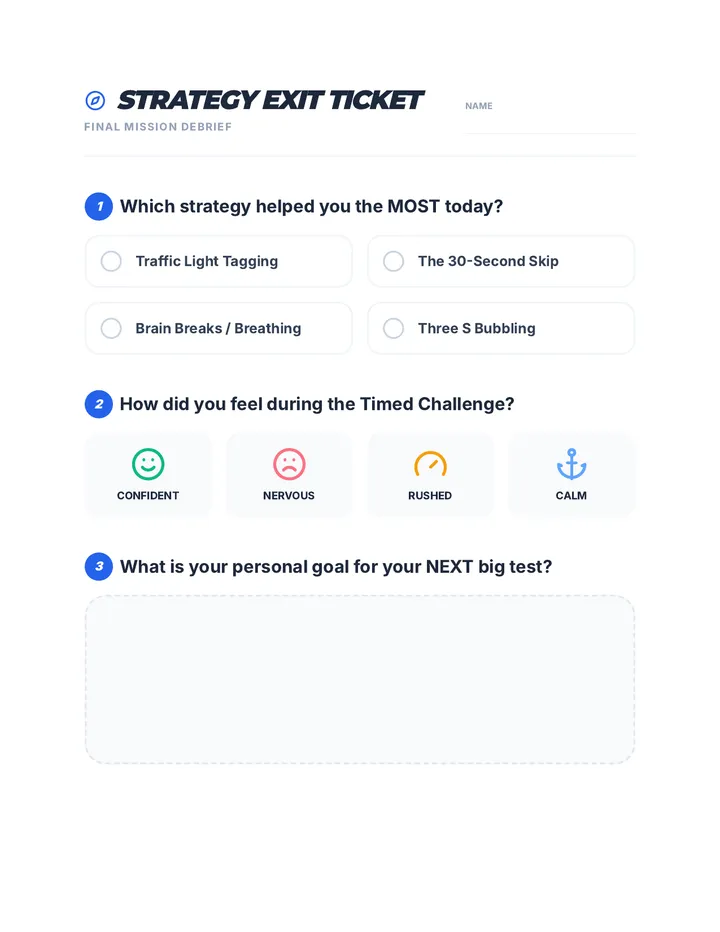
Strategy Reflection Exit Ticket Strategy Exit Ticket
Final Mission Debrief
Name
1 Which strategy helped you the MOST today?
Traffic Light Tagging
The 30-Second Skip
Brain Breaks / Breathing
Three S Bubbling
2 How did you feel during the Timed Challenge?
Confident
Nervous
Rushed
Calm
3 What is your personal goal for your NEXT big test?
Mission Accomplished
You have completed the Test Power Tactics training!
Total Missions
5 / 5
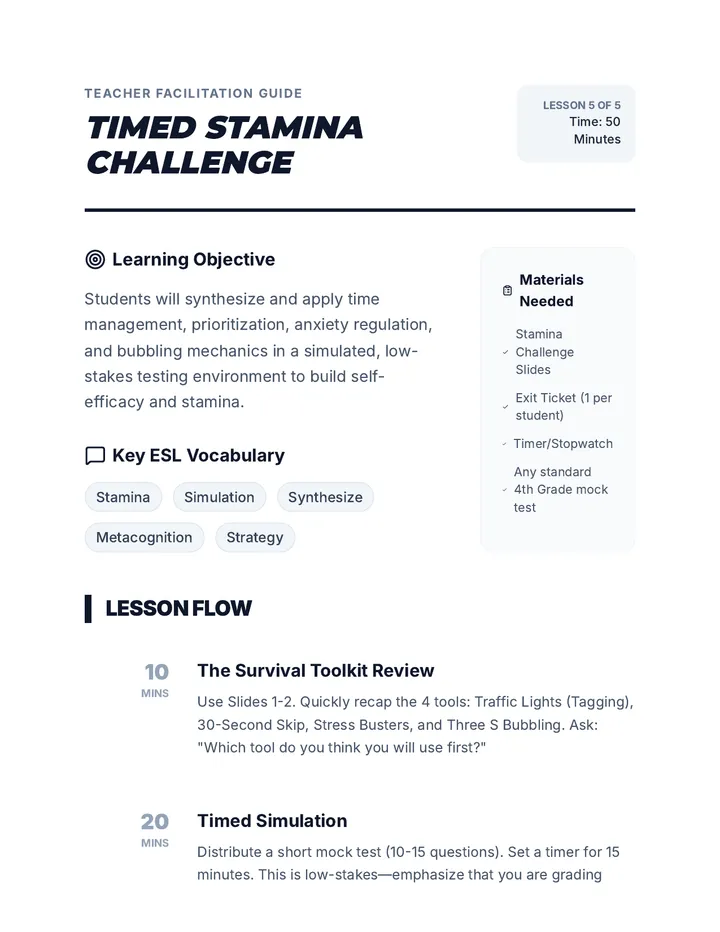
Stamina Challenge Teacher Guide Teacher Facilitation Guide
Timed Stamina Challenge
Lesson 5 of 5
Time: 50 Minutes
Learning Objective
Students will synthesize and apply time management, prioritization, anxiety regulation, and bubbling mechanics in a simulated, low-stakes testing environment to build self-efficacy and stamina.
Key ESL Vocabulary
Stamina Simulation Synthesize Metacognition Strategy
Materials Needed
Stamina Challenge Slides
Exit Ticket (1 per student)
Timer/Stopwatch
Any standard 4th Grade mock test
Lesson Flow
10
Mins
The Survival Toolkit Review
Use Slides 1-2. Quickly recap the 4 tools: Traffic Lights (Tagging), 30-Second Skip, Stress Busters, and Three S Bubbling. Ask: "Which tool do you think you will use first?"
20
Mins
Timed Simulation
Distribute a short mock test (10-15 questions). Set a timer for 15 minutes. This is low-stakes—emphasize that you are grading their behavior and strategy use , not their score.
Teacher Role: Walk around and observe. If you see a student looking stressed, tap their "Calm Down Kit" on their desk. If you see them stuck on a question, point to the clock.
15
Mins
The Mission Debrief
Students complete the Strategy Reflection Exit Ticket . Once finished, facilitate a group discussion. "Who skipped more than 3 questions? Did it help you get more Greens right?"
05
Mins
The Ninja Graduation
Congratulate the class on becoming "Test Power Ninjas." Remind them that these tools stay with them forever, not just for one test.
ESL Empowerment
Metacognition
ESL students often feel that testing is a measure of their "smartness" in English. Shift the focus to testing as a "game" they can beat by using their toolkit effectively.
Positive Framing
Highlight students who used Stress Busters or Skips correctly. Show the class that "expert" test takers use these strategies constantly.
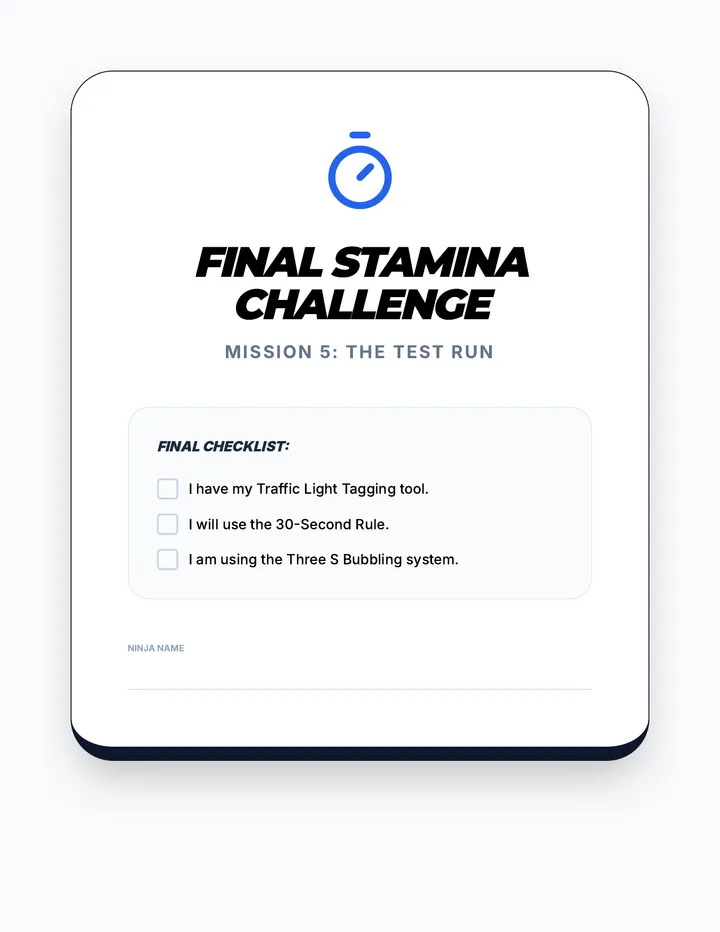
Mock Test Simulation Activity Final Stamina
Challenge
Mission 5: The Test Run
Final Checklist:
I have my Traffic Light Tagging tool.
I will use the 30-Second Rule.
I am using the Three S Bubbling system.
Ninja Name
Section 1: Pacing
15 Minutes
1
What is the capital of Florida?
A) Miami
B) Orlando
C) Tallahassee
D) Tampa
G
Y
R
2
Solve for \( y \): \( 12y + 45 = (345 \times 2) - 12 \)
A) 55
B) 56.5
C) 44.2
D) 61
G
Y
R
3
Read this snippet:
"The ancient turtle moved slowly across the hot sand, searching for the cool ocean water. It had been a long day, and its shell felt heavy under the burning sun."
How does the turtle feel?
A) Happy
B) Tired
C) Scared
D) Fast
G
Y
R
Official Bubble Sheet
A
B
C
D
A
B
C
D
A
B
C
D
A
B
C
D
A
B
C
D
Feeling Overwhelmed?
"Breathe in for 4... Hold for 7... Out for 8..."