Idea Filter Slides Research Lab: Module 1
The Idea Filter
How to extract the core meaning from a text without getting lost in the details.
Unit: Idea Architect Workshop
The "Everything" Problem
BAD HIGHLIGHTING
Honeybees are small insects that live in complex colonies. They are famous for their role in pollination and for producing honey. The hive is ruled by a single queen bee. Worker bees do all the heavy lifting, like gathering nectar and defending the nest.
Why is this useless?
If everything is important, nothing is important.
You haven't separated the "food" from the "wrapper."
Goal: Find the Main Idea and Key Details .
Building the Blueprint
The Main Idea
The "Big Picture." What is the entire paragraph or text mostly about? (The Foundation)
Key Details
Facts, examples, or evidence that support the main idea. (The Pillars)
The Filter Method
1. Skim the text
The Golden Rule of Notes
Never Copy Sentences
When you copy a whole sentence, your brain goes to sleep. You aren't learning; you're just a photocopier.
Bad Note (Copying)
"Honeybees are small insects that live in complex colonies."
Good Note (Filtering)
- Bees live in groups (colonies)
Idea Architect Notebook Idea Architect Notebook
Lesson 1: The Idea Filter
Student Name:
Date:
Architect's Mission
Your job today is to separate the Main Idea from the Key Details . Do not highlight everything! Use the "Filter Method" to find the most important facts.
1
The Filter Phase: Highlighting
Electric cars are becoming a common sight on many roads today. These vehicles do not use gasoline but instead run on electricity stored in large batteries. Because they don't have an exhaust pipe, they produce zero emissions, which is much better for the environment and air quality. Many people choose electric cars because they are quieter than traditional cars and can be cheaper to maintain over time. Governments often offer special tax breaks or money back to people who decide to switch from gas to electric.
Instructions:
Highlight the Main Idea in YELLOW.
Highlight 2-3 Key Details in BLUE.
Use your pens to mark the text above.
2
The Blueprint Phase: Note-Taking
Transform your highlights into bulleted notes. DO NOT copy full sentences!
Main Idea
Supporting Pillars (Key Details)
•
•
•
Architect's Check-In
How did you decide what was "fluff" and what was a "pillar"?
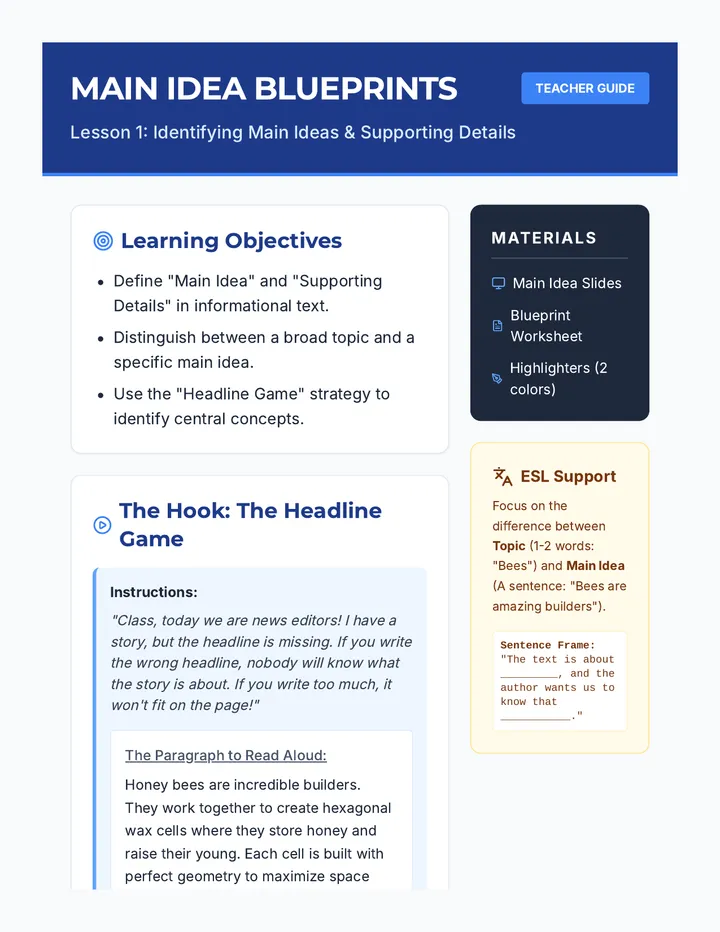
Highlighting Hacks Teacher Guide Highlighting Hacks
Teacher Facilitation Guide | Lesson 1
Time: 45-60 mins
Objective
Students will distinguish between main ideas and supporting details in a technical text. They will practice the "Idea Filter" technique to generate bulleted notes that preserve meaning without verbatim copying.
The Hook (10 mins)
"Give students a paragraph with every single sentence highlighted yellow and ask why this method of highlighting is useless."
Discussion Prompts:
What stands out to you in this paragraph? (Answer: Nothing)
If I gave you a map where every single road was highlighted, would it help you find your way?
Why do we highlight? (To find the "food" inside the "wrapper").
Key Vocabulary
Main Idea The "Big Point" or primary focus.
Key Details Facts/examples that support the main idea.
Note-Taking Writing down ideas in your own words.
Instructional Flow
Phase Teacher Actions & Tips Direct Instruction Use the Idea Filter Slides to model identifying the "Foundation" (Main Idea) vs the "Pillars" (Details). Tip: Use a physical filter or sieve as a visual metaphor if possible. Guided Practice Hand out the Idea Architect Notebook . Read the 'Electric Cars' passage aloud. Ask: "What is the topic?" (Electric Cars). "What is the author trying to tell us about them?" (They are becoming common because they use electricity/no gas). The "No Copying" Rule Watch for students copying full sentences in Step 2. Redirect them: "If you had to text this to a friend in 5 words, what would you say?"
ESL Scaffold: Sifting Language
Sentence Starters for Summarizing:
This paragraph is mainly about...
One important fact is...
The author wants us to know that...
Visual Support:
Encourage students to draw a quick icon (a battery, a leaf) next to their bulleted notes to anchor the meaning without needing complex vocabulary immediately.
Sample Answer Key: Electric Cars
Main Idea:
Electric cars are getting popular because they run on batteries instead of gas.
Key Details:
Voice Lab Slides Research Lab: Module 2
The Voice Lab
Breaking the "Copy-Paste" habit through oral storytelling.
Oral Paraphrasing Practice
The Telephone Effect
When we play "Telephone," the words change, but the message usually stays (mostly) the same.
"The dragon slept on the gold."
"A giant lizard rested on coins."
Concept over Words
Your goal is to catch the IDEA in your mind, then let the WORDS come out naturally.
The R.C.R. Method
1. READ
Read a short passage (1-2 sentences) twice. Look for the main idea.
2. COVER
Put your hand over the text. NO PEEKING! Separate your brain from the author's words.
3. RECITE
Tell a partner what it said in your own words. Start with:"Basically, it says..."
Let's Try One Together
THE ORIGINAL TEXT
"The Great Barrier Reef is so massive that it can actually be seen from outer space by astronauts."
COVER IT
SAY IT
Recall Relay Cards Recall Relay Cards
The Voice Lab: Oral Practice
Read • Cover • Recite
How to Play:
Cut out the cards below.
Partner A reads the card silently twice.Partner A covers the card and tells Partner B what it said.Partner B listens and checks: Was the information correct? Did they use different words?
Topic: Animals
"Octopuses have three hearts and blue blood. They also have no bones, which allows them to squeeze through tiny gaps."
Partner A: Recite
Success?
Topic: Space
"On Venus, the sun rises in the west and sets in the east. This is because the planet rotates backwards compared to Earth."
Partner A: Recite
Success?
Topic: History
"The Great Wall of China was not built all at once. It was constructed over hundreds of years by different emperors."
Partner A: Recite
Success?
Topic: Food
"Honey is the only food that never expires. Archaeologists have found pots of honey in ancient tombs that are still edible."
Partner A: Recite
Success?
The Recap Review
After finishing all cards, discuss with your partner: What was the hardest part about covering the text? Which card had the easiest "main idea" to remember?
One thing my partner did well:
One tip for next time:
Voice Lab Teacher Guide The Voice Lab Guide
Teacher Facilitation Guide | Lesson 2
Time: 45-60 mins
Objective
Students will practice the "Read, Cover, Recite" (RCR) method to separate conceptual understanding from the original author's linguistic structure. The goal is to prove that understanding exists independently of specific vocabulary.
The Hook: Telephone (10 mins)
"Play a game of 'Telephone' to demonstrate how messages change. Start with a complex sentence like: 'The nocturnal feline pursued the rodent through the narrow corridor.'"
Debrief Questions:
What changed? (The specific words)
What stayed the same? (The idea of a cat chasing a mouse)
Which is more important for a researcher: the exact words or the meaning?
RCR Protocol
R
Read Twice
C
Cover Thoroughly
R
Recite to Partner
Instructional Steps
01
Modeling (Slides 3-4)
Show a sentence on the board. Model the "Covering" physically. Say: "I'm looking away so my eyes don't cheat and use the author's words. I'm telling you what my brain remembers, not what my eyes saw."
02
Recall Relay (Cards)
Pairs use the Recall Relay Cards . Circulate to ensure students are actually covering the text. Listen for "ESL fillers" like "Basically," "So," "It's like..." and encourage them!
03
Reflection
Bring the class together. Ask: "Which card was hardest? Why?" (Usually cards with technical terms like 'Archaeologists' or ' Emperors').
ESL Scaffold: Concept Retrieval
Retrieval Frames:
Teach students that they don't need the exact nouns. They can use "The place," "The person," or "The thing."
"Basically, this animal has..."
"There is this thing in space where..."
"The text says that in the past..."
Visualizing:
Tell students to close their eyes while covering. Encourage them to "see the movie" of the octopuses or the Great Wall. It's easier to describe a movie than to memorize a sentence.
Sentence Shifter Slides Research Lab: Module 3
Sentence Shifters
Tools for remodeling sentences while keeping the original meaning.
Sentence Transformation Techniques
The 5-Way Challenge
ORIGINAL SENTENCE
"The dog chased the cat."
How many ways can we say this?
The cat was pursued by the canine.
A hound ran after the feline.
The puppy followed the kitten quickly.
Tool #1: Synonym Swap
Change Key Words (Nouns, Verbs, Adjectives) to words that mean the same thing.
Example:
"The huge city was built long ago."
"The massive metropolis was constructed in the past."
Eat
Consume / Devour
Happy
Joyful / Content
Fast
Rapid / Quick
Hard
Difficult / Tough
Tool #2: Structure Flip
Active to Passive
Change who is doing the action. Move the "object" to the front.
Active:
"Ancient Romans created concrete."
Passive:
"Concrete was created by ancient Romans."
Mix & Match!
The best paraphrasing uses BOTH tools at once.
"A strong material was invented by people in Rome."
Sentence Shifter Lab The Sentence Shifter Lab
Lesson 3: Rewriting with Style
Engineer Name:
Lab Date:
The Word Vault
Write at least two synonyms for each word to prepare your brain for shifting.
BIG
QUICKLY
DIFFICULT
MADE
L1
Synonym Swap
Rewrite the sentence by changing the underlined words to synonyms from your vault or your brain.
"The large whale ate many small fish."
"Solving the puzzle was very hard for the student."
L2
Structure Flip (Active → Passive)
Change the structure. Start the sentence with the result or object .
"Thomas Edison invented the lightbulb."
"The heavy rain flooded the city streets."
Level 3: The Master Shifter
Swap the words AND Flip the structure!
"The scientist discovered a new species of bacteria."
Sentence Shifter Teacher Guide Sentence Shifter Guide
Teacher Facilitation Guide | Lesson 3
Time: 45-60 mins
Objective
Students will use synonym substitution and grammatical transformations (active to passive voice) to rewrite individual sentences without changing the original meaning.
The Hook: 5-Way Challenge (10 mins)
"Challenge students to say 'The dog chased the cat' in five completely different ways."
Discussion Prompts:
Is the dog still the one doing the chasing in your new sentence?
Which way sounded the most professional?
Does using a different word for "dog" change what happened?
Transformation Tools
Synonym Swap
Change vocabulary but keep the "flavor."
Structure Flip
Change the grammar (Active → Passive).
Instructional Flow
1. Modeling the Shifters (Slides 3-4)
Focus on the word "Object." Explain that moving the object to the front of the sentence is like putting a spotlight on it. Romans → Concrete. Concrete was created by → Romans.
2. Synonym Bank Strategy
Students often struggle with "over-paraphrasing" (changing words until the sentence makes no sense). Remind them: "If you don't know the synonym, don't use it." Accuracy is more important than being a walking thesaurus.
3. The Master Shifter Challenge
Encourage students to use a "Bridge word" like BY or WAS to help with the passive structure.
Sample Transformation Keys
Level 1: Synonym Swap
Large/Ate: "The enormous whale consumed many small fish."Hard: "Solving the puzzle was very difficult/challenging for the student."
Level 2: Structure Flip
Edison: "The lightbulb was invented by Thomas Edison."Rain: "The city streets were flooded by the heavy rain."
Level 3: Master Shifter
"A fresh type of germ was found by the researcher." or "A previously unknown bacteria was identified by the scientist."
Quote Quest Slides Research Lab: Module 4
Quote Quest
The art of choosing when to borrow words and when to build your own.
Quoting vs. Paraphrasing
The Quote Overload
"The Earth is round," said Smith. "It has water," noted Jones. "There are many trees," added Brown. "The atmosphere is thin," claimed White. "It orbits the sun," concluded Green.
"Is this fun to read?"
It feels like a robot is talking.
It's boring and repetitive.
It shows the author hasn't processed the info.
The "Quote It" Rulebook
Beautiful Language
If the original words are poetic, powerful, or unique. You can't say it better.
"I have a dream..."
Technical Experts
If a specific scientist or expert says something exactly a certain way.
"The virus mutation rate is exactly 0.05% per week."
The "Paraphrase It" Rulebook
General Facts
Simple information that anyone can know. It doesn't belong to one person.
"Paris is the capital of France."
Long Explanations
If the original text is too long or wordy. Shrink it down to the main point.
A 3-page article summarized into one sentence.
Quote or Rewrite Sort The Quote Sort
Lesson 4: Evidence Selection
Quote vs. Paraphrase
Architect's Orders:
Look at the text pieces below. Decide if you should use a Direct Quote (keep the exact words in quotation marks) or Paraphrase (write it in your own voice). Circle your choice and explain WHY .
Case #01
"The moon's gravity is about one-sixth of the gravity on Earth, which is why astronauts can jump so high."
Quote It
Rewrite It
Reason:
Case #02
"Never in the field of human conflict was so much owed by so many to so few." (Winston Churchill, 1940)
Quote It
Rewrite It
Reason:
Case #03
"The average temperature in the Gobi Desert can drop as low as minus 40 degrees Celsius during the winter months."
Quote It
Rewrite It
Reason:
The Golden Decision
If you had to pick ONLY ONE sentence to quote in a whole essay, which type of sentence would you pick and why?
Quote Quest Teacher Guide Quote Quest Guide
Teacher Facilitation Guide | Lesson 4
Time: 45-60 mins
Objective
Students will evaluate text snippets to determine the most effective evidence integration strategy: direct quoting or paraphrasing. They will learn to identify "powerful language" vs. "general facts."
The Hook: Quote Overload (10 mins)
"Show a text composed entirely of quotation marks and discuss why it is difficult and boring to read."
Discussion Prompts:
Whose voice are you hearing when you read this?
Does the author actually understand the topic, or are they just repeating things?
When should we stop repeating and start explaining?
Decision Matrix
Quote It if...
It's a "Mic Drop" moment. Unique, emotional, or high-level expertise.
Paraphrase it if...
It's "Just the Facts." Numbers, dates, or basic science.
Instructional Flow
1. Direct Instruction (Slides 3-4)
Contrast "Paris is the capital of France" with "I have a dream." Ask: "Can I say the first one better? Yes. Can I say the second one better? Probably not."
2. Guided Sort Practice
Hand out the Quote or Rewrite Sort . Do Case #01 together. Point out that numbers (one-sixth) are facts, not "artistic language," so they should be rewritten.
3. The Peer Defense
Have students compare their "Reasons" with a neighbor. There isn't always one right answer, but there is always a better choice!
Sample Key & Justification
Case 01: Rewrite It
This is a scientific fact. It's easy to say "Moon gravity is low" in your own words.
Case 02: Quote It
This is a famous, powerful speech. The rhythm and specific words (owed, so few) are iconic.
Case 03: Rewrite It
This is purely data. It's better to summarize the temperature range than quote it.
Synthesis Studio Slides Research Lab: Module 5
The Source Weaver
The final challenge: Combining different threads into a single story.
Synthesizing Multiple Sources
The Recipe Challenge
Recipe #1: Flour, Sugar, Eggs
"The cake needs a sweet base."
Recipe #2: Cocoa, Butter, Milk
"Chocolate makes everything better."
The Synthesis
"By combining the sweet base with chocolate and butter, we can bake a delicious chocolate cake."
A NEW WHOLE
Synthesis = Connecting Ideas
Compare
How are the two sources the same? What facts do they both mention?
Contrast
What is different? Does one source give a detail the other doesn't?
Combine
Organize the facts logically. Don't just list them one after another.
"Source A says X, and Source B adds Y, which proves Z."
The Step-by-Step Build
1
NOTES
Take bulleted notes from both sources using the Filter Method.
2
GROUP
Group similar facts together. What is the shared "Big Idea"?
3
SHIFTERS
Use your Sentence Shifter tools to write your own sentences.
4
CONNECT
Use transition words (Furthermore, Additionally, However) to glue it all together.
The Source Weaver Project The Source Weaver Project
Capstone Task: The Mars Mission
Expert Name:
The Weaver's Goal
You are researching the challenges of sending humans to Mars. Use the two sources below to create a single synthesized paragraph that explains why this mission is so difficult.
Source A: NASA Report
"A journey to Mars takes approximately seven to nine months. During this long flight, astronauts are exposed to high levels of cosmic radiation, which can damage human cells and increase the risk of serious health problems."
Bullet Notes (Source A)
Source B: Tech Journal
"Spacecraft must carry huge amounts of food, water, and oxygen for a multi-year mission. Because Mars is so far away, resupplying the crew from Earth is impossible. Astronauts must rely entirely on what they bring with them."
Bullet Notes (Source B)
The Connector Brainstorm
How can you connect Source A (health/radiation) with Source B (supplies/distance)?
Shared Topic:
Key Connection Word:
(e.g., Therefore, Also, In addition)
The Final Synthesis
Architect's Workspace
Weaver's Quality Check:
Did I use facts from BOTH sources?
Did I use MY OWN words (no copying)?
Did I use TRANSITION words (e.g., also, however)?
Does the paragraph make sense as a WHOLE ?
Self-Rating:
Needs Work
Getting There
Synthesis Master
Source Weaver Teacher Guide Synthesis Success Guide
Teacher Facilitation Guide | Lesson 5
Time: 60-75 mins
Objective
Students will synthesize information from two distinct sources into a single, logically organized paragraph. This requires combining previous skills (Main Idea filtering, RCR retelling, and Sentence Shifting) to create a "new whole."
The Hook: Recipe Mix (10 mins)
"Give students ingredients (facts) from two different recipes and ask them to bake a new, single cake (paragraph)."
Key Points:
You can't just put the ingredients next to each other; they have to be mixed .
Does the final cake look like a pile of flour? No, it looks like a cake.
Your paragraph should look like a new piece of writing, not a list of quotes.
Weaver's Checklist
Both Sources Used
Zero Plagiarism
Logical Flow
Clear Transitions
The Final Workshop Flow
Step 1: The Sift
"Notes before writing."
Ensure students are only writing 3-5 words per bullet point. If they write full sentences now, they will copy them later.
Step 2: The Logic Lock
"How do these relate?"
Ask: "Is Source B a reason for Source A? Or is it just another problem?" (Answer: Both describe different types of 'long-distance' problems).
Step 3: Draft & Shift
"Put it in your voice."
Remind students to use their "Sentence Shifter" tools. Flip active sentences and use synonyms for 'danger' and 'difficult'.
Step 4: The Glue
"Smooth transitions."
Model how to use 'Furthermore' or 'Additionally' to connect the health risks of radiation to the logistics of resupply.
ESL Scaffold: Transition Bank
Provide these "Bridge Words" on the board during the final writing phase:
Additionally
Furthermore
In addition
Moreover
Also
Because of this
Sample Synthesized Paragraph:
"Sending humans to Mars is incredibly difficult because of the long travel time and the lack of resources. According to Source A, the journey takes nearly nine months, which exposes astronauts to dangerous space radiation. Additionally, Source B explains that resupplying the crew is impossible due to the distance. Therefore, astronauts must carry all of their own food, oxygen, and water for the entire multi-year mission."