Descriptive Eyes Teacher Guide Unit: Compare & Speak • Lesson 1 of 3
Descriptive Eyes Teacher Guide
Grade 7 ENL / Expanding
Focus: Describing Words & Final Consonants
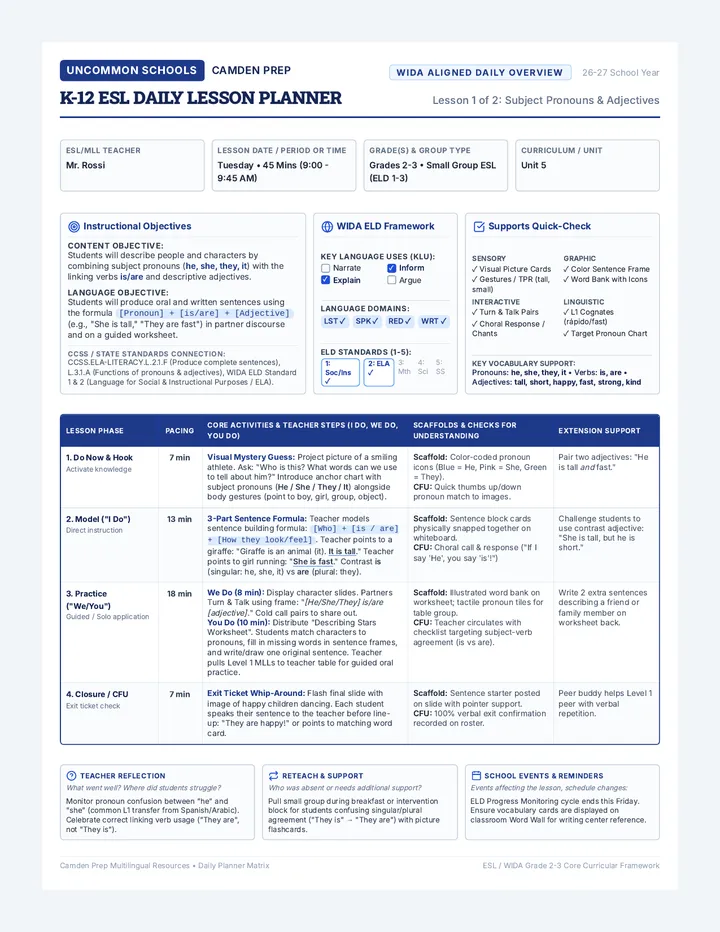
Lesson Objective: Students will identify and pronounce sensory adjectives describing visual pictures, accurately articulating final consonants /t/, /d/, /m/, /s/ in single-word and noun-phrase contexts.
Pacing: 45 Min
• Warm-Up & Sound Check: 8 min
• Picture Observation: 12 min
• Guided Adjective Pairing: 15 min
• Pronunciation Exit Slip: 10 min
Language Targets
Identify single-syllable and two-syllable descriptive words; pair adjectives with nouns ("the fast cheetah"); articulate final stop and nasal consonants.
Target Phonemes
/t/: fast, hot, quiet, bright
/d/: loud, cold, hard, round
/m/: calm, warm, dim
/s/: fierce, cross, famous
Mouth Mechanics Routine: Crisp Ending Consonants
Sound /t/ (Voiceless Stop) fast, quiet
Teacher Prompt: "Tongue tip taps the roof of your mouth right behind your top teeth. Release a small, clean burst of air. Do not say 'tuh'."
Sound /d/ (Voiced Stop) loud, cold
Teacher Prompt: "Place your hand on your throat. Feel your vocal cords vibrate. Stop the voice cleanly with your tongue—no extra 'duh' vowel at the end."
Sound /m/ (Bilabial Nasal) calm, warm
Teacher Prompt: "Press both lips firmly together. Hum through your nose. Keep your lips closed until the sound finishes completely."
Sound /s/ (Voiceless Fricative) fierce, cross
Teacher Prompt: "Teeth close together, tongue held behind them. Blow air out like a gentle hissing snake. Don't stop it abruptly."
Step-by-Step Lesson Execution
1
Warm-Up Echo Drill (8 min): Model the 4 target sounds using hand mirrors or touch cues (hand on throat for /d/, hand in front of lips for /t/). Have students repeat: calm → cold → fast → fierce.
2
Picture Decoding (12 min): Direct students to Section A of the student worksheet. Prompt: "What visual traits do you see in the lion versus the cheetah? Let's choose the describing word that tells how it acts or feels."
3
Noun-Phrase Construction (15 min): Teach the formula: "The + [Adjective] + [Noun]". Model choral reading with exaggeration of the final consonant sound before the noun.
Unit: Compare & Speak • Descriptive Eyes Page 1 of 2
Instructional Facilitation & Support
Differentiation, Common Traps & Assessment
Lesson 1 Guide
Common ENL Speech Obstacles & Corrections
Final Consonant Deletion (Dropping the ending sound):
Students speaking Spanish, Vietnamese, or Cantonese may say "col" instead of "cold" or "fas" instead of "fast" because their primary language rarely ends in stop consonant clusters.Corrective cue: "Tap your desk when you hit the final letter: fas-[TAP] . Hear the click!"
Epenthesis (Adding an extra vowel sound like "fasteh" or "louda"):
Students attempt to complete the consonant by opening their mouth into a schwa.Corrective cue: "Freeze your tongue or lips right when the word finishes. Close the door on the word!"
Support: Entering & Emerging
• Provide tactile letter cards (T, D, M, S) to hold up after speaking.
• Pair with picture flashcards showing physical antonyms (fire = hot, ice = cold).
• Accept single adjective + noun verbal responses before requiring full sentences.
Extension: Expanding & Bridging
• Challenge students to use two adjectives: "The calm, quiet ocean."
• Ask students to identify which ending consonants share tongue positions (/t/ and /d/).
• Have students record their own audio on a tablet and playback to self-monitor final stops.
Oral Pronunciation Check Rubric (Formative Assessment)
Criteria
Mastery (3 pts)
Developing (2 pts)
Emerging (1 pt)
Sound Articulation (/t/, /d/, /m/, /s/)
Final sound is crisp, audible, and stops cleanly without added vowels.
Sound is produced but quiet, muffled, or followed by slight schwa.
Final sound is omitted completely (e.g., "col" for "cold").
Vocabulary Match
Accurately identifies visual traits of picture prompt.
Identifies plausible trait with verbal prompting.
Selects inaccurate describing word for the image.
Phrase Structure
Confidently pairs "The [Adj] [Noun]" in natural spoken flow.
Pauses heavily between adjective and noun.
Reverses order (e.g., "The lion fierce").
Unit: Compare & Speak • Descriptive Eyes Page 2 of 2
Descriptive Eyes Student Worksheet Lesson 1 Practice
Descriptive Eyes Student Worksheet
Name:
Date: Period:
Goal: Practice looking at pictures, choosing describing words (adjectives), and saying ending consonant sounds clearly: /t/, /d/, /m/, /s/.
Part 1: Ending Sound Word Bank
Say each word out loud. Feel the ending sound!
/t/ Sound
fast
hot
quiet
bright
/d/ Sound
loud
cold
hard
round
/m/ Sound
calm
warm
dim
firm
/s/ Sound
fierce
cross
close
famous
Part 2: Picture Detective — Choose the Best Describing Word
Look at each picture scene. Choose the best describing word from the bank. Then write the word and circle its ending consonant sound.
🦁
Scene 1: Wild Lion Roaring with sharp teeth
Describing Word:
Ending Sound:
/t/ /d/ /m/ /s/
🏔️
Scene 2: Snow Peak Covered in deep winter ice
Describing Word:
Ending Sound:
/t/ /d/ /m/ /s/
☕
Scene 3: Steaming Mug Steam rising from fresh cocoa
Describing Word:
Ending Sound:
/t/ /d/ /m/ /s/
🌊
Scene 4: Still Lake Water is peaceful, no waves
Describing Word:
Ending Sound:
/t/ /d/ /m/ /s/
Lesson 1: Descriptive Eyes Page 1 of 2 • Continue to Page 2
Part 3 & Part 4
Building Descriptive Phrases & Pronunciation Check
Name:
Phrase Pattern: The + [Describing Word] + [Naming Word]
Example: The + fast (adjective) + cheetah (noun) = "The fast cheetah"
Part 3: Combine Words to Describe Pictures
Use an adjective from your word bank that ends with /t/, /d/, /m/, or /s/. Write complete descriptive phrases on the lines below.
1. Picture: A thunderstorm at night with thunder Ending sound: /d/
2. Picture: A runner sprinting across the track Ending sound: /t/
3. Picture: A warm blanket on a winter bed Ending sound: /m/
4. Picture: A tiger showing sharp claws Ending sound: /s/
Part 4: Partner Pronunciation Listening Station
Partner's Name: ____________
Read your 4 phrases out loud to your partner. Your partner listens and puts a checkmark (✓) if they hear the ending sound clearly without dropping it!
/t/ Sound
e.g., fast
/d/ Sound
e.g., loud
/m/ Sound
e.g., calm
/s/ Sound
e.g., fierce
Lesson 1: Descriptive Eyes Page 2 of 2 • Great job practicing your ending sounds!
Descriptive Eyes Answer Key Educator Answer Key & Guide
Descriptive Eyes Answer Key
Lesson 1 Key
Grade 7 ENL Program
Part 1: Ending Sound Categorization Key
/t/ (Tongue tap)
• fast
• hot
• quiet
• bright
/d/ (Vocal buzz)
• loud
• cold
• hard
• round
/m/ (Nasal hum)
• calm
• warm
• dim
• firm
/s/ (Hissing stream)
• fierce
• cross
• close
• famous
Part 2: Picture Detective Answers & Acceptable Variations
Scene 1: Wild Lion Target: fierce (/s/)
Primary Answer: fierce → Circle: /s/Acceptable Alternate: loud → Circle: /d/
Scene 2: Snow Peak Target: cold (/d/)
Primary Answer: cold → Circle: /d/Acceptable Alternate: quiet → Circle: /t/
Scene 3: Steaming Mug Target: hot (/t/) or warm (/m/)
Primary Answer: hot → Circle: /t/Acceptable Alternate: warm → Circle: /m/
Scene 4: Still Lake Target: calm (/m/)
Primary Answer: calm → Circle: /m/Acceptable Alternate: quiet → Circle: /t/
Part 3: Descriptive Phrase Model Answers
Item 1: Thunderstorm (/d/) "The loud thunderstorm" (or "The cold rain")
Item 2: Runner (/t/) "The fast runner" (or "The bright athlete")
Item 3: Blanket (/m/) "The warm blanket" (or "The calm bedroom")
Item 4: Tiger (/s/) "The fierce tiger" (or "The cross cat")
Oral Pronunciation Diagnostic Tips
• In Part 4 Partner Check: Circulate and listen specifically for the juncture between the adjective and noun (e.g., "fas-t-runner" vs "fas-runner"). Many ENL students elide the final consonant before the next initial consonant. Encourage a mini micro-pause.
• Praise Effort: When students intentionally articulate the voiceless /t/ or voiced /d/, reinforce with praise: "Great tongue tap on that /t/!"
Lesson 1: Descriptive Eyes Answer Key Document Page 1 of 1
Comparison Power Teacher Guide Unit: Compare & Speak • Lesson 2 of 3
Comparison Power Teacher Guide
Grade 7 ENL / Expanding
Focus: Comparative Adjectives & Suffix Articulation
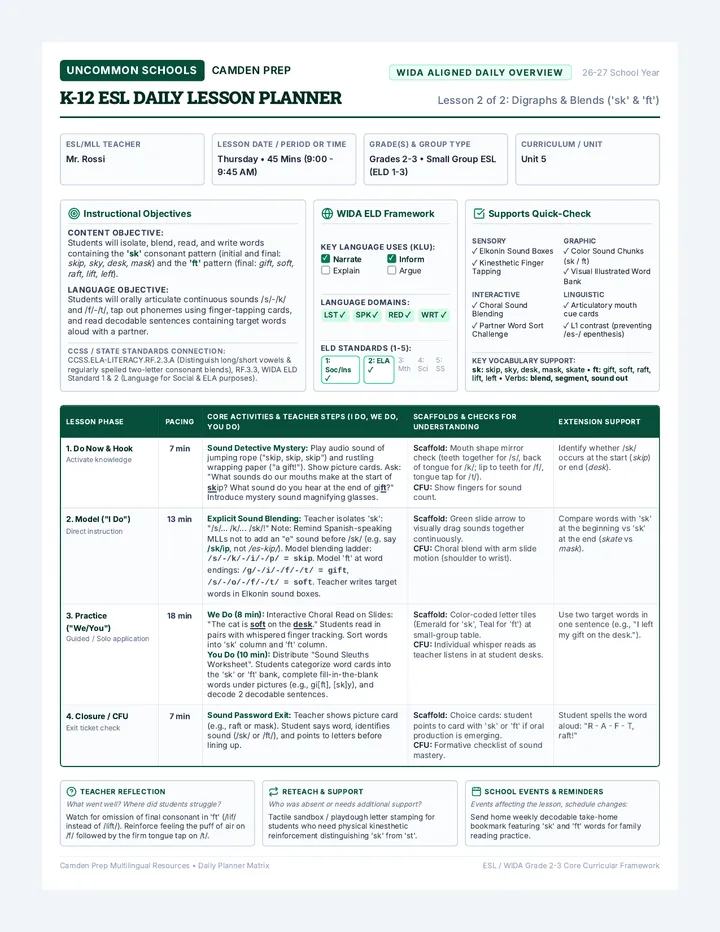
Lesson Objective: Students will transform base adjectives into comparative forms ("-er than") to contrast two picture subjects, correctly pronouncing the consonant bridge (/t/, /d/, /m/, /s/) before the suffix.
Pacing (45 Min)
• Morphological Warm-Up: 8 min
• Consonant Bridge Modeling: 12 min
• Side-by-Side Comparison: 15 min
• Pronunciation Speed-Check: 10 min
Grammar Target
Construct basic comparative clauses: [Noun A] is [Adj]-er than [Noun B]. Master spelling adjustments (doubling final consonants in hot → hotter ).
Phonetic Bridge
Preserve articulation of root consonants when followed by the vowel suffix -er : fast-er, loud-er, warm-er, fierce-er.
The "Consonant Bridge" Pronunciation Technique
When adding -er , ENL students frequently swallow the ending consonant or drop the suffix entirely (e.g., saying "The jet is more fast" or "fasser" ). Use the syllable-split clapping routine:
Bridge /t/: fas-ter / ho-tter Clap & Tap
Script: "Clap for the base word: FAST . Tap your desk for the ending: -ER . Keep the /t/ firm and crisp between syllables: fast-er ."
Bridge /d/: loud-er / cold-er Vocal Hum
Script: "Feel the vibration in your throat on /d/ before opening into /ər/. Don't let the /d/ disappear into a lazy roll: loud-er ."
Bridge /m/: warm-er / calm-er Lip Seal
Script: "Press your lips together firmly on the /m/ before releasing for the suffix: warm... er . Do not skip the hum!"
Bridge /s/: fier-cer / clo-ser Air Stream
Script: "Keep the steady hissing /s/ sound as your mouth moves into the /ər/. Hear the distinct friction: fier-cer ."
Step-by-Step Instructional Sequence
1
Comparative Rule & Transformation (8 min): Introduce adding "-er" for 1-syllable adjectives. Explicitly teach the linking word "than" (focus on voiced /ð/). Contrast "The cheetah is fast" with "The cheetah is faster than the lion."
2
Side-by-Side Visual Modeling (12 min): Show two contrasting pictures (e.g., Airplane vs Train; Iceberg vs Glacier). Model asking: "Which one has more speed?" → "The plane is faster than the train."
3
Choral & Partner Practice (15 min): Have students complete Worksheet Section B & C. Conduct choral reading of comparative pairs to reinforce rhythm and consonant retention.
Unit: Compare & Speak • Comparison Power Page 1 of 2
Scaffolding & Troubleshooting
Comparative Grammar Scaffolding & Speaking Fluency
Lesson 2 Guide
Key Syntactic & Phonetic Traps for 7th Grade ENL
Trap 1: Double Comparatives ("more faster")
Students often translate directly from Spanish ("más rápido" ) or simply stack both forms.Teacher Fix: "If you add -er to the tail, you don't need more in the front! One power boost only."
Trap 2: Omitting "than" or using "that"
Students say: "The dog is louder that the cat" or omit than entirely.Teacher Fix: Drill the two-finger bridge gesture: index finger = "-er" , middle finger = "than" .
Scaffolding for Level 1 & 2 Students
• Provide color-coded word cards: Noun (Blue) + Verb (Red) + Comparative (Green) + Than (Purple) + Noun (Blue).
• Use physical scale balance manipulatives: place heavier/taller item on higher side.
• Allow choral echo before calling on individual student oral production.
Extensions for Level 3 & 4 Students
• Prompt students to justify comparisons: "The plane is faster than the train because it flies in the sky."
• Contrast with irregular comparatives (e.g., good → better, bad → worse ).
• Have students create reverse comparisons: "The train is slower than the plane."
30-Second Pronunciation Check Protocol
During independent practice, visit individual students and ask them to read one sentence. Score immediately:
Consonant Clarity Is /t/, /d/, /m/, /s/ audible before the -er?
Comparative Form Correctly uses -er without inserting "more"?
Connector "Than" Includes voiced "than" /ðæn/ smoothly?
Unit: Compare & Speak • Comparison Power Page 2 of 2
Comparison Power Student Worksheet Lesson 2 Practice
Comparison Power Student Worksheet
Name:
Date: Period:
Grammar Rule: Add -er + than to compare two things. Keep your ending consonants (/t/, /d/, /m/, /s/) loud and clear!
Part 1: The Comparative Builder
Add "-er" and say both words out loud
Base Adjective
Ending Sound
Comparative Form (-er)
fast
/t/
faster (example)
loud
/d/
calm
/m/
cold
/d/
warm
/m/
fierce
/s/
Part 2: Side-by-Side Picture Comparisons
Compare the two pictures in each box. Fill in the missing comparative word and read the comparison aloud.
✈️ Jet
VS
🚂 Train
The jet is than the train.
🧊 Iceberg
VS
💧 Puddle
The iceberg is than the puddle.
🥁 Bass Drum
VS
🔔 Small Bell
The bass drum is than the bell.
Lesson 2: Comparison Power Page 1 of 2 • Continue to Page 2
Part 3 & Part 4
Comparative Sentences & Pronunciation Track
Name:
Sentence Frame Formula
The + [Noun A] + is + [Adjective]-er + than + the + [Noun B].
Part 3: Write Complete Comparative Sentences
Look at the picture pairs. Write a complete sentence using the frame. Remember to include is and than .
1. Compare: Cheetah vs Turtle (Word: fast) Bridge sound: /t/
2. Compare: Winter Snow vs Autumn Breeze (Word: cold) Bridge sound: /d/
3. Compare: Cozy Fire vs Morning Sun (Word: warm) Bridge sound: /m/
4. Compare: Guard Dog vs House Bunny (Word: fierce) Bridge sound: /s/
Part 4: Oral Fluency Rhythm Clapping Drill
Say each sentence with rhythm. Clap on the CAPITAL words. Hold the ending consonant sound!
👏 "The CHEE-tah is FAS-ter than the TUR-tle ."
👏 "The THUN-der is LOU-der than the WHIS-per ."
Consonant Bridge Clear? Heard /t/, /d/, /m/, /s/ before "-er"
Used "Than" Correctly? Did not say "that" or skip it
Lesson 2: Comparison Power Page 2 of 2 • Excellent work comparing picture subjects!
Comparison Power Answer Key Educator Answer Key & Guide
Comparison Power Answer Key
Lesson 2 Key
Grade 7 ENL Program
Part 1: Comparative Builder Answer Key
loud (/d/) → louder
calm (/m/) → calmer
cold (/d/) → colder
warm (/m/) → warmer
fierce (/s/) → fiercer (drop 'e', add -er)
fast (/t/) → faster
Part 2: Side-by-Side Sentence Completions
Jet vs. Train: "The jet is [ ______ ] than the train." faster
Iceberg vs. Puddle: "The iceberg is [ ______ ] than the puddle." colder (also accept 'harder')
Bass Drum vs. Bell: "The bass drum is [ ______ ] than the bell." louder
Part 3: Comparative Sentence Models
1. Cheetah vs. Turtle:
"The cheetah is faster than the turtle."
Alternative: "The turtle is calmer than the cheetah."
2. Winter Snow vs. Autumn Breeze:
"The winter snow is colder than the autumn breeze."
3. Cozy Fire vs. Morning Sun:
"The cozy fire is warmer than the morning sun."
4. Guard Dog vs. House Bunny:
"The guard dog is fiercer than the house bunny."
Alternative: "The guard dog is louder than the house bunny."
Auditory Monitoring Checklist for Teacher Circulation
• Listen for the distinction between "warm" and "warmer" . Check that students do not say "more warm" .
• Ensure students pronounce than with an initial voiced dental fricative /ð/, not an unvoiced /θ/ (like in "thin") or /d/ (like "dan").
• Give immediate non-verbal cues: tap pointer finger on desk for each syllable (FAS-TER) to maintain cadence.
Lesson 2: Comparison Power Answer Key Document Page 1 of 1
Sentence Sculptors Teacher Guide Unit: Compare & Speak • Lesson 3 of 3 (Culmination)
Sentence Sculptors Teacher Guide
Grade 7 ENL / Expanding
Focus: Compound Picture Description & Speech Mastery
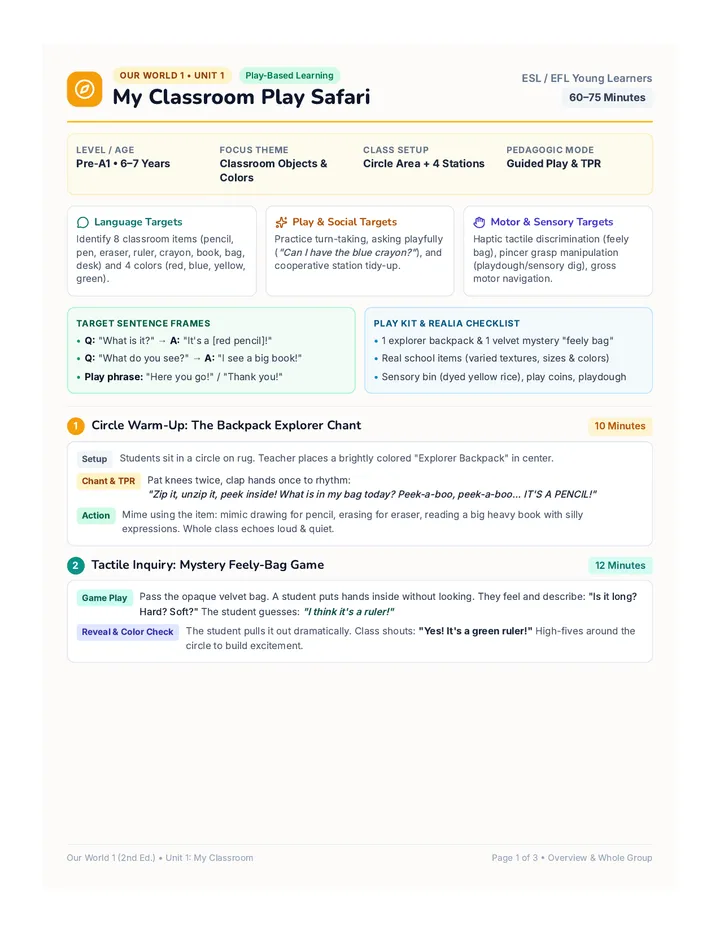
Culminating Objective: Students will synthesize Lessons 1 & 2 by generating oral and written picture descriptions using the target frame: "The [adj] [noun] is [adj]-er than the [noun]", articulating all ending consonants (/t/, /d/, /m/, /s/) across both descriptive positions.
Pacing (45 Min)
• Dual Adjective Warm-Up: 7 min
• Frame Anatomy & Color Coding: 13 min
• Rich Picture Synthesis: 15 min
• Showcase & Pronunciation Audit: 10 min
Syntax Target
Unite an attributive adjective (position 1) with a predicate comparative adjective (position 2) in a single coherent contrastive sentence.
Phonemic Rigor
Audit final stops and nasals (/t/, /d/, /m/, /s/) in consecutive words (e.g., "fast cat is calm-er").
Anatomy of the Target Sentence Frame
Article The
[Adj 1] fast Ending /t/
[Noun 1] cheetah
Verb is
[Adj 2]-er than calmer than Bridge /m/
the [Noun 2] the lion.
"The fast cheetah is calmer than the lion." — Notice how the sentence paints two distinct visual qualities at once!
Step-by-Step Lesson Execution
1
Target Frame Deconstruction (13 min): Display the formula on the board. Model with finger counting: 1 (The) 2 (fast) 3 (dog) 4 (is) 5 (louder than) 6 (the cat). Practice choral chant with rhythm.
2
Picture Observation & Attribute Selection (15 min): Guide students through worksheet pictures. Point to Animal A: "What adjective describes it right now?" Point to Animal B: "How does Animal A compare to Animal B?"
3
Double-Check Sound Station (10 min): Have students read sentences aloud in pairs with the Final Consonant Scoring Card. Students check off every sound heard clearly.
Unit: Compare & Speak • Sentence Sculptors Page 1 of 2
Scaffolding & Oral Mastery
Culminating Assessment & Differentiation
Lesson 3 Guide
Culminating 4-Point Oral Rubric
Score
Grammar Frame Accuracy
Pronunciation of Consonants
4 - Mastery
Includes both adjectives, "is", and "than the [noun]" without missing elements.
All ending consonants (/t/, /d/, /m/, /s/) articulated with crisp distinction and no dropped endings.
3 - Proficient
Sentence frame is complete with minor pause or hesitation before "than".
Consonants clearly audible; minor softening of final stop (/t/ or /d/) without loss of meaning.
2 - Developing
Missing one element (e.g., omits first adjective or forgets "is").
Drops 1-2 final consonants (e.g., says "cal" for "calm" or "fas" for "fast").
1 - Emerging
Produces isolated words; unable to link into the full comparative frame.
Final consonants frequently omitted; needs physical prompt cards.
Sentence Strip Scaffolds
For students struggling with frame memory, write color-coded sentence blocks on magnetic dry-erase strips. Allow them to physically arrange the strip pieces before speaking.
Audio Recording Extension
Have students use a classroom tablet or voice recorder to record their final 2 sentences. Play back at 0.75x speed to let students hear their own ending consonant precision!
Coaching Dialogue for Instant Feedback
Student: "The loud dog is fasser than the cat."
Teacher: "You nailed the sentence frame! Now tap your fingers: fas... ter . Put that /t/ right in the middle."
Student: "The loud dog is fas-ter than the cat."
Teacher: "Perfect! Crisp ending on loud and crisp bridge on faster !"
Unit: Compare & Speak • Sentence Sculptors Page 2 of 2
Sentence Sculptors Student Worksheet Lesson 3 • Culminating Master Practice
Sentence Sculptors Student Worksheet
Name:
Date: Pd:
Sentence Frame: "The [adj] [noun] is [adj]-er than the [noun]."
Target Sounds: /t/ • /d/ • /m/ • /s/
Adjective Word Bank (Listen for ending sounds) Notice the ending consonant of each word
/t/: fast, quiet, hot, bright
/d/: loud, cold, hard, round
/m/: calm, warm, dim, firm
/s/: fierce, close, cross
Part 1: Guided Picture Practice — Fill in the Master Frame
Use adjectives from the bank. Fill in the blanks so each sentence follows the frame exactly.
🦁 🐱 Lion vs Cat
The lion is than the cat.
☕ 🥛 Cocoa vs Milk
The cocoa is than the milk.
⚡ 🌬️ Storm vs Breeze
The storm is than the breeze.
🏔️ 🏖️ Peak vs Beach
The peak is than the beach.
Part 2: Sentence Sculptor Scramble
Unscramble the words into the correct order to form the target comparison frame.
[ is / fast / The / cheetah / calmer than / the lion . ]
[ dog / The / is / loud / fiercer than / the cat . ]
Lesson 3: Sentence Sculptors Page 1 of 2 • Turn over for Free Practice Studio →
Part 3 & Part 4
Free Practice Studio & Pronunciation Check
Name:
Part 3: Picture Story Comparisons — Write Full Sentences
Write a full sentence using the target frame: "The [adj] [noun] is [adj]-er than the [noun]."
1. Picture: A roaring jet plane (fast / loud) vs a cargo train (slow / calm) Sounds: /t/ and /d/
2. Picture: A cozy winter campfire (warm / bright) vs morning sunlight Sounds: /m/ and /t/
Part 4: Free Practice Studio — Create Your Own Comparisons!
Student Choice
Pick any two items you want to compare (animals, sports, foods, vehicles, or places). Choose describing words ending in /t/, /d/, /m/, or /s/ and build your own original sentences!
Free Comparison #1: Noun 1: ____________ & Noun 2: ____________ Adjectives: ____________ & ____________
Write your complete comparison sentence below:
Free Comparison #2: Noun 1: ____________ & Noun 2: ____________ Adjectives: ____________ & ____________
Write your complete comparison sentence below:
Part 5: Final Consonant & Free Practice Speaking Passport
Partner: _________________
Read your Free Practice sentences aloud. Partner checks each box when the ending sound and frame are crisp!
/t/ Sound fast, quiet, hot
/d/ Sound loud, cold, hard
/m/ Sound calm, warm, dim
/s/ Sound fierce, close
Frame Check is ... -er than
Lesson 3: Sentence Sculptors Page 2 of 2 • Mastery complete!
Sentence Sculptors Answer Key Educator Answer Key & Free Practice Rubric
Sentence Sculptors Answer Key
Lesson 3 Key
Grade 7 ENL Program
Part 1: Guided Practice Keys
1. Lion vs Cat:
2. Cocoa vs Milk:
3. Storm vs Breeze:
4. Peak vs Beach:
Part 2: Scramble Solutions
Scramble Item 1:
"The fast cheetah is calmer than the lion."
Phonemes: /t/ on fast , /m/ on calmer .
Scramble Item 2:
"The loud dog is fiercer than the cat."
Phonemes: /d/ on loud , /s/ on fiercer .
Part 3: Picture Story Model Sentences
1. Jet Plane vs Cargo Train:
"The fast jet is louder than the train."
Sounds: /t/ & /d/
2. Campfire vs Sunlight:
"The warm campfire is brighter than the sun."
Sounds: /m/ & /t/
Part 4: Free Practice Studio Evaluation Rubric & Exemplars
Accept any creative student pairing that follows the frame "The [adj] [noun] is [adj]-er than the [noun]" and uses targeted consonant words.
High Quality Exemplar A (Animals):
"The quiet rabbit is faster than the turtle."
✓ Frame complete • /t/ on quiet • /t/ on faster
High Quality Exemplar B (Sports/Weather):
"The cold ice is harder than the snow."
✓ Frame complete • /d/ on cold • /d/ on harder
Criteria
Full Credit (2 pts)
Partial (1 pt)
Master Frame
Includes The + [Adj] + [Noun] + is + [Adj]-er + than + the + [Noun].
Missing "is" or "than".
Sound Target
Both adjectives end in /t/, /d/, /m/, or /s/ (e.g., loud, calm, fast).
Only one word matches sound targets.
Part 5 Speaking Passport Scoring Quick-Tips
• Tongue /t/ & /d/: Listen for audible tongue release on fast, quiet, loud, cold without an added schwa vowel.
• Lip /m/: Confirm lips press together during the hum on calm, warm .
• Fricative /s/: Check for continuous hissing airflow on fierce, close .
Lesson 3: Sentence Sculptors Answer Key Document Page 1 of 1