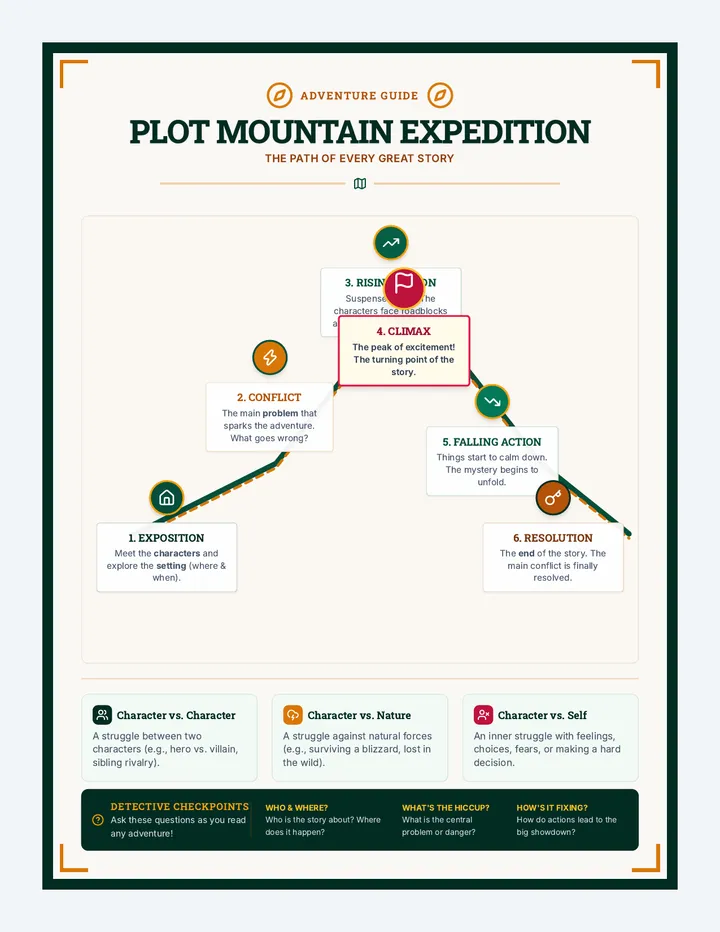
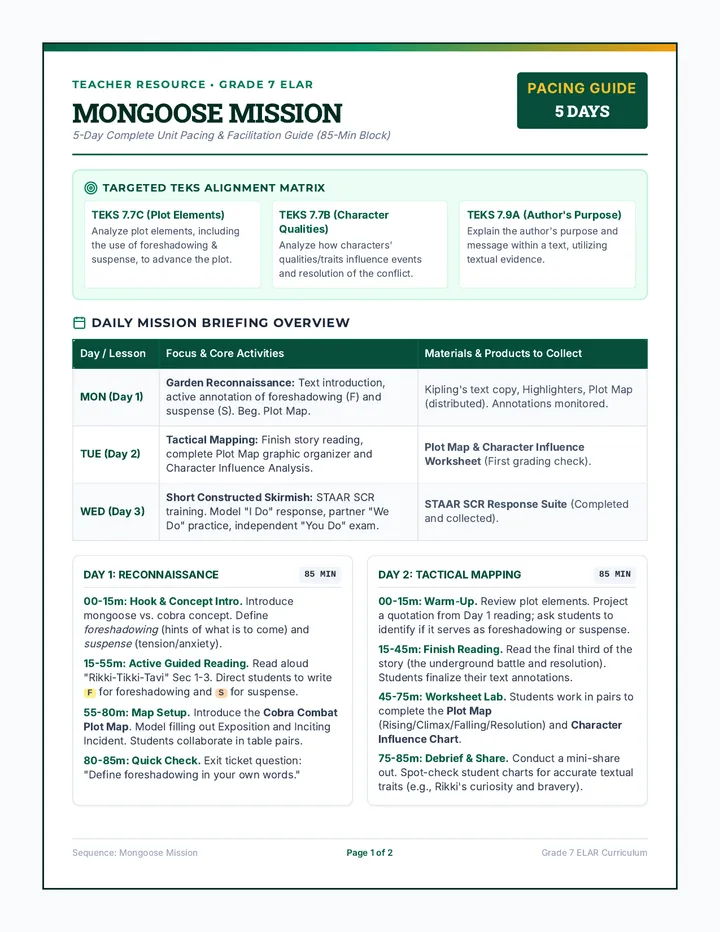
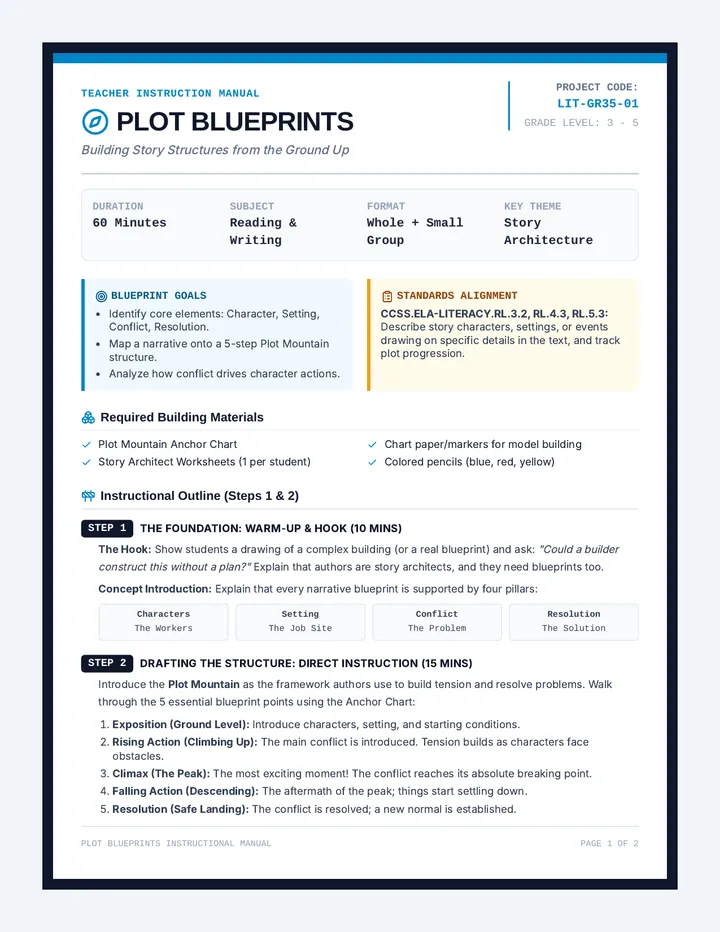
DAY 2 • TUESDAY
|
Science & Nature
Name:
Date:
Science Nonfiction
When you walk through a quiet forest, you might think the trees are standing completely alone. But underground, beneath your feet, a massive and silent network is busy connecting the entire forest. This natural internet is made of tiny, thread-like structures called fungi.
Scientists call this underground connection a mycorrhizal network, but many people simply call it the "Wood Wide Web." Through these threads, trees can actually talk and transfer resources with one another.
For example, a tall, fully grown oak tree has plenty of sunlight to make food. A tiny oak sapling growing in the deep shade nearby cannot get enough sunlight. Through the underground network, the older tree can transfer water and rich nutrients directly to the young sapling to help it grow.
Even more amazing, trees use this network to send warning signals. If a hungry swarm of beetles starts attacking a pine tree, that tree can send chemical signals through the fungi to neighboring trees. Once they receive the warning, the other trees quickly produce a bitter, bad-tasting chemical in their leaves to keep the beetles from eating them.
Without this underground partnership, young trees would struggle to survive. This hidden connection shows us that nature survives not by competing, but by working together.
STAAR® COMPREHENSION QUEST
Q1
What is the main idea of the third paragraph about oak trees and saplings?
A Oak saplings always grow taller than adult oak trees.
B Large trees share water and nutrients with young saplings to help them survive.
C Sunlight is the only resource a young tree needs to grow.
D Roots of an oak tree can stretch for miles across a dark forest.
Q2
Read this sentence from the passage:
"Through these threads, trees can actually talk and transfer resources..."
In this sentence, the word transfer means to —
F block or stop something from moving
G move something from one place to another
H break something into small, useless pieces
J hide resources deep in the damp ground
Q3
Why does the author use the phrase "Wood Wide Web" to describe the network?
A To show that trees are made of wood and metal internet cables.
B To explain that spiders build massive web systems on tree branches.
C To help the reader understand how trees are connected and share information like computers.
D To list the different species of rare mushrooms that inhabit forests.
Q4
Based on the passage, how do neighboring pine trees protect themselves after receiving a beetle warning signal? Use text evidence.
DAY 3 • WEDNESDAY
|
Realistic Fiction
Name:
Date:
Realistic Fiction
Sofia could hardly sit still in her seat. Today was the elementary art gallery, and she was bringing her masterpiece: a hand-painted clay bluebird. She had spent three weeks painting every feather a bright, shiny blue.
But when Sofia opened her locker before class, her heart stopped. The cardboard box containing her bird was completely empty!
"My bird is gone!" Sofia gasped. She turned and saw Gabe standing nearby. "Someone stole it! I bet it was someone who wanted to win the blue ribbon."
Gabe shook his head gently. "Let's not panic, Sofia. Are you sure you put it in there?"
"Of course I am!" Sofia cried, tears filling her eyes. "I carried it into the school this morning."
"Okay," Gabe said calmly. "Let's trace your steps back to where you started today."
Reluctantly, Sofia agreed. They walked down the quiet hallway, checking the main office, the drinking fountain, and finally the bus loading zone. The school bus was parked outside, and the driver, Mr. Ruiz, let them search Sofia's seat.
Slipped behind the heavy metal seat leg was her small cardboard box. Inside, the clay bluebird was safe and unbroken. Sofia felt her face turn red with embarrassment.
STAAR® COMPREHENSION QUEST
Q1
Why does Sofia's face turn red with embarrassment at the end of the story?
A She realized she had left her bird on the bus and accused her classmates without proof.
B She did not want the school bus driver, Mr. Ruiz, to see her empty box.
C Gabe laughed at her hand-painted project in front of other students.
D She was too warm while walking down the quiet school hallways.
Q2
The word reluctantly in paragraph 7 means doing something —
F with great physical speed and excitement
G with hesitation or unwillingness
H with absolute certainty and pure joy
J with deep anger and loud shouting
Q3
Which sentence best summarizes the plot of this story?
A Sofia spends three weeks painting a clay bluebird for her school's art gallery.
B Gabe helps a crying classmate search her school locker for a lost cardboard box.
C Sofia thinks her art project was stolen, but she finds it on the school bus after Gabe helps her trace her steps.
D Mr. Ruiz helps two young elementary students look under the seats of a large school bus.
Q4
What lesson does Sofia learn about making assumptions? Support your answer with details from the text.
DAY 4 • THURSDAY
|
Science & Nature
Name:
Date:
Science Nonfiction
On the dark, icy floor of the deepest oceans, there is no sunlight, and the water is freezing cold. It seems like an impossible place for any living thing to survive. Yet, scientists have discovered busy, crowded communities of bizarre creatures thriving around hydrothermal vents.
Hydrothermal vents are essentially underwater volcanoes. They form where cracks in the Earth's crust spew boiling-hot water filled with dark, toxic chemicals.
How can animals live in a place with boiling chemicals and zero sunlight? The answer lies in a special process called chemosynthesis.
On land, plants use sunlight to make food through photosynthesis. In the deep sea, tiny organisms called bacteria use the toxic chemicals from the vents to produce food and energy instead of light. These tiny bacteria form the foundation of this entire deep-sea ecosystem.
Giant tube worms, which can grow up to eight feet long, have millions of these bacteria living inside their bodies. The bacteria make food, and the tube worms provide shelter. Strange, white ghost crabs and blind shrimp crawl over the volcanic rocks to feast on the bacteria, while larger predatory fish hunt the crabs.
STAAR® COMPREHENSION QUEST
Q1
The word thriving in the first paragraph means —
A growing and doing very well
B freezing in extremely cold water
C hiding away from large predators
D struggling to find enough food
Q2
Based on the passage, what makes deep-sea bacteria the foundation of the vent ecosystem?
F They are the largest animal species living near underwater geysers.
G They collect tiny rays of sunlight to produce fresh oxygen for worms.
H They use toxic minerals to produce food that supports other deep-sea life.
J They actively hunt ghost crabs and blind shrimp on the rocks.
Q3
How does the author structure the description of the deep-sea vent food chain in paragraph 5?
A By comparing the hot temperatures of ocean vents to active land volcanoes.
B By listing the organisms in order from food producers to predatory hunters.
C By explaining the many difficulties scientists face when diving to the seafloor.
D By describing the detailed physical appearance of eight-foot-tall tube worms.
Q4
Describe how chemosynthesis is different from photosynthesis. Support your answer with details from the text.
TEACHER GUIDE
|
STAAR Answer Key (Days 1 & 2)
Grade 3 Reading Prep
Detailed standards alignment, correct choices, and scoring exemplars for Monday and Tuesday warmups.
Day 1 • Monday (Fable) The Crow's Clever Jar
Q1 Answer: B
Skill: Vocabulary & Context Clues
Rationale: In paragraph 3, the crow asks "Was he going to remain thirsty with water right in front of him?" showing he felt a deep loss of hope or sadness.
Q2 Answer: G
Skill: Inference & Drawing Conclusions
Rationale: The crow does not give up; instead, he patiently picks up pebbles in his beak one by one and drops them in over thirty times to rise the water level.
Q3 Answer: B
Skill: Main Idea & Details (Theme/Moral)
Rationale: The crow directly notes at the end of the text that "patience and a clever plan are far more powerful than physical strength," validating Choice B.
Q4 Short Constructed Exemplar:
"The crow realizes that the jar is too narrow and heavy to tilt. He gathers thirty smooth gray pebbles nearby and drops them in one by one. The pebbles take up space at the bottom, pushing the water level gradually to the rim so he can drink."
Day 2 • Tuesday (Science) Forest Networks
Q1 Answer: B
Skill: Main Idea & Details
Rationale: Paragraph 3 details how older oak trees, which get plenty of sun, use mycorrhizal networks to share rich water and nutrients directly with shaded Oak saplings.
Q2 Answer: G
Skill: Vocabulary & Context Clues
Rationale: "Transfer" describes the sharing of water and nutrients from the older tree directly to the sapling, meaning to move things from one place to another.
Q3 Answer: C
Skill: Text Features & Structure
Rationale: Comparing the fungal thread connections to the "internet" or "Wood Wide Web" helps students grasp how trees share vital data and nutrients quickly over large spaces.
Q4 Short Constructed Exemplar:
"When beetles attack a pine tree, it sends warning chemicals through underground fungi to neighbor trees. These neighboring trees receive the signal and quickly produce a bitter, bad-tasting chemical in their leaves so beetles won't eat them."
TEACHER GUIDE
|
STAAR Answer Key (Days 3 & 4)
Grade 3 Reading Prep
Day 3 • Wednesday (Fiction) The Missing Masterpiece
Q1 Answer: A
Skill: Inference & Drawing Conclusions
Rationale: Sofia felt embarrassed because she rushed to accuse others of stealing her bluebird without looking for facts or proof first.
Q2 Answer: G
Skill: Vocabulary & Context Clues
Rationale: Sofia is reluctant because she is crying and convinced her work is stolen, making her feel hesitant and unwilling to go trace steps.
Q3 Answer: C
Skill: Main Idea & Details (Summary)
Rationale: Choice C covers the main characters, the conflict (the lost bird), the resolution (finding it under her school bus seat), and the lesson learned.
Q4 Short Constructed Exemplar:
"Sofia learns that she shouldn't jump to conclusions or blame her classmates of stealing without proof. She realizes she needs to seek the facts first, as her box had actually slipped under her school bus seat by accident."
Day 4 • Thursday (Science) Deep Sea Vents
Q1 Answer: A
Skill: Vocabulary & Context Clues
Rationale: "Thriving" around these vents represents growing and doing well, since they live in busy, crowded communities despite dark and toxic water.
Q2 Answer: H
Skill: Inference & Drawing Conclusions
Rationale: Deep cracks spew dark, toxic minerals. Bacteria use these minerals instead of light to generate rich energy and food, feeding giant worms, crabs, and shrimp.
Q3 Answer: B
Skill: Text Features & Structure
Rationale: The author lays out the food chain starting with bacteria (producer), to tube worms, to ghost crabs and shrimp (feeders), up to larger fish (predatory hunters).
Q4 Short Constructed Exemplar:
"Photosynthesis happens on land where plants use sunlight to make food. In contrast, chemosynthesis occurs in the dark deep sea where bacteria use boiling toxic chemicals and minerals from vents to make food instead of using sunlight."
Use the diagnostic breakdown below to track class performance and identify high-need standard intervention areas for student development:
| Question | Assessed Target Skill | Key Cognitive Strategy | Intervention Focus |
|---|---|---|---|
| Q1 Questions | Vocabulary & Context Clues | Identifying synonyms/antonyms & defining domain words | Using text clues & root words |
| Q2 Questions | Inference & Drawing Conclusions | Synthesizing details & drawing text-based conclusions | Justifying ideas with direct quotes |
| Q3 Questions | Main Idea & Text Structure | Summarizing central messages & analyzing organization | Distinguishing details from summaries |
| Q4 Questions | Short Constructed Response | Citing direct textual evidence to explain changes/motifs | Complete sentence building & evidence |