Plot Blueprints Lesson Plan Teacher Instruction Manual
PLOT BLUEPRINTS
Building Story Structures from the Ground Up
PROJECT CODE:
LIT-GR35-01
GRADE LEVEL: 3 - 5
Duration 60 Minutes
Subject Reading & Writing
Format Whole + Small Group
Key Theme Story Architecture
Blueprint Goals
Identify core elements: Character, Setting, Conflict, Resolution.
Map a narrative onto a 5-step Plot Mountain structure.
Analyze how conflict drives character actions.
Standards Alignment
CCSS.ELA-LITERACY.RL.3.2, RL.4.3, RL.5.3: Describe story characters, settings, or events drawing on specific details in the text, and track plot progression.
Required Building Materials
Plot Mountain Anchor Chart
Story Architect Worksheets (1 per student)
Chart paper/markers for model building
Colored pencils (blue, red, yellow)
Instructional Outline (Steps 1 & 2)
STEP 1
The Foundation: Warm-Up & Hook (10 Mins)
The Hook: Show students a drawing of a complex building (or a real blueprint) and ask: "Could a builder construct this without a plan?" Explain that authors are story architects, and they need blueprints too.
Concept Introduction: Explain that every narrative blueprint is supported by four pillars:
Characters
Setting
Conflict
Resolution
STEP 2
Drafting the Structure: Direct Instruction (15 Mins)
Introduce the Plot Mountain as the framework authors use to build tension and resolve problems. Walk through the 5 essential blueprint points using the Anchor Chart:
Exposition (Ground Level): Introduce characters, setting, and starting conditions.Rising Action (Climbing Up): The main conflict is introduced. Tension builds as characters face obstacles.Climax (The Peak): The most exciting moment! The conflict reaches its absolute breaking point.Falling Action (Descending): The aftermath of the peak; things start settling down.Resolution (Safe Landing): The conflict is resolved; a new normal is established.
PLOT BLUEPRINTS INSTRUCTIONAL MANUAL PAGE 1 OF 2
Teacher Instruction Manual
PLOT BLUEPRINTS
Building Story Structures from the Ground Up
PROJECT CODE:
LIT-GR35-01
GRADE LEVEL: 3 - 5
Instructional Outline (Steps 3 & 4)
STEP 3
Stress Testing: Guided Practice (15 Mins)
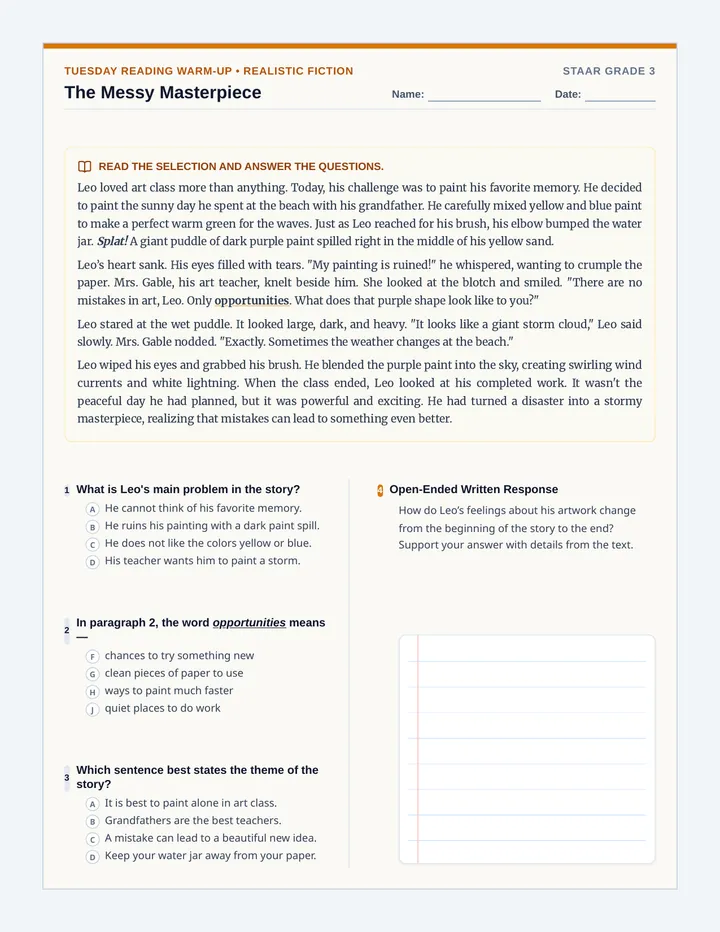
The Model Story: Read a brief, highly structural fable to the class (e.g., The Three Little Pigs ).
Interactive Mapping: Draw a large triangle on chart paper. Work as a team to plot the story together:
Exposition: Pigs setting off to build their houses.Rising Action: Wolf blows down the straw and twig houses.Climax: The Wolf tries to blow down the brick house but fails, or climbs down the chimney.Falling Action: The Wolf is scared off or caught by the pot of water.Resolution: The pigs live safely together in the brick house.
STEP 4
Independent Construction: Practice (15 Mins)
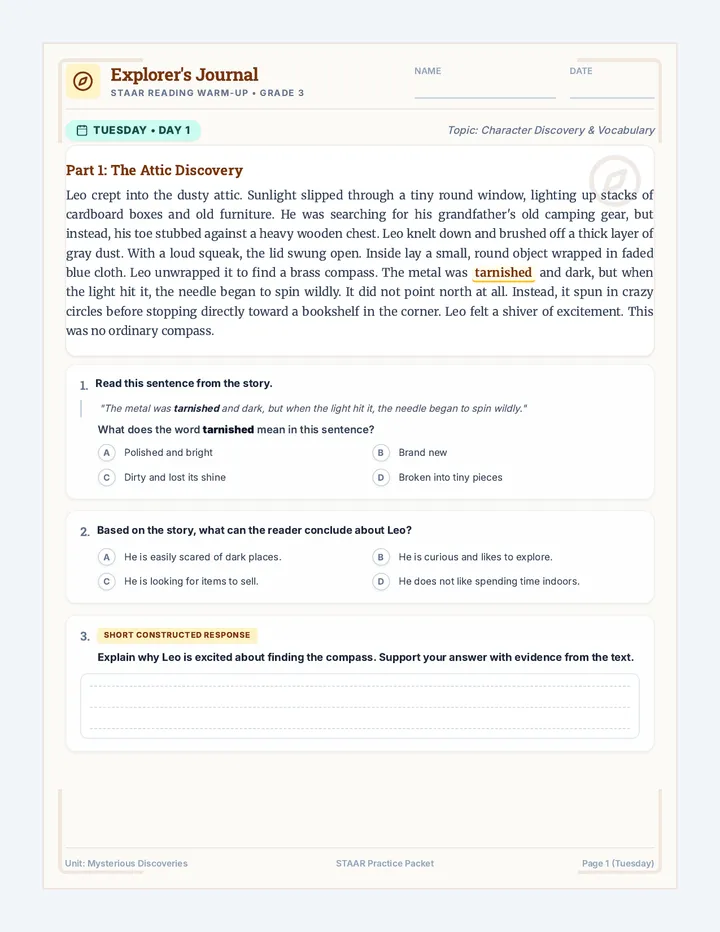
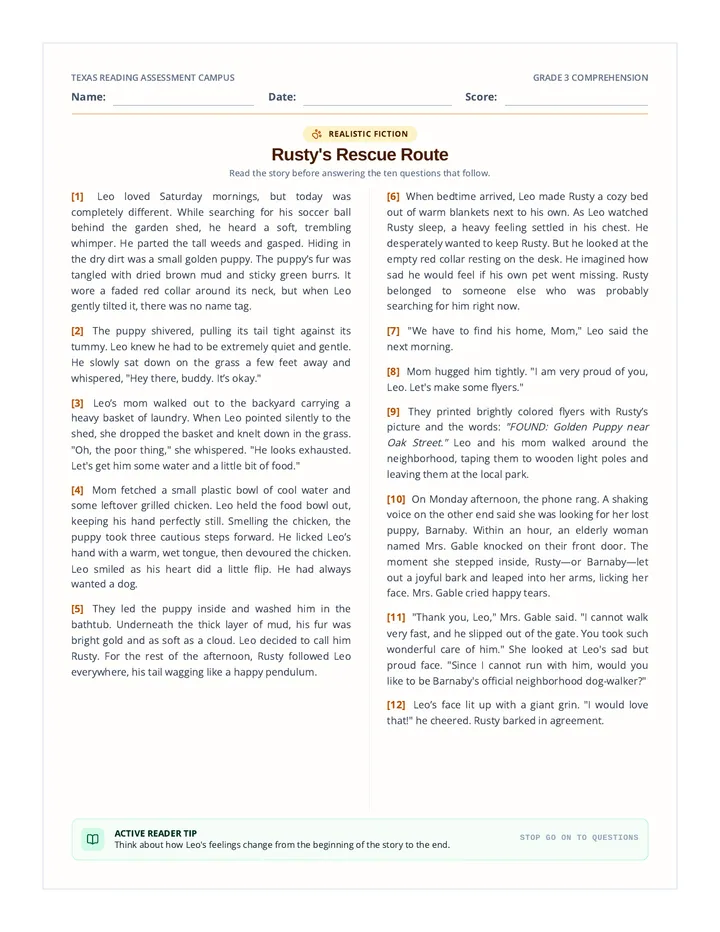
Distribute the Story Architect Worksheet . Instruct students to:
Read the provided short story carefully.
Identify the 4 foundation pillars (Character, Setting, Conflict, Resolution) using the blueprint table.
Map out the 5 key plot points directly onto the worksheet's Plot Mountain blueprint.
Code Inspection & Assessment
Closing & Reflection (5 Mins): Ask students: "Which part of the plot has the absolute highest tension? Why?" (The Climax). Collect worksheets to inspect for proper structural alignment. Have students complete a quick 1-sentence exit ticket matching a story element to its blueprint definition.
Structural Adjustments (Differentiation)
Scaffolding Support (Below Level)
Pre-populate 2-3 boxes on their Plot Mountain to anchor their answers.
Allow students to write key bullet phrases rather than full sentences.
Highlight the climax sentence in their reading passage before starting.
Extension Challenges (Above Level)
Ask students to outline a sequel paragraph changing only the resolution.
Prompt them to identify the narrative point of view and explain its impact on the conflict.
Have them identify minor conflicts contributing to the rising action.
PLOT BLUEPRINTS INSTRUCTIONAL MANUAL PAGE 2 OF 2
Plot Mountain Anchor Chart Technical Story Specifications
PLOT BLUEPRINT PLAN
GRID NO: SC-35-PM
SCALE: 1 STORY = 5 PHASES
Peak Tension
3
2
4
1
5
1. Exposition
The ground floor. Meet the main characters, discover the setting, and find out how life starts.
2. Rising Action
The structural climb. A problem/conflict is introduced. Tension builds with every step.
3. The Climax
The critical peak! The absolute turning point where the main conflict faces its ultimate showdown.
4. Falling Action
The steady descent. The direct aftermath of the climax. Tension begins to fade away.
5. Resolution
The structural landing. The core conflict is solved, leaving characters with a brand new normal.
Narrative Anchors (Foundation Pillars)
Pillar A: Characters
The active agents or forces driving the narrative forwards.
Pillar B: Setting
The spatial dimension and chronological time of the plot.
Pillar C: Conflict
The dynamic engine—the main friction/obstacle to be overcome.
Pillar D: Resolution
The safe structural landing where structural balance is restored.
APPROVED BY: STORY ARCHITECT ASSOCIATES
DISTRIBUTION: CLASSROOM WALL REFERENCE ONLY
RELEASE DATE: AUGUST 2026
SHEET: PM-01-01
Story Architect Worksheet NAME:
DATE:
CLASS/SECTION:
Story Architect Worksheet
Analyze the narrative structure of "The Clockwork Contraption" below.
Blueprints Blueprint Passage: The Clockwork Contraption
Leo was a young apprentice clockmaker in the metallic city of Cogsville. For weeks, he worked in a tiny workshop surrounded by ticking gears, hoping to win the Mayor's Annual Grand Exhibition with his masterpiece: a self-winding pocket watch that tracked both the time and the phases of the moon.
Just an hour before the exhibition, Leo stood on a street corner, polishing the watch. Suddenly, a rushing pedestrian bumped his elbow! The watch slipped from his fingers and fell down a deep drainage grate, landing on a wooden platform inside the dark sewer pipe below. Leo stared in horror. If he couldn't retrieve it, his dream would be ruined.
Leo scrambled down the rusty metal ladder into the damp sewer, but he couldn't reach the platform. Worse, a sudden rainstorm began to pour, and rushing water began rising rapidly toward his watch! Thinking quickly, Leo took a magnetic screwdriver and a long metal measuring tape from his tool belt.
As the sewer water splashed against his boots, Leo lowered his magnetic tape toward the pocket watch. Just as a giant wave of muddy water rushed forward to wash it away, the magnet clicked onto the watch's brass casing. Leo yanked the tape up, catching the watch a split-second before the flood swept the platform clean!
He scrambled back up to the street, wiped the mud off the casing, and breathed a sigh of relief. The gears were still spinning perfectly. At the exhibition, the Mayor marveled at the watch's intricate design and awarded Leo the Golden Gear Trophy.
Task A: Identify the Pillars
Write a brief description for each of the four narrative pillars based on the story above.
Character(s)
Setting
The Main Conflict
The Resolution
STORY ARCHITECT: NARRATIVE BLUEPRINT WORK PAGE 1 OF 2
Plot Mountain Blueprint
Task B: Diagram Mapping
Map out the five phases of the plot of "The Clockwork Contraption" inside the structural layout below.
3 The Climax (Peak Tension)
2 Rising Action
4 Falling Action
1 Exposition
5 Resolution
STORY PROGRESSION LINE
→→→ MOVES LEFT TO RIGHT →→→
STORY ARCHITECT: NARRATIVE BLUEPRINT WORK PAGE 2 OF 2