Messy Masterpiece WorksheetTuesday Reading Warm-Up • Realistic Fiction STAAR Grade 3 The Messy Masterpiece Name: Date: Read the selection and answer the questions. Leo loved art class more than anything. Today, his challenge was to paint his favorite memory. He decided to paint the sunny day he spent at the beach with his grandfather. He carefully mixed yellow and blue paint to make a perfect warm green for the waves. Just as Leo reached for his brush, his elbow bumped the water jar. Splat! A giant puddle of dark purple paint spilled right in the middle of his yellow sand. Leo’s heart sank. His eyes filled with tears. "My painting is ruined!" he whispered, wanting to crumple the paper. Mrs. Gable, his art teacher, knelt beside him. She looked at the blotch and smiled. "There are no mistakes in art, Leo. Only opportunities. What does that purple shape look like to you?" Leo stared at the wet puddle. It looked large, dark, and heavy. "It looks like a giant storm cloud," Leo said slowly. Mrs. Gable nodded. "Exactly. Sometimes the weather changes at the beach." Leo wiped his eyes and grabbed his brush. He blended the purple paint into the sky, creating swirling wind currents and white lightning. When the class ended, Leo looked at his completed work. It wasn't the peaceful day he had planned, but it was powerful and exciting. He had turned a disaster into a stormy masterpiece, realizing that mistakes can lead to something even better. 1 What is Leo's main problem in the story? A He cannot think of his favorite memory. B He ruins his painting with a dark paint spill. C He does not like the colors yellow or blue. D His teacher wants him to paint a storm. 2 In paragraph 2, the word opportunities means — F chances to try something new G clean pieces of paper to use H ways to paint much faster J quiet places to do work 3 Which sentence best states the theme of the story? A It is best to paint alone in art class. B Grandfathers are the best teachers. C A mistake can lead to a beautiful new idea. D Keep your water jar away from your paper. 4 Open-Ended Written Response How do Leo’s feelings about his artwork change from the beginning of the story to the end? Support your answer with details from the text.
Tiny Gliders WorksheetWednesday Reading Warm-Up • Informational Text STAAR Grade 3 Nature's Tiny Gliders Name: Date: Read the selection and answer the questions. Would you believe that some squirrels can fly? While they are called flying squirrels, they do not actually fly like birds. Instead, they glide gracefully through the air from tree to tree. Built to Glide Flying squirrels have a special fold of skin that stretches from their front ankles to their back ankles. This skin is called a patagium (puh-TAY-jee-um). When a squirrel leaps into the air, it spreads its legs wide. This stretches the skin out like a parachute. By tilting its flat tail, the squirrel can steer left or right, easily dodging branches. A single glide can cover up to 150 feet! Active in the Dark Unlike regular squirrels, flying squirrels are nocturnal, meaning they are active at night. They have giant, dark eyes that help them see in the dark. This night vision is crucial for finding food, such as acorns, berries, and insects, while avoiding predators like owls and raccoons. During the day, they curl up inside cozy tree hollows to sleep safely. Quick Facts Diet: Seeds, nuts, fruit, insects, and bird eggs. Predators: Owls, hawks, raccoons, and tree snakes. Cool Habit: They use high-pitched squeaks to talk to other flying squirrels in the dark! Home: Cozy tree cavities or abandoned woodpecker nests. Source: Forest Wildlife Guide 1 What is the main idea of the section titled "Built to Glide"? A Flying squirrels do not fly the same way birds fly. B Flying squirrels have a special body structure that helps them glide. C Flying squirrels can glide for more than 150 feet. D Flying squirrels use their tails to steer around tree branches. 2 Based on the "Quick Facts" box, which animal is a predator of the flying squirrel? F A woodpecker G A hawk H A wild squirrel J An insect 3 Which detail from the text best supports the idea that flying squirrels are active when it is dark? A They spread their legs wide when leaping. B They eat seeds, fruit, and bird eggs. C They have giant, dark eyes that help them see. D They can steer left or right with their tail. 4 Open-Ended Written Response Based on the text, how does a flying squirrel control its movement when it is gliding in the air? Support your answer with details from the selection.
River Helpers WorksheetThursday Reading Warm-Up • Fable STAAR Grade 3 River Helpers Name: Date: Read the selection and answer the questions. Bramble the beaver was famous along the river for his slow, careful work. He spent hours dragging heavy willow branches to build his mud dam. "Tap, tap, plaster," Bramble hummed, smoothing the thick gray mud with his flat tail. He made sure every single branch was perfectly placed. Just then, Pip the hummingbird zoomed overhead. "You work too slowly, Bramble!" Pip chirped, darting from flower to flower. "Look at me! I can fly circles around the tallest pine tree before you can drag one twig!" Pip zipped around in a dizzy blur, showing off his shimmering green wings. Bramble smiled warmly and kept working. "Speed is wonderful, Pip, but safety takes time." That night, a sudden autumn storm roared through the forest. Heavy rains fell, and the river rose quickly. The wild winds whipped through the trees, shaking Pip's tiny nest right out of his favorite oak. Shivering and wet, Pip had nowhere to go as the rushing waters climbed. Fortunately, Bramble’s sturdy dam was strong and high. The thick mud and heavy branches held back the rushing floodwaters, creating a calm, safe pool. Bramble spotted the tiny, cold bird and scooped him up, carrying him safely inside his dry beaver lodge. The next morning, Pip looked at Bramble's perfect dam. "I am sorry I made fun of your slow work," Pip said. "Your patience saved my life." 1 What is Bramble's most important character trait in the story? A Selfishness B Patience C Fearfulness D Forgetfulness 2 Which of the following is the best summary of the fable? F A hummingbird boasts about speed but loses his nest. He is saved by a beaver whose sturdy dam blocks the flood, and the bird learns to value steady work. G A beaver builds a mud dam to show off. A hummingbird tries to help him build the dam but gets tired and goes to sleep. H A storm destroys a dam and a nest. Both animals must work all night to build a new tree home. J A beaver and a hummingbird argue about who is best until an art teacher helps them paint a storm together. 3 What is the main moral lesson of this fable? A It is dangerous to fly during an autumn storm. B Patience and careful work are valuable strengths. C Beavers and hummingbirds should not be friends. D Wildflowers grow best near calm river pools. 4 Open-Ended Written Response How does Bramble’s action during the storm change Pip’s attitude? Support your answer with details from the fable.
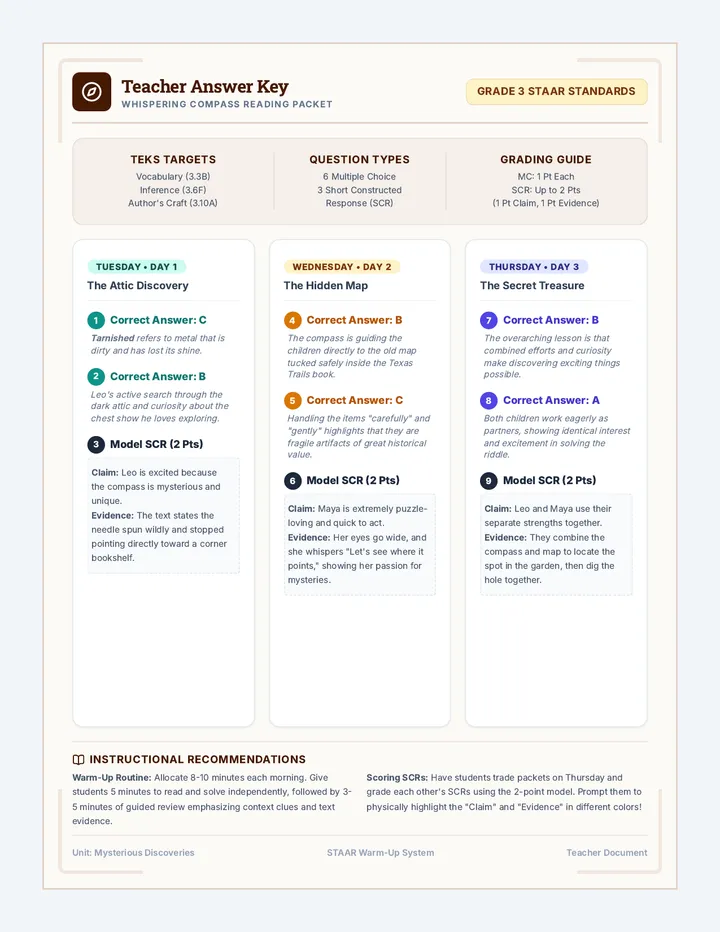
Weekly Warmups Teacher GuideTeacher-Facing Resource • Grade 3 Reading STAAR Alignment Weekly Reading Warmups Instructional Guide, Answer Keys & Rationales Monday • Tuesday • Wednesday • Thursday Quick-Reference Answer Key DayTitle (Genre)Q1Q2Q3Q4: Open-Ended Response Focus & TEKS AlignmentMondayThe Playground Wind (Poetry)BGAPlayful actions (stealing caps, playing tag) with textual proof (TEKS 3.10B)TuesdayThe Messy Masterpiece (Realistic Fiction)BFCEmotional change from devastated to proud/perseverant (TEKS 3.8A)WednesdayNature's Tiny Gliders (Informational)BGCUse of skin (patagium) & flat tail to steer (TEKS 3.9D)ThursdayRiver Helpers (Fable)BFBShifts from teasing to appreciative/humbled (TEKS 3.8A, 3.8C) Monday Rationales Poetry Q1 (B) — TEKS 3.10B (Personification) The poet attributes playful child-like actions ("chase," "whisper," "play") to the wind, showing it is active and friendly rather than scary or hostile. Q2 (G) — TEKS 3.3B (Context Clues) "Chime" refers to the ringing bell that ends recess. Q3 (A) — TEKS 3.8A (Theme) The poem's theme is that the wind acts as a friend waiting outside to play tag with kids again tomorrow. Prompt 4: Accept details like drawing in the sandbox or blowing hats off. Tuesday Rationales Realistic Fiction Q1 (B) — TEKS 3.8C (Conflict) Leo's main conflict is the dark purple paint splash that threatens to ruin his sandy beach watercolor. Q2 (F) — TEKS 3.3B (Context Clues) "Opportunities" refers to chances to try a new creative path, as encouraged by Mrs. Gable. Q3 (C) — TEKS 3.8A (Theme) The story focuses on finding beauty and success inside a sudden mishap (painting a storm). Prompt 4: Focus on shift from sadness to pride/inspiration. Wednesday Rationales Informational Q1 (B) — TEKS 3.9Di (Main Idea) "Built to Glide" is dedicated to explaining the physical structures that allow squirrels to glide.
Playground Wind WorksheetMonday Reading Warm-Up • Poetry STAAR Grade 3 The Playground Wind Name: Date: Read the poem and answer the questions. I am the giant of the blacktop court, I chase the red ball as you run and play, I whirl the dry leaves in a spinning sport, And steal your baseball caps and fly away. I whisper secrets in the maple tree, And shake the heavy swings with invisible hands, I set the bright flags flapping wild and free, And draw strange patterns in the sandbox sands. You cannot see my face or touch my hair, But you can hear me whistle through the gate, I puff your jacket like a balloon of air, And lift your paper glider high and straight. And when the school bell rings its silver chime, And all you children run back through the door, I’ll wait right here until tomorrow's time, To play our windy tag games once more. 1 The poet uses words like "chase," "whisper," and "play" to make the wind seem like — A a scary forest monster B a playful child C a helpful school teacher D an angry rain storm 2 In stanza 4, the word chime means — F a bright light G a ringing sound H a heavy iron door J a cold wave of air 3 What is the main theme/message of the poem? A The wind enjoys playing active games with the children on the playground. B Recess is a dangerous time when the weather is very windy. C Children should always wear thick jackets when playing outside. D The playground becomes a boring and empty place when the school day ends. 4 Open-Ended Written Response What are two things the wind does in the poem that show it has a playful personality? Support your answer with details from the poem.
Secret Room WorksheetMonday Reading Warm-Up • Poetry (Week 2) STAAR Grade 3 The Secret Room Name: Date: Read the poem and answer the questions. A giant box of cardboard brown, Arrived upon our porch today, The biggest box in all the town, Before they threw the card away. I tipped it over on its side, And crawled into the quiet space, A secret room where I could hide, My own private, magical place. With yellow crayons on the wall, I drew a window broad and bright, A shining castle grand and tall, And stars that sparkled in the night. The living room was far behind, As I sailed off to distant lands, Within the borders of my mind, And cardboard held in dusty hands. 1 The cardboard box is important to the speaker because it — A holds a fun toy that was delivered to the house B is the biggest box in the whole neighborhood C becomes a special place for creative imagination D is made of strong and sturdy brown paper 2 In stanza 4, the phrase distant lands helps the reader understand that the speaker — F is traveling in a real boat on the ocean G is imagining a fantasy adventure inside the box H wants to leave home to live in a castle J is lost and cannot find the living room door 3 Which line from the poem best shows that the speaker is using imagination? A "A giant box of cardboard brown" B "I tipped it over on its side" C "I drew a window broad and bright" D "And cardboard held in dusty hands" 4 Open-Ended Written Response Based on the poem, how does the speaker feel about being inside the cardboard box? Support your answer with details from the poem.