RACE Strategy Slides
ELA Writing Toolkit
Grades 3–5 • Constructive Responses
The Formula for Written Success
The RACE Strategy
Learn how to build complete, rock-solid answers using text evidence and clear explanations!
R Restate
A Answer
C Cite
E Explain
Step-By-Step Framework
What is the RACE Strategy?
4 Core Steps
R
Restate the Question
Turn the prompt into a statement. Remove question words like why or how.
A
Answer the Question
Give your direct answer. Be sure to answer all parts of multi-step prompts!
C
Cite Text Evidence
Prove your point with exact words from the text using quotation marks and evidence stems.
E
Explain the Evidence
Explain how your evidence proves your point. Connect the dots for the reader!
Why use RACE?
It ensures your written answer is thorough, believable, and complete!
R
Step One
Restate the Question
Turn it into a Statement
How to Restate
- Drop question words (Why, How, What).
- Drop helper verbs (do, does, did).
- Rearrange remaining words into a complete sentence starter.
Rule: Never start an answer with "Because..." or "It is..."!
Question Prompt
"Why do honeybees do a waggle dance?"
Weak Restatement
"Because they want to tell about food."
Strong Restatement
Honeybees do a waggle dance because...
Quick Check: Does your starter make complete sense all on its own before adding your answer?
A
Step Two
Answer ALL Parts
Combine R + A
Hit the Target
Combine R (Restate) and A (Answer) into your very first topic sentence!
Use your own words to state the main answer.
Check if the prompt has two questions in one!
Tip: Re-read the prompt to make sure no parts were skipped.
Example Question
"Why do camels have thick foot pads?"
R Camels have thick foot pads...
A ...to protect their feet from hot sand.
Finished Topic Sentence: "Camels have thick foot pads to protect their feet from hot sand."
Steps 1 & 2 Complete! Now, you must prove your claim with evidence from the text!
C
Step Three
Cite Text Evidence
Show the Proof
Evidence Starters
Always introduce your proof with an evidence stem:
• According to the text, "..."
• The author states that "..."
• In paragraph __, the text mentions "..."
• For example, the author explains that "..."
Golden Rules of Evidence
1. Exact Words = Quotation Marks
Wrap direct quotes in quotation marks: "..."
2. Pick the Best Evidence
Don't copy the whole paragraph! Select the 1 best sentence.
3. Don't Float Your Quote
Never drop a quote alone without a starter phrase.
Detective Mindset: Text evidence is the physical proof that supports your answer!
E
Step Four
Explain the Evidence
Connect the Dots
Answer: "So What?"
Your evidence cannot speak for itself! You must tell the reader how that evidence proves your original claim.
Common Trap:
Do NOT just repeat the quote in different words. Explain why it matters!
Think: "Because the author said this, it proves that..."
Explanation Starters
Use these bridge phrases to explain your evidence:
• This shows that...
• This proves that...
• This evidence means that...
• From this, the reader can understand that...
The Golden Connection: Evidence without explanation is like a clue without a detective!
Guided Practice
Read the Mentor Passage
Science Informational Text
Masters of Disguise: The Mimic Octopus
Lexile ~720L
Deep in the shallow waters of Indonesia lives one of the ocean's cleverest survivors: the mimic octopus. Unlike other sea creatures that hide by blending into coral reefs, this remarkable animal actually pretends to be dangerous predators.
When threatened by a hungry fish, the octopus changes both its skin texture and color. It can bend its eight flexible arms to look and swim exactly like a venomous sea snake or a poisonous lionfish. By copying animals that other predators fear, the mimic octopus scares away attackers without ever having to fight.
Our Target Prompt:
"How does the mimic octopus protect itself from dangerous predators?"
Ready to Race! Let's build the full response together on the next slide!
Complete Model
The Assembled RACE Response
Full 4/4 Score
Prompt: How does the mimic octopus protect itself from dangerous predators?
The mimic octopus protects itself from predators by disguising its body to look like poisonous ocean creatures. According to the text, "It can bend its eight flexible arms to look and swim exactly like a venomous sea snake." This proves that by tricking attackers into believing it is deadly, the octopus can safely escape being eaten.
R Restate
A Answer
C Cite Evidence
E Explain Proof
Notice: All 4 parts combine to create one cohesive, high-scoring paragraph!
Independent Practice
Your RACE Inspection Checklist
Ready to Write!
Self-Check Questions
- R Did I turn the question into a complete statement?
- A Did I accurately answer every part of the prompt?
- C Did I use an evidence starter and quotation marks?
- E Did I explain how my evidence supports my answer?
Worksheet Mission
You will now read about an incredible desert architect—the Trapdoor Spider.
Your Goal:
Practice isolating each piece (R, A, C, E) before crafting your final response!
Good luck, Evidence Detectives! 🔍
RACE Writing Strategy Deck Grade 3–5 Standard CCSS.ELA-LITERACY.RL/RI.3-5.1
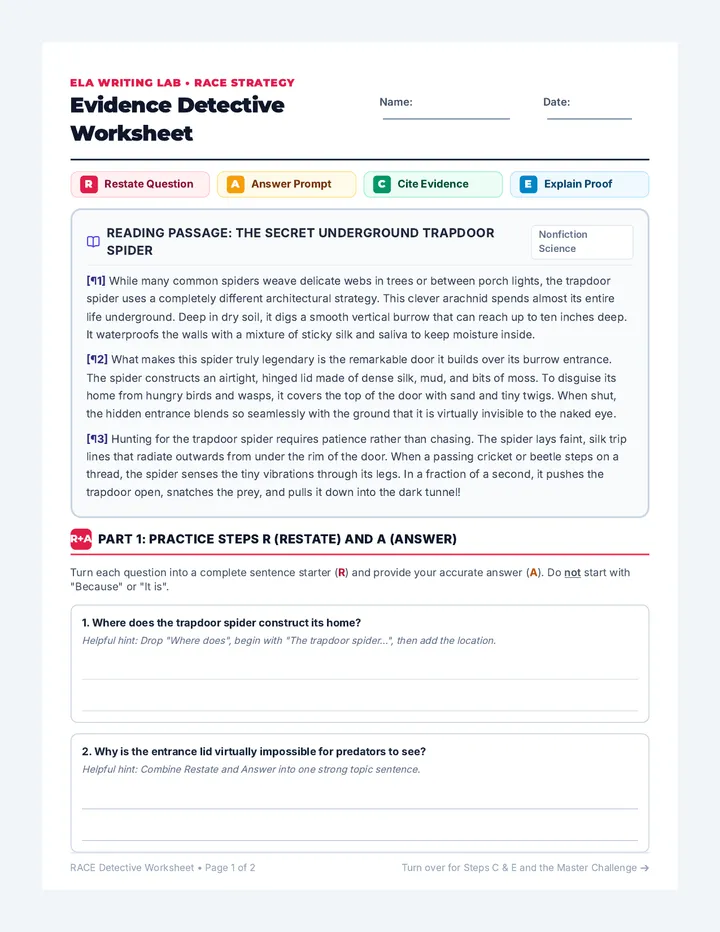
RACE Detective Worksheet
ELA Writing Lab • RACE Strategy
Evidence Detective Worksheet
Name:
Date:
R Restate Question
A Answer Prompt
C Cite Evidence
E Explain Proof
Reading Passage: The Secret Underground Trapdoor Spider
Nonfiction Science
[¶1] While many common spiders weave delicate webs in trees or between porch lights, the trapdoor spider uses a completely different architectural strategy. This clever arachnid spends almost its entire life underground. Deep in dry soil, it digs a smooth vertical burrow that can reach up to ten inches deep. It waterproofs the walls with a mixture of sticky silk and saliva to keep moisture inside.
[¶2] What makes this spider truly legendary is the remarkable door it builds over its burrow entrance. The spider constructs an airtight, hinged lid made of dense silk, mud, and bits of moss. To disguise its home from hungry birds and wasps, it covers the top of the door with sand and tiny twigs. When shut, the hidden entrance blends so seamlessly with the ground that it is virtually invisible to the naked eye.
[¶3] Hunting for the trapdoor spider requires patience rather than chasing. The spider lays faint, silk trip lines that radiate outwards from under the rim of the door. When a passing cricket or beetle steps on a thread, the spider senses the tiny vibrations through its legs. In a fraction of a second, it pushes the trapdoor open, snatches the prey, and pulls it down into the dark tunnel!
R+A
Part 1: Practice Steps R (Restate) and A (Answer)
Turn each question into a complete sentence starter (R) and provide your accurate answer (A). Do not start with "Because" or "It is".
1. Where does the trapdoor spider construct its home?
Helpful hint: Drop "Where does", begin with "The trapdoor spider...", then add the location.
2. Why is the entrance lid virtually impossible for predators to see?
Helpful hint: Combine Restate and Answer into one strong topic sentence.
RACE Detective Worksheet • Page 1 of 2 Turn over for Steps C & E and the Master Challenge ➔
2 Page 2: Citing Evidence & Explaining Proof
Student Name:
C
Part 2: Practice Step C (Cite Text Evidence)
Find exact words from Paragraph 2 that prove how the spider camouflages its lid. Use a starter stem and quotation marks.
Choose one evidence starter: "According to the text..." • "In paragraph 2, the author states..."
E
Part 3: Practice Step E (Explain the Evidence)
RACE Master Teacher Guide
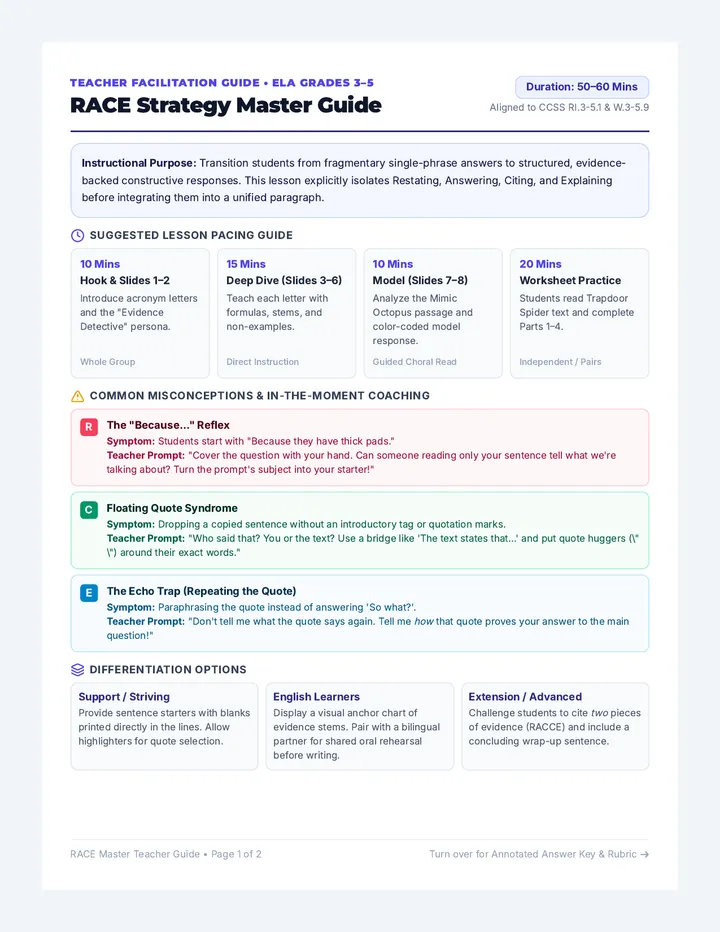
Teacher Facilitation Guide • ELA Grades 3–5
RACE Strategy Master Guide
Duration: 50–60 Mins
Aligned to CCSS RI.3-5.1 & W.3-5.9
Instructional Purpose: Transition students from fragmentary single-phrase answers to structured, evidence-backed constructive responses. This lesson explicitly isolates Restating, Answering, Citing, and Explaining before integrating them into a unified paragraph.
Suggested Lesson Pacing Guide
10 Mins
Hook & Slides 1–2
Introduce acronym letters and the "Evidence Detective" persona.
Whole Group
15 Mins
Deep Dive (Slides 3–6)
Teach each letter with formulas, stems, and non-examples.
Direct Instruction
10 Mins
Model (Slides 7–8)
Analyze the Mimic Octopus passage and color-coded model response.
Guided Choral Read
20 Mins
Worksheet Practice
Students read Trapdoor Spider text and complete Parts 1–4.
Independent / Pairs
Common Misconceptions & In-the-Moment Coaching
R
The "Because..." Reflex
Symptom: Students start with "Because they have thick pads."
Teacher Prompt: "Cover the question with your hand. Can someone reading only your sentence tell what we're talking about? Turn the prompt's subject into your starter!"
C
Floating Quote Syndrome
Symptom: Dropping a copied sentence without an introductory tag or quotation marks.
Teacher Prompt: "Who said that? You or the text? Use a bridge like 'The text states that...' and put quote huggers (\" \") around their exact words."
E
The Echo Trap (Repeating the Quote)
Symptom: Paraphrasing the quote instead of answering 'So what?'.
Teacher Prompt: "Don't tell me what the quote says again. Tell me how that quote proves your answer to the main question!"
Differentiation Options
Support / Striving
Provide sentence starters with blanks printed directly in the lines. Allow highlighters for quote selection.
English Learners
Display a visual anchor chart of evidence stems. Pair with a bilingual partner for shared oral rehearsal before writing.
Extension / Advanced
Challenge students to cite two pieces of evidence (RACCE) and include a concluding wrap-up sentence.