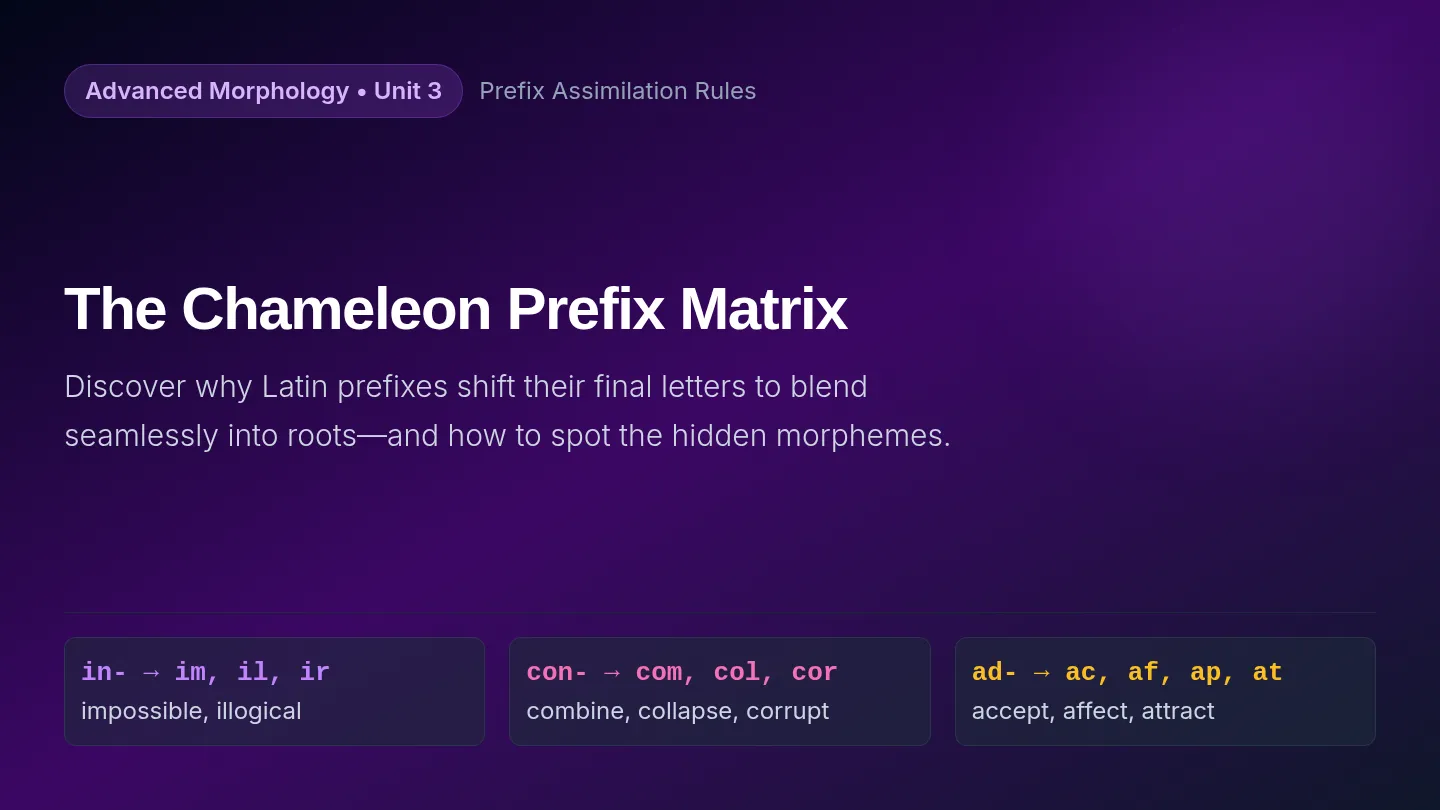
A high school vocabulary lesson targeting six academic Tier-2 words with prefixes com- and con- (complexity, compose, compound, comprise, conceal, concede) tailored for Deaf and Hard of Hearing students through visual morphology, contextual reasoning, and collaborative visual analysis.
Did the attorney concede the argument or did she conceal it?
Team Decision:
Key Context Clues:
Which phrase signals yielding or admitting truth?
Clue:
Team Sentence Formulation: Write a sentence explaining the attorney's decision using the target word:
2
Case 02: The Coastal Storm Crisis
Earth & Environmental Science
The low-lying coastal city was already struggling with sea-level flooding following high tide. When hurricane winds knocked out electrical substations and blocked main evacuation highways, emergency response became drastically harder. The sudden secondary hazards intensified the existing flooding into an unprecedented regional disaster.
Target Word Debate:
Did the second disaster compound the problem or compose it?
Team Decision:
Conceptual ASL / Visual Clue:
How do you visually show problems multiplying / piling on?
Concept:
Team Sentence Formulation: Write a sentence explaining how the hazards interacted:
Prefix Detectives Lab • Collaborative Activity Pack Page 2 of 4 Turn to Case Files (Cases 3 & 4) →
Prefix Detectives: Investigation Stations
Team Name: ___________________________
3
Case 03: The Lunar Research Station
Aerospace Engineering
NASA’s deep-space lunar outpost plan details six essential operational modules: pressurized living quarters, hydroponic greenhouses, solar energy arrays, water filtration units, science laboratories, and emergency airlocks. The complete facility consists of these exact designated components.
Target Word Debate:
Does the station comprise the six modules or does it compound them?
Team Decision:
Syntactic Structure Test:
Whole → Parts rule: Is the subject the whole station or the individual parts?
Subject is:
Team Sentence Formulation: Write a sentence describing the station using the target word:
4
Case 04: The Cryptic Resistance Archives
Historical Fiction / Cyber Security
In a historical resistance movement, an underground journalist created cipher keys to encode sensitive messages. To protect fellow operatives from discovery by military censors, she slipped the handwritten parchment keys behind false hollow bricks in the bakery oven, intentionally keeping them out of view.
Target Word Debate:
Did the journalist conceal the documents or concede them?
Team Decision:
Contrast Analysis:
How would the story change if she had conceded the documents instead?
Explanation:
Team Sentence Formulation: Write a sentence explaining the journalist's action:
Prefix Detectives Lab • Collaborative Activity Pack Page 3 of 4 Turn to Synthesis & Grammar Forge →
Prefix Detectives: Final Synthesis Board
Team Name: ___________________________
M
Master Investigation Matrix
Consensus evidence summary
Case
Target Word
Key Text Evidence / Clue
ASL / Visual Sign Concept
Case 01
Concede
|
| Case 02 | Compound |
|
|
| Case 03 | Comprise |
|
|
| Case 04 | Conceal |
|
|
V
Visual Grammar Anchor: Compose vs. Comprise
Direction of Build Rule
COMPOSE (Parts → Whole) Bottom-Up
Individual members come together to assemble the completed entity.
Formula: [Parts] compose [Whole]
Example: Twelve chapters compose this novel.
COMPRISE (Whole → Parts) Top-Down
The complete unit consists of or contains its specific parts.
Formula: [Whole] comprises [Parts]
Example: The novel comprises twelve chapters.
Team Sentence Forge: Write two original sentences about a sports team, club, or school:
Compose:
Comprise:
Team Readiness Sign-Off: All 4 roles confirmed. Lead Presenter is prepared to share evidence with class.
Ready to Share ✓
Prefix Detectives Lab • Collaborative Activity Pack Page 4 of 4 End of Activity Pack
Confused due to orthographic similarity (conc-).
Emphasize polar opposites in ASL: Concede opens hands to agree/yield; Conceal covers/hides under hands.
Prefix Precision Teacher Guide • Instructional Foundations Page 1 of 4 Turn to Assessment Key & Rubric →
Part 3: Linguistic Nuance Rationale (9 Pts / 3 Pts Each) Page 3
Item 13: Choice [ B ] "The whole comprises the parts." Grammatically, the United States (whole) comprises 50 states (parts). Choice [ A ] reverses syntax; Choice [ C ] uses non-standard passive phrasing.
Item 14: Choice [ C ] Compounded here is used in the sense of exponential increase—it multiplied and worsened the existing traffic delays.
Item 15: Choice [ A ] Semantic contrast: concede brings truth into the open by admitting validity; conceal pushes truth out of sight by deliberately hiding it.
Part 4: Written Application Rubric & Exemplars (9 Pts Total / 4.5 Pts Each)
Page 4 of Assessment
Advanced (4–4.5 Pts) Demonstrates flawless semantic fit and mature academic syntax. Uses context clues within the sentence to define the term implicitly.
Proficient (3–3.5 Pts) Word is used correctly in a standard sentence. Meaning is clear and grammatically sound, though syntax is basic.
Developing (≤ 2.5 Pts) Sentence exhibits semantic confusion (e.g., uses comprise when meaning compose) or incomplete grammatical fragment.
Exemplar High-Scoring Benchmark Responses:
Complexity:"The geneticist analyzed the extraordinary complexity of the human genome to understand hereditary traits."
Compose:"Over three grueling months, the student orchestra composed an original symphony for graduation."
Concede:"Faced with incontrovertible archaeological evidence, the historian conceded that the timeline required revision."
Conceal:"The diplomats attempted to conceal their private negotiations until a formal peace treaty was signed."
Prefix Precision Teacher Guide • Assessment Key & Rubric Page 2 of 4 Turn to Collaborative Lab Facilitation →
Collaborative Lab Facilitation & ASL Conceptual Maps
Resource: Word Sleuths Group Activity
Case Study Solutions & Inquiry Prompts
Facilitation Benchmarks
Case 01: Mock Trial CONCEDE
Rationale: The attorney formally acknowledges undisputed video evidence to preserve credibility. She yields the point.
Debrief Question: "Why did she choose to concede instead of conceal? What would have happened if she concealed the video?"
Case 02: Coastal Storm COMPOUND
Rationale: Downed power lines and blocked roads added to existing flooding, multiplying and intensifying the regional crisis.
Debrief Question: "How does compounding a problem differ from merely describing its complexity?"
Case 03: Lunar Habitat COMPRISE
Rationale: The lunar station as a complete unit consists of the six distinct modules (Whole → Parts relationship).
Debrief Question: "How can you flip this sentence so that the word compose is grammatically correct instead?"
Case 04: Resistance Archives CONCEAL
Rationale: The journalist deliberately slipped cipher keys behind hollow bricks to prevent military censors from finding them.
Debrief Question: "What physical classifiers in ASL match the act of concealing documents?"
ASL Conceptual Sign Parameters for Target Vocabulary
Visual Linguistic Modeling
Complexity (noun)
ASL Sign: COMPLICATED / INTRICATE / MIX-UP. Bent-V or 5-hands interlacing with furrowed brow (non-manual marker), conveying tangled connections.
Compose (verb)
ASL Sign: CREATE / PUT-TOGETHER / WRITE. Dominant hand systematically places individual elements into a collective spatial formation.
Compound (verb)
ASL Sign: ADD-ON-TOP / MULTIPLY / WORSE-EXPAND. Stacking flat hands or claw classifiers upward with intensified facial grammar.
Comprise (verb)
ASL Sign: INCLUDE / ENCOMPASS / CONTAIN. Dominant C-hand or flat-O hand sweeps around and embraces base-hand finger elements.
Conceal (verb)
ASL Sign: HIDE / COVER-OVER / SECRET. Non-dominant palm faces downward while dominant hand slips fully underneath to obscure from view.
Concede (verb)
ASL Sign: ADMIT / SURRENDER-POINT / AGREE. Open palms-up hands yield forward slightly with accepting nod and relaxed shoulders.
Prefix Precision Teacher Guide • Collaborative Lab Facilitation Page 3 of 4 Turn to Differentiation & Debrief →
Differentiation Pathways & Debrief Framework
Universal Design for Learning (UDL)
Tiered Scaffolding Across DHH Language Profiles
Modalities & Accommodations
1. Native / Fluent ASL Signers
• Focus on cross-linguistic translation: mapping rich spatial classifiers directly to high-register English syntax.
• Challenge students to write compound-complex sentences incorporating subordinate clauses.
• Emphasize exact spelling and part-of-speech inflection in written English.
2. Emerging Bilingual Readers
• Provide visual cloze frames: "[The whole] comprises [Item 1, 2, and 3]."
• Supply bilingual English/ASL gloss anchor cards at each table station.
• Allow students to sketch or sign their sentence justification before writing it in English.
Standardized assessments frequently test the passive misuse of comprise. Present students with editing drills:
Incorrect: "The team is comprised of ten players."
Correct: "The team comprises ten players." OR "Ten players compose the team."
Whole-Class Visual Debrief Questions:
Question 1 (Morphology): "How does understanding that com- means 'together' help you remember the difference between compose and compound?"
Question 2 (Application): "In a real-life disagreement or debate, why is it sometimes a sign of strength—rather than weakness—to concede a valid point?"