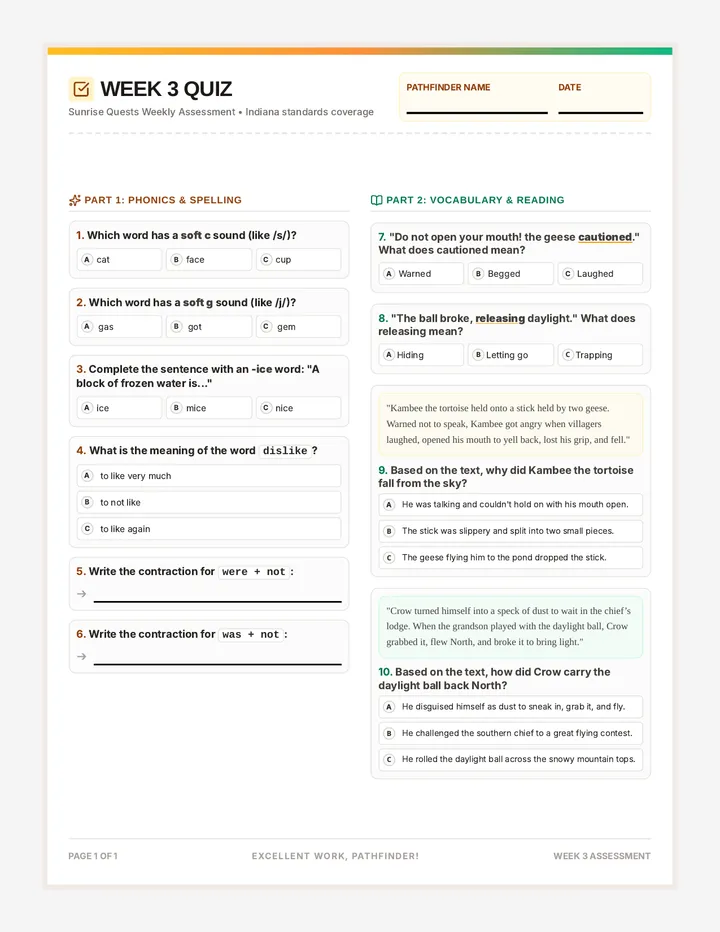
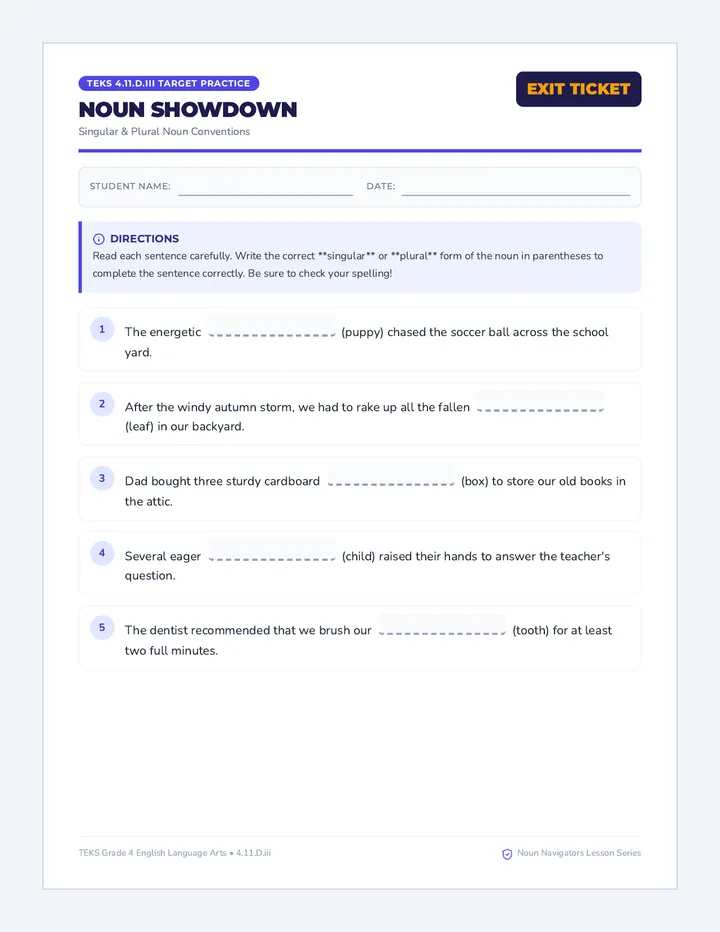
A quick diagnostic assessment to identify student mastery of irregular plural noun forms including vowel shifts, -f to -ves endings, and nouns with no change.
This lesson covers Chapters 19 and 20 of Carl Hiaasen's Hoot, focusing on the climax of the story and the resolution of the conflict between the students and Mother Paula's Pancake House. students will explore key vocabulary and analyze character motivations through comprehension questions.
This lesson provides Specially Designed Instruction (SDI) for crafting introductory paragraphs. It utilizes graphic organizers and sentence starters to help students build a strong foundation for informative writing.
A comprehensive quiz covering the four foundational parts of speech: nouns, verbs, adjectives, and pronouns. Includes matching, multiple choice, identification, and creative fill-in-the-blank questions.
A fun, phonics-focused lesson on long /a/ vowel teams and magic -e spelling patterns. Students will practice identifying and reading words with -ai, -ay, -eigh, -ea, and a-e patterns through a high-energy bingo game.
A lesson focused on mastering commas in compound and complex sentences within the context of space exploration. Students practice identifying and correcting punctuation and capitalization errors in mission-themed reports.
A comprehensive review and assessment of nouns, verbs, adjectives, and pronouns for 3rd-grade students, featuring a space-themed quest.
A lesson focused on crafting powerful persuasive essay conclusions, specifically exploring the deep connection between Native American cultures and the natural world.
A comprehensive lesson on identifying and constructing simple, compound, and complex sentences using a construction site theme.
A collection of comprehension resources for the latter half of R.J. Palacio's Wonder, focusing on perspective shifts and character growth in Parts 4-8.
A mini-lesson designed to help 5th graders craft powerful argumentative thesis statements for compare and contrast essays, specifically focusing on Caitlyn and Sara.
A collection of realistic fiction reading passages designed for assessing reading levels from 2nd through 5th grade. These texts feature age-appropriate themes for older students while maintaining accessible vocabulary and structure for struggling readers.
A small group phonics lesson focused on identifying and mapping various spelling patterns for Long A and Long E sounds through sorting and dictation.
A focused lesson on closed syllable exceptions (-ost, -ild, -ind, -olt, -old), featuring decodable passages, instructional slides, and teacher support materials designed for grades 1-3.
A collection of decodable reading passages for Grade 2 students focusing on the role of pollinators in nature, aligned with EL Education Module 3. Includes tracking tools for fluency assessment.
A lesson focused on using context clues to make inferences about character traits and feelings using 5th-grade level vocabulary. Students will analyze situational clues to identify sophisticated synonyms for common emotions and behaviors.
A high-stakes, game-show style lesson based on the 'Are You Smarter Than a 5th Grader' format, specifically targeting Ohio 3rd Grade Informational Text and Language standards. Students test their knowledge of main ideas, text features, and vocabulary to see if they can outsmart a 3rd grader.
A comprehensive set of guided notes and materials based on the 'Building Your Children Book' workshop slides, covering theme, characterization, story structure, and sentence syntax.
A high-energy, game-show style lesson where students test their knowledge of 3rd-grade informational text and language standards through animal science and nature topics.
A mini-lesson focused on replacing 'telling' adjectives with 'showing' character actions to create more vivid and engaging narrative writing. Students will learn to use physical behaviors as evidence of internal emotions and traits.
A lesson focused on 'decoding' writing prompts by identifying the core task and highlighting essential keywords across diverse topics like animal habitats and social-emotional learning.
A lesson introducing the concept of cause and effect within narrative structures, focusing on how events trigger one another to drive a plot forward.
A detective-themed ELA test prep escape room where students solve challenges based on 3rd grade reading and writing standards to unlock the library's lost ledger.
A high-stakes, detective-themed escape room designed to prepare 3rd-grade students for the Ohio State Test (OST) in English Language Arts. Students solve a series of 'locks' involving reading comprehension, vocabulary, and grammar to recover stolen agency data.
A fun, detective-themed lesson designed to help 3rd grade students master Dolch sight words through visual association and investigative play. Students use 'dossier' flashcards to identify and practice high-frequency words.
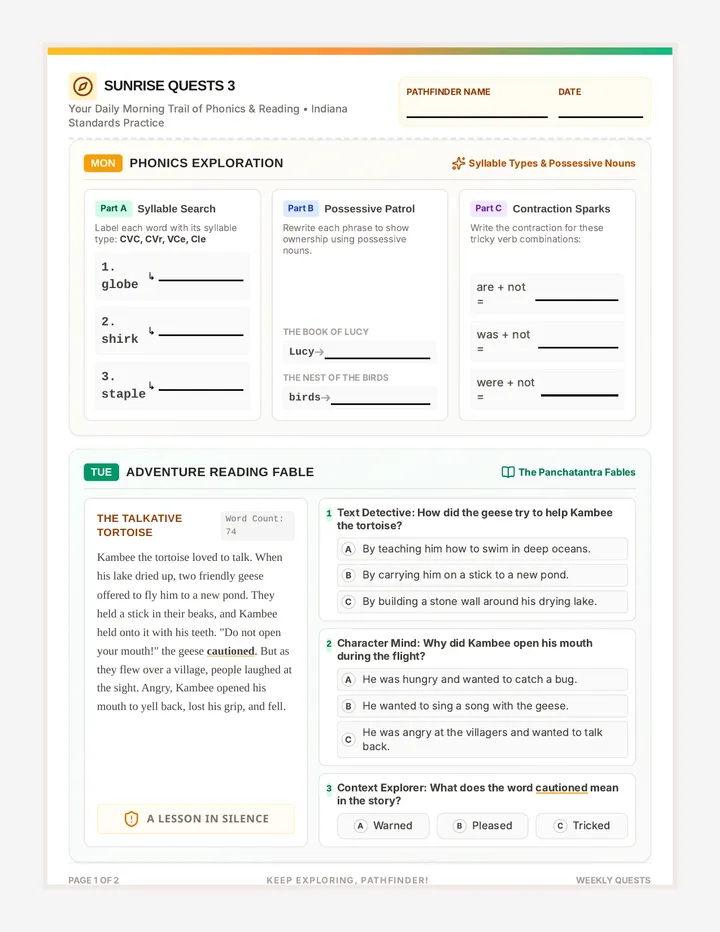
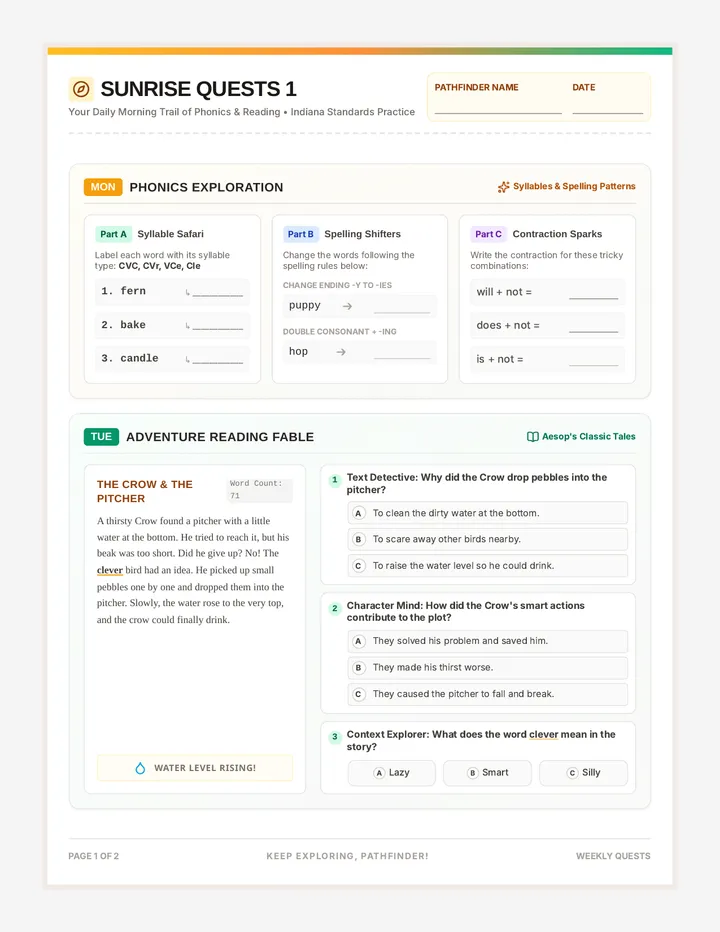
A collection of resources focused on decoding open and closed multisyllabic words through a spring-themed reading passage, designed for early 3rd-grade students.
A complete lesson on magnetism featuring an informational reading passage and a comprehension quiz designed to mirror standardized testing formats.
The final mission where detectives apply all their skills to crack the ultimate code and earn their Phonics Detective Badge.
Detectives learn to break down big, multi-syllabic words and track down suffixes at the end of word 'trails'.
A mystery involving the Silent E and its team of vowels that change the 'identities' of words.
Detectives use blueprints to understand how consonants work together in blends and digraphs to create unique sounds.
Detectives investigate the 'Lineup of Sounds' to master individual letter sounds and build CVC words using vowel clues.
The final training phase where sleuths break down complex multi-syllabic words and analyze suffixes to solve big linguistic cases.
Detectives study vowel teams to understand how pairs of vowels collaborate to make specific long sounds.
A surveillance mission into the silent but powerful 'e' and how it changes short vowels into long ones.