Piñata Connections Worksheet
Grade 3 • ELA Standard 3.RI.3 • Cause, Effect & Sequence
Informational Text • Part 1
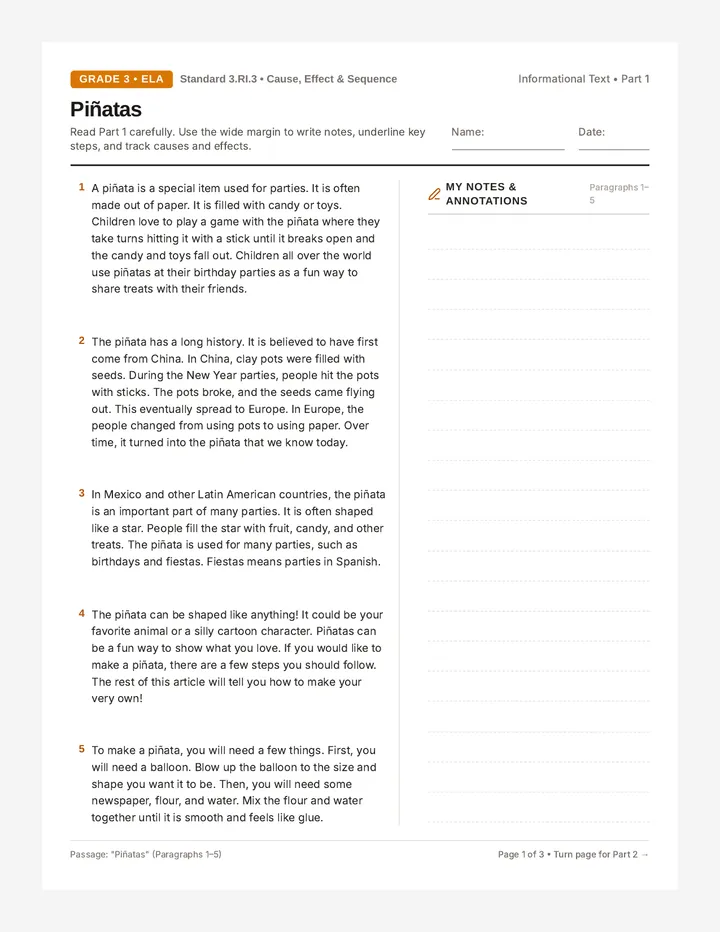
Piñatas
Read Part 1 carefully. Use the wide margin to write notes, underline key steps, and track causes and effects.
Name:
Date:
1 A piñata is a special item used for parties. It is often made out of paper. It is filled with candy or toys. Children love to play a game with the piñata where they take turns hitting it with a stick until it breaks open and the candy and toys fall out. Children all over the world use piñatas at their birthday parties as a fun way to share treats with their friends.
2 The piñata has a long history. It is believed to have first come from China. In China, clay pots were filled with seeds. During the New Year parties, people hit the pots with sticks. The pots broke, and the seeds came flying out. This eventually spread to Europe. In Europe, the people changed from using pots to using paper. Over time, it turned into the piñata that we know today.
3 In Mexico and other Latin American countries, the piñata is an important part of many parties. It is often shaped like a star. People fill the star with fruit, candy, and other treats. The piñata is used for many parties, such as birthdays and fiestas. Fiestas means parties in Spanish.
4 The piñata can be shaped like anything! It could be your favorite animal or a silly cartoon character. Piñatas can be a fun way to show what you love. If you would like to make a piñata, there are a few steps you should follow. The rest of this article will tell you how to make your very own!
5 To make a piñata, you will need a few things. First, you will need a balloon. Blow up the balloon to the size and shape you want it to be. Then, you will need some newspaper, flour, and water. Mix the flour and water together until it is smooth and feels like glue.
My Notes & Annotations
Paragraphs 1–5
Passage: "Piñatas" (Paragraphs 1–5) Page 1 of 3 • Turn page for Part 2 →
Grade 3 • ELA Standard 3.RI.3 • Cause, Effect & Sequence
Informational Text • Part 2
Piñatas (Continued)
Continue reading about the steps and party rules. Annotate your observations in the margin.
Name:
6 Next, tear the newspaper into strips. Dip the strips into the glue. Cover the balloon with the strips of newspaper. Make sure to smooth out any bumps. Cover the entire balloon with the newspaper so that it will be strong enough to hold the candy and toys.
7 Once the newspaper is in place, let the piñata dry for several hours or overnight. This will give the newspaper and glue time to harden and become strong. When the glue on the piñata has dried, you will be able to pop the balloon and pull it out of the hard shell made by the newspaper. This will leave just the shape of your piñata made out of hardened newspaper.
8 After the piñata is dry, it is time to make it beautiful! Use tissue paper in different colors to cover the piñata in a fun way. You can cut the tissue paper into strips or squares and glue them onto the piñata. You can use different colors to create a character or picture. You can make your piñata into any design you can think of!
9 After you have decorated your piñata, fill it up with candy! You can put anything inside that will fit! Finally, you will need to make a small hole at the top of the piñata and put a string or ribbon through it. This will be used to hang the piñata from a tree.
10 When it is time to play the piñata game, hang the piñata from a tree. Each child takes a turn trying to hit the piñata with a stick. When it is their turn, children must have their eyes covered. The game is over when the piñata breaks open and spills the candy and toys. It is important to make sure that the children are at a safe distance from the piñata so that no one gets hurt.
11 The piñata is a fun and exciting activity that has been around for years and years and years. It is a way to bring joy to children. By following these simple steps, you can make your own piñata and enjoy the game with your friends and family.
My Notes & Annotations
Paragraphs 6–11
Passage: "Piñatas" (Paragraphs 6–11) Page 2 of 3 • Turn page for Comprehension Quiz →
Comprehension Quiz RI.3.3
Total Score: _____ / 5
Piñatas • Check For Understanding
Directions: Read each question carefully. Choose the best answer based on evidence from the text.
Name:
Date:
Which statement BEST describes what causes the piñata to be strong?
A The glue and newspaper strips dry and harden.
B The piñata is hung at a safe distance from children.
C The small ribbon is tightly tied in the hole at the top.
D The decorations are added to the piñata.
According to paragraph 2, what caused the seeds to come flying out during New Year parties in China?
A The wind blew the clay pots off the party tables.
B People pulled ribbons tied around the clay pots.
C The clay pots broke when people hit them with sticks.
D The seeds expanded and burst open the pots.
According to paragraph 7, what is an effect of popping and removing the balloon after the glue dries?
A The piñata fills up with treats automatically.
B The newspaper strips become soft and flexible again.
C You are left with just the hollow shell of hardened newspaper.
D The newspaper shell crumbles into small pieces.
According to paragraph 10, what is the result when the piñata breaks open?
A The game is over and the candy and toys spill out.
B Each child must immediately put on an eye covering.
C The piñata is lifted higher into the branches of the tree.
D The balloon inside pops with a loud sound.
According to the steps in paragraphs 5–8, which step happens AFTER the piñata dries and the balloon is removed, but BEFORE filling it with candy?
A Mix flour and water together until it feels like glue.
B Hang the piñata from a tree using a string or ribbon.
C Decorate the piñata with colorful strips or squares of tissue paper.
D Tear newspaper into strips and dip them into glue.
Standard 3.RI.3 CFU Quiz • Piñatas (Items 1–5) Page 3 of 3
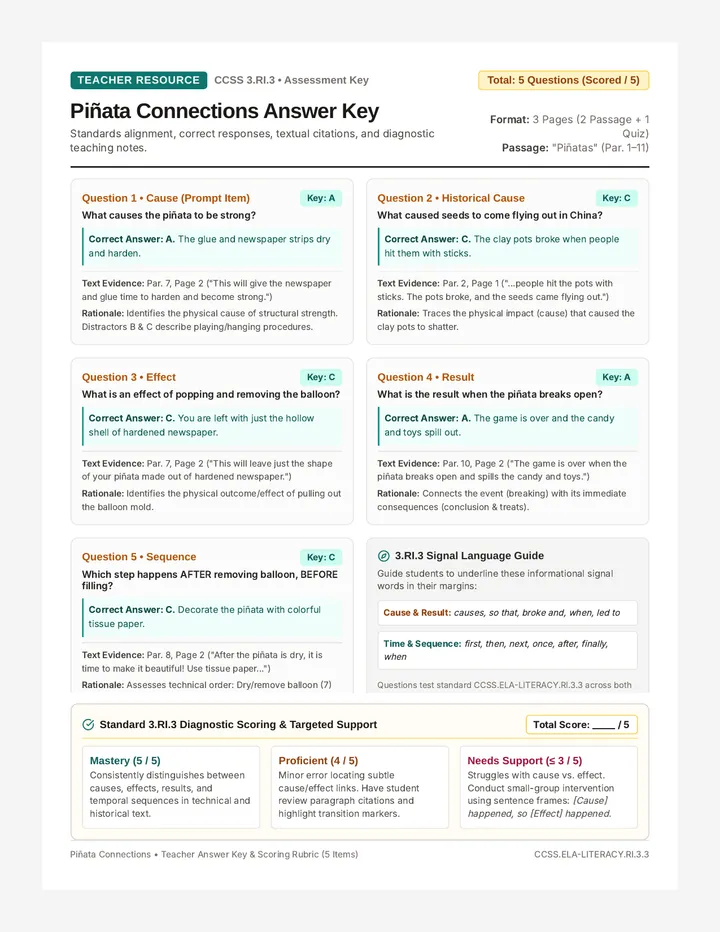
Piñata Connections Answer Key
Teacher Resource CCSS 3.RI.3 • Assessment Key
Total: 5 Questions (Scored / 5)
Piñata Connections Answer Key
Standards alignment, correct responses, textual citations, and diagnostic teaching notes.
Format: 3 Pages (2 Passage + 1 Quiz)
Passage: "Piñatas" (Par. 1–11)
Question 1 • Cause (Prompt Item) Key: A
What causes the piñata to be strong?
Correct Answer: A. The glue and newspaper strips dry and harden.
Text Evidence: Par. 7, Page 2 ("This will give the newspaper and glue time to harden and become strong.")
Rationale: Identifies the physical cause of structural strength. Distractors B & C describe playing/hanging procedures.
Question 2 • Historical Cause Key: C
What caused seeds to come flying out in China?
Correct Answer: C. The clay pots broke when people hit them with sticks.
Text Evidence: Par. 2, Page 1 ("...people hit the pots with sticks. The pots broke, and the seeds came flying out.")
Rationale: Traces the physical impact (cause) that caused the clay pots to shatter.
Question 3 • Effect Key: C
What is an effect of popping and removing the balloon?
Correct Answer: C. You are left with just the hollow shell of hardened newspaper.
Text Evidence: Par. 7, Page 2 ("This will leave just the shape of your piñata made out of hardened newspaper.")
Rationale: Identifies the physical outcome/effect of pulling out the balloon mold.
Question 4 • Result Key: A
What is the result when the piñata breaks open?
Correct Answer: A. The game is over and the candy and toys spill out.
Text Evidence: Par. 10, Page 2 ("The game is over when the piñata breaks open and spills the candy and toys.")
Rationale: Connects the event (breaking) with its immediate consequences (conclusion & treats).
Question 5 • Sequence Key: C
Which step happens AFTER removing balloon, BEFORE filling?
Correct Answer: C. Decorate the piñata with colorful tissue paper.
Text Evidence: Par. 8, Page 2 ("After the piñata is dry, it is time to make it beautiful! Use tissue paper...")
Rationale: Assesses technical order: Dry/remove balloon (7) → Decorate (8) → Fill with candy (9).
3.RI.3 Signal Language Guide
Guide students to underline these informational signal words in their margins:
Cause & Result: causes, so that, broke and, when, led to
Time & Sequence: first, then, next, once, after, finally, when
Questions test standard CCSS.ELA-LITERACY.RI.3.3 across both history (Par. 2) and technical craft steps (Par. 5–10).