Pet Detective Slides PET DETECTIVE ACADEMY • GRADE 2
Standard: RI.2.1 & RI.2.2
Reading Clue Mission
Pet Detectives: Main Idea & Key Details
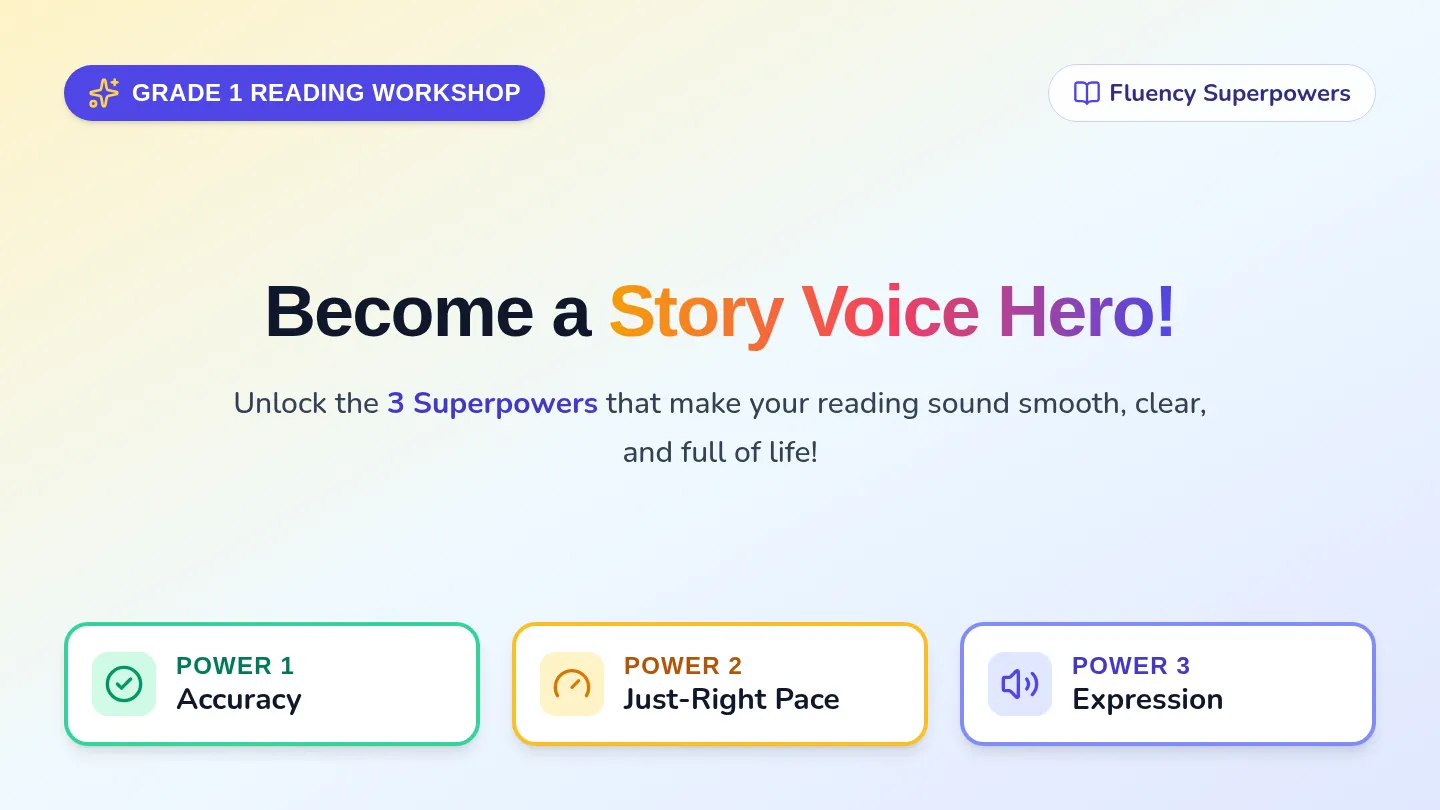
Grab your magnifying glass! Learn to ask questions, track down key details, and prove your answers with text evidence.
1
Find the Big Idea
What is the whole text about?
2
Ask & Answer
Use Who, What, Why clues
3
Prove It!
Find exact text evidence
Our Detective Mission Target
Step 1 • The Goal
Today's "I Can" Mission
“I can ask and answer questions about key details that support the main idea, using evidence from the text.”
Good readers don't just guess—they gather evidence like real detectives solving an animal mystery!
Three Clues We Need Today:
🐾
1. Spot the Main Idea
The big point the author wants us to learn.
🔍
2. Ask 5W Questions
Who? What? Where? Why? How?
📖
3. Quote the Text
Show the words that prove your answer!
Detective Rule: If you can't point to it in the text, you haven't proved it yet!
The Big Umbrella & Key Details
Concept Map
THE MAIN IDEA
The Big Umbrella
The main idea covers the whole passage . It tells what the entire text is mostly about.
Detective Question:
"What is the author's ONE big message about this pet?"
Supported by
KEY DETAILS
The Raindrops (Clues)
Key details are the specific facts, reasons, and examples that hold up and prove the main idea.
💧 Fact: Tells a true detail about the pet.
💧 Example: Shows how or why it happens.
Watch out! A tiny detail is NOT the whole main idea. It is just one clue!
The Detective Question Wheel: 5W's
Tool #1 • Asking Questions
To unlock key details, ask these question words while reading:
WHO
The Characters
Who is this text about? Which pet or owner?
WHAT
The Action
What special thing can this pet do?
WHERE
The Place
Where does the pet live, sleep, or play?
WHY
The Reason
Why does the pet do that unique behavior?
HOW
The Way
How do owners care for or train them?
Detective Strategy:
Ask a question BEFORE you read, then hunt for the answer IN the text!
Case File #1: Super Sniffer Dogs
Read Together
Case File: Dogs at Work 🐕
1 Dogs have an amazing sense of smell that helps them do incredible jobs. A dog's wet nose can smell things thousands of times better than human noses can!
2 Because of their powerful noses, search-and-rescue dogs can find lost hikers in deep snow or thick forests. Other sniffer dogs work at airports to check luggage and keep travelers safe.
3 Whether as pets or working partners, dogs use their super noses every single day to explore the world and help people.
🔍 Think: What is this whole text mostly about? What clues support it?
Let's investigate on the next slide ➔
Case Solved: Finding the Evidence
Teacher Model
MAIN IDEA (The Big Umbrella)
“Dogs have an amazing sense of smell that helps them do incredible jobs.”
Question 1 (How?)
How good is their nose?
A dog's nose can smell thousands of times better than humans!
✓ Proves super smell
Question 2 (What?)
What jobs do they do?
Rescue dogs find lost hikers in deep snow and thick forests.
✓ Proves helpful jobs
Question 3 (Where?)
Where else do they work?
They check luggage at airports to keep travelers safe.
✓ Proves airport safety
All three details connect straight back to the Main Idea umbrella!
Sentence Starters: Prove Your Evidence!
Tool #2 • Evidence Talk
When answering questions, talk like a real detective! Use these sentence starters:
A
“The text states that…”
Example: “The text states that dogs can smell thousands of times better than humans.”
B
“According to paragraph…”
Example: “According to paragraph 2, rescue dogs find lost hikers in deep snow.”
C
“The author explains…”
Example: “The author explains how sniffer dogs check luggage at airports.”
D
“I know this because…”
Example: “I know this because the passage says dogs use their super noses every day.”
🔎 Always match your words to the exact clues on the page!
Detective Partner Challenge: Clever Cats
Guided Practice
Case Mini-File 🐱
Why Cats Have Whiskers
Whiskers are not just ordinary cat hairs. They are super-sensitive feelers! Whiskers help cats judge if a tight space is wide enough for their body. They also help cats navigate in the dark by feeling tiny air movements.
💡 Talk to your partner: What is the main idea?
Partner Clue Questions
1. What is the Main Idea?
Cats use their whiskers as super-sensitive tools to explore and stay safe.
2. Ask a "WHY" or "HOW" Question:
“How do whiskers help cats in the dark?”
3. Prove It with Evidence:
“The text says whiskers feel tiny air movements!”
Give your partner a high-paw 🐾 if you both found the exact words in the text!
Official Detective Checklist
Ready for Independent Practice!
1
Read Closely
Read every paragraph with your detective eyes open.
2
Umbrella Check
Name the main idea that covers the whole text.
3
Ask 5W Questions
Ask Who, What, Where, When, Why, and How.
4
Show Evidence
Underline or quote the exact clue that proves it!
Your Mission Awaits!
Open your Pet Detective Worksheet and crack the case!
Case File Open 🐾
Pet Detectives Lesson Plan Grade 2 • English Language Arts • Informational Text Duration: 45–55 Minutes
🐾 Pet Detectives: Main Idea & Evidence
Asking and answering questions about key details that support the main idea using text evidence.
Std. 1, I-1 (RI.2.1 / RI.2.2)
Learning Target ("I Can")
“I can ask and answer questions about key details that support the main idea, using evidence from the text.”
Success Criteria
• State the main idea (the "Big Umbrella") of a pet passage.
• Formulate 5W questions (Who, What, Where, When, Why, How).
• Underline and cite exact words from the text as proof.
Materials Needed
• Pet Detective Slide Deck (8 slides)
Core Vocabulary
Main Idea: The single biggest point the author makes.Key Details: Facts and examples that prove the main idea.Text Evidence: Exact words from the story used as proof.
Instructional Sequence (50-Minute Plan)
1. Hook & Target Launch (Slide 1–2) 7 Mins
Teacher Hook: "Detectives search for clues to solve mysteries. Readers search for key details to understand an author's main idea!" Present the detective badge and introduce today's "I Can" target.
2. Direct Instruction: The Umbrella & 5Ws (Slides 3–4) 10 Mins
Teach the Umbrella Metaphor : the umbrella covers the whole passage (Main Idea), while raindrops are individual facts (Key Details). Introduce the 5W Question Wheel (Who, What, Where, When, Why, How) to unlock clues.
3. Modeled Reading & Evidence Hunt (Slides 5–7) 13 Mins
Read aloud "Case File #1: Super Sniffer Dogs". Think aloud to isolate the main idea. Model asking: "How good is their nose?" and "What jobs do they do?" Model writing evidence using the sentence starter: "The text states that..."
4. Guided Practice: Partner Investigation (Slide 8) 8 Mins
Students read "Clever Cats" with a partner. Partners take turns: Partner A asks a 5W question; Partner B finds the sentence in the text and reads the proof aloud.
5. Independent Practice & Exit Debrief (Slide 9) 12 Mins
Distribute the "Amazing Guinea Pigs" worksheet. Students complete the reading passage, answer 5W questions, and write text evidence. Close with a 2-minute whole-group detective debrief.
Pet Detectives Lesson Bundle • Teacher Planning Guide Page 1 of 2
Teacher Implementation Toolkit & Scaffolding
Explicit teacher scripts, error correction, and tiered differentiation
Pedagogical Notes
Scripted Think-Aloud (Slide 6)
Teacher: “I just read paragraph 2 about rescue dogs finding lost hikers in snow. I ask myself: Is this whole text only about snowy mountains? No! That’s just one raindrop—one key detail! The big umbrella is that dogs have super smelling abilities that help them do many jobs .”
Prompting Students: “Turn to your neighbor and tell them: Why isn't 'airports have sniffer dogs' the main idea? How does it support the big umbrella instead?”
Common Misconceptions & Corrections
Misconception: Confusing a cool detail for the main idea.
Correction: “Ask yourself: Does this sentence cover everything in the passage, or just one part? If it's just one part, it's a detail raindrop!”
Misconception: Answering from background memory without text evidence.
Correction: “You might know lots of fun dog facts, but detective rules require proof! Put your finger on the exact words in paragraph 1 or 2.”
Tiered Differentiation Matrix
Support / ELL
• Pre-highlight paragraph numbers."The main idea is ____." and "The text says ____."
On-Level
• Underline key details independently.
Extension / Gifted
• Write a two-sentence summary synthesizing main idea and two key details.
Quick Assessment Rubric (3 Points)
Criteria
1 - Developing
2 - Approaching
3 - Proficient
Main Idea
Identifies an isolated detail or unrelated topic.
Identifies general topic (e.g., "guinea pigs") but misses author's point.
Accurately states the overarching main idea of the passage.
Key Details
Answers questions with outside knowledge or guesses.
Answers correctly but cannot cite or explain supporting details.
Answers 5W questions accurately using text details.
Text Evidence
No text reference or points to incorrect section.
Paraphrases vaguely without referring to the text.
Underlines and cites exact words/phrases from the passage.
Pet Detectives Lesson Bundle • Teacher Planning Guide Page 2 of 2
Pet Detectives Student Worksheet 🐾 Official Case File #2 • Grade 2 Reading
Pet Detectives: Clue Investigator
Name:
Date:
My Detective Mission: I can ask and answer questions about key details that support the main idea, using evidence from the text.
Informational Case File Read 2 Times 🐾
Amazing Guinea Pigs: Perfect Pocket Pets
1 Guinea pigs are wonderful, gentle pets that make sweet companions for families. Even though they are called "pigs," they are actually friendly rodents with round bodies, soft fur, and no tails at all!
2 These little animals have special ways of communicating with their owners. When a guinea pig feels happy or excited to eat, it makes a high-pitched squeaking noise called a "wheek." They also do a happy hop called "popcorning," where they jump straight into the air and twist!
3 Guinea pigs need thoughtful care to stay healthy and safe. They eat fresh hay and leafy greens every day, and they love having a soft hideout where they can rest. Because they are social pets, they are happiest when living with another guinea pig friend.
1
Part 1: The Big Umbrella (Main Idea)
Which sentence states the main idea of the entire passage? Fill in the bubble next to your choice.
A. Guinea pigs make a high squeak called a "wheek" when they are hungry. B. Guinea pigs are gentle, wonderful pets that have unique behaviors and need caring homes. C. Guinea pigs eat fresh timothy hay and like having leafy greens every day. D. Guinea pigs do not have tails and belong to the rodent family.
Turn the page to investigate key details & text evidence! ➔ Page 1 of 2
Part 2 • Case Evidence Investigation Passage: "Amazing Guinea Pigs"
Case Clues
1. (WHAT) What is "popcorning," and what does it tell you about a guinea pig?
Paragraph 2
Write your answer in a complete sentence, then quote the text evidence that proves it.
Answer:
Text Evidence:
2. (WHY) Why are guinea pigs happiest when living with another guinea pig?
Paragraph 3
Use the sentence starter: "According to the text..." to cite your evidence.
Answer:
Text Evidence:
3. (HOW) How does the detail about "wheeking" support the author's main idea?
Deep Thinking
Explain how this detail shows guinea pigs make sweet, communicative companions.
★
Part 3: Be the Detective! (Ask Your Own Question)
Write your own Who, What, Where, When, Why, or How question about a key detail in the passage. Then challenge a friend or write the answer below!
My 5W Question:
Text Answer:
Found in: Paragraph _____
🕵️ Detective Self-Check: Did you prove each answer with words from the text?
Yes! Need to check
Pet Detectives Student Worksheet • Grade 2 Reading Page 2 of 2
Pet Detectives Answer Key Teacher Reference & Evaluation Guide Grade 2 • RI.2.1 & RI.2.2
🐾 Pet Detectives: Answer Key & Rubric
Exemplary student answers, acceptable phrasing variations, and evidence citations for "Amazing Guinea Pigs".
Master Solution Key
Part 1: Main Idea Solution
Correct: Option B
Option B: “Guinea pigs are gentle, wonderful pets that have unique behaviors and need caring homes.”
Diagnostic Analysis: Option B is the overarching umbrella covering the entire passage. Options A and C are specific factual details from paragraphs 2 and 3. Option D is an anatomical detail from paragraph 1. None of these cover the complete text.
Part 2: Clue Hunt Solutions & Text Evidence
Question 1 (What is popcorning?): Paragraph 2
Exemplary Answer: "Popcorning is a happy hop where guinea pigs jump straight up in the air and twist. It tells us the guinea pig is feeling joyful and excited."
Text Evidence: "They also do a happy hop called 'popcorning,' where they jump straight into the air and twist!"
Acceptable Phrasing: Jumping in the air, twisting when happy, showing excitement.
Question 2 (Why live with another guinea pig?): Paragraph 3
Exemplary Answer: "Guinea pigs are happiest with a friend because they are social pets."
Text Evidence: "According to the text, 'Because they are social pets, they are happiest when living with another guinea pig friend.'"
Acceptable Phrasing: They like having company, they get lonely alone, they are social animals.
Question 3 (How does "wheeking" support the main idea?): Deep Thinking
Exemplary Answer: "The wheeking sound shows how guinea pigs talk and communicate with humans, which proves the main idea that they make wonderful, interactive companions."
Acceptable Phrasing: It proves they are friendly pets; it shows how they tell owners they are happy or hungry.
Part 3: Student-Generated Questions (Sample Rubric)
Sample Valid Questions: • "What do guinea pigs eat every day?" (Hay and greens)
Evaluation Criteria: • Uses a 5W question word correctly.
Actionable Teacher Feedback Stems
If picked A or C: "That is a fun fact! But did the whole story only talk about food? What umbrella covers all paragraphs?"
If no text evidence: "Great thinking! Now point your detective finger to the exact sentence on page 1 that proves it."
If answer is vague: "Can you use words straight from paragraph 2, like 'wheek' or 'popcorning'?"
Pet Detectives Lesson Bundle • Teacher Answer Key & Diagnostic Guide Grade 2 Reading ELA