Corn Choices WIDA 1 PacketName: ________________________ Period: ______ Date: ____________ ELA • Mrs. DeFusco WIDA Level 1 The Omnivore's Dilemma: Unit 1 Lesson 3, Section 2 • Vocabulary Log (Pages 30–49) 🌽 ▲ Academic Word: Used in many school subjects 🌾 Topic Word: Used for farming & food Part A: Match the Word to the Picture Draw a line from each word to its matching picture and meaning. 1. yield Page 34 • ▲ 2. GMO foods Page 36 • 🌾 3. bonanza Page 36 • 🌾 4. subsidy Page 46 • 🌾 💰 A very big amount of money or success 🏛️💵 Money the government gives to farmers 🌾🌽 How much food a farm grows 🧬🌱 Plants with DNA changed in a lab Part B: Use the Word Bank Write the correct word on each line. yield • GMO foods • bonanza • subsidy 🧬 1. Scientists change the DNA of seeds to make ________________________. 🌾 2. New seeds give farmers a bigger ________________________ of corn. 🏛️ 3. The government pays a ________________________ to help corn farmers. 💰 4. Selling patented seeds is a big money ________________________ for companies. Synopsis: Section 2 (Picture Summary) Grade 8 • Module 2 • Unit 1 • Lesson 3 WIDA Level 1 🛒🌽 Pages 17–19 Almost everything in the supermarket is made from corn. Nonfood items also have corn: diapers 👶, toothpaste 🪥, and makeup 💄. 🧬🐛 Pages 34–36 Long ago, farmers saved their own seeds. Now seeds are GMO (changed in a lab). Scientists put strong traits into seeds to stop bugs and disease. Big companies own patents on GMO seeds. Farmers must buy new seeds every year. 🚜💸 Pages 46–49 Farms grow a lot of corn, but farmers do not make much money. It costs more to grow corn than to buy it, so farmers lose money. The government only gives subsidies (money) for growing corn. Check Understanding: Circle YES or NO Read each sentence. Look at the picture. Circle YES or NO. 🪥 1. Toothpaste and diapers can contain corn. YES NO 🧬 2. Scientists change GMO seed DNA to fight bugs. YES NO 💰 3. Farmers make a lot of money growing corn today. YES NO 🏛️ 4. The government gives subsidies for growing corn. YES NO Paragraph Structure & Reading Questions Standards: RI.8.1, RI.8.5 • Visual Guide WIDA Level 1 Part 1: 4 Types of Paragraphs ⚖️ A. Compare / Contrast Shows how things are same & different. 👁️ B. Descriptive Uses 5 senses to paint a picture. 📖 C. Narrative Tells a story with events in order. 💡 D. Expository / Explanatory Gives facts, data, and experts. Part 2: Match the Quote to the Paragraph Type Write the letter (A, B, C, or D) from the chart above. 1. Page 17: "Look again... behind the brightly colored packaging... there is a mountain of corn." Clue: Uses the sense of sight (brightly colored). 2. Page 35: "New hybrids have increased farm yields to about 180 bushels per acre." Clue: Gives facts and data (180 bushels). Part 3: Reading Questions (Circle the Best Answer) 1. (Page 34) What is a problem (disadvantage) with hybrid plants? 🌱 A. They grow too fast B. New seeds make less corn C. Cows will not eat them 2. (Page 36) How do big seed companies make money from farmers? 🏭 A. Farmers buy new seeds every year B. Companies sell tractors C. Companies give free seeds 3. (Page 49) Why aren't corn farmers making money? 💸 A. Nobody buys corn B. Growing corn costs more than selling it C. Corn does not grow well Exit Ticket & Author's Purpose Unit 1, Lesson 3 • Standards: RI.8.5, RI.8.6 WIDA Level 1 🎫 Exit Ticket (RI.8.5) Circle the best answer for each question. 1. On page 36 ("These new GMO seeds..."), what type of paragraph does the author use? A. 📖 Narrative (tells a story) B. 👁️ Descriptive (5 senses) C. ⚖️ Compare / Contrast D. 💡 Expository / Explanatory (facts) 2. Read this quote from page 36: "They believe that GMOs are a reckless experiment with the natural order of things." How does this sentence help the reader? A. It gives the author's opinion on GMOs. B. It gives a reason to oppose industrial farming. C. It defines industrial farming. 🏠 Homework: Author's Purpose (RI.8.6) Circle the best answer for each question. 1. On page 34, what does the author say about the "children" of hybrid seeds? A. They grow faster than natural corn. B. They do not have the same big yield as the first hybrid seeds. C. They are resistant to all diseases. 2. Why did the author write "Rich Fields, Poor Farmers" (pages 46–49)? A. To explain the business of farming to readers B. To sell more corn and soybeans C. To tell a funny story about farms
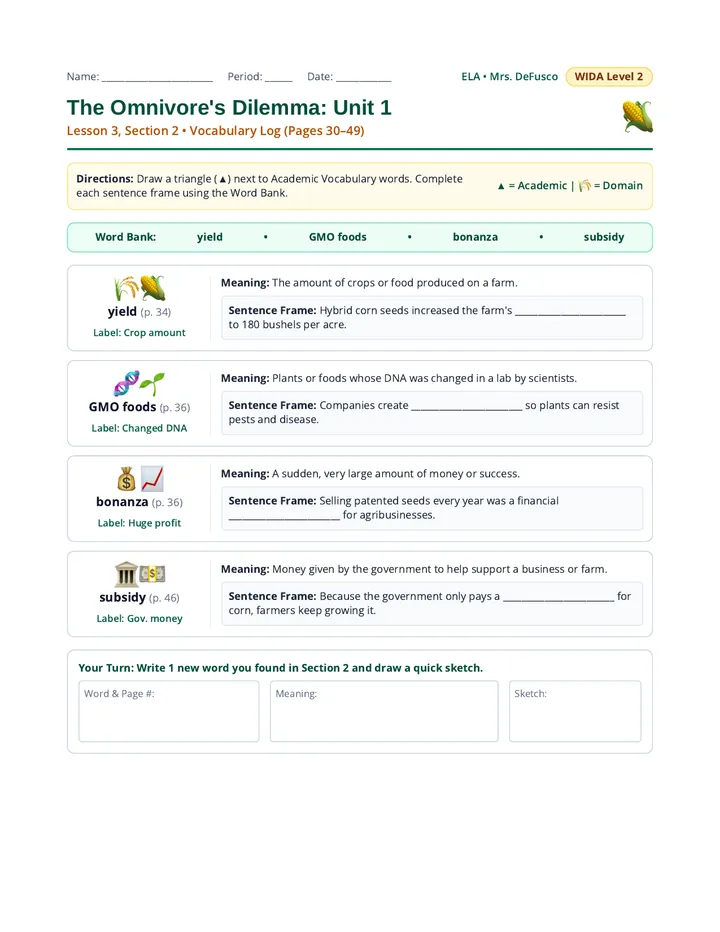
Corn Choices WIDA 2 PacketName: ________________________ Period: ______ Date: ____________ ELA • Mrs. DeFusco WIDA Level 2 The Omnivore's Dilemma: Unit 1 Lesson 3, Section 2 • Vocabulary Log (Pages 30–49) 🌽 Directions: Draw a triangle (▲) next to Academic Vocabulary words. Complete each sentence frame using the Word Bank. ▲ = Academic | 🌾 = Domain Word Bank: yield • GMO foods • bonanza • subsidy 🌾🌽 yield (p. 34) Label: Crop amount Meaning: The amount of crops or food produced on a farm. Sentence Frame: Hybrid corn seeds increased the farm's ________________________ to 180 bushels per acre. 🧬🌱 GMO foods (p. 36) Label: Changed DNA Meaning: Plants or foods whose DNA was changed in a lab by scientists. Sentence Frame: Companies create ________________________ so plants can resist pests and disease. 💰📈 bonanza (p. 36) Label: Huge profit Meaning: A sudden, very large amount of money or success. Sentence Frame: Selling patented seeds every year was a financial ________________________ for agribusinesses. 🏛️💵 subsidy (p. 46) Label: Gov. money Meaning: Money given by the government to help support a business or farm. Sentence Frame: Because the government only pays a ________________________ for corn, farmers keep growing it. Your Turn: Write 1 new word you found in Section 2 and draw a quick sketch. Word & Page #: Meaning: Sketch: Synopsis: The Omnivore's Dilemma, Section 2 Grade 8 • Module 2 • Unit 1 • Lesson 3 WIDA Level 2 🛒🌽 Pages 17–19 Although supermarkets seem to have many different foods, almost every product is made from corn. Nonfood items like diapers, toothpaste, and makeup also contain corn. 🧬🏭 Pages 34–36 Farmers used to grow their own seeds, but now seeds are genetically modified (GMO). Seed companies modify seed DNA by moving a disease-resistant trait from one plant into another. Agribusinesses patent GMO seeds, so farmers must keep buying seeds from these corporations to compete. 🚜🏛️ Pages 46–49 American farms are more productive than ever, yet farmers do not make much money. The cost to buy corn is lower than the cost to grow it, so farmers actually lose money. The government only gives subsidies for corn, so farmers cannot make money growing other crops. Check Understanding: Match Cause & Effect Write the matching letter (A, B, C, or D) in each box. Cause (Why it happens) 1. Plants can be destroyed by pests or disease. 🐛 2. Agribusinesses own patents on GMO seeds. 🏭 3. Corn costs more to grow than to buy. 💸 4. Government only gives subsidies for corn. 🏛️ Effect (What happens next) A. Farmers lose money even when they grow huge harvests. B. Farmers cannot make money growing crops other than corn. C. Scientists modify seed DNA to make stronger plants. D. Farmers must keep buying GMO seeds from corporations. Paragraph Structure & Reading Questions Standards: RI.8.1, RI.8.5 • Sentence Frames WIDA Level 2 Part 1: Paragraph Structure Anchor Chart ⚖️ Compare / Contrast Explains similarities and differences between two things. (Clues: both, instead, however) 👁️ Descriptive Uses sensory language (5 senses) to help readers imagine a scene. (Clues: brightly, look, sounds) 📖 Narrative Tells a story with a sequence, characters, or conflict. (Clues: back when, then, in the 1930s) 💡 Expository / Explanatory Gives information, facts, and data; often cites experts. (Clues: numbers, experts, explains) Part 2: Identify the Paragraph Type (Use the Word Bank) Compare/Contrast • Descriptive • Narrative • Expository/Explanatory 1. Page 17, Para 2: "Look again. Somewhere, behind the brightly colored packaging... there is a mountain of corn." This paragraph is ________________________ because it appeals to the sense of sight. 2. Page 35, Para 3: "New hybrids have increased farm yields to about 180 bushels per acre." This paragraph is ________________________ because it gives data to inform the reader. Part 3: Reading Questions (Complete the Sentence Frames) Word Bank: higher yields | buy new seeds every year | smaller crops | costs more to grow 1. (Page 34) What are the advantages and disadvantages of hybrid plants? 🌱 An advantage of hybrid plants is ________________________, but a disadvantage is that the next generation produces ________________________. 2. (Page 36) How do agribusinesses profit from farmers? 🏭 Agribusinesses profit because they patent GMO seeds, so farmers must ________________________ from them. 3. (Page 49) Why aren't farmers making money? 💸 Farmers aren't making money because corn ________________________ than the price they can sell it for. Exit Ticket & Author's Purpose Unit 1, Lesson 3 • Standards: RI.8.5, RI.8.6 WIDA Level 2 🎫 Exit Ticket: Unit 1, Lesson 3 (RI.8.5) Circle the best answer for each question. 1. In paragraph 2 on page 36, beginning with "These new GMO seeds . . .," what type of paragraph structure does the author use? A. Narrative (tells a story) B. Descriptive (uses 5 senses) C. Compare/Contrast (same & different) D. Expository/Explanatory (gives facts) 2. How does this sentence help develop the concept of food choices? "They believe that GMOs are a reckless experiment with the natural order of things" (36). A. by giving the author's opinion on the use of GMOs B. by giving an analysis of corporations that sell corn C. by giving a reason to oppose industrial farming D. by giving a definition of industrial farming 🏠 Homework: Author's Purpose & Point of View (RI.8.6) Circle the best answer, then complete the sentence frame. 1. On page 34, seed companies say hybrid seeds produce hybrid corn. How does the author respond? A. by showing that seed companies cannot guarantee hybrid plants B. by showing that hybrid seeds cannot produce corn like natural seeds C. by showing that hybrid corn is not resistant to disease D. by showing that the "children" of hybrid seeds do not have the same yield 2. What is the author's purpose for writing "Rich Fields, Poor Farmers" (pages 46–49)? A. to explain the business of agriculture B. to promote corn and soybean crops C. to convince readers farmers are lazy D. to show farmers don't understand math Explain: In "Rich Fields, Poor Farmers," the author wants readers to understand that ________________________.
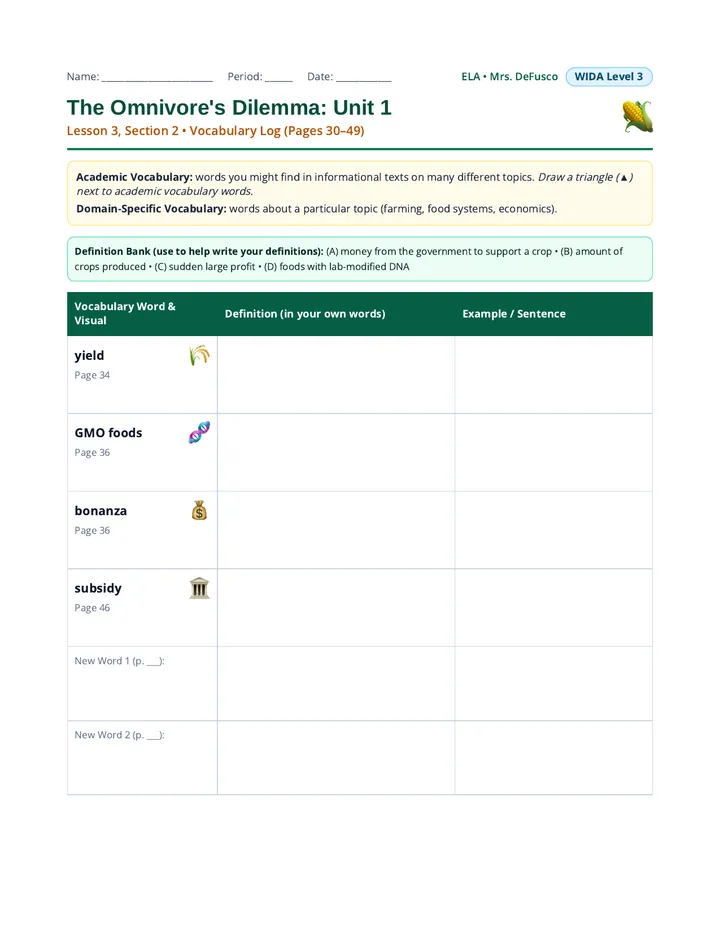
Corn Choices WIDA 3 PacketName: ________________________ Period: ______ Date: ____________ ELA • Mrs. DeFusco WIDA Level 3 The Omnivore's Dilemma: Unit 1 Lesson 3, Section 2 • Vocabulary Log (Pages 30–49) 🌽 Academic Vocabulary: words you might find in informational texts on many different topics. Draw a triangle (▲) next to academic vocabulary words. Domain-Specific Vocabulary: words about a particular topic (farming, food systems, economics). Definition Bank (use to help write your definitions): (A) money from the government to support a crop • (B) amount of crops produced • (C) sudden large profit • (D) foods with lab-modified DNA Vocabulary Word & Visual Definition (in your own words) Example / Sentence yield 🌾 Page 34 | | | | GMO foods 🧬 Page 36 | | | | bonanza 💰 Page 36 | | | | subsidy 🏛️ Page 46 | | | | New Word 1 (p. ___): | | | | New Word 2 (p. ___): | | | Synopsis & Paragraph Structure Anchor Chart Grade 8 • Module 2 • Unit 1 • Lesson 3 • RI.8.1, RI.8.5 WIDA Level 3 Section 2 Synopsis: Key Ideas 🛒 Pages 17–19: Almost every supermarket product is made of corn or uses corn as a main ingredient—even nonfood items like diapers, toothpaste, and makeup. 🧬 Pages 34–36: Farmers used to save their own seeds, but now seeds are genetically modified (GMO). Scientists transfer disease-resistant traits into seed DNA. Agribusinesses patent GMO seeds, forcing farmers to keep buying seeds from corporations to compete. 🚜 Pages 46–49: American farms are more productive than ever, yet farmers lose money because the cost to buy corn is lower than the cost to grow it. Government subsidies only support corn, limiting farmers' other crop choices. Part I: Paragraph Structure Anchor Chart (RI.8.1, RI.8.5) ⚖️ Compare / Contrast Identifies similarities and differences between two or more people, places, things, or ideas. Signal words: instead, however, both, unlike. 👁️ Descriptive Uses sensory language (five senses) to help readers imagine a scene, person, or object. Uses detailed observations to make a point. 📖 Narrative Tells a story and usually follows a time sequence. May contain characters, a setting, a conflict, and/or a resolution. 💡 Expository / Explanatory Gives information and often cites credible sources or experts. Specifies the topic, why it is important, and what is to come. Quick Check: Match each clue to the correct paragraph structure (write C, D, N, or E). 1. Appeals to the five senses ______ 2. Cites experts and gives data ______ 3. Tells a story with a sequence ______ 4. Shows similarities & differences ______ Paragraph Analysis & Reading Questions Part II Examples & Section 2 Text-Dependent Questions WIDA Level 3 Directions: Identify the Type of Paragraph (Compare/Contrast, Descriptive, Narrative, or Expository/Explanatory) and its purpose. Example Type of Paragraph & Purpose Key Concept & Developing Sentence Page 17, Paragraph 2 "Take a look . . ." to ". . . mountain of corn." Type: ____________________ Purpose: _________________ | "Look again. Somewhere, behind the brightly colored packaging... there is a mountain of corn." Appeals to sight so readers imagine how most supermarket foods contain corn. | | Page 34, Paragraph 1 "Back when George's grandfather . . ." to "Sounds good, right?" | Type: ____________________ Purpose: _________________ | "Then in the 1930s seed companies came up with a new kind of corn seed—hybrid corn." Provides the reader with the history of farmers and seeds. | | Page 35, Paragraph 3 "New hybrids have . . ." to ". . . thought to myself." | Type: ____________________ Purpose: _________________ | "New hybrids have increased farm yields to about 180 bushels per acre." Provides data to inform the reader about hybrid corn plants. | Reading Questions: Answer in Complete Sentences with Evidence 1. (Page 34: "But the children of that crop . . .") What are the advantages and disadvantages of hybrid plants? 🌱 Starter: An advantage of hybrid plants is ________, whereas a disadvantage is ________. The text states, "________." 2. (Page 36: "Even if farmers face hard times . . .") How do agribusinesses profit from farmers? 🏭 Starter: Agribusinesses profit from farmers by ________. According to page 36, ________. 3. (Page 49: "Prices go lower, but the mountain of corn . . .") Why aren't farmers making money? 💸 Starter: Farmers aren't making money because ________. For example, the text explains that ________. Exit Ticket & Author's Purpose Unit 1, Lesson 3 • Standards: RI.8.5, RI.8.6 WIDA Level 3 🎫 Exit Ticket: Unit 1, Lesson 3 (RI.8.5) Answer the following questions about paragraph structure in The Omnivore's Dilemma. 1. In paragraph 2 on page 36, beginning with "These new GMO seeds . . .," what type of paragraph structure does the author use? A. Narrative B. Descriptive C. Compare/Contrast D. Expository/Explanatory 2. How does the following sentence contribute to developing the concept of food choices? "They believe that GMOs are a reckless experiment with the natural order of things" (36). A. by providing the author's opinion on the use of GMOs B. by providing an analysis of corporations that sell corn C. by providing a reason to oppose industrial farming D. by providing a definition of industrial farming 🏠 Homework: Analyze Author's Purpose & Point of View (RI.8.6) Answer the questions about the author's purpose and point of view in pages 34–36 and 46–49. 1. On page 34, how does the author respond to the seed companies' conflicting viewpoint that hybrid seeds produce hybrid corn? A. by pointing out that seed companies cannot guarantee that hybrid seeds will produce hybrid plants B. by pointing out that hybrid seeds are not able to produce hybrid corn like natural seeds produce natural corn C. by pointing out that hybrid seeds do not always produce hybrid corn that is resistant to disease D. by pointing out that the "children" of hybrid seeds do not have the same yield as the original hybrid seeds 2. What is the author's purpose for writing "Rich Fields, Poor Farmers" on pages 46–49? A. to explain the business of agriculture to readers B. to promote the importance of corn and soybean crops C. to convince readers that farmers are trapped in poverty D. to analyze why farmers do not understand agribusiness