Court Whispers Teacher Guide 平安時代 • HEIAN ERA
EDUCATOR COMPANION
Homeschool Lesson Guide
Court Whispers: Secret Verses of Japan
Heian Court Etiquette, Indirect Nature Imagery, and Poetic Duels
Target: Grades 6–8 (2 Students)
Duration: 50–60 Minutes
Subjects: World History & Literature
Essential Question
Why did Heian nobles use seasonal nature metaphors instead of speaking directly—and how did poetry become a tool for political survival?
Learning Targets
Analyze how the Heian aristocracy (794–1185 CE) viewed direct speech as vulgar and disguised feelings through nature symbols (kigo ).Differentiate between page 1's 31-syllable waka (5-7-5-7-7) and page 2's 17-syllable haiku (5-7-5) with matching rhythm breaks.Execute a timed 5-minute secret verse exchange using symbolic courtly missives with folded origami presentation.
Lesson Pacing (50 Minutes)
10 Mins • Hook
Introduce the taboo of direct speech. Show how nobles spoke from behind bamboo screens (*kicho*).
15 Mins • Reading
Explore the two poem types: Page 1 for Waka (5-7-5-7-7) and Page 2 for Haiku (5-7-5) with rhythm breaks.
15 Mins • 5-Min Duel
Set a 5-minute timer. Brothers secretly craft, fold, and slip their missives across the table.
10 Mins • Debrief
Brothers decode each other's hidden metaphors. Compare court missives to modern encrypted messaging.
Historical Context: The "Rule of Taste" in Heian-kyo
During the Heian period (794–1185 CE), the imperial capital of Heian-kyo (modern Kyoto) fostered a hyper-refined court aristocracy known as the kuge . Direct confrontation, loud voices, and crude honesty were viewed as social suicide. Instead, court life was governed by miyabi (courtly refinement) and mono no aware (a poignant awareness of transience).
Sleeve Concealment
Nobles hid their faces behind wide silk sleeves or cypress fans (*hiogi*). Writing was more intimate than speaking face-to-face.
Botanical Delivery
Poems were folded into tiny polygons (*musubi-bomi*) and tied to a seasonal branch—such as a blooming plum twig or maple leaf.
Calligraphy & Ink
Recipients judged the sender's moral fiber and intelligence purely by the stroke pressure, paper texture, and ink darkness.
HEIAN SECRET VERSES • TEACHER GUIDE PAGE 1 OF 2
平安時代 • FACILITATION
EDUCATOR COMPANION
Activity Facilitation & Master Keys
Step-by-step coaching for the two-student interactive poetry duel
Running the 5-Minute Timed Court Duel
Set the Environment: Place the two boys facing each other across a table. Put a small barrier or folder between them ("The Bamboo Screen"). Instruct complete silence—speaking aloud disqualifies their noble rank.Pick a Court Drama (Prompt): Choose one scenario from the activity sheet (e.g., "You suspect your rival stole the Emperor's falcon" or "You want to forge a secret pact against the Chancellor" ).Start the 5-Minute Timer: Students must choose their form—either the 5-7-5 Haiku or 5-7-5-7-7 Waka. They MUST incorporate at least one seasonal natural element (kigo ) to veil their message.The Fold & Delivery: At minute 5:00, pens down! Students fold their paper along the origami guide lines and slide it under the barrier into their brother's hands.Decoding & Counter-Verse (5 Mins): Each brother reads his received missive, writes down his decoded interpretation on the worksheet, and composes a 2-line poetic reply.
Guided Inquiry Prompts & Sample Responses
Q1: "Why was a poem tied to a pine twig considered more powerful than saying 'I agree with your plan'?"
Target insight: Pine represents eternal loyalty and endurance through winter frost. It gave the recipient "plausible deniability" while demonstrating deep literacy and self-control. Direct speech is clumsy; poetry tests the receiver's wit.
Q2: "How is a Heian secret verse similar to modern social media or encrypted messaging?"
Target insight: Like 'subtweeting' or using emoji codes, only the intended recipient with the shared cultural key can decrypt the meaning. Outsiders only see a simple poem about autumn mist.
Historical Poem Decryption Key (By Handout Page)
Page 1: Waka (5-7-5-7-7)
Ono no Komachi (Fading Blossom)
"Color of the flowers / has already faded..."
Hidden Meaning: A melancholic confession of aging and lost youth. The endless rain represents passing time and court neglect, masking her sorrow as weather.
Page 1: Waka (5-7-5-7-7)
Ki no Tsurayuki (Plum Blossom)
"As for human hearts / no one can tell..."
Hidden Meaning: A diplomatic jab at an old friend who broke a promise. The plum blossom is constant, proving the human friend was fickle and untrustworthy.
Page 2: Haiku (5-7-5)
Basho (The Ancient Pond)
"An ancient dark pond / a lone frog leaps..."
Hidden Meaning: Zen contrast between eternal stillness (the timeless pond) and sudden, transient life (the splash). No emotion is stated; pure mindfulness.
Page 2: Haiku (5-7-5)
Basho (Withered Bough & Crow)
"On a withered bough / a solitary black crow sits..."
Hidden Meaning: Bleak solitary vigilance. In court espionage, the silent crow waiting on a dead branch in twilight symbolizes a spy watching patiently in shadows.
HOMESCHOOL TIP: CHANNEL SIBLING COMPETITION INTO WHO CAN HIDE THE COOLEST DOUBLE-MEANING PAGE 2 OF 2
Hidden Sleeves Reading Handout POEM TYPE 1 和歌 • 31 SYLLABLES
The Courtly Waka (Tanka)
Name:
Date:
The Secret Weapon of the Heian Court (794–1185 CE)
5 - 7 - 5 - 7 - 7 Structure
In the imperial capital of Heian-kyo , nobles lived behind silk screens (*kicho*). Speaking directly was considered crude, boastful, or dangerous. Instead, courtiers communicated by slipping folded Waka poems into sleeves or tying them to flower twigs. A waka always has 5 lines and 31 syllables :
Upper Phrase (Kami-no-ku): 5 - 7 - 5
Establishes the natural scene, weather, season (*kigo*), or plant.
Lower Phrase (Shimo-no-ku): 7 - 7
The "pivot" delivering the secret human feeling, alliance, or grievance.
1. Ono no Komachi (c. 850 CE) Waka: 5-7-5-7-7
Hana no iro wa(5)
utsuri ni keri na(7)
itazura ni(5)
waga mi yo ni furu(7)
nagame seshi ma ni(7)
Translation (Rhythm Break):
Color of the flowers (5)
has already faded away (7)
while I lived in vain, (5)
watching the unending rain (7)
fall upon the weeping world. (7)
The Secret Code: She is not crying over cherry blossoms. She is secretly mourning her aging looks and broken trust from a court lover.
2. Ki no Tsurayuki (c. 905 CE) Waka: 5-7-5-7-7
Hito wa isa(5)
kokoro mo shirazu(7)
furusato wa(5)
hana zo mukashi no(7)
ka ni nioi keru(7)
Translation (Rhythm Break):
As for human hearts, (5)
no one can tell what they hide— (7)
yet in this old town, (5)
the flowering plum still breathes (7)
the same sweet perfume of old. (7)
The Secret Code: A sarcastic court jab! He tells his host: "Unlike you, who forgot your promise and proved untrustworthy, nature remains loyal."
Courtier Waka Decryption Practice
Look at Ki no Tsurayuki's waka above. In the first 3 lines (5-7-5), he sounds polite; in the last 2 lines (7-7), he delivers the punchline. Why was delivering an insult inside a 5-7-5-7-7 poem safer than confronting his rival openly in the palace?
PAGE 1: POEM TYPE 1 (THE COURTLY WAKA • 5-7-5-7-7) HEIAN SECRET VERSES
POEM TYPE 2 俳句 • 17 SYLLABLES
The Sudden Haiku (Hokku)
Secret Verse Exchange Activity 5-Minute Interactive Challenge
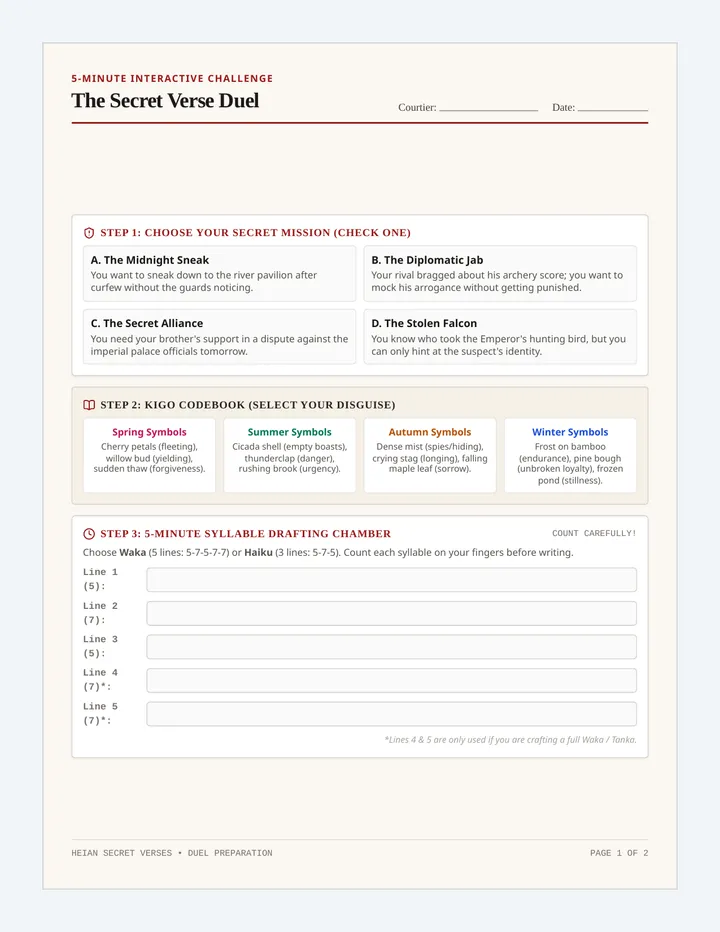
The Secret Verse Duel
Courtier:
Date:
Step 1: Choose Your Secret Mission (Check One)
A. The Midnight Sneak
You want to sneak down to the river pavilion after curfew without the guards noticing.
B. The Diplomatic Jab
Your rival bragged about his archery score; you want to mock his arrogance without getting punished.
C. The Secret Alliance
You need your brother's support in a dispute against the imperial palace officials tomorrow.
D. The Stolen Falcon
You know who took the Emperor's hunting bird, but you can only hint at the suspect's identity.
Step 2: Kigo Codebook (Select Your Disguise)
Spring Symbols
Cherry petals (fleeting), willow bud (yielding), sudden thaw (forgiveness).
Summer Symbols
Cicada shell (empty boasts), thunderclap (danger), rushing brook (urgency).
Autumn Symbols
Dense mist (spies/hiding), crying stag (longing), falling maple leaf (sorrow).
Winter Symbols
Frost on bamboo (endurance), pine bough (unbroken loyalty), frozen pond (stillness).
Step 3: 5-Minute Syllable Drafting Chamber
COUNT CAREFULLY!
Choose Waka (5 lines: 5-7-5-7-7) or Haiku (3 lines: 5-7-5). Count each syllable on your fingers before writing.
Line 1 (5):
Line 2 (7):
Line 3 (5):
Line 4 (7)*:
Line 5 (7)*:
*Lines 4 & 5 are only used if you are crafting a full Waka / Tanka.
HEIAN SECRET VERSES • DUEL PREPARATION PAGE 1 OF 2
The Exchange & Counter-Strike
The Imperial Missive Scroll
CUT OR FOLD & DELIVER
Sender's Verse To:
Season Chosen: _______________
Write your polished verse cleanly below in your finest calligraphy. Once finished, fold along the dotted line and slide it across the table!
FOLD HERE -------------------------------------------- SEAL WITH HONOR [印]
Receiver's Decryption Decoded by:
1. What nature/seasonal symbol(s) did your brother use?
2. What secret court message do you believe he is actually saying?
3. Your Counter-Verse Reply (Write a 2-line response in 7-7 or 5-7 syllables):
Peer Judgment: The Emperor's Score (Rate 1 to 5)
1. Nature Camouflage
Did they veil their true thoughts in seasonal nature?