Q3: Key (A) 3.RC.11 • DOK 2
Rationale: Context clues "trembled" and "scampered away when a leaf rustled" directly signal fear and shyness, defining timid. Distractors represent opposite or unrelated behaviors.
Q4: Key (B) 3.RC.11 • DOK 2
Rationale: Context clue "hikers could easily walk across without water reaching their knees" indicates low water depth, meaning not deep. Other choices refer to temperature or clarity.
Q5: Key (C) 3.RC.12 • DOK 1
Rationale: Cautious means taking care to avoid danger. Its antonym is reckless (acting without thought of danger). Options (A) and (B) are synonyms.
Q6: Key (A) 3.RC.12 • DOK 1
Rationale: Knight and night sound identical (/naɪt/) but possess different spellings and definitions (warrior vs. dark time of day), making them true homophones.
Q7: Key (C) 3.RC.12 • DOK 2
Rationale: In (C), campfire utilizes fire as noun definition 1 (flames giving off heat). Sentence (A) uses definition 3 (dismissal); sentences (B) and (D) use definition 2 (shooting a projectile).
Q8: Key (B) 3.RC.12 • DOK 1
Rationale: Delighted means feeling high pleasure or satisfaction; overjoyed is a direct synonym. Distractors represent confusion, sadness, or physical fatigue.
Grade 3 Reading Benchmark • Teacher Answer Key & Explanations Page 1 of 4
Teacher Reference
Passages 1 & 2 • Saguaro Cactus & Wright Brothers
Passage 1: "The Giant of the Desert: The Saguaro Cactus" Questions 9–12
Q9: Key (B) 3.RC.1 • DOK 1
Text Citation: Paragraph 2 states: "When a rare desert storm arrives, the cactus absorbs hundreds of gallons of water. The pleats expand to hold the water inside."
Distractor Analysis: (A, C, D) are unsupported fabrications not found in the text.
Q10: Key (C) 3.RC.5 • DOK 2
Text Citation: The text details how physical adaptations (pleats, wax) enable survival, and how it provides shelter for birds and bats.
Distractor Analysis: (A) is a minor detail; (B) contradicts the text ("rare"); (D) is too narrow and inaccurate.
Q11: Key (B) 3.RC.7 • DOK 2
Text Citation: The callout box summarizes four specific physical parts (pleated skin, waxy coating, spines, shallow roots) and their survival functions.
Distractor Analysis: The callout contains no map (A), no chick feeding details (C), and no scientist names (D).
Q12: Key (B) 3.RC.1 • DOK 1
Text Citation: Paragraph 3 states: "Gila woodpeckers drill nesting holes into its flesh. When the woodpeckers leave, owls and bats move in."
Distractor Analysis: Owls (A) and bats (C) move in only after woodpeckers leave.
Passage 2: "Taking to the Skies: The Wright Brothers" Questions 13–16
Q13: Key (B) 3.RC.1 • DOK 1
Text Citation: Paragraph 1 explicitly states: "Wilbur and Orville Wright ran a bicycle repair shop in Dayton, Ohio."
Distractor Analysis: Automobile, clockmaker, and train depot are incorrect historical inventions.
Q14: Key (B) 3.RC.8 • DOK 2
Text Citation: The text traces chronological steps from bird observations to problem-solving, Kitty Hawk testing, and the 1903 flight, reinforced by the timeline.
Distractor Analysis: The text does not compare modern jets (A) or argue against airplanes (D).
Q15: Key (B) 3.RC.6 • DOK 2
Text Citation: Paragraph 2 states: "earlier gliders crashed because pilots could not steer. To solve this, the Wrights designed a movable rudder and wings that could twist."
Distractor Analysis: Removing motors (A) or solid iron wings (D) contradict the aeronautic design explained.
Q16: Key (A) 3.RC.1 • DOK 1
Text Citation: Paragraph 3 states: "The flight lasted only 12 seconds and covered 120 feet..."
Distractor Analysis: Students selecting (D) confused the distance (120 feet) with the time duration (12 seconds).
Grade 3 Reading Benchmark • Teacher Answer Key & Explanations Page 2 of 4
Teacher Reference
Passages 3 & 4 • Maple Syrup & Tortoise Folktale
Passage 3: "From Tree to Table: The Story of Maple Syrup" Questions 17–20
Q17: Key (B) 3.RC.5 • DOK 2
Text Citation: Paragraph 3 details: "It takes about forty gallons of watery sap to make just one single gallon of pure maple syrup!" proving the immense effort and volume needed.
Distractor Analysis: (A, C, D) provide descriptive details but do not directly show the large effort/resource ratio.
Q18: Key (C) 3.RC.7 • DOK 1
Text Citation: The text feature chart shows: Step 3 (Boil in Evaporator) followed directly by Step 4: "Filter & Bottle - Strain and pour warm syrup into jugs."
Distractor Analysis: Tapping (A) and collecting (B) occur prior to boiling.
Q19: Key (B) 3.RC.6 • DOK 2
Text Citation: Paragraph 3 states: "As steam escapes, the liquid thickens and turns a rich golden amber."
Distractor Analysis: The text explicitly notes sap contains natural sugar; no artificial coloring (A) or pan melting (D) occurs.
Q20: Key (C) 3.RC.1 • DOK 1
Text Citation: Paragraph 1 explicitly states: "Freezing nights followed by sunny, warm days cause clear sap to rise through sugar maple trees."
Distractor Analysis: Summer heat (A) and continuous blizzards (B) do not produce sap harvest conditions.
Passage 4: "The Clever Tortoise and the Great Tug-of-War" (Folktale) Questions 21–24
Q21: Key (B) 3.RC.2 • DOK 3
Text Citation: The trickster tortoise proves that intelligence and ingenuity overcome the immense physical strength of Elephant and Hippo.
Distractor Analysis: (A) is the opposite of the folktale's moral; (C, D) are superficial plot elements.
Q22: Key (B) 3.RC.1 • DOK 1
Text Citation: Paragraph 1 states: "Elephant and Hippopotamus loved to brag about their immense size... The giant beasts roared with laughter..."
Distractor Analysis: No jokes were told (A); they were boasting about their own power.
Q23: Key (C) 3.RC.3 • DOK 2
Text Citation: Tortoise formulates an ingenious plan and boldly challenges two massive creatures, exhibiting high intellect and confidence.
Distractor Analysis: Tortoise is neither lazy (A) nor frightened (D); he acts calmly throughout.
Q24: Key (A) 3.RC.3 • DOK 2
Text Citation: In paragraphs 3 and 4, by pitting the two giants against each other, both tire out and bow their heads, resolving the conflict without Tortoise lifting heavy weight.
Distractor Analysis: The animals remain in their habitat (B), and no baobab falls (C).
Grade 3 Reading Benchmark • Teacher Answer Key & Explanations Page 3 of 4
Teacher Reference
Passages 5 & 6 • Maya's Mystery Box & Leo's Bike Rescue
Passage 5: "Maya and the Mystery Box" Questions 25–28
Q25: Key (B) 3.RC.1 • DOK 1
Text Citation: Paragraph 1 explicitly states: "Tucked behind a rocking chair, Maya noticed an ornate cedar box carved with swimming fish."
Q26: Key (B) 1.RC.4 • DOK 2
Text Citation: In paragraph 2, Maya remembers Grandma Rosa's words ("treasures are always sweeter when discovered together"), leading to the prediction that she invites Grandma.
Q27: Key (B) 3.RC.3 • DOK 2
Text Citation: Paragraph 3 describes Rosa's reaction: "her eyes glowing with astonishment. 'My childhood sketchbooks!' Rosa gasped."
Q28: Key (A) 3.RC.1 • DOK 1
Text Citation: Paragraph 4 confirms: "Inside lay dozens of colorful drawings of songbirds, butterflies, and garden flowers drawn when Grandma Rosa was nine..."
Passage 6: "The Great Bike Rescue" Questions 29–32
Q29: Key (B) 3.RC.3 • DOK 2
Text Citation: Leo comforts Clara ("Don't worry, Clara"), locates an oak stick to use as a lever, and repairs the chain without panicking.
Q30: Key (A) 3.RC.3 • DOK 2
Text Citation: The slipped chain halts their ride while storm clouds gather, threatening to make them miss the 4:00 PM kickoff and get drenched.
Q31: Key (B) 3.RC.1 • DOK 1
Text Citation: Paragraph 3 states: "He spotted a thick oak stick on the grass. Using the stick as a lever, he pried the stuck chain free..."
Q32: Key (B) 3.RC.1 • DOK 1
Text Citation: Paragraph 1 confirms: "They were on their way to the public library for the kickoff of the summer reading club, which started at four o’clock sharp."
Teacher Diagnostic Tip: Common Error Patterns Diagnostic Intervention Guide
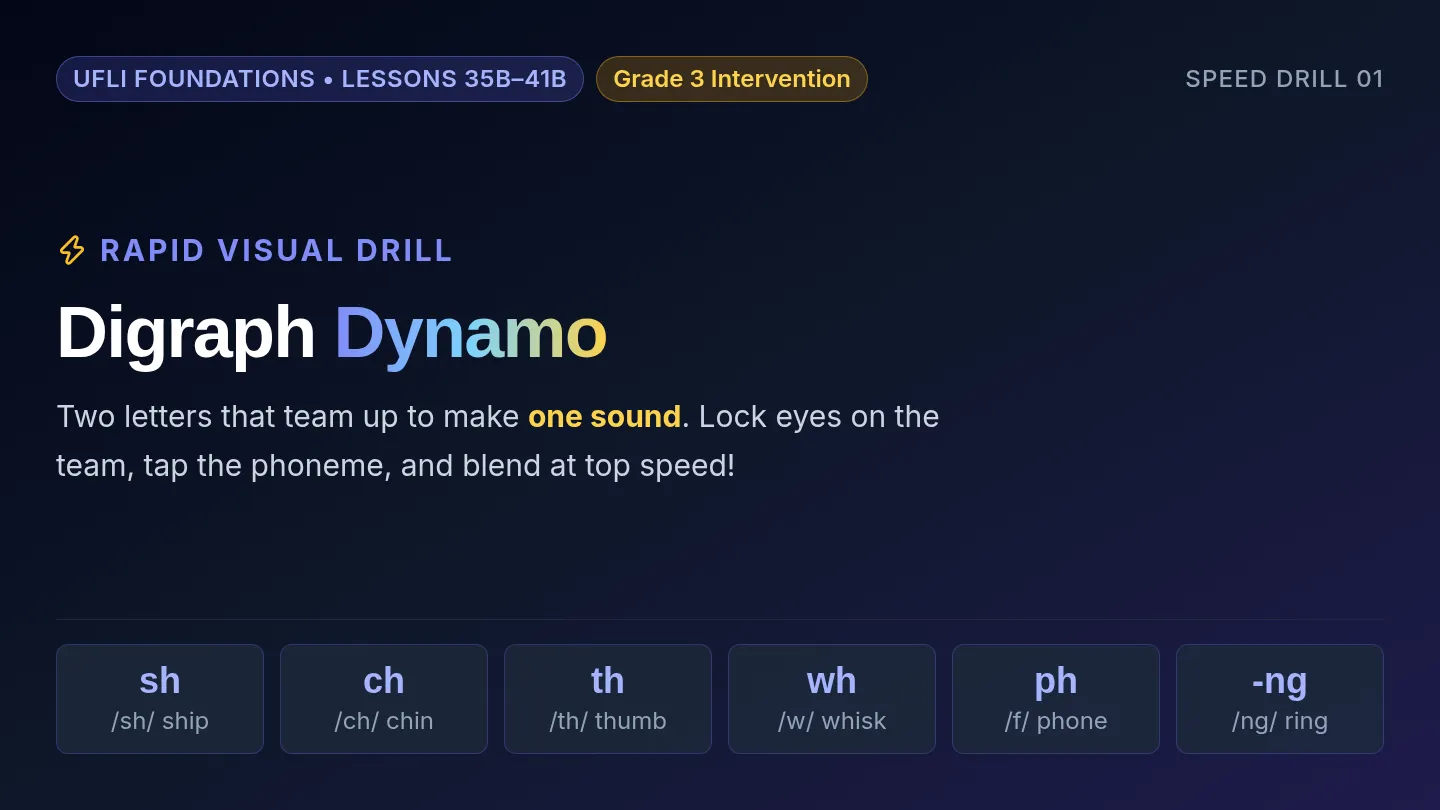
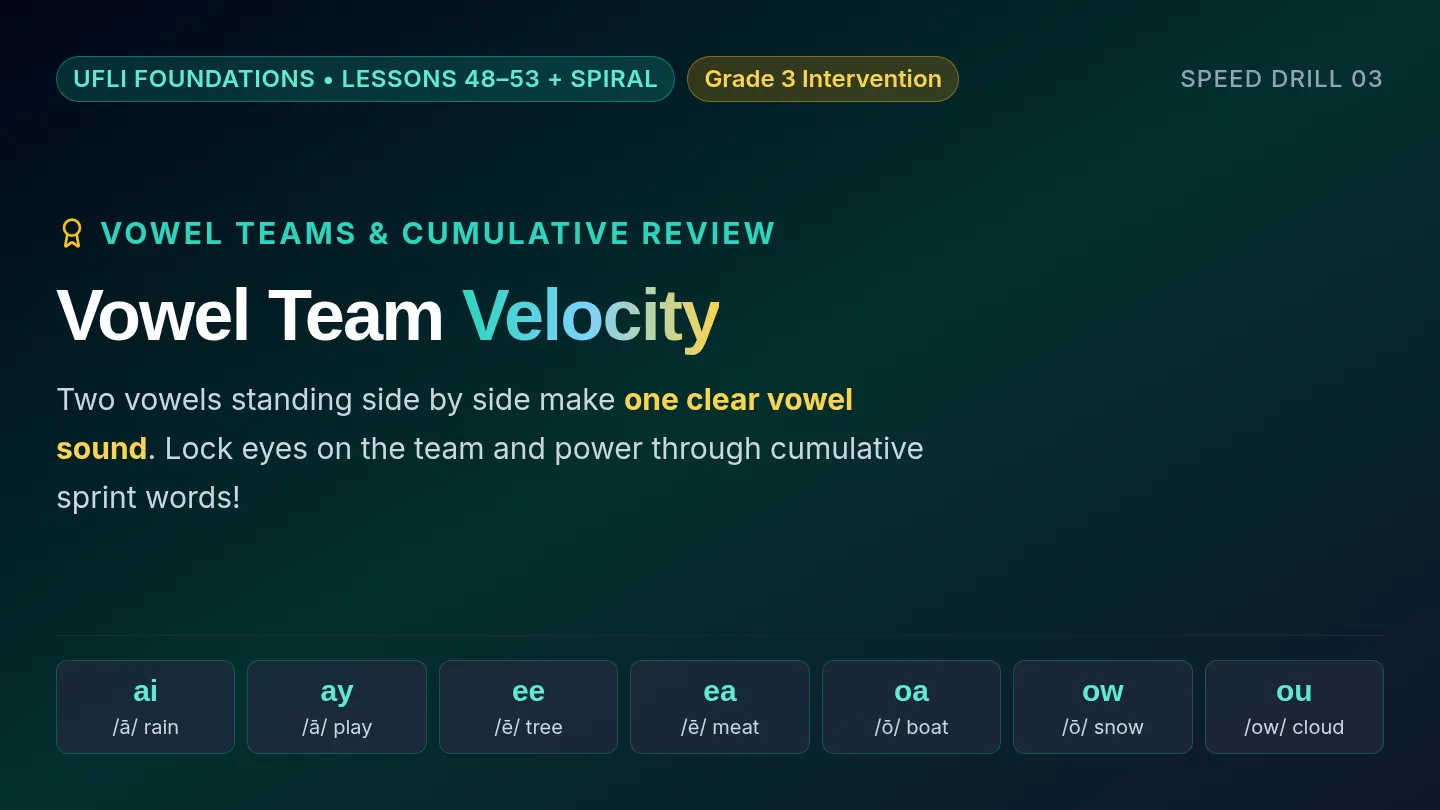
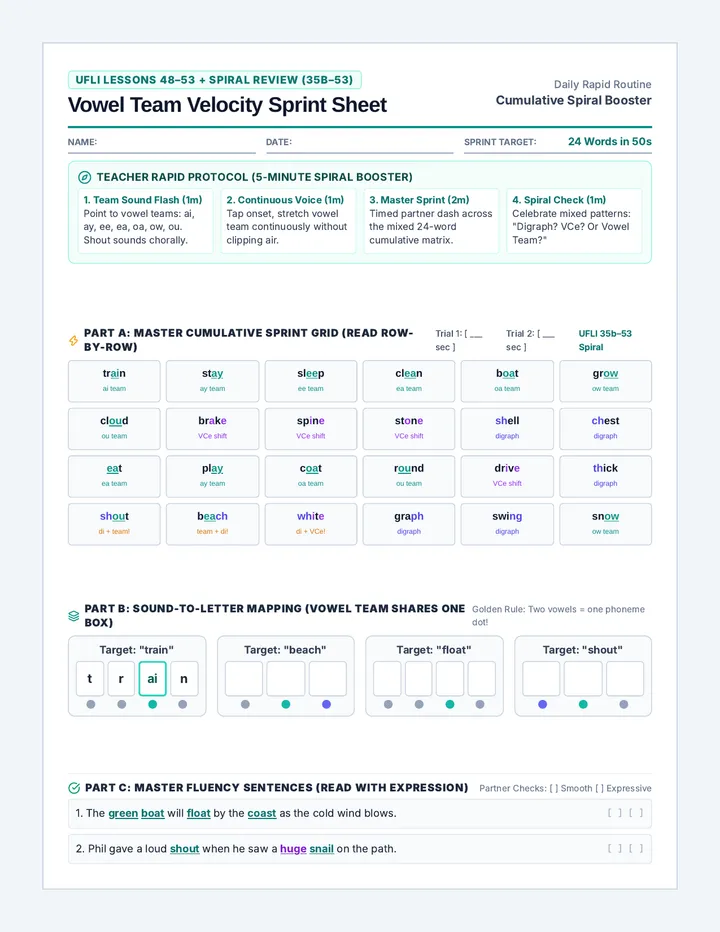
Foundational Phonics (Q1-Q2): If students miss Q1 or Q2, provide targeted small-group phonics drills on vowel digraphs (ai/ay) and distinguishing closed syllables from silent-e patterns.
Text Features (Q11, Q18): If students miss text feature items, instruct them to explicitly point to headings, callouts, and numbered flow steps before reading answer choices.
Character Actions (Q24, Q30): Ensure students differentiate between a character's general emotion and how a specific action alters the events in the plot sequence.
Grade 3 Reading Benchmark • Teacher Answer Key & Explanations Page 4 of 4
| 6.25% |
| 11, 18 |
| 3.RC.8 | Nonfiction text structure (chronological order / problem-solution) | Essential | 0–2 (0–2%) | 1 | 3.1% | 14 |
| 3.RC.1 | Ask & answer questions referring explicitly to literature text | Essential | 4–7 (10–18%) | 5 | 15.6% | 22, 25, 28, 31, 32 |
| 3.RC.2 | Recount folktales/fables and identify central themes/lessons | Essential | 0–2 (0–5%) | 1 | 3.1% | 21 |
| 3.RC.3 | Describe character traits, feelings & actions contributing to plot | Standard | 3–6 (8–15%) | 5 | 15.6% | 23, 24, 27, 29, 30 |
| 1.RC.4 | Make and confirm predictions about what will happen next | Standard | 1–2 (3–5%) | 1 | 3.1% | 26 |
| Assessment Totals: | 32 | 100% | Items 1–32 |
DOK 1: Recall & Reproduction
14 Items (43.8%)
Explicit facts, phonics, definitions, synonyms
DOK 2: Skills & Concepts
16 Items (50.0%)
Context clues, main idea, cause/effect, character actions
DOK 3: Strategic Thinking
2 Items (6.25%)
Theme synthesis across folktale, multi-step structures
Grade 3 Reading Benchmark • Standards Blueprint & Item Specifications Page 1 of 3
Teacher Scoring Guide
Benchmark Cut Scores & Descriptors
Level 4: Exceeds Benchmark
28–32 Points (88%–100%)
Student demonstrates superior mastery of foundational decoding, seamlessly decodes unfamiliar multi-syllable terms, extracts nuanced explicit text details, accurately identifies themes and complex text structures, and analyzes character motivations with high accuracy.
Level 3: Proficient / Meets Benchmark
23–27 Points (72%–87%)
Student exhibits solid grade-level competence in foundational phonics, context clues, and word relationships. Consistently answers text-dependent questions across nonfiction and literature, identifies main ideas and key details, and understands standard text features.
Level 2: Approaching Benchmark
17–22 Points (53%–71%)
Student displays basic decoding ability and grasps straightforward literal questions, but struggles with multi-step relationships, unfamiliar vocabulary in context, identifying overarching themes, or utilizing visual text features effectively. Requires targeted Tier 2 support.
Level 1: Substantial Support Needed
0–16 Points (0%–52%)
Student demonstrates critical gaps in basic phonics decoding, word recognition, and reading comprehension. Requires intensive Tier 3 individualized intervention, frequent progress monitoring, and systematic phonics and fluency instruction.
Domain Subscore Mastery Cutoff Reference
Reading Foundations (8 Pts)
Nonfiction Comprehension (12 Pts)
Literature Comprehension (12 Pts)
Mastery: 6–8 points (75%+)
Approaching: 4–5 points
At-Risk: 0–3 points
Mastery: 9–12 points (75%+)
Approaching: 6–8 points
At-Risk: 0–5 points
Mastery: 9–12 points (75%+)
Approaching: 6–8 points
At-Risk: 0–5 points
Student Name:
Total Raw Score:___ / 32 (___%)
Assigned Benchmark Level:
Foundations Score:___ / 8 [Pass: 6+]
Nonfiction Score:___ / 12 [Pass: 9+]
Literature Score:___ / 12 [Pass: 9+]
Grade 3 Reading Benchmark • Scoring Guide & Performance Descriptors Page 2 of 3
Instructional Next Steps
MTSS / RTI Tier 2 & 3 Strategies
1. Foundational Decoding Deficit (Standards 1.RF.5, 2.RF.2 • Q1, Q2) Tier 2/3 Small Group
Diagnostic Indicator: Student missed Q1 (vowel team /ai/, /ay/) or Q2 (short vowel in closed syllables).
Recommended Protocol: Implement 15-minute daily explicit phonics instruction. Use word-sort mats with Elkonin sound boxes to isolate vowel teams (ai, ay, ee, ea, oa) versus closed syllable CVC patterns (speck, track, clap). Incorporate decodable passage re-reading with auditory feedback.
2. Context Clues & Word Nuances (Standards 3.RC.11, 3.RC.12 • Q3–Q8) Tier 2 Guided Practice
Diagnostic Indicator: Missed 2 or more items among Q3, Q4, Q5, Q6, Q7, Q8.
Recommended Protocol: Teach the "Clue Hunt" strategy (looking for definition, synonym, or contrast signal words like 'because', 'so', 'unlike'). Model multiple-meaning word webs for anchor words (fire, puzzle, spring, light), requiring students to create sentences illustrating both noun and verb definitions.
3. Text Evidence & Main Idea Synthesis (Standards 3.RC.1, 3.RC.5 • Q9, 10, 12, 13, 16, 17, 20) Tier 1 Core Reteach
Diagnostic Indicator: Missed literal recall items or failed to isolate overarching main ideas from supporting details.
Recommended Protocol: Utilize highlighters to match question stems directly with text lines before selecting an answer. Implement the "Sentence Strip Main Idea" routine: Have students identify the topic, then state what the author teaches about that topic in one complete sentence.
4. Text Features & Organizational Patterns (Standards 3.RC.6, 3.RC.7, 3.RC.8 • Q11, 14, 15, 18, 19) Tier 2 Focus Strategy
Diagnostic Indicator: Inability to navigate diagrams, timelines, or identify problem/solution and chronological text structures.
Recommended Protocol: Explicitly model "Preview the Visuals" before reading passages. Provide graphic organizers (Flow Charts for processes like maple syrup; Timelines for historical accounts like the Wright Brothers; Problem-Solution boxes).
5. Folktale Themes & Character Trait Impact (Standards 3.RC.2, 3.RC.3, 1.RC.4 • Q21–Q32) Tier 2 Literature Circles
Diagnostic Indicator: Missed Q21 (folktale theme) or struggled to connect character actions to plot resolutions (Q24, Q30).
Recommended Protocol: Use "Character Action-Reaction" two-column notes: Column A: "What the character does" -> Column B: "How the plot changes". For themes, use the formula: "What did the character learn that we can apply to our own lives?"
Classroom Pacing & Post-Assessment Timeline Next Steps Schedule
Day 1 Post-Test: Score bubble sheets and log domain subscores into teacher gradebook.
Day 2: Sort students into Tier 2 intervention cohorts based on domain cut scores.
Weeks 1–3: Conduct 3x weekly 20-min targeted small-group remediation sessions.
Week 4: Administer 5-question quick-check progress monitoring mini-quizzes.
Grade 3 Reading Benchmark • Instructional Intervention & Remediation Plan Page 3 of 3