Lenny.com
Explore
Create
ActivitiesNewMathEnglish Language ArtsScience & EngineeringSocial StudiesGlobal LanguagesHealth & Physical EducationSpecial EducationCounseling & Life SkillsArts & CreativityESL
Lenny.com
Lenny.com
Explore
Create
ActivitiesNewMathEnglish Language ArtsScience & EngineeringSocial StudiesGlobal LanguagesHealth & Physical EducationSpecial EducationCounseling & Life SkillsArts & CreativityESL
Lenny.com
Lenny.com

Solutions

Lenny for EducatorsLenny for SchoolsLenny for Districts

Product

ExploreSign inCreateSupportAbout

Resources

Getting startedMTSS Acceleration Program

Newsletters

School Funding Newsletter

© 2026 Lenny Learning Inc.

TermsPrivacyAccessibility
LinkedInInstagramX
Lenny
English Language ArtsPhonics & Reading FoundationsLetter IdentificationLearn Letters A-ZLowercase and Uppercase LettersConsonants and VowelsLetter-Sound AssociationsLetter-Sound Associations: LowercaseLetter-Sound Associations: UppercaseBeginning and Ending SoundsRhymingBlending And SegmentingShort VowelsShort Vowel SoundsConsonant BlendsConsonant DigraphsBlends, Digraphs, and TrigraphsDigraphs, Blends, and Silent LettersLong Vowel SoundsLong Vowel PatternsShort and Long VowelsShort and Long Vowel PatternsSilent EVowel SoundsVowel TeamsR-Controlled VowelsDiphthongs: Oi, Oy, Ou, OwVariant VowelsVariant, Diphthong, And R Vowel PatternsSoft G And CSight WordsIrregular WordsWord RecognitionSyllablesSyllable TypesTwo-Syllable WordsMultisyllabic WordsPhoneme ManipulationDecodable TextsVocabularyAction WordsQuestion WordsNouns and AdjectivesClassify WordsCompound WordsSynonyms and AntonymsHomophonesHomophones and HomonymsShades of MeaningContext CluesPrefixes and SuffixesGreek and Latin RootsAnalogiesIdioms and AdagesForeign Words and ExpressionsWord Choice and UsageReference SkillsReading ComprehensionRead-Along Literary TextsRead-Along Informational TextsReality vs. FictionStory ElementsCharacterSequenceMain IdeaCause And EffectCompare And ContrastReading StrategiesText StructureAuthor's PurposeAuthor's Purpose And ToneAuthor's PerspectivePoint Of ViewThemeInference And ThemeInference And AnalysisPoetry ElementsLiterary DevicesAnalyzing LiteratureAnalyzing Informational TextsComparing TextsAudience, Purpose, And ToneBusiness DocumentsNovel StudyNonfiction Book StudyGrammar & MechanicsSentencesNounsVerbsAdjectivesPronounsCapitalizationPunctuationContractionsConjunctionsPrepositionsArticlesAdjectives And AdverbsVerb TypesVerb TensePronouns And AntecedentsPronoun TypesSubject-Verb AgreementDirect And Indirect ObjectsSentences, Fragments, And Run-OnsPhrases And ClausesCommasSemicolons, Colons, And CommasDashes, Hyphens, And EllipsesSpellingAbbreviationsFormattingVerb Tense And MoodMisplaced ModifiersWritingDescriptive DetailsCreative WritingOpinion WritingTopic SentencesOrganizing WritingLinking WordsSentence VarietyIntroductions And ConclusionsPersuasive And Opinion WritingExpository WritingPersuasive StrategiesDeveloping And Supporting ArgumentsTopic Sentences And Thesis StatementsSummarizingResearch SkillsEditing And RevisingActive And Passive Voice=Writing Clearly And ConciselyDebate & Public SpeakingPublic Speaking BasicsPersuasive TechniquesClaims and EvidenceTypes of ArgumentsReasoning TypesLogical FallaciesTopic ResearchOrganizing EvidenceDebate Speech OrganizationAttacking and Defending ArgumentsClash and EngagementImpact CalculusQuestioning and Cross-ExaminationCritical ThinkingInformal LogicFormal LogicInductive Reasoning

Conventions Checkpoint Review

A targeted test-preparation lesson designed to equip 6th graders for ILEARN Checkpoint 3 in English/Language Arts conventions. Students master pronoun case, intensive pronouns, nonrestrictive punctuation (commas, parentheses, dashes), and agreement conventions through direct instruction, authentic checkpoint-style practice, and rapid formative assessment.

AD amee dougherty
"—the experienced mission commander—"
astronaut
remained

Distractor Alert: B breaks the noun phrase randomly. C incorrectly places a trailing dash after the verb phrase. D separates one and astronaut.

ILEARN Checkpoint 3 Key • Grade 6 ELA Page 1 of 2 • Continue to Part 3 & Part 4 Key →

Answer Key: Page 2

Agreement, Editing Passage & Reteaching Protocol

Standards 6.W.6.1 • 6.W.6.2

Detailed Rationales: Part 3 & Part 4 (Questions 6–10)

6. Correct Answer: B 6.W.6.1 • Subject-Verb Agreement

Rule & Rationale: The true simple subject is singular crate, not the plural object of the preposition lenses. Singular subject requires singular verb: was delivered.

Distractor Alert: A is tricked by proximity to lenses. C uses plural know for singular indefinite pronoun Each. D uses plural grow for singular collective noun cluster.

7. Correct Answer: C 6.W.6.1c • Verb Tense Consistency

Rule & Rationale: Sentence C consistently uses past tense verbs throughout (approached, gathered, rumbled) describing events occurring in the same time frame.

Distractor Alert: A abruptly shifts from past (rang) to present (packs) then back to past (hurried). B shifts from present to past. D shifts from present (brushes) to past (discovered).

8. Correct Answer: A 6.W.6.2a • Passage Editing (Commas)

Rule & Rationale: The nonrestrictive appositive "a towering sand dune along Lake Michigan" already had an opening comma after Mount Baldy, but missed the closing comma after Michigan.

Distractor Alert: B removes an essential boundary comma. C and D introduce ungrammatical punctuation.

9. Correct Answer: A 6.W.6.1 • Compound Subject Agreement

Rule & Rationale: The subject joined by and ("shifting wind and blowing sand") is compound plural and requires plural present verb reshape, not singular reshapes.

Distractor Alert: B creates an incomplete participle. C confuses general scientific truths (standard present tense). D changes the correct verb in an unrelated sentence.

10. Correct Answer: A 6.W.6.1a • Objective Case in Context

Rule & Rationale: The pronoun is receiving the action of reminded. Removing Marcus reveals: "Mrs. Gable reminded me," proving me is required.

Distractor Alert: B uses reflexive myself without a matching subject I. C violates standard polite order and grammar. D overlooks the objective case error.

High-Yield Checkpoint Reteaching Protocols

1. The "Drop-the-Partner" Test (Q1, Q10) Cover the other person and the word "and". Say the sentence with just the pronoun. If "She invited I" sounds wrong, "She invited Maya and I" is also wrong!

2. The "Finger Lift" Test (Q4, Q5, Q8) Place two fingers over the words between the commas/dashes. Read the rest of the sentence. If it forms a complete, logical sentence, it is nonrestrictive and needs paired punctuation!

ILEARN Checkpoint 3 Key • Grade 6 ELA Page 2 of 2 • Teacher Instructional Reference ✓

✓ Singular Subject: crate → requires singular verb was (not plural were)

Compound Subject Rule: Joined by AND = Plural verb • Joined by OR / NOR = Match closest subject!


Strategy

The 4-Step Checkpoint Protocol

Test-Day Success

1

Read Sentence Completely

Never look at the answer choices first. Read the full sentence to identify context and time frame.

2

Isolate Subject & Verb

Eliminate prepositional phrases between the subject and verb to ensure flawless singular/plural agreement.

3

Drop the Partner

For compound pronouns, speak the sentence with only the pronoun to test whether subjective or objective case is needed.

4

Check Both Punctuation Ends

Nonrestrictive elements in the middle of a sentence require paired commas, dashes, or parentheses!

Ready for Checkpoint 3! Take your time • Trust your rules • Double check both sides

Checkpoint Homophone Watch Standard 6.W.6.2b

its vs. it's
its = possessive (its shell)
it's = it is (it's raining)

their / there / they're
their = owns / there = place
they're = they are

whose vs. who's
whose = possessive pronoun
who's = contraction for who is

affect vs. effect
affect = Action verb (to alter)
effect = End result (a noun)

Vague Pronoun Alert (6.W.6.1d)

If a sentence contains two nouns (e.g. vase and table), never use it without clarifying which object cracked! Replace the pronoun with the exact specific noun.

Test Day Check:

✓ 1. Read full sentence ✓ 2. Cross out prep phrases ✓ 3. Drop compound partner ✓ 4. Check both punctuation ends

Indiana ELA ILEARN Checkpoint 3 Reference Tool Keep in Study Folder • Review Before Test Day ✓

Part 2 & Part 3

Punctuation & Subject-Verb Agreement

Student:

The "Finger Lift" Rule (6.W.6.2a)

Extra details need commas on both sides: "Lake Michigan**, a Great Lake,** is huge."

The "Crossout" Rule (6.W.6.1)

Cross out the phrase in the middle: "The box [of books] is heavy."

5 Which sentence correctly places commas around the extra description?

A. Mount Baldy the tall sand dune stands along Lake Michigan.

B. Mount Baldy, the tall sand dune stands along Lake Michigan.

C. Mount Baldy, the tall sand dune, stands along Lake Michigan.

6 The crate [of delicate glass lenses] ______ delivered to the science lab.

Step: The true subject is singular crate (one crate). Ignore lenses!

A. was (singular verb)

B. were (plural verb)

Checkpoint Mini-Passage Editing 3 Short Sentences

[1] Our guide led Marcus and I across the wooden path.

[2] The group of eager students was ready to see the living dunes.

[3] Strong winds and shifting sand continually shapes the giant hills.

7 Look at Sentence 1: "Our guide led Marcus and I..." Which edit fixes the pronoun error?

A. Change to: led Marcus and me

B. Change to: led Marcus and myself

8 Look at Sentence 3: "Strong winds and shifting sand continually shapes..." Which edit fixes the subject-verb agreement error?

A. Change shapes to plural shape

B. Change winds to singular wind

My Checkpoint Confidence:

□ I used Drop the Partner □ I checked commas on both sides □ I crossed out prep phrases

Indiana ELA Checkpoint 3 • Tier 2 Guided Practice Key: 1-B • 2-A • 3-B • 4-B • 5-C • 6-A • 7-A • 8-A ✓

Teacher / Advisor:

Parent / Guardian:

Middle School Academic Executive Functioning Dashboard Review Weekly During Advisory / Homeroom ✓
You might also like

Prompt Decoder Slides

Argument Architecture

A comprehensive middle school writing sequence guiding students through the Extended Constructed Response process, from prompt deconstruction and claim generation to evidence integration and multi-paragraph synthesis.

Lenny Avatar
Lenny
6
Full Response Writing Packet

Full ECR Construction

Students synthesize claims, paired evidence, and detailed commentary into an organized multi-paragraph Extended Constructed Response, evaluating their work against standard criteria.

Lenny Avatar
Lenny
2
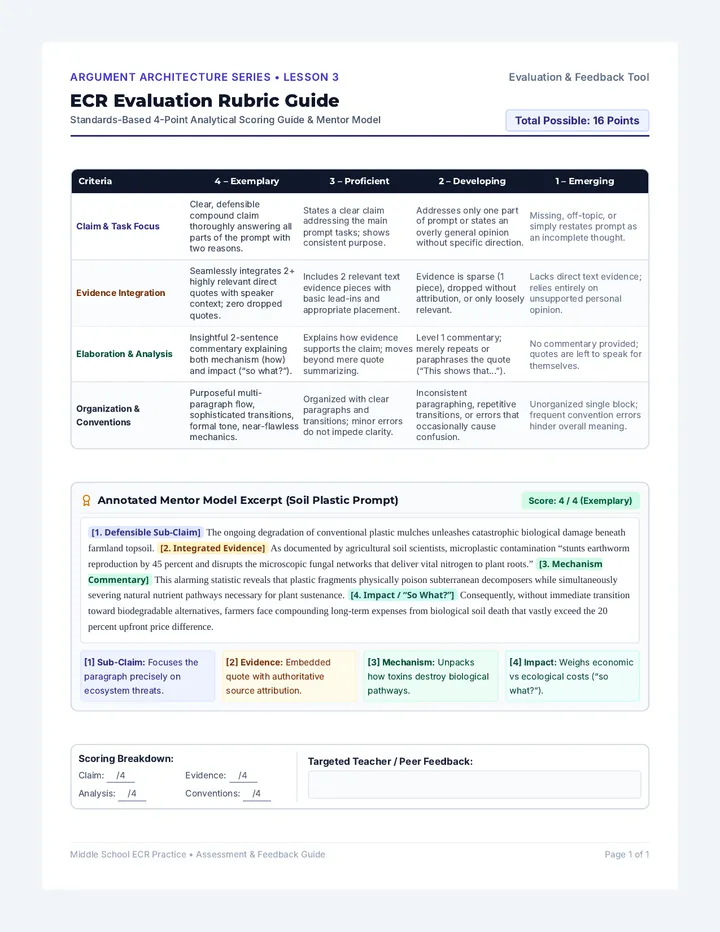
ECR Evaluation Rubric Guide

ECR Evaluation Rubric Guide

A comprehensive one-page analytical scoring rubric and annotated mentor model guide for evaluating middle school Extended Constructed Responses.

Lenny Avatar
Lenny
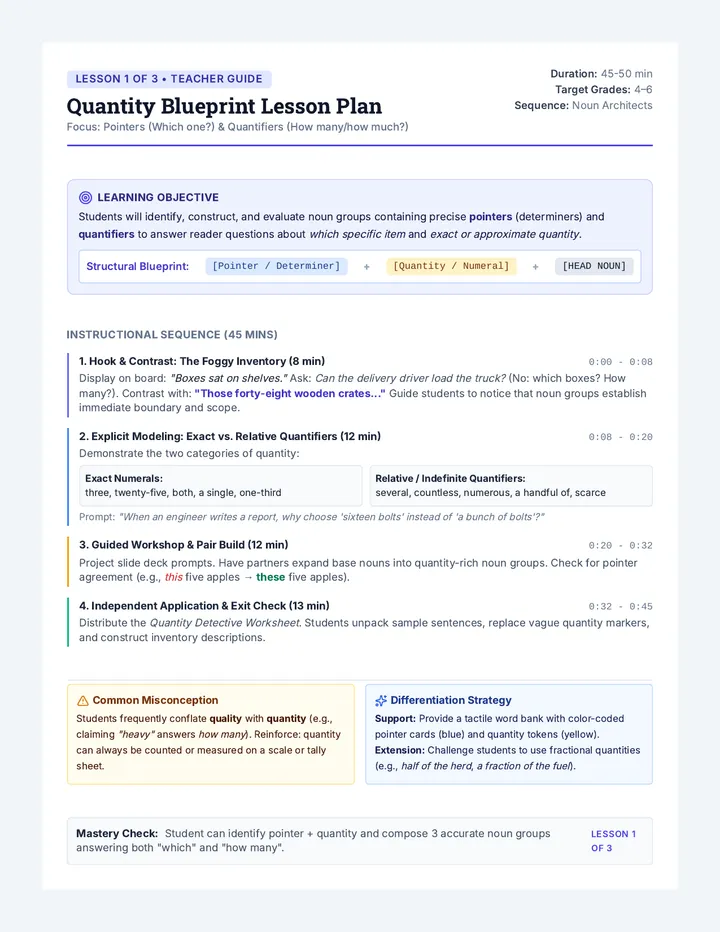
Quantity Blueprint Lesson Plan

Noun Group Architects

A three-part grammar and writing unit where students investigate, assemble, and refine precise noun groups. Learners progress from tracking quantity and pointer determiners to layering vivid qualities and specific classifiers for rich descriptive writing.

A

arlavoie-ridings

9
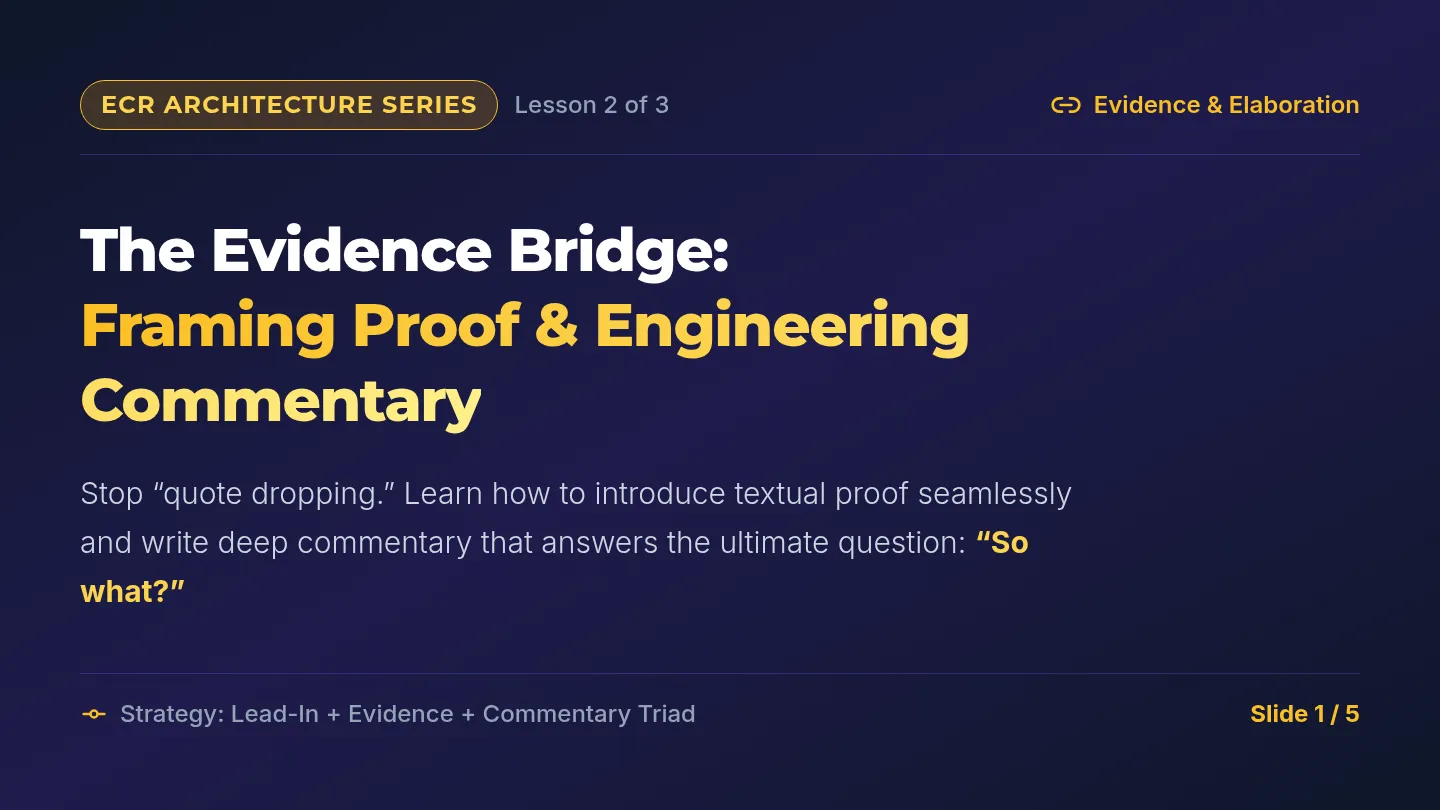
Evidence Bridge Slides

Evidence and Explanation

Students master selecting compelling textual evidence and constructing strong elaboration bridges that explain how and why evidence supports their central claim.

Lenny Avatar
Lenny
2
Full Response Writing Packet

Full Response Writing Packet

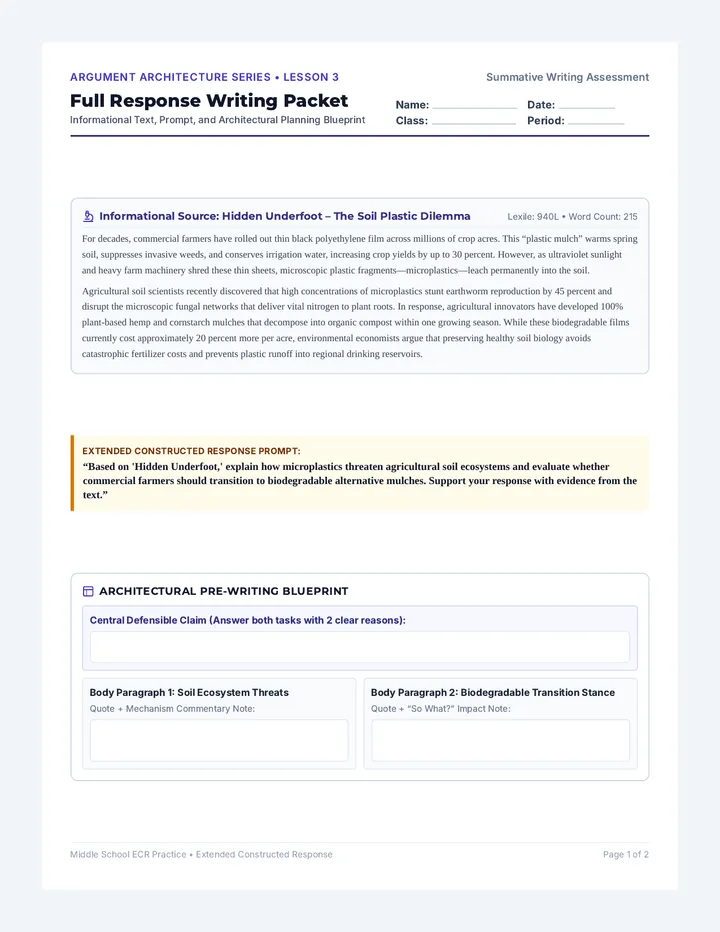
A two-page middle school ECR writing packet containing an authentic informational source passage, prompt deconstruction blueprint, and lined drafting space with an editing checklist.

Lenny Avatar
Lenny
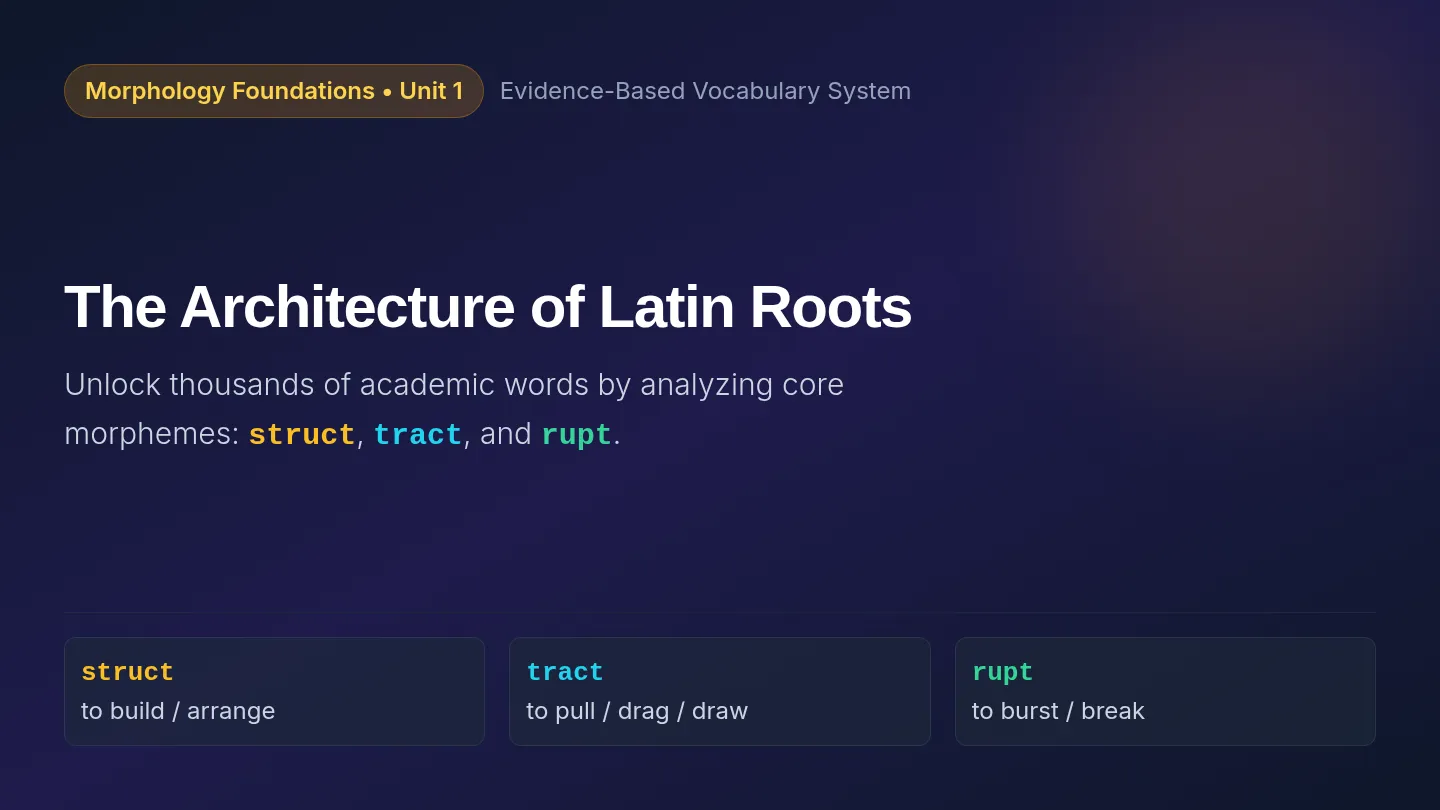
Latin Roots Slide Deck

Rooted Words Curriculum

A comprehensive, evidence-based morphology curriculum systematically teaching Latin roots, Greek combining forms, and prefix assimilation through word matrices, morpheme sums, and contextual decoding.

M

melissa.white

6
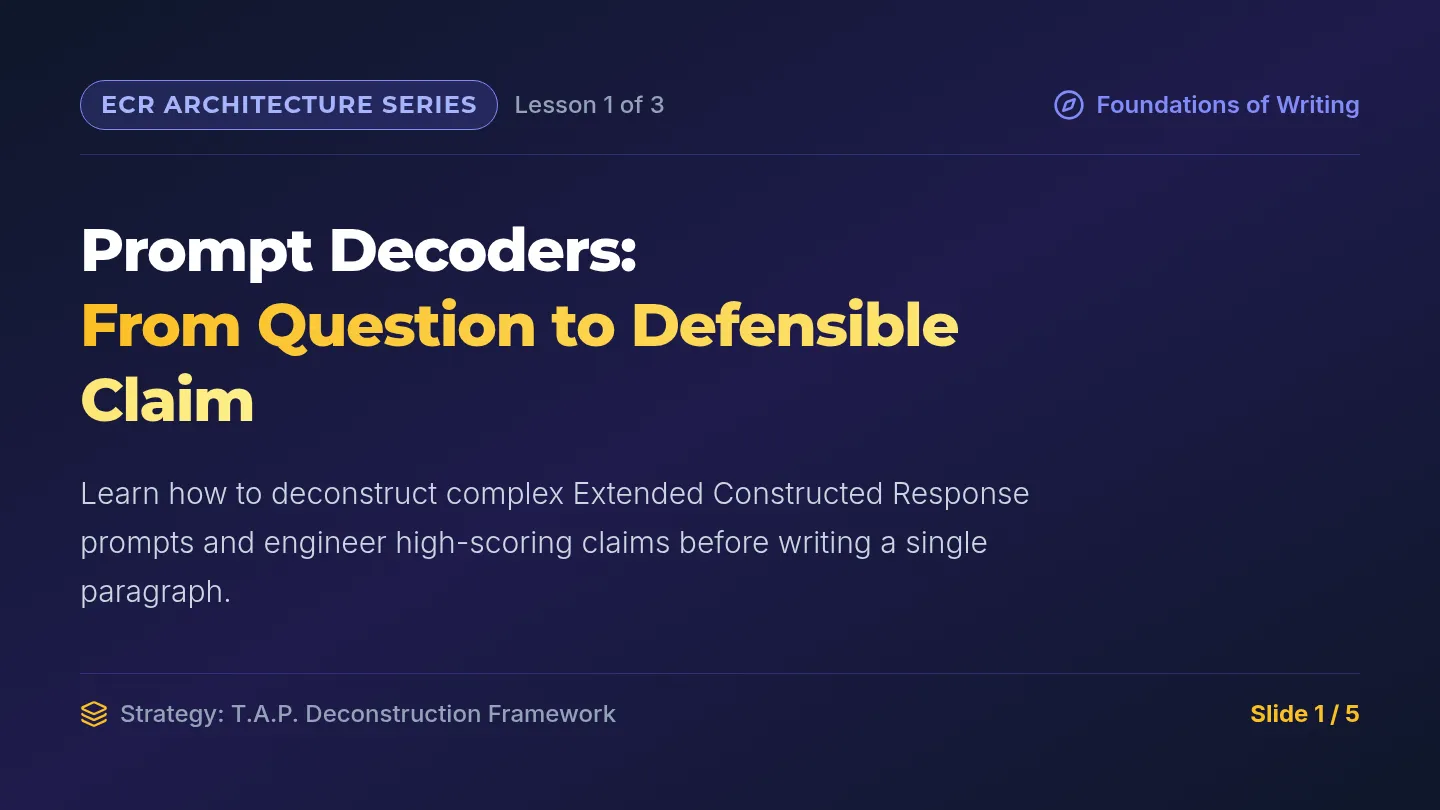
Prompt Decoder Slides

Dissect and Claim

Students learn to dissect multi-part informational and argumentative writing prompts using the TAP strategy, identify task expectations, and compose defensible, text-based claims.

Lenny Avatar
Lenny
2
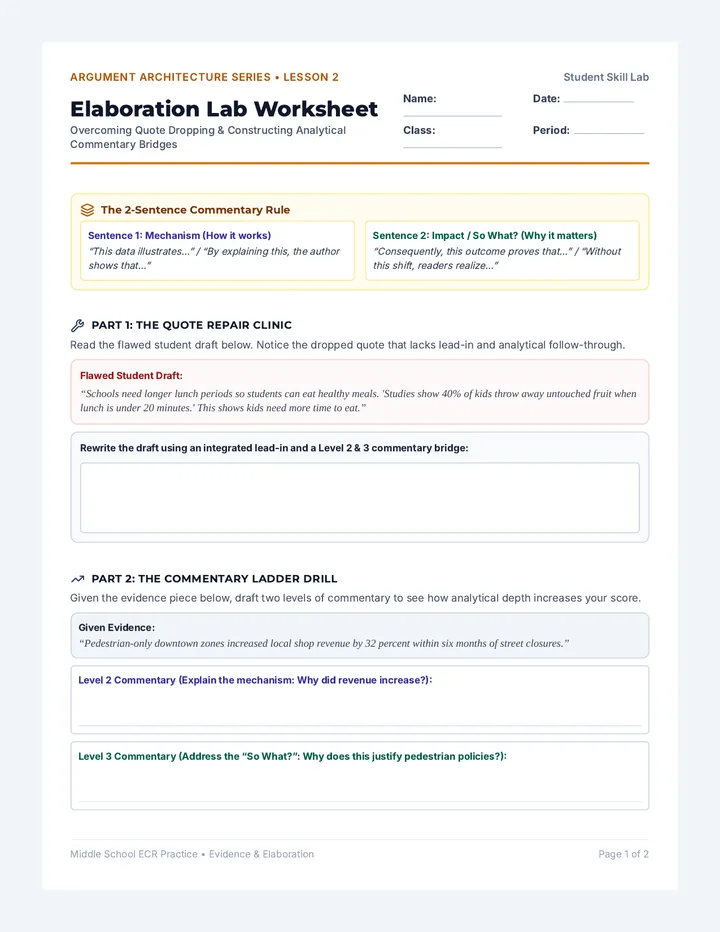
Elaboration Lab Worksheet

Elaboration Lab Worksheet

A two-page middle school practice worksheet featuring a quote repair clinic, commentary ladder progression, and passage-based evidence integration practice.

Lenny Avatar
Lenny
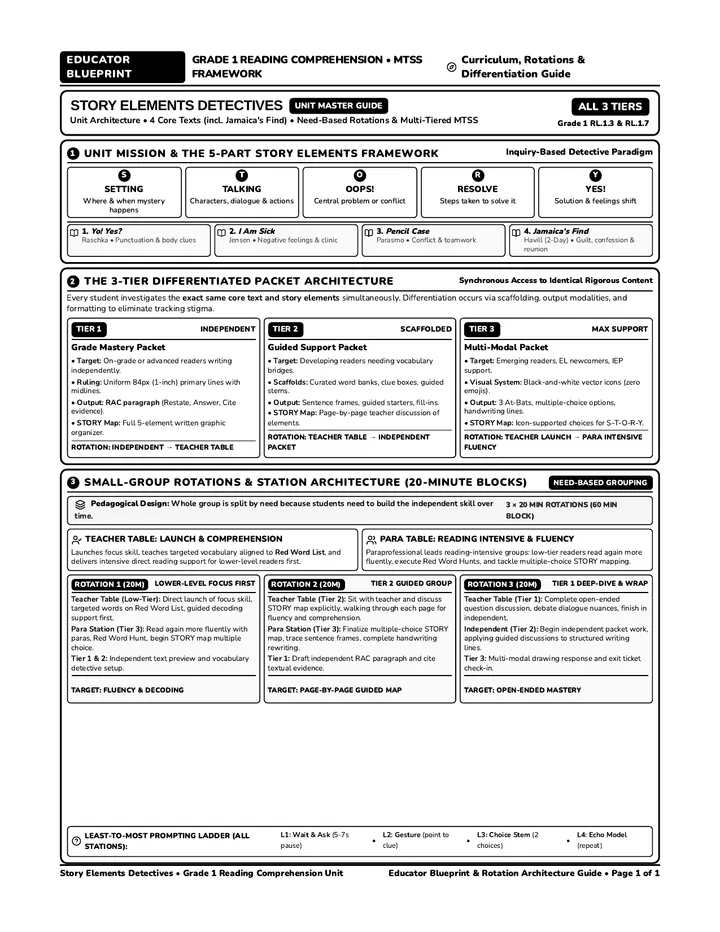
Unit Architecture Overview Guide

Story Elements Detectives

A Grade 1 reading comprehension unit teaching students how to identify character feelings, actions, dialogue, and problems using the STORY elements framework with multi-tiered differentiated packets and paraprofessional guides.

JE

jenn edwards

86
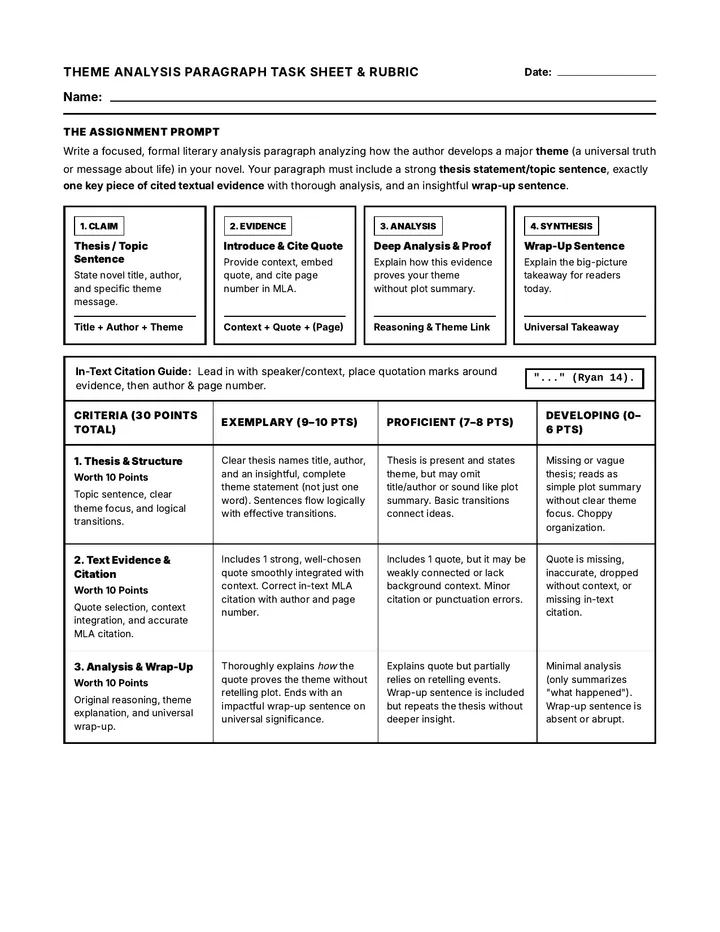
Theme Paragraph Rubric Task Sheet

Theme Paragraph Mastery

A focused middle school literary analysis lesson guiding students through identifying universal themes, citing textual evidence in MLA format, and writing in-depth analytical paragraphs.

KD

kathy dale

2
Evidence Bridge Slides

Evidence Bridge Slides

Instructional slide deck guiding middle schoolers away from quote dropping toward purposeful evidence framing and multi-level analytical elaboration.

Lenny Avatar
Lenny