Evidence Detectives Slides Case File: RI.4.8 Grade 4 Informational Text
Evidence Detectives
Uncovering how authors use reasons and evidence to back up their points.
Mission: Spot the Point, Track the Reasons, Verify the Evidence
Today's Detective Mission
RI.4.8
Learning Target
I can explain how an author uses reasons and evidence to support particular points in a text.
1. Spot
Find the main point the author wants you to believe.
2. Track
Identify the reasons that explain why the point is true.
3. Verify
Check the facts, numbers, and examples that prove it.
Good readers never just take an author's word for it—they check the clues!
The Detective Toolkit
Key Vocabulary
Point
An important idea or claim the author makes in the text.
Ask yourself:
"What does the author want me to know or agree with?"
Reason
An explanation of why the author's point makes sense.
Ask yourself:
"Why does the author say this is true?"
Evidence
Specific proof—like facts, data, or examples—that backs up a reason.
Ask yourself:
"How does the author prove it?"
Tip: A reason tells why ; evidence gives the real-world proof !
MODEL
Case #1: Tiny Pollinators
Step 1: Find the Point
Bees are some of the most important insects on Earth. Without bees, many of the foods we eat every day would disappear. As bees fly from flower to flower collecting nectar, they carry pollen that helps plants grow fruits and seeds. In fact, scientists estimate that bees help pollinate about one-third of all the food crops grown around the world, including apples, almonds, and blueberries.
Author's Point
Bees are some of the most important insects on Earth.
Detective Clue:
Authors often state their main point in the first sentence, then spend the rest of the paragraph proving it!
Next: Let's track the reason and verify the evidence!
MODEL
Case #1: Cracking the Clues
Step 2 & 3: Reason & Evidence
Bees are some of the most important insects on Earth. Without bees, many of the foods we eat every day would disappear. As bees fly from flower to flower collecting nectar, they carry pollen that helps plants grow fruits and seeds. In fact, scientists estimate that bees help pollinate about one-third of all the food crops grown around the world, including apples, almonds, and blueberries.
Reason (Why?)
Bees pollinate plants so they can grow the fruits and seeds we eat every day.
Evidence (Proof!)
Scientists estimate bees pollinate 1/3 of all food crops, including apples, almonds, and blueberries.
Notice how the number ("one-third") and specific examples ("apples, almonds, blueberries") prove the reason!
GUIDED PRACTICE
Case #2: Recess Power
Turn & Talk
Every elementary school should give students at least 30 minutes of recess each day. Taking a break to run and play actually helps students focus better when they return to class. In a 2019 study of fourth graders, students who had longer recess scored higher on reading tasks than students who stayed inside. Recess also gives kids time to practice teamwork and solve problems with friends on the playground.
1. What is the author's point?
2. Name one reason why.
3. Find the evidence!
Discuss with your partner: How do you know which sentence is evidence and not just a reason?
CASE SOLVED
Case #2: Evidence Check
Check Your Thinking
Point
Elementary schools should give students at least 30 minutes of recess each day.
Reasons
Helps students focus better in class.
Gives kids time to practice teamwork and solve problems with friends.
Evidence
A 2019 study of fourth graders showed students with longer recess scored higher on reading tasks than those who stayed inside.
The 2019 study is hard proof that backs up the author's first reason!
Your Solo Case File
Independent Practice
Open your Clue Crackers Worksheet to investigate: "Plastic-Free Lunchrooms"
Step 1
Read the article carefully from start to finish.
Step 2
Complete the Evidence Map with the point, reasons, and proof.
Step 3
Answer the detective questions using details from the text.
Remember: Always cite specific facts or examples when explaining an author's evidence!
Clue Crackers Worksheet Clue Crackers Worksheet
Case File: RI.4.8 • Points, Reasons & Evidence
Name: ___________________________
Date: ____________________________
Point
The main idea or claim the author makes.
Reason
Why the author says the point is true.
Evidence
Facts, numbers, or examples that prove it.
Plastic-Free Lunchrooms
Schools should replace single-use plastic forks, spoons, and trays in their cafeterias with reusable supplies. Every day, school lunchrooms create mountains of plastic trash that hurt our planet. Most plastic utensils are used for only fifteen minutes at lunch, yet they can sit in landfills for hundreds of years without breaking down.
Switching to reusable trays and metal utensils also saves schools money over time. At Oakview Elementary, the school spent $3,200 every year buying throwaway plastic forks and foam trays. After switching to washable metal silverware and sturdy trays, Oakview cut its supply costs in half within two years. Even though washing dishes takes a little extra time, reusable lunch supplies are a smart choice for both the Earth and school budgets.
Part A
Complete the Evidence Map using details from the passage.
1. Author's Main Point (What does the author want schools to do?)
2. Reason #1 (Why?)
3. Evidence #1 (Fact or Proof)
4. Reason #2 (Why?)
5. Evidence #2 (Fact or Proof)
Clue Crackers Worksheet — Page 2 Name: ___________________________
Part B
Detective Questions
1. Which sentence from the passage is evidence that plastic utensils harm the planet?
A. Schools should replace single-use plastic forks, spoons, and trays in their cafeterias.
B. Most plastic utensils are used for only fifteen minutes, yet they sit in landfills for hundreds of years.
C. Washing dishes takes a little extra time for cafeteria workers each day.
D. Reusable lunch supplies are a smart choice for schools everywhere.
2. Why does the author include the example of Oakview Elementary in paragraph 2?
A. To show that Oakview Elementary has the largest cafeteria in the district.
B. To prove that reusable supplies can save a school real money over time.
C. To explain how students helped wash the metal silverware after lunch.
D. To argue that foam trays are stronger than reusable trays.
3. Explain how the author uses reasons and evidence to support the point that schools should stop using single-use plastics. Use at least two details from the text.
Part C
Detective Check-In
Circle how confident you feel finding an author's points, reasons, and evidence:
Got It! Ready for more
Getting There! Need practice
Need Help! Let's review
Clue Crackers Answer Key Clue Crackers Answer Key
Case File: RI.4.8 • "Plastic-Free Lunchrooms"
Teacher Resource
Part A
Evidence Map — Sample Responses
1. Author's Main Point
Schools should replace single-use plastic forks, spoons, and trays in cafeterias with reusable supplies.
2. Reason #1
Plastic lunchroom trash hurts the planet.
3. Evidence #1
Plastic utensils are used for only 15 minutes but can sit in landfills for hundreds of years without breaking down.
4. Reason #2
Switching to reusable supplies saves schools money over time.
5. Evidence #2
Oakview Elementary spent $3,200/year on disposables and cut supply costs in half within two years after switching.
Part B
Detective Questions — Answers & Rationales
1. Correct Answer: B
Rationale: Option B gives specific facts (15 minutes of use vs. hundreds of years in landfills) that prove how plastic harms the planet. Option A is the main point; Option C is a minor counterclaim; Option D is a concluding restatement.
2. Correct Answer: B
Rationale: The Oakview Elementary example provides real-world numbers ($3,200/year cut in half) to prove the author's reason that reusable supplies save money.
3. Constructed Response — Exemplar & 2-Point Rubric
Sample 2-Point Response:
"The author argues that schools should switch to reusable lunch supplies for two main reasons. First, plastic trash hurts the Earth; the author proves this by noting that plastic utensils are used for 15 minutes but stay in landfills for hundreds of years. Second, reusable supplies save money, which the author supports with the example of Oakview Elementary cutting its $3,200 supply cost in half."
2 Points (Proficient)
Clearly explains how the author supports the point using at least one reason AND two specific pieces of text evidence.
1 Point (Developing)
Identifies the point or a reason, but includes only one detail or mixes up reasons and evidence.
0 Points (Needs Support)
Response is off-topic, inaccurate, or provides no supporting details from the passage.
Case File Teacher Guide Case File Teacher Guide
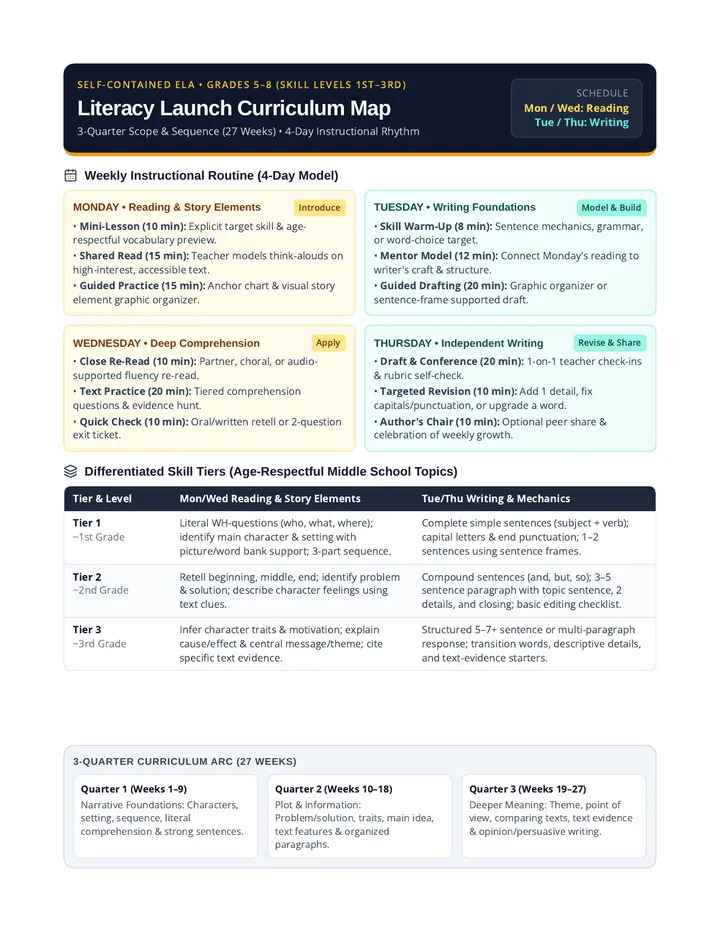
Lesson Plan & Facilitation Notes • 45–50 Minutes
CCSS.RI.4.8
Standard & Learning Objective
RI.4.8: Explain how an author uses reasons and evidence to support particular points in a text. Students will distinguish between an author's main point, supporting reasons ("why"), and concrete evidence (facts, data, examples) across modeled, guided, and independent texts.
Lesson Pacing & Facilitation
Time
Phase & Slides
Teacher Moves & Key Prompts
5 min
Hook & Target
Introduce the "Evidence Detectives" mission. Ask: "If a friend says recess should be longer, what makes you believe them?" Connect to today's target.
10 min
Toolkit & Model
Explicitly contrast Reason (the why ) and Evidence (real-world proof: numbers, studies, examples). Think aloud through Case #1 (Bees), highlighting how "1/3 of food crops" proves the reason.
10 min
Guided Practice
Read Case #2 (Recess Power) chorally. Have partners Turn & Talk to identify the point, one reason, and the 2019 study evidence before revealing Slide 7.
15 min
Independent Work
Distribute Clue Crackers Worksheet . Students read "Plastic-Free Lunchrooms," complete the Evidence Map, and answer Part B questions independently.
5 min
Debrief & Check-In
Review Question 3 using student examples. Have students circle their confidence level in Part C to guide tomorrow's small-group reteach.
Common Misconceptions
Mixing up reasons & evidence: Students often label a general reason as evidence. Prompt: "Does this sentence have a specific number, study, or real-world example?"
Topic vs. Point: A topic is 1–2 words ("plastic forks"); a point is a full claim ("schools should replace plastic").
Differentiation
Support (ELL / Striving Readers): Have students color-code the passage first (underline Point, circle Reasons, star numbers/examples) before filling the Evidence Map.
Extension: Ask early finishers to evaluate which piece of evidence (landfill years vs. $3,200 savings) is stronger and justify why.