Timber Fire Dispatch
NAME: ____________________________________
DATE: __________________
CLASS: ___________
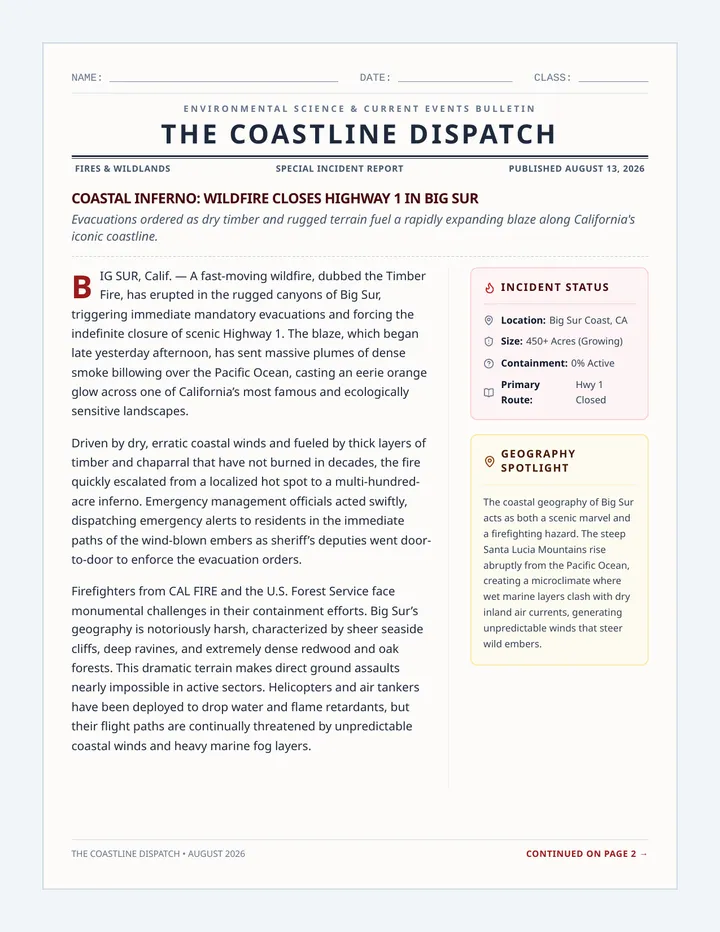
Environmental Science & Current Events Bulletin
The Coastline Dispatch
FIRES & WILDLANDS SPECIAL INCIDENT REPORT PUBLISHED AUGUST 13, 2026
Coastal Inferno: Wildfire Closes Highway 1 in Big Sur
Evacuations ordered as dry timber and rugged terrain fuel a rapidly expanding blaze along California's iconic coastline.
BIG SUR, Calif. — A fast-moving wildfire, dubbed the Timber Fire, has erupted in the rugged canyons of Big Sur, triggering immediate mandatory evacuations and forcing the indefinite closure of scenic Highway 1. The blaze, which began late yesterday afternoon, has sent massive plumes of dense smoke billowing over the Pacific Ocean, casting an eerie orange glow across one of California’s most famous and ecologically sensitive landscapes.
Driven by dry, erratic coastal winds and fueled by thick layers of timber and chaparral that have not burned in decades, the fire quickly escalated from a localized hot spot to a multi-hundred-acre inferno. Emergency management officials acted swiftly, dispatching emergency alerts to residents in the immediate paths of the wind-blown embers as sheriff’s deputies went door-to-door to enforce the evacuation orders.
Firefighters from CAL FIRE and the U.S. Forest Service face monumental challenges in their containment efforts. Big Sur’s geography is notoriously harsh, characterized by sheer seaside cliffs, deep ravines, and extremely dense redwood and oak forests. This dramatic terrain makes direct ground assaults nearly impossible in active sectors. Helicopters and air tankers have been deployed to drop water and flame retardants, but their flight paths are continually threatened by unpredictable coastal winds and heavy marine fog layers.
Incident Status
Location: Big Sur Coast, CA
Size: 450+ Acres (Growing)
Containment: 0% Active
Primary Route: Hwy 1 Closed
Geography Spotlight
The coastal geography of Big Sur acts as both a scenic marvel and a firefighting hazard. The steep Santa Lucia Mountains rise abruptly from the Pacific Ocean, creating a microclimate where wet marine layers clash with dry inland air currents, generating unpredictable winds that steer wild embers.
THE COASTLINE DISPATCH • AUGUST 2026 CONTINUED ON PAGE 2 →
THE COASTLINE DISPATCH • FIRES & WILDLANDS Page 2 — Incident Report Continued
Highway 1, the primary transportation artery for the region, remains closed in both directions between the Ripplewood resort area and Andrew Molera State Park. California Highway Patrol reported that the closure is necessary not only due to active fire on both sides of the roadway, but also because of the high risk of falling rocks, burning trees, and debris sliding down the scorched hillsides.
"This terrain is as unforgiving as it gets," said Captain Elena Vance, a spokesperson for CAL FIRE. "We are dealing with steep slopes, limited access points, and extremely dense fuels. Our primary focus right now is structure protection and securing a containment line along the western flank to prevent the fire from jumping the highway."
The environmental implications of the Timber Fire are significant. Big Sur is home to several sensitive ecosystems, including ancient coast redwood groves and nesting habitats for the endangered California condor. Ecologists warn that while fire is a natural part of California’s landscape, the increasing frequency and intensity of these coastal fires, exacerbated by rising global temperatures and prolonged droughts, threaten to permanently alter these delicate habitats.
Critical Response Prompts
1. How do Big Sur's steep cliffs and coastal wind patterns combine to limit air-based firefighting?
2. Explain why Highway 1 is closed even in areas where the fire is not actively burning on the asphalt.
Academic Vocabulary
Artery (n.) A vital and major route within a transportation network.
Exacerbate (v.) To make a critical situation worse or more severe.
Unforgiving (adj.) Severe, harsh, and leaving no margin for error.
Reading Check
1. Why is the closure of Highway 1 necessary?
[ ] A. For general road maintenance
[ ] B. Due to landslides and burning debris
[ ] C. To host a coastal running event
2. Which ecological hazard is mentioned?
[ ] A. Danger to California condor nests
[ ] B. Destruction of desert cacti
[ ] C. Flooding of dry mountain creeks
Lexile matched for high school reading standards. Source adapted from KSBW News coverage.