Cacao Quest Reading Worksheet
Informational Reading • Grade 5
Name: _____________________ Date: ___________
From Cacao Pod to Chocolate Bar
Read carefully. Pay attention to the main idea of each section and the order of steps.
🍫
1 A Surprise Inside the Tropical Pod
Where does a sweet chocolate bar begin? It starts on a tropical cacao (kah-KOW) tree in warm, rainy places near the equator. Unlike apples on thin twigs, cacao pods grow right out of the tree's thick trunk and main branches. Each football-shaped pod holds thirty to forty seeds inside soft, white pulp. Raw cacao seeds are bitter and taste nothing like a sweet treat. Turning them into chocolate takes many careful steps and plenty of patience.
2 From Bitter Pulp to Sun-Dried Beans
First, farmers harvest ripe yellow or red pods using sharp tools so they do not harm the tree's bark. Next, workers slice open the pods, scoop out the wet seeds and pulp, and cover them with large banana leaves. For five to seven days, the seeds go through fermentation. As the pile warms, the pulp melts away and the seeds build their chocolatey flavor. After fermenting, farmers spread the damp beans on wooden trays under the hot sun and rake them often so they dry evenly.
3 Traveling to the Factory
Once the cacao beans are completely dry, farmers pack them into large burlap sacks. Trucks and ships carry the sacks to chocolate factories around the world. Before any beans enter the machines, workers inspect them to make sure they are clean and ready.
4 Roasting, Cracking, and Grinding
Inside the factory, heat and heavy machines turn dried beans into smooth liquid chocolate. First, giant ovens roast the beans, bringing out a rich smell and loosening their papery shells. Then, a machine cracks the beans and blows the shells away, leaving crunchy cacao nibs. After that, heavy rollers crush and grind the nibs. The heat melts the natural fat inside, turning the nibs into a thick, warm liquid.
5 Sweetening and Shaping the Bar
This cacao liquid is unsweetened, so makers blend it with sugar—and often milk—until it is silky smooth. Finally, they heat and cool the chocolate for a shiny snap, pour it into bar-shaped molds, and let it harden. Once wrapped, it is ready to enjoy!
Key Words:
Cacao pod: fruit with cacao seeds
Fermentation: warming that builds flavor
Nibs: crunchy insides of roasted beans
Comprehension Check: Questions 1–4
Main Idea & Sequencing
Circle the letter of the best answer for each question. Look back at the passage to check your thinking.
1. What is the main idea of the entire passage?
A Cacao trees can only grow in warm, rainy tropical forests near the equator.
B Turning bitter cacao seeds into sweet chocolate bars takes many careful steps.
C Chocolate makers use giant machines to roast and grind cacao nibs.
D Fermenting cacao beans under banana leaves is the hardest part of making chocolate.
2. According to Section 2, what happens right after workers slice open the ripe cacao pods?
A They roast the beans in giant factory ovens.
B They spread the beans out on wooden trays under the hot sun.
C They scoop out the wet seeds and pulp and cover them with banana leaves.
D They blend the melted cacao with sugar and milk.
3. What is Section 2 ("From Bitter Pulp to Sun-Dried Beans") mostly about?
A Why banana leaves grow so well in tropical countries
B How fermenting and drying prepare the cacao beans after harvest
C Why wet cacao beans weigh more than dry cacao beans
D How long it takes for a cacao tree to grow ripe yellow pods
4. Which step must happen before the cacao beans are packed into sacks and shipped to a factory?
A The beans are dried in the sun until they are no longer damp.
B The papery outer shells are cracked open and blown away.
C Heavy rollers crush and grind the cacao nibs into liquid.
D The melted chocolate is poured into bar-shaped molds to harden.
Continue to Questions 5–8 on the next page →
Comprehension Check: Questions 5–8
Main Idea, Sequencing & Vocabulary
5. Which detail from Section 1 best supports the idea that raw cacao seeds are not ready to eat right off the tree?
A Cacao pods grow right out of the tree's thick trunk and main branches.
B Each football-shaped pod holds thirty to forty seeds inside soft, white pulp.
C Raw cacao seeds are bitter and taste nothing like a sweet treat.
D Cacao trees grow in warm, rainy places near the equator.
6. Which list shows the steps of making chocolate in the correct order from first to last?
A Dry the beans → Harvest the pods → Roast the beans → Grind the nibs
B Harvest the pods → Ferment the beans → Roast the beans → Grind the nibs
C Ferment the beans → Harvest the pods → Dry the beans → Pour into molds
D Roast the beans → Dry the beans → Grind the nibs → Harvest the pods
7. What is the main idea of Section 4 ("Roasting, Cracking, and Grinding")?
A Cacao nibs are the crunchy inside part of a roasted cacao bean.
B Chocolate factories use giant ovens that are hotter than home kitchens.
C Sugar and milk are more important than cacao nibs in a chocolate bar.
D Inside the factory, heat and grinding turn dried beans into smooth chocolate liquid.
8. Read this sentence from Section 3: "Before any beans enter the machines, workers inspect them to make sure they are clean and ready." What does the word inspect mean in this sentence?
A To pack tightly into large burlap sacks
B To crush and grind into a thick liquid
C To look at carefully and check for problems
D To dry out under the hot sun
Great work! Double-check your answers against the passage before turning in your paper.
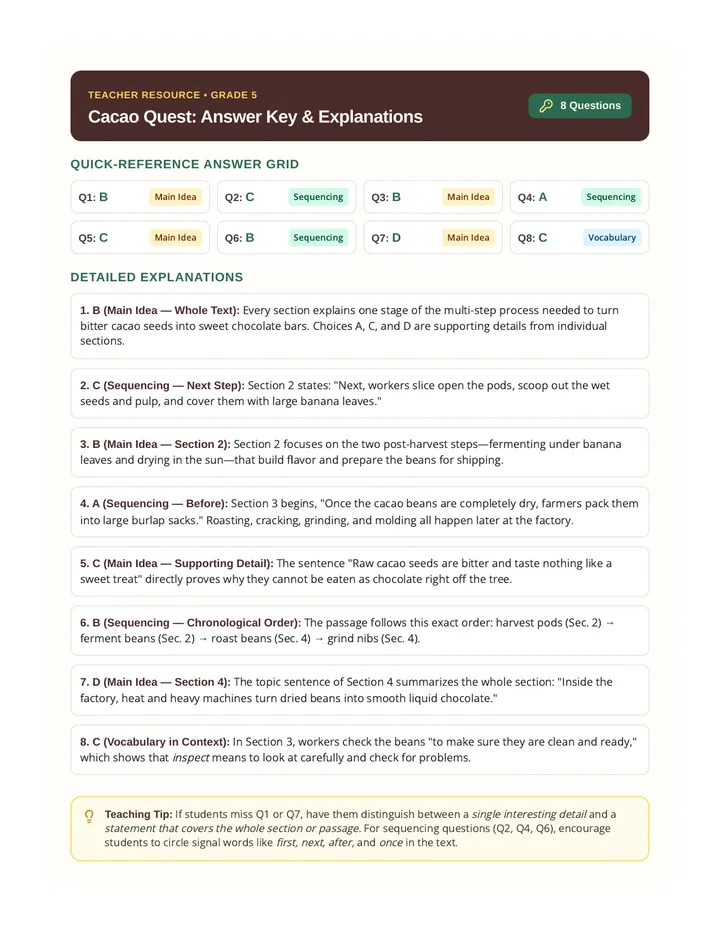
Cacao Quest Answer Key
Teacher Resource • Grade 5
Cacao Quest: Answer Key & Explanations
8 Questions
Quick-Reference Answer Grid
Q1: B Main Idea
Q2: C Sequencing
Q3: B Main Idea
Q4: A Sequencing
Q5: C Main Idea
Q6: B Sequencing
Q7: D Main Idea
Q8: C Vocabulary
Detailed Explanations
1. B (Main Idea — Whole Text): Every section explains one stage of the multi-step process needed to turn bitter cacao seeds into sweet chocolate bars. Choices A, C, and D are supporting details from individual sections.
2. C (Sequencing — Next Step): Section 2 states: "Next, workers slice open the pods, scoop out the wet seeds and pulp, and cover them with large banana leaves."
3. B (Main Idea — Section 2): Section 2 focuses on the two post-harvest steps—fermenting under banana leaves and drying in the sun—that build flavor and prepare the beans for shipping.
4. A (Sequencing — Before): Section 3 begins, "Once the cacao beans are completely dry, farmers pack them into large burlap sacks." Roasting, cracking, grinding, and molding all happen later at the factory.
5. C (Main Idea — Supporting Detail): The sentence "Raw cacao seeds are bitter and taste nothing like a sweet treat" directly proves why they cannot be eaten as chocolate right off the tree.
6. B (Sequencing — Chronological Order): The passage follows this exact order: harvest pods (Sec. 2) → ferment beans (Sec. 2) → roast beans (Sec. 4) → grind nibs (Sec. 4).
7. D (Main Idea — Section 4): The topic sentence of Section 4 summarizes the whole section: "Inside the factory, heat and heavy machines turn dried beans into smooth liquid chocolate."
8. C (Vocabulary in Context): In Section 3, workers check the beans "to make sure they are clean and ready," which shows that inspect means to look at carefully and check for problems.
Teaching Tip: If students miss Q1 or Q7, have them distinguish between a single interesting detail and a statement that covers the whole section or passage. For sequencing questions (Q2, Q4, Q6), encourage students to circle signal words like first, next, after, and once in the text.