ADHD Perspectives Reading Questions
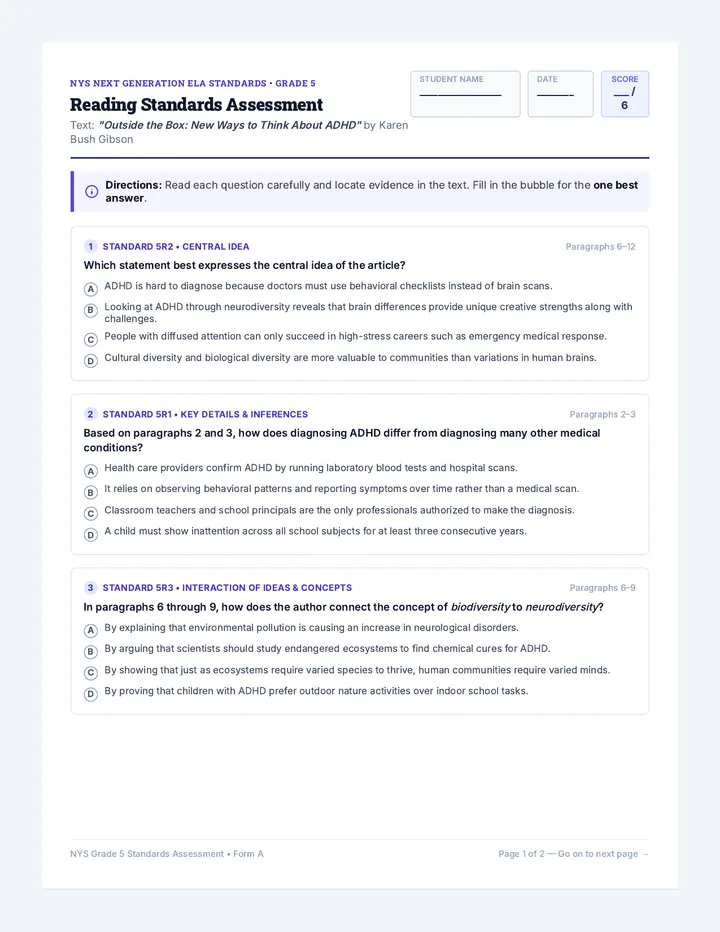
NYS Next Generation ELA Standards • Grade 5
Reading Standards Assessment
Text: "Outside the Box: New Ways to Think About ADHD" by Karen Bush Gibson
Student Name __________________
Date ________
Score ___ / 6
Directions: Read each question carefully and locate evidence in the text. Fill in the bubble for the one best answer.
1 Standard 5R2 • Central Idea Paragraphs 6–12
Which statement best expresses the central idea of the article?
A ADHD is hard to diagnose because doctors must use behavioral checklists instead of brain scans.
B Looking at ADHD through neurodiversity reveals that brain differences provide unique creative strengths along with challenges.
C People with diffused attention can only succeed in high-stress careers such as emergency medical response.
D Cultural diversity and biological diversity are more valuable to communities than variations in human brains.
2 Standard 5R1 • Key Details & Inferences Paragraphs 2–3
Based on paragraphs 2 and 3, how does diagnosing ADHD differ from diagnosing many other medical conditions?
A Health care providers confirm ADHD by running laboratory blood tests and hospital scans.
B It relies on observing behavioral patterns and reporting symptoms over time rather than a medical scan.
C Classroom teachers and school principals are the only professionals authorized to make the diagnosis.
D A child must show inattention across all school subjects for at least three consecutive years.
3 Standard 5R3 • Interaction of Ideas & Concepts Paragraphs 6–9
In paragraphs 6 through 9, how does the author connect the concept of biodiversity to neurodiversity?
A By explaining that environmental pollution is causing an increase in neurological disorders.
B By arguing that scientists should study endangered ecosystems to find chemical cures for ADHD.
C By showing that just as ecosystems require varied species to thrive, human communities require varied minds.
D By proving that children with ADHD prefer outdoor nature activities over indoor school tasks.
NYS Grade 5 Standards Assessment • Form A Page 1 of 2 — Go on to next page →
Outside the Box: New Ways to Think About ADHD Assessment Continued
Student: ____________________
4 Standard 5R4 • Diction Analysis & Meaning Paragraph 10
In paragraph 10, the author contrasts a "focused attentional style" with a "diffused attention" style. What does the word "diffused" most clearly suggest?
A The attention is scattered and broken, making learning impossible in normal classrooms.
B The attention spreads widely across multiple things at once rather than locking onto a single target.
C The brain processes information very slowly because it takes hours to notice new details.
D The person purposely ignores instructions because they dislike structured assignments.
5 Standard 5R4 • Diction & Tone Analysis Sidebar: Roots of "Neurodiversity"
In the sidebar, author Thomas Armstrong notes that the word neurodiversity helped people "liberate themselves from the prison of negative expectations." What impact does this specific diction have?
A It describes how students with brain differences were unfairly treated by legal authorities.
B It emphasizes that deficit-focused labels trapped people, while embracing neurodiversity brought freedom.
C It shows that having ADHD makes it impossible to meet expectations set by teachers or parents.
D It suggests that people with neurological conditions should be placed in separate schools.
6 Standard 5R6 • Point of View & Perspective Whole Text
How does the author's point of view influence how information about ADHD is presented throughout the article?
A She presents ADHD primarily as an educational disorder that requires strict classroom discipline to fix.
B She shifts the conversation from viewing ADHD as a weakness to celebrating its creative strengths and potential.
C She argues that pediatricians should stop diagnosing ADHD because nearly every child gets distracted.
D She claims that people with ADHD should avoid using technology and organization apps altogether.
Standards Check • Text Evidence Justification Standard 5R1
Choose one question from above (1–6). Write the question number and quote one sentence or phrase from the text that directly proves your answer:
Question # chosen: Paragraph / Section:
NYS ELA Standards Assessed: 5R1, 5R2, 5R3, 5R4, 5R6 Page 2 of 2 • End of Assessment
ADHD Reading Standards Answer Key
Teacher Guide & Answer Key • Grade 5
Reading Standards Item Analysis
Text: "Outside the Box: New Ways to Think About ADHD" by Karen Bush Gibson
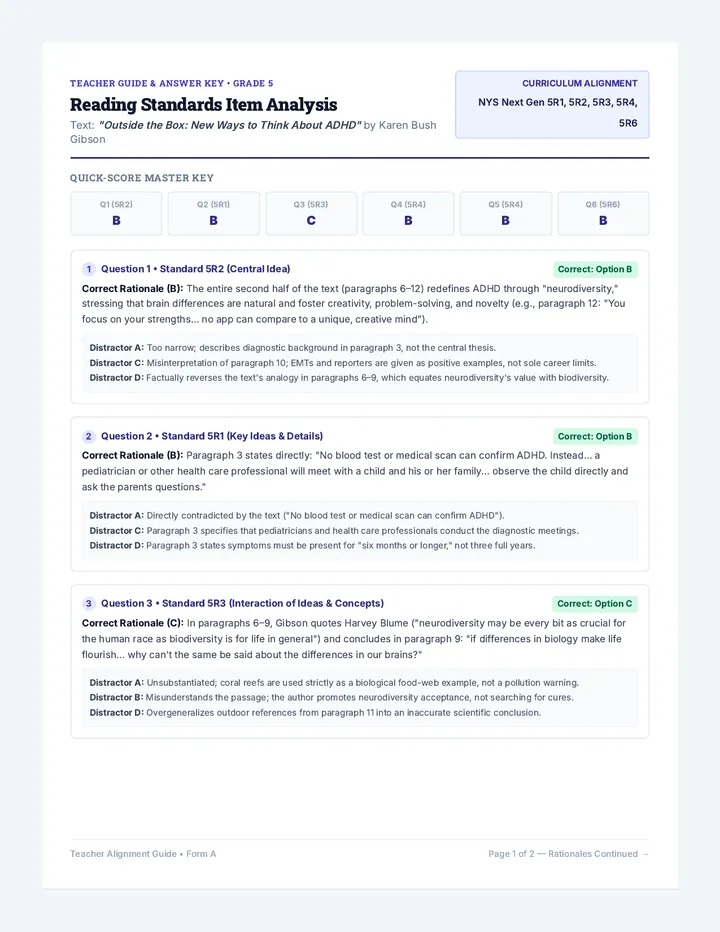
Curriculum Alignment NYS Next Gen 5R1, 5R2, 5R3, 5R4, 5R6
Quick-Score Master Key
Q1 (5R2) B
Q2 (5R1) B
Q3 (5R3) C
Q4 (5R4) B
Q5 (5R4) B
Q6 (5R6) B
1 Question 1 • Standard 5R2 (Central Idea) Correct: Option B
Correct Rationale (B): The entire second half of the text (paragraphs 6–12) redefines ADHD through "neurodiversity," stressing that brain differences are natural and foster creativity, problem-solving, and novelty (e.g., paragraph 12: "You focus on your strengths... no app can compare to a unique, creative mind").
Distractor A: Too narrow; describes diagnostic background in paragraph 3, not the central thesis.
Distractor C: Misinterpretation of paragraph 10; EMTs and reporters are given as positive examples, not sole career limits.
Distractor D: Factually reverses the text's analogy in paragraphs 6–9, which equates neurodiversity's value with biodiversity.
2 Question 2 • Standard 5R1 (Key Ideas & Details) Correct: Option B
Correct Rationale (B): Paragraph 3 states directly: "No blood test or medical scan can confirm ADHD. Instead... a pediatrician or other health care professional will meet with a child and his or her family... observe the child directly and ask the parents questions."
Distractor A: Directly contradicted by the text ("No blood test or medical scan can confirm ADHD").
Distractor C: Paragraph 3 specifies that pediatricians and health care professionals conduct the diagnostic meetings.
Distractor D: Paragraph 3 states symptoms must be present for "six months or longer," not three full years.
3 Question 3 • Standard 5R3 (Interaction of Ideas & Concepts) Correct: Option C
Correct Rationale (C): In paragraphs 6–9, Gibson quotes Harvey Blume ("neurodiversity may be every bit as crucial for the human race as biodiversity is for life in general") and concludes in paragraph 9: "if differences in biology make life flourish... why can't the same be said about the differences in our brains?"
Distractor A: Unsubstantiated; coral reefs are used strictly as a biological food-web example, not a pollution warning.
Distractor B: Misunderstands the passage; the author promotes neurodiversity acceptance, not searching for cures.
Distractor D: Overgeneralizes outdoor references from paragraph 11 into an inaccurate scientific conclusion.
Teacher Alignment Guide • Form A Page 1 of 2 — Rationales Continued →
Teacher Item Analysis Continued Questions 4–6 & Pedagogical Insights
Grade 5 ELA Assessment
4 Question 4 • Standard 5R4 (Diction Analysis & Meaning) Correct: Option B
Correct Rationale (B): The author defines "diffused attention" immediately in paragraph 10: "Diffused attention allows, and sometimes demands, a person to pay attention to many things at the same time." Diffused signifies spread-out awareness rather than a pinpoint focus.
Distractor A: Incorrectly adopts a deficit mindset, whereas the author explicitly states "This isn't always a bad thing."
Distractor C & D: Contradicted by paragraph 10, which links diffused attention to success in fast-paced jobs.
5 Question 5 • Standard 5R4 (Diction & Tone / Figurative Language) Correct: Option B
Correct Rationale (B): The metaphor "prison of negative expectations" contrasts confinement (deficit views) with liberation ("redefine their identity"). Armstrong's word choice highlights the emotional relief and empowerment neurodiversity provides.
Distractor A: Takes "prison" literally rather than recognizing it as a metaphor for social stigma.
Distractor C & D: Directly opposite of Armstrong's message of empowerment and inclusion.
6 Question 6 • Standard 5R6 (Point of View & Perspective) Correct: Option B
Correct Rationale (B): Gibson begins with traditional frustration (paragraph 1), then purposefully pivots in paragraph 6 ("differences in brains are to be expected and respected") and concludes in paragraph 12 by emphasizing strengths, proving her perspective reframes ADHD positively.
Distractor A: The author explicitly rejects treating ADHD as mere misbehavior or a deficit.
Distractor C & D: Distorts details; Gibson acknowledges diagnostic criteria and recognizes that organizational apps can be useful.
Standards Check (5R1) Scoring Guide & Exemplars
Award 1 point if the student identifies a valid question and directly quotes or accurately cites evidence from the text:
Exemplar for Q1 or Q6: "ADHD looks different through the lens of neurodiversity. You focus on your strengths... no app can compare to a unique, creative mind." (Paragraph 12)
Exemplar for Q4: "Diffused attention allows, and sometimes demands, a person to pay attention to many things at the same time." (Paragraph 10)
Pedagogical Insights & Common Misconceptions
- Diction vs. Literal Meaning (5R4): Students often struggle with figurative language in non-fiction sidebars (like "prison of negative expectations"). Guide students to identify the emotional connotation rather than physical interpretation.
- Interactions Across Concepts (5R3): When authors use scientific analogies (biodiversity → neurodiversity), model how the comparison transfers value from nature to the human mind.
- Central Idea vs. Introductory Detail (5R2): Ensure students do not mistake the opening paragraphs on CDC diagnostic symptoms for the overarching thesis of the whole text.
NYS Next Gen ELA Assessment Resource • Grade 5 Page 2 of 2 • Teacher Reference