Lenny.com
Explore
Create
ActivitiesNewMathEnglish Language ArtsScience & EngineeringSocial StudiesGlobal LanguagesHealth & Physical EducationSpecial EducationCounseling & Life SkillsArts & CreativityESL
Lenny.com
Lenny.com
Explore
Create
ActivitiesNewMathEnglish Language ArtsScience & EngineeringSocial StudiesGlobal LanguagesHealth & Physical EducationSpecial EducationCounseling & Life SkillsArts & CreativityESL
Lenny.com
Lenny.com

Solutions

Lenny for EducatorsLenny for SchoolsLenny for Districts

Product

ExploreSign inCreateSupportAbout

Resources

Getting startedMTSS Acceleration Program

© 2026 Lenny Learning Inc.

TermsPrivacyAccessibility
LinkedInInstagramX
Lenny

Writing Clearly And Concisely

Techniques for eliminating redundancy, utilizing active voice, and selecting precise vocabulary to enhance readability. Equips writers with strategies for distilling complex ideas into direct, impactful sentences.

English Language ArtsPhonics & Reading FoundationsLetter IdentificationLearn Letters A-ZLowercase and Uppercase LettersConsonants and VowelsLetter-Sound AssociationsLetter-Sound Associations: LowercaseLetter-Sound Associations: UppercaseBeginning and Ending SoundsRhymingBlending And SegmentingShort VowelsShort Vowel SoundsConsonant BlendsConsonant DigraphsBlends, Digraphs, and TrigraphsDigraphs, Blends, and Silent LettersLong Vowel SoundsLong Vowel PatternsShort and Long VowelsShort and Long Vowel PatternsSilent EVowel SoundsVowel TeamsR-Controlled VowelsDiphthongs: Oi, Oy, Ou, OwVariant VowelsVariant, Diphthong, And R Vowel PatternsSoft G And CSight WordsIrregular WordsWord RecognitionSyllablesSyllable TypesTwo-Syllable WordsMultisyllabic WordsPhoneme ManipulationDecodable TextsVocabularyAction WordsQuestion WordsNouns and AdjectivesClassify WordsCompound WordsSynonyms and AntonymsHomophonesHomophones and HomonymsShades of MeaningContext CluesPrefixes and SuffixesGreek and Latin RootsAnalogiesIdioms and AdagesForeign Words and ExpressionsWord Choice and UsageReference SkillsReading ComprehensionRead-Along Literary TextsRead-Along Informational TextsReality vs. FictionStory ElementsCharacterSequenceMain IdeaCause And EffectCompare And ContrastReading StrategiesText StructureAuthor's PurposeAuthor's Purpose And ToneAuthor's PerspectivePoint Of ViewThemeInference And ThemeInference And AnalysisPoetry ElementsLiterary DevicesAnalyzing LiteratureAnalyzing Informational TextsComparing TextsAudience, Purpose, And ToneBusiness DocumentsNovel StudyNonfiction Book StudyGrammar & MechanicsSentencesNounsVerbsAdjectivesPronounsCapitalizationPunctuationContractionsConjunctionsPrepositionsArticlesAdjectives And AdverbsVerb TypesVerb TensePronouns And AntecedentsPronoun TypesSubject-Verb AgreementDirect And Indirect ObjectsSentences, Fragments, And Run-OnsPhrases And ClausesCommasSemicolons, Colons, And CommasDashes, Hyphens, And EllipsesSpellingAbbreviationsFormattingVerb Tense And MoodMisplaced ModifiersWritingDescriptive DetailsCreative WritingOpinion WritingTopic SentencesOrganizing WritingLinking WordsSentence VarietyIntroductions And ConclusionsPersuasive And Opinion WritingExpository WritingPersuasive StrategiesDeveloping And Supporting ArgumentsTopic Sentences And Thesis StatementsSummarizingResearch SkillsEditing And RevisingActive And Passive Voice=Writing Clearly And ConciselyDebate & Public SpeakingPublic Speaking BasicsPersuasive TechniquesClaims and EvidenceTypes of ArgumentsReasoning TypesLogical FallaciesTopic ResearchOrganizing EvidenceDebate Speech OrganizationAttacking and Defending ArgumentsClash and EngagementImpact CalculusQuestioning and Cross-ExaminationCritical ThinkingInformal LogicFormal LogicInductive Reasoning

Videos

How the Oxford Comma Prevents Confusion

How the Oxford Comma Prevents Confusion

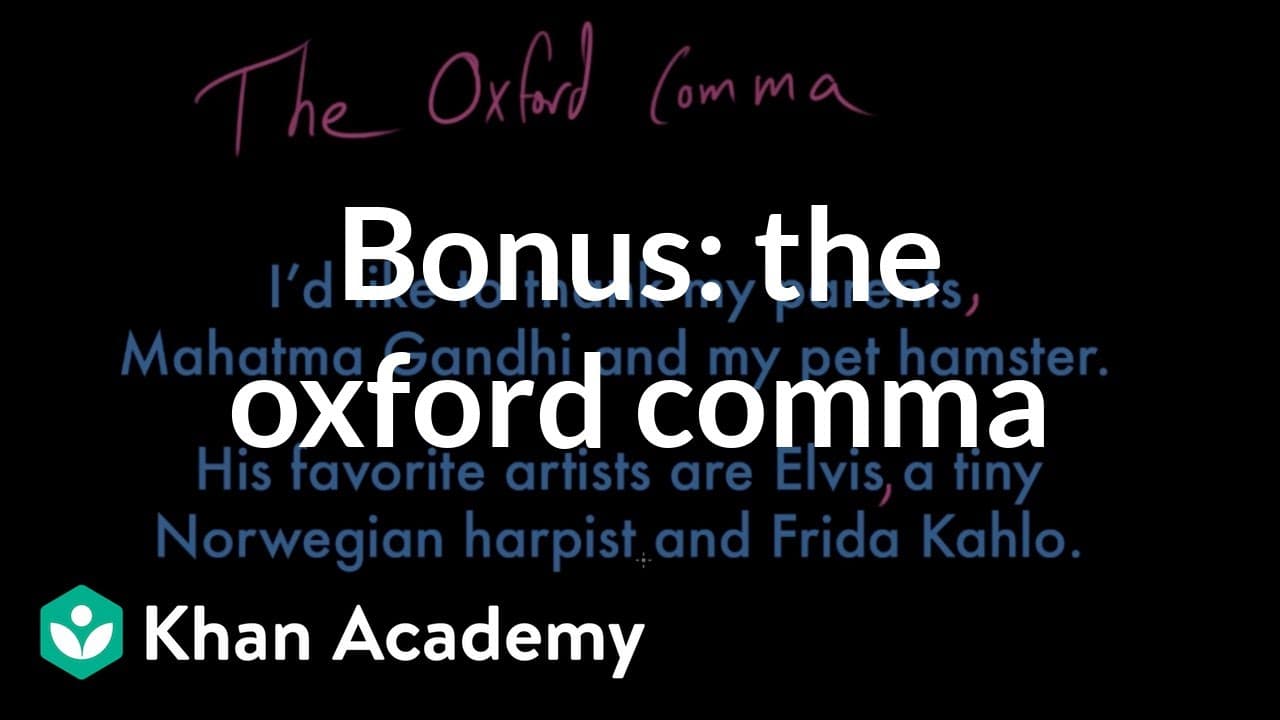
This engaging video explores the function and importance of the Oxford comma (also known as the serial comma) through humorous and memorable examples. Narrators David and Paige explain that while the comma placed before the conjunction in a list is optional in some style guides, its omission can lead to hilarious and confusing misunderstandings. They illustrate this with sentences implying one's parents are Mahatma Gandhi and a hamster, or that Elvis is a tiny Norwegian harpist. The video delves into the nuances of grammatical clarity versus stylistic choice, referencing major style guides like AP (which typically omits it) and Chicago (which includes it). It introduces the grammatical concept of "apposition" to explain why these specific misunderstandings occur. The narrators also offer a sophisticated counter-argument: that rewriting a sentence to change the word order is often a better solution for ambiguity than relying solely on punctuation. For educators, this video serves as an excellent hook for grammar lessons, demonstrating that punctuation is not just about following arbitrary rules but about ensuring clear communication. It provides a non-threatening entry point into complex topics like appositives, ambiguity, and style guides. The humorous examples stick in students' minds, making the concept of the serial comma easier to recall and apply in their own writing.

Khan AcademyKhan Academy

3mins 43s

How Intensifiers and Adverbs of Degree Work

How Intensifiers and Adverbs of Degree Work

This animated grammar lesson explores the function and usage of intensifiers and adverbs of degree. The narrator explains how these specific types of adverbs modify adjectives to express intensity or extent, distinguishing them from simple comparative modifiers. Using clear handwritten text and simple illustrations, the video demonstrates how adding words like "really," "very," and "extremely" can double down on a description. The video uses engaging and humorous examples, such as the "Incredibly Deadly Viper" from Lemony Snicket's *A Series of Unfortunate Events*, to visualize abstract grammatical concepts. By altering the viper's description to "somewhat deadly" and "barely deadly"—and adjusting the drawing's teeth accordingly—the narrator concretely shows how adverbs of degree shift meaning along a spectrum. Teachers can use this video to help students move beyond basic descriptions in their writing. It provides a accessible framework for understanding how language can be precise regarding "how much" or to what extent something is true, moving from binary descriptions to a nuanced scale of meaning using modifiers.

Khan AcademyKhan Academy

5mins 14s

Mastering Language Register: Formal vs. Informal Writing

Mastering Language Register: Formal vs. Informal Writing

This engaging video lesson introduces students to the concept of "register" in language arts—the level of formality used in speaking and writing. Through a narrative involving a "Deportment Store" in Media Metropolis, the narrator explains the difference between formal and informal communication using relatable analogies like choosing the right outfit for an occasion. The video defines key terms like deportment and register, helping students understand that language choices depend heavily on the audience and context.

Miacademy & MiaPrep Learning ChannelMiacademy & MiaPrep Learning Channel

10mins 5s

Mastering Parallel Structure in Writing

Mastering Parallel Structure in Writing

This educational video provides a clear and engaging guide to understanding parallel structure in writing. Hosted by David, Rosie, and Paige, the lesson distinguishes parallel structure as a stylistic choice rather than a strict grammatical rule, emphasizing how it creates harmony and flow in sentences. Through handwritten visual examples on a blackboard, the instructors demonstrate how to align items in a list—whether they are nouns, verbs, or phrases—to ensure they match in form.

Khan AcademyKhan Academy

5mins 5s

Understanding Grammatical Number and Pronoun Agreement

Understanding Grammatical Number and Pronoun Agreement

This video provides a clear and engaging introduction to the concept of grammatical number in English, specifically focusing on the distinction between singular (one) and plural (more than one). The narrator uses handwritten text and simple drawings to visualize how nouns and pronouns must agree in number, explaining that "singular" refers to one thing while "plural" refers to multiple things. The video highlights how this concept is encoded into the language, particularly within pronouns like "me" versus "us." Key themes include pronoun-antecedent agreement, the importance of consistency in writing to avoid confusion, and specific exceptions to standard rules. The narrator uses humorous and memorable examples—such as a sci-fi cloning machine to explain the shift from "me" to "us," and a confusing scenario about sharing a single watch to illustrate agreement errors. The video also briefly touches upon "you" and "they" as flexible pronouns that can function as both singular and plural. For educators, this resource is excellent for introducing or reviewing the mechanics of pronoun usage and sentence structure. It moves beyond rote memorization by providing context for *why* grammar rules exist: to prevent ambiguity. Teachers can use the video's specific examples, like the "cantaloupe" test at the end, to help students identify antecedents and ensure their own writing maintains logical consistency between subjects and pronouns.

Khan AcademyKhan Academy

5mins 18s

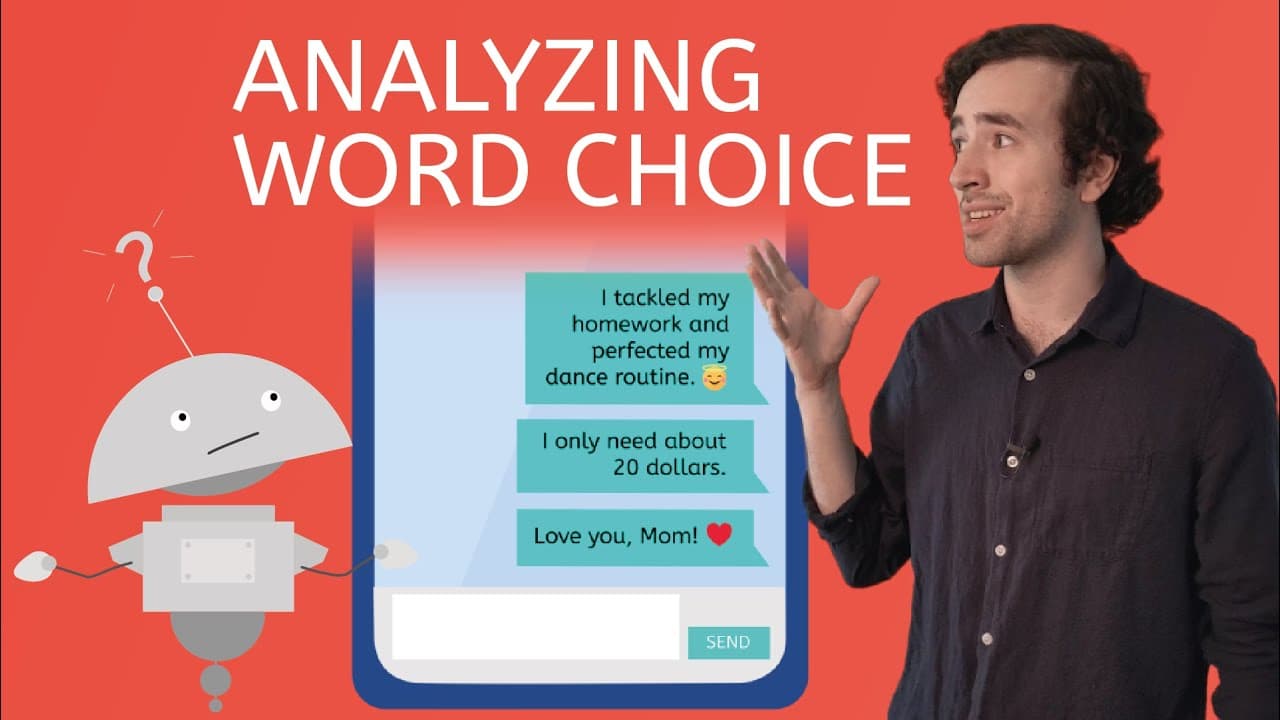
How Word Choice Changes Tone and Meaning

How Word Choice Changes Tone and Meaning

This engaging video lesson illustrates the critical impact of word choice on tone, meaning, and persuasion through a relatable real-world scenario. By analyzing a series of text messages sent by a student named Liz—first to her mother asking for money, and then to a friend—the video demonstrates how subtly changing specific words (like switching "Mom" to "Mommy" or "did" to "tackled") can completely alter the reception of a message. The narrator guides viewers through the revision process, highlighting how strategic vocabulary selection allows writers to soften requests, emphasize effort, and tailor communication to specific audiences. The content explores key themes of rhetoric, audience awareness, and the difference between denotation and connotation. It provides concrete examples of how synonyms are rarely perfectly interchangeable and how context dictates appropriate vocabulary. The video contrasts formal, persuasive language used for authority figures with casual, direct language used among peers, helping students understand code-switching and tonal shifts. For educators, this video serves as an excellent hook for units on persuasive writing, revision, or narrative voice. It effectively bridges the gap between students' daily digital communication habits and academic writing skills. The visual breakdown of text message editing offers a clear, scaffolding model for how students can critically evaluate and improve their own writing, moving them from simple statements to more nuanced, impactful expression.
Miacademy & MiaPrep Learning ChannelMiacademy & MiaPrep Learning Channel

4mins 31s

Materials

Rainforest Adventure Titles Worksheet Project

Rainforest Adventure Titles Worksheet Project

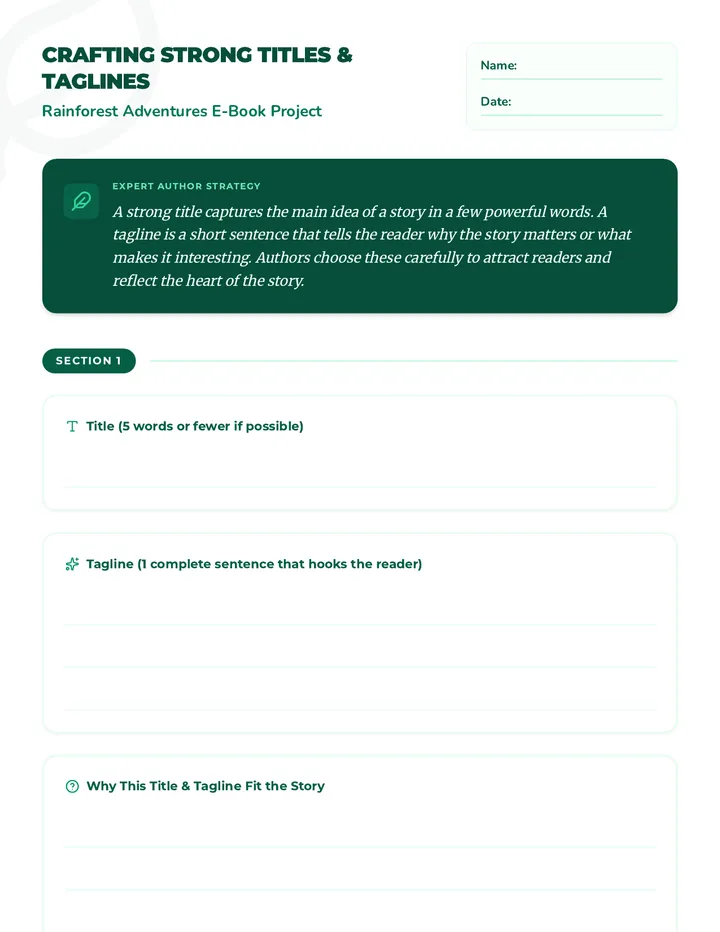
A professional 2-page printable worksheet for student authors to brainstorm and refine titles and taglines for their rainforest-themed e-books. It features a cohesive rainforest aesthetic across two structured pages, providing space for two distinct draft sections and a final synthesis reflection.

BJ

Brandon Jackson

Polished Prose Anchor Chart Split Page

Polished Prose Anchor Chart Split Page

An expanded anchor chart featuring a second page focused on academic articulation. It provides curated lists of formal sentence starters for stating arguments, introducing evidence, and performing deep text analysis, maintaining a professional editorial aesthetic.

JB

John Beebe

Brevet Chrono Fiche Revision

Brevet Chrono Fiche Revision

Une version mise à jour de la fiche mémo de français pour le brevet, incluant désormais les 10 procédés littéraires incontournables (avec la comparaison, l'allégorie, l'anaphore, la gradation, l'antithèse, la métaphore, etc.) présentés dans une grille ultra-synthétique et lisible pour éviter tout dépassement.

MW

Myriam Wb

Daily Passage Bell Ringer

Daily Passage Bell Ringer

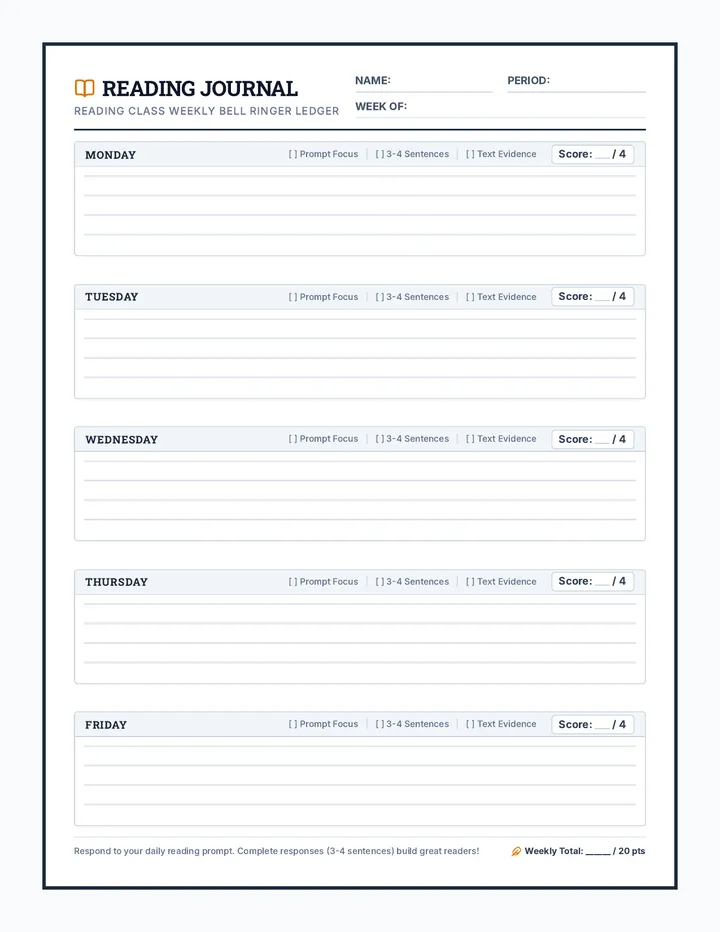
A single-page academic bell ringer log for reading classes, styled as a 'Reading Journal' weekly ledger. Features a warm slate and amber theme, large Monday-Friday response boxes with clean, realistic handwriting lines, and no rubric panel at the top.

M

Megan.Tanner

Inbox Blueprints Slides

Inbox Blueprints Slides

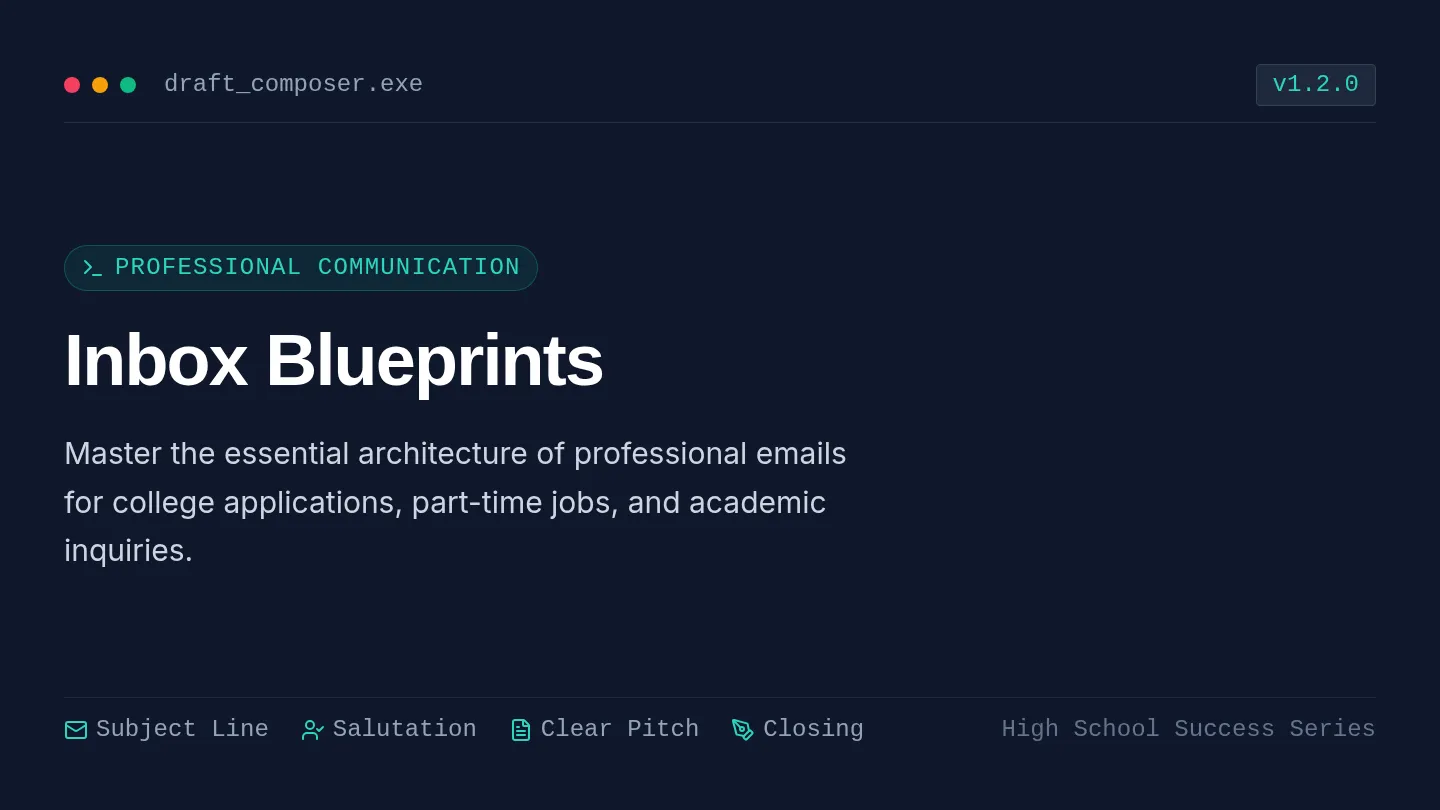
A visually engaging, slide-by-slide presentation designed for high schoolers. It covers the core anatomy of a professional email—subject lines, formal salutations, body composition, and signatures—tailored for academic inquiries and job applications, styled with a modern 'Inbox Blueprint' digital design.

CE

C. Essex

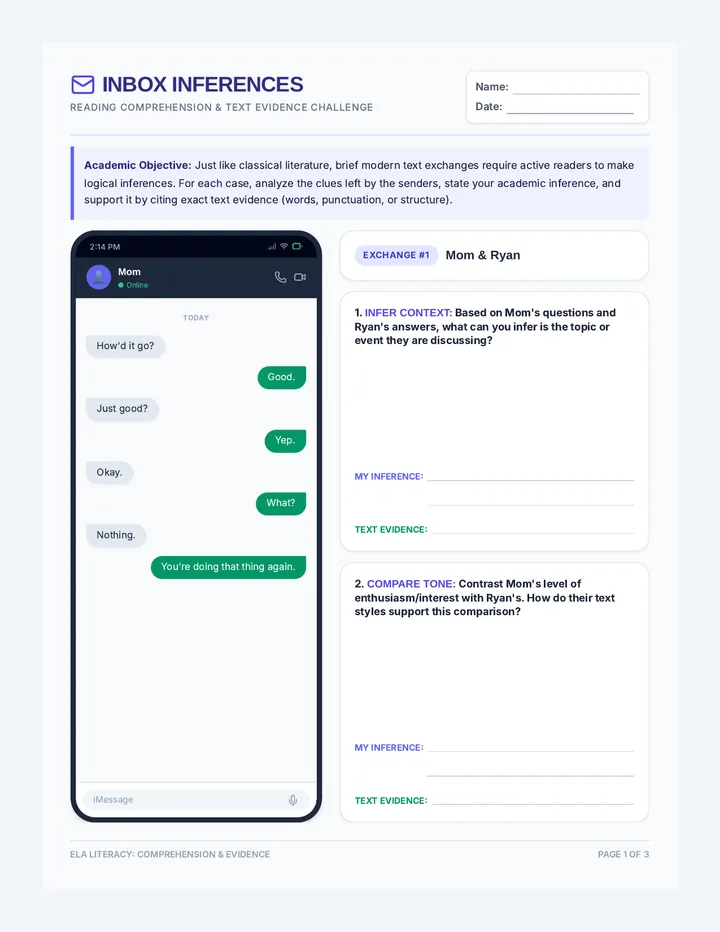
Inbox Inferences Worksheet

Inbox Inferences Worksheet

A 3-page academic ELA reading comprehension worksheet called 'Inbox Inferences Worksheet' focused purely on inferencing, tone, character analysis, and citing text evidence from text message exchanges, ending with an academic synthesis activity.

LK

Lisa Kmetz

Sequences

Echo Showdown Quiz

Statement Chasers

A writing sequence focused on the 'Echo Method'—teaching students to transform writing prompts into strong topic statements by reusing prompt keywords.

KB

Krista Bodkin

18
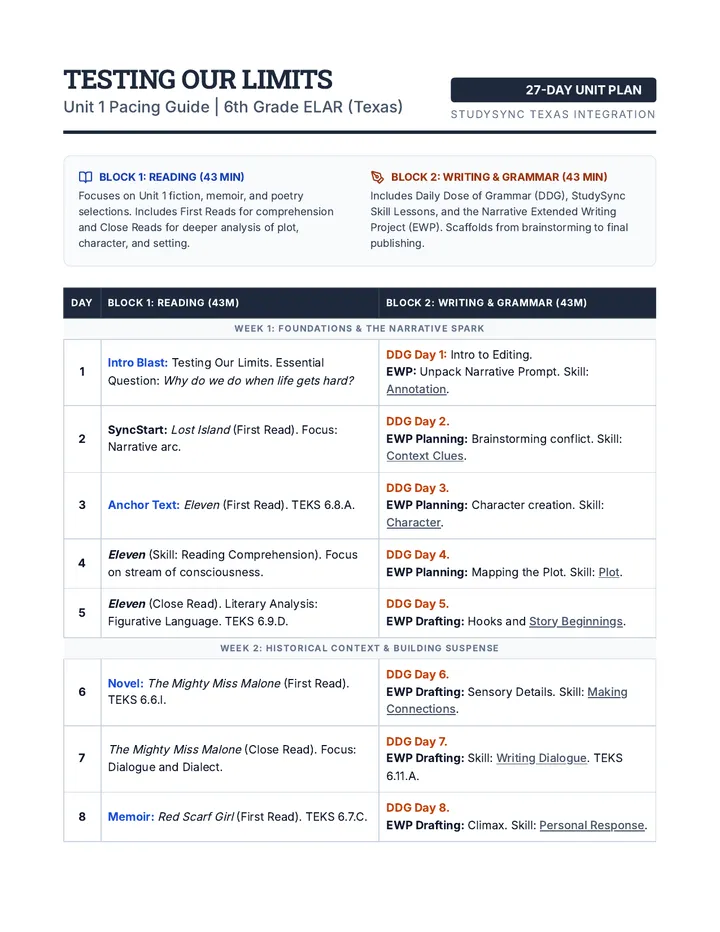
Unit 1 Pacing Guide Document

Testing Our Limits Unit Sequence

A 27-day instructional sequence for 6th Grade ELAR Unit 1: Testing Our Limits, featuring dual blocks for Reading and Writing with daily grammar and skill scaffolding.

DM

Dawn Mustian

81
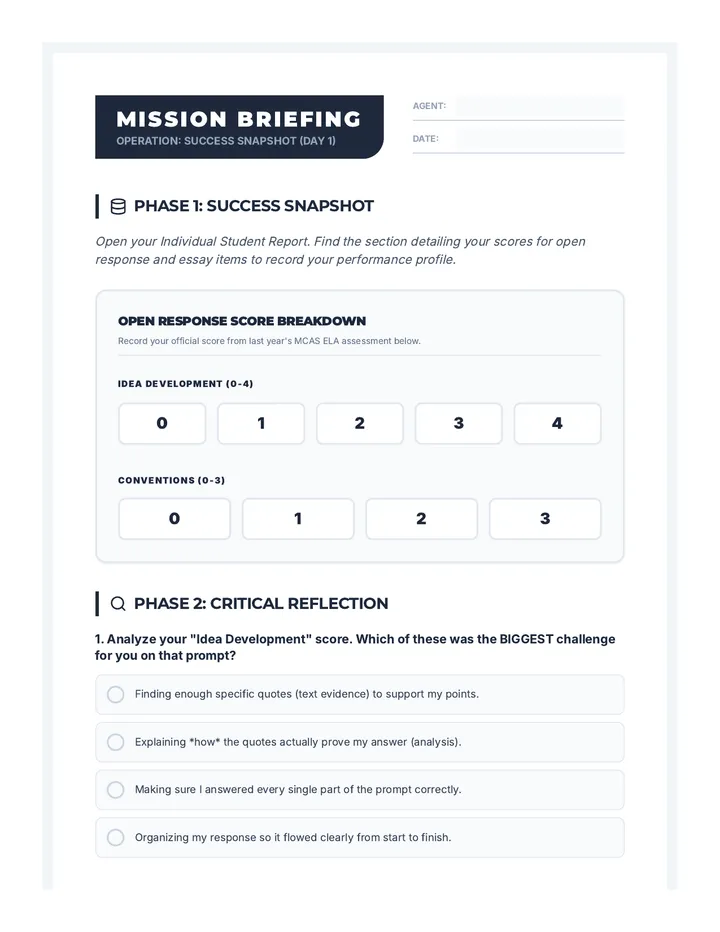
Mission Briefing Worksheet

Mastery Mission

A project-based learning unit designed to help middle school students analyze their past MCAS ELA performance, deconstruct scoring rubrics, and create a personalized strategy playbook for upcoming assessments. Students move from 'investigating' their scores to 'rebooting' their responses and 'finalizing' their test-taking toolkit.

M

mhbutterworth

18
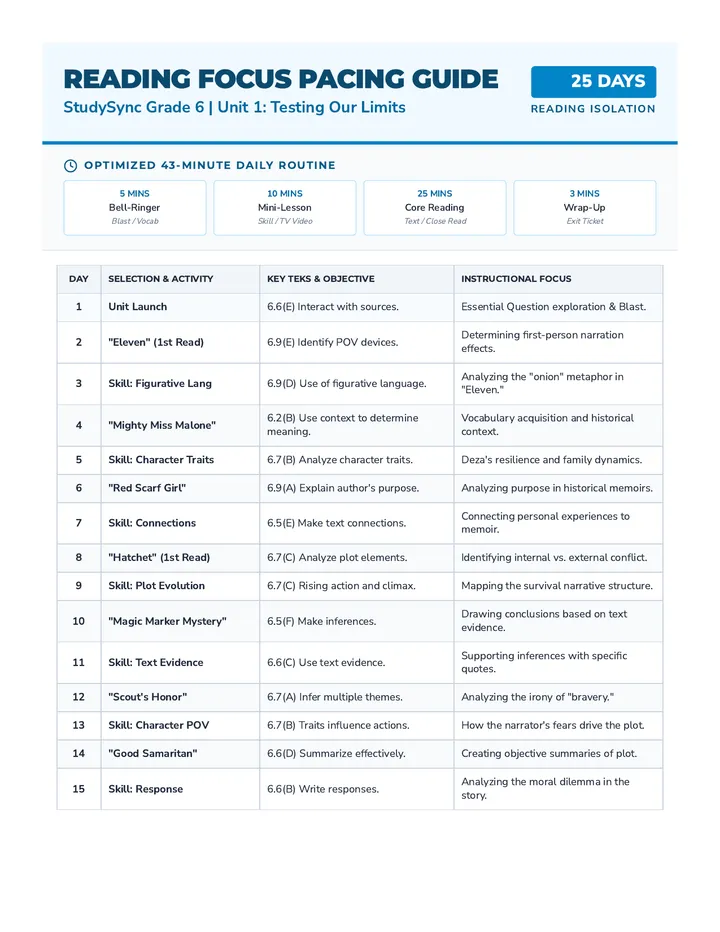
Reading Focus Pacing Guide

Testing Our Limits Unit

A 25-day comprehensive unit for StudySync Grade 6 that explores the theme of courage and resilience through isolated reading and writing tracks, aligned to ELA TEKS.

DM

Dawn Mustian

79
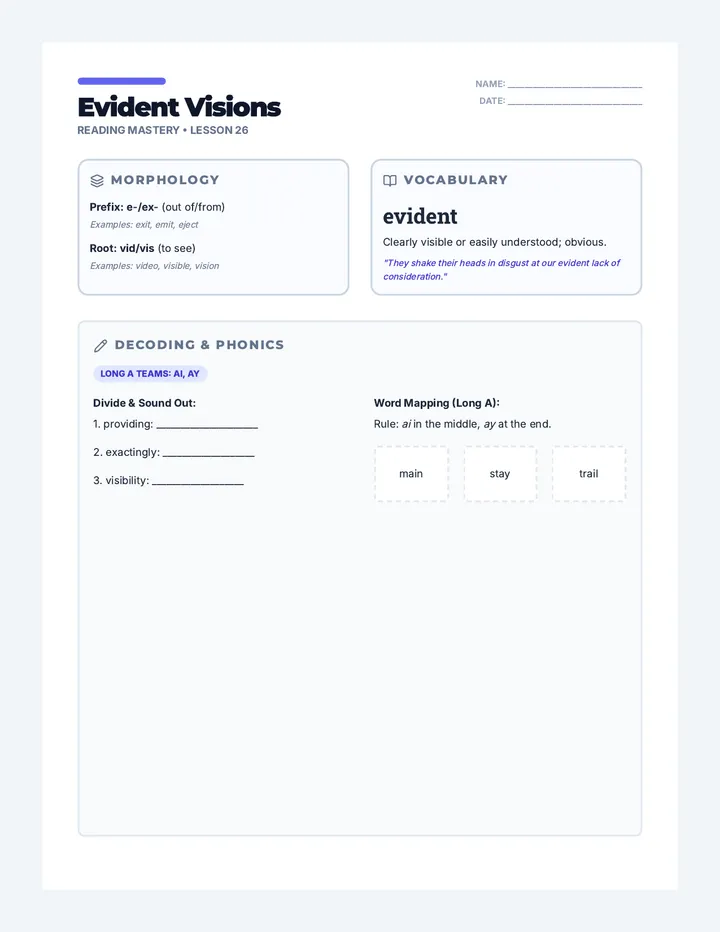
Integrated Mastery Handouts 26-40

Reading Power Pack

A comprehensive literacy intervention sequence for high school TESOL students (Lessons 16-25) focused on morphology, academic vocabulary, systematic decoding, and vowel mastery.

AP

Alexis Paolini

30
Literary Dossier Packet

The STAAR Files Web Quest Extended Mission

A comprehensive 380-minute digital web quest for STAAR English 2 preparation, divided into 9 high-intensity missions of 45 minutes or less, covering the top five most tested TEKS.

LF

Lindsey Foulks

13

Lessons

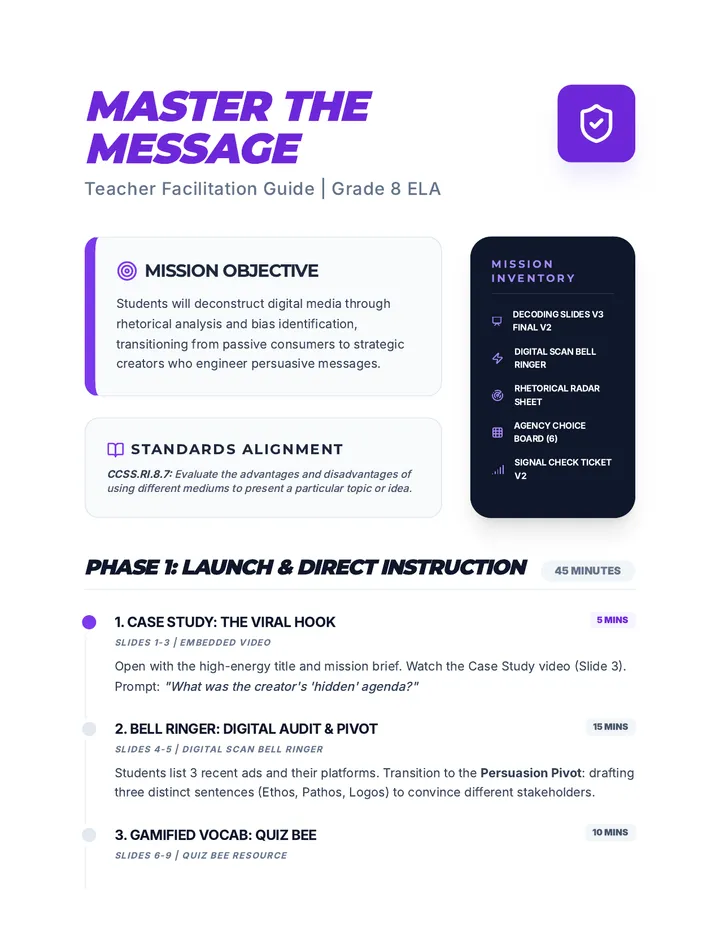
Master the Message Teacher Guide v2

Media Message Mastery

An 8th-grade ELA lesson focused on deconstructing digital media messages through the lens of rhetorical appeals (ethos, pathos, logos) and identifying bias in various online formats. Students transition from passive consumers to critical analysts of news clips, social media, and advertisements.

V

vivianbelarmino

36
Awakening Words Bell Ringer

Stolen Seconds

A comprehensive lesson exploring Tanith Lee's 'Awake,' a subversion of Sleeping Beauty, focusing on structural choices and source material transformation (RL.5 and RL.9). Students will analyze character conflict and the concept of 'the gift of time.'

V

vivianbelarmino

25
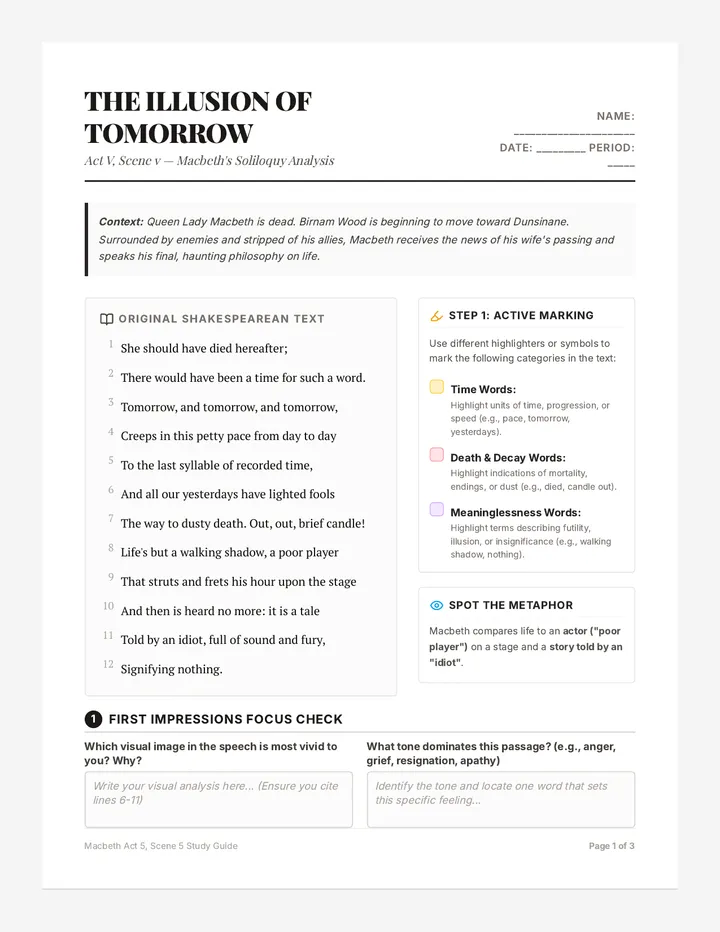
Tomorrow Speech Worksheet

The Illusion of Tomorrow

A comprehensive 10th-grade ELA lesson analyzing Macbeth's famous 'Tomorrow, and tomorrow, and tomorrow' speech from Act 5, Scene 5. Students explore Macbeth's psychological state—whether he is depressed, defeated, or finally realizing the truth of his ambitions—using textual annotation, group evidence organizers with scaffolded sentence stems, a Philosophical Four Corners debate, and a reflective exit ticket.

EC

Erin Cloutier

5
Narrative Navigator Slides

Journal Journey Cultural Bridge

An advanced 8th-grade ELA lesson exploring the intersection of Filipino and American identities through personal narrative. Students analyze the immigrant experience, master advanced vocabulary via a 'Quiz Bee,' and draft narratives that bridge their cultural heritage with their current journey.

V

vivianbelarmino

13
Second Proof Assessment Plus Added Question

The Editors Desk

A comprehensive lesson on advanced revising and editing for 10th grade, focusing on organizational structure, parallel construction, sentence effectiveness, and grammatical precision. Students will learn to transform drafts into polished, professional pieces of writing.

SM

Samantha Moore

6
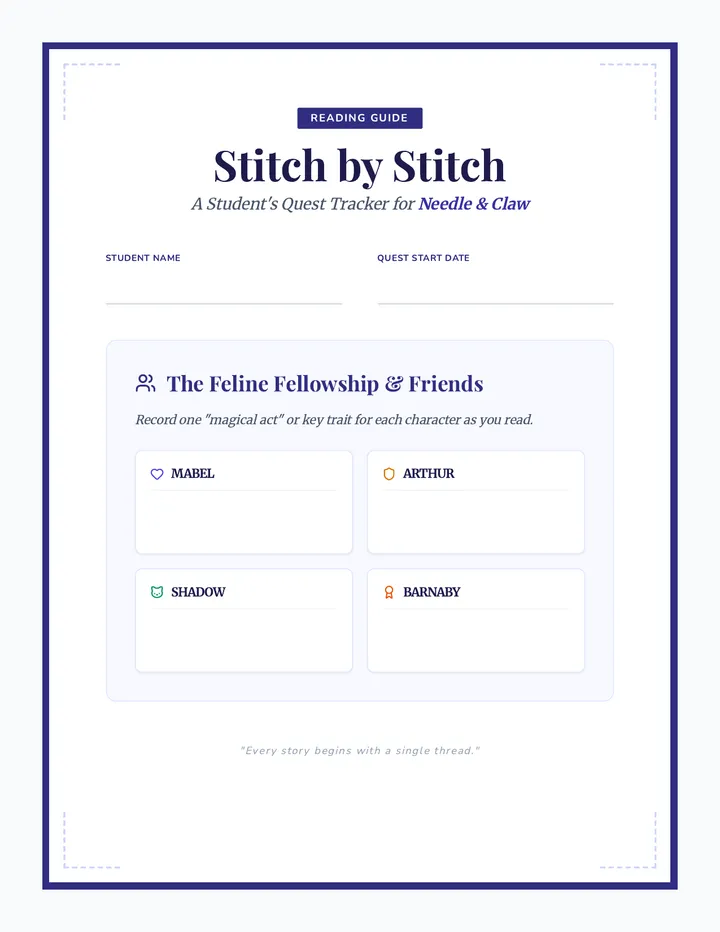
Stitch by Stitch Reading Guide

Needle and Claw

A creative story outline and character guide for a high-interest, low-readability (Hi-Lo) novel featuring an elderly protagonist in a fantasy world.

AP

Alexis Paolini

27