Lenny.com
Explore
Create
ActivitiesNewMathEnglish Language ArtsScience & EngineeringSocial StudiesGlobal LanguagesHealth & Physical EducationSpecial EducationCounseling & Life SkillsArts & CreativityESL
Lenny.com
Lenny.com
Explore
Create
ActivitiesNewMathEnglish Language ArtsScience & EngineeringSocial StudiesGlobal LanguagesHealth & Physical EducationSpecial EducationCounseling & Life SkillsArts & CreativityESL
Lenny.com
English Language ArtsPhonics & Reading FoundationsLetter IdentificationLearn Letters A-ZLowercase and Uppercase LettersConsonants and VowelsLetter-Sound AssociationsLetter-Sound Associations: LowercaseLetter-Sound Associations: UppercaseBeginning and Ending SoundsRhymingBlending And SegmentingShort VowelsShort Vowel SoundsConsonant BlendsConsonant DigraphsBlends, Digraphs, and TrigraphsDigraphs, Blends, and Silent LettersLong Vowel SoundsLong Vowel PatternsShort and Long VowelsShort and Long Vowel PatternsSilent EVowel SoundsVowel TeamsR-Controlled VowelsDiphthongs: Oi, Oy, Ou, OwVariant VowelsVariant, Diphthong, And R Vowel PatternsSoft G And CSight WordsIrregular WordsWord RecognitionSyllablesSyllable TypesTwo-Syllable WordsMultisyllabic WordsPhoneme ManipulationDecodable TextsVocabularyAction WordsQuestion WordsNouns and AdjectivesClassify WordsCompound WordsSynonyms and AntonymsHomophonesHomophones and HomonymsShades of MeaningContext CluesPrefixes and SuffixesGreek and Latin RootsAnalogiesIdioms and AdagesForeign Words and ExpressionsWord Choice and UsageReference SkillsReading ComprehensionRead-Along Literary TextsRead-Along Informational TextsReality vs. FictionStory ElementsCharacterSequenceMain IdeaCause And EffectCompare And ContrastReading StrategiesText StructureAuthor's PurposeAuthor's Purpose And ToneAuthor's PerspectivePoint Of ViewThemeInference And ThemeInference And AnalysisPoetry ElementsLiterary DevicesAnalyzing LiteratureAnalyzing Informational TextsComparing TextsAudience, Purpose, And ToneBusiness DocumentsNovel StudyNonfiction Book StudyGrammar & MechanicsSentencesNounsVerbsAdjectivesPronounsCapitalizationPunctuationContractionsConjunctionsPrepositionsArticlesAdjectives And AdverbsVerb TypesVerb TensePronouns And AntecedentsPronoun TypesSubject-Verb AgreementDirect And Indirect ObjectsSentences, Fragments, And Run-OnsPhrases And ClausesCommasSemicolons, Colons, And CommasDashes, Hyphens, And EllipsesSpellingAbbreviationsFormattingVerb Tense And MoodMisplaced ModifiersWritingDescriptive DetailsCreative WritingOpinion WritingTopic SentencesOrganizing WritingLinking WordsSentence VarietyIntroductions And ConclusionsPersuasive And Opinion WritingExpository WritingPersuasive StrategiesDeveloping And Supporting ArgumentsTopic Sentences And Thesis StatementsSummarizingResearch SkillsEditing And RevisingActive And Passive Voice=Writing Clearly And ConciselyDebate & Public SpeakingPublic Speaking BasicsPersuasive TechniquesClaims and EvidenceTypes of ArgumentsReasoning TypesLogical FallaciesTopic ResearchOrganizing EvidenceDebate Speech OrganizationAttacking and Defending ArgumentsClash and EngagementImpact CalculusQuestioning and Cross-ExaminationCritical ThinkingInformal LogicFormal LogicInductive Reasoning
Lenny.com

Solutions

Lenny for EducatorsLenny for SchoolsLenny for Districts

Product

ExploreSign inCreateSupportAbout

Resources

Getting startedMTSS Acceleration Program

© 2026 Lenny Learning Inc.

TermsPrivacyAccessibility
LinkedInInstagramX
Lenny

Homophones and Homonyms

Distinguishes between words that sound alike but differ in spelling and terms with identical spelling but multiple meanings. Strengthens spelling accuracy and reading comprehension through context clues.

Videos

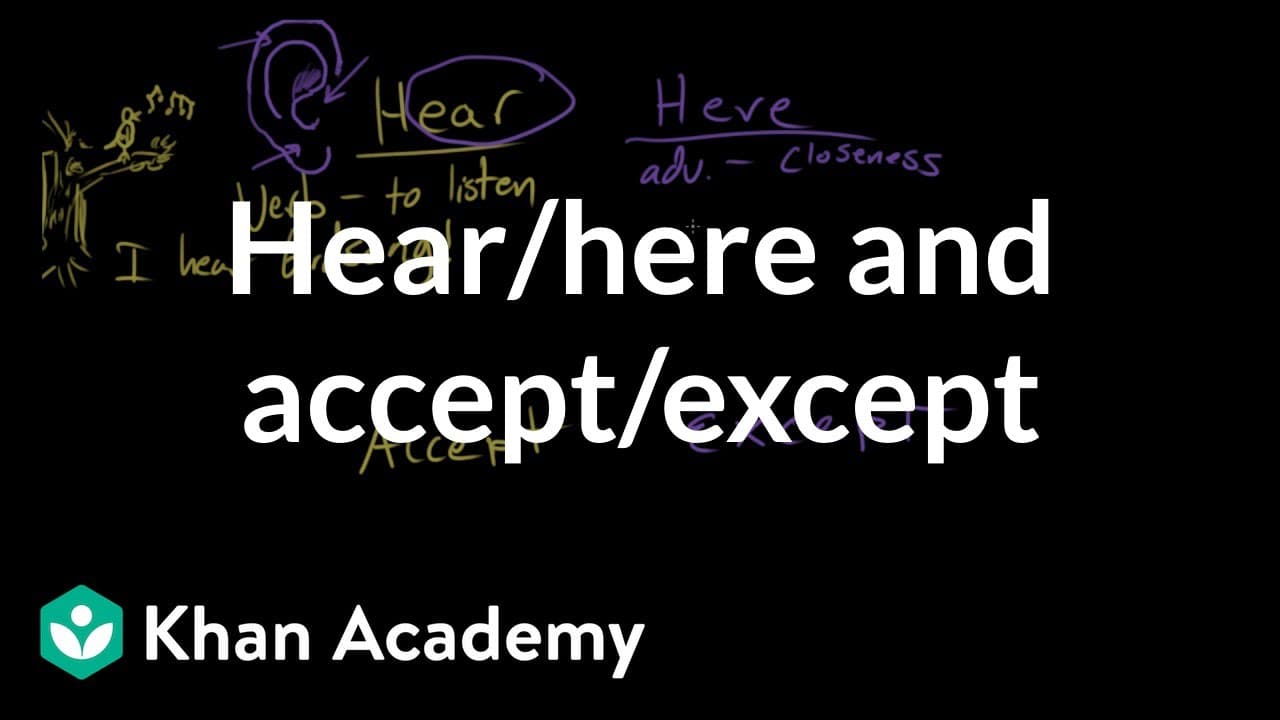
Mastering Confusing Words: Hear vs. Here and Accept vs. Except

Mastering Confusing Words: Hear vs. Here and Accept vs. Except

This educational video provides a clear and engaging guide to mastering two sets of frequently confused words: "hear" vs. "here" and "accept" vs. "except." The narrator, David, breaks down these homophones (or near-homophones) by defining their parts of speech and meanings, ensuring students understand not just how to spell them, but how they function grammatically within a sentence. The video explores key themes of spelling, grammar, and mnemonic strategies. For each word pair, the narrator provides specific memory aids: finding the word "ear" inside "hear," rhyming "here" with "near," linking the "ex" in "except" to "exclude," and connecting the "ac" in "accept" to "access." These cognitive hooks are designed to help learners permanently distinguish between the spellings. For educators, this video is an excellent resource for strengthening vocabulary and writing skills. It directly addresses common pitfalls in student writing and offers practical, visual tools for self-correction. The content is versatile enough to be used as a flipped classroom assignment, a review before a spelling test, or a reference tool for editing workshops, empowering students to proofread their work with greater confidence.

Khan AcademyKhan Academy

3mins 14s

Learning Vocabulary with Moon Goblin Detectives

Learning Vocabulary with Moon Goblin Detectives

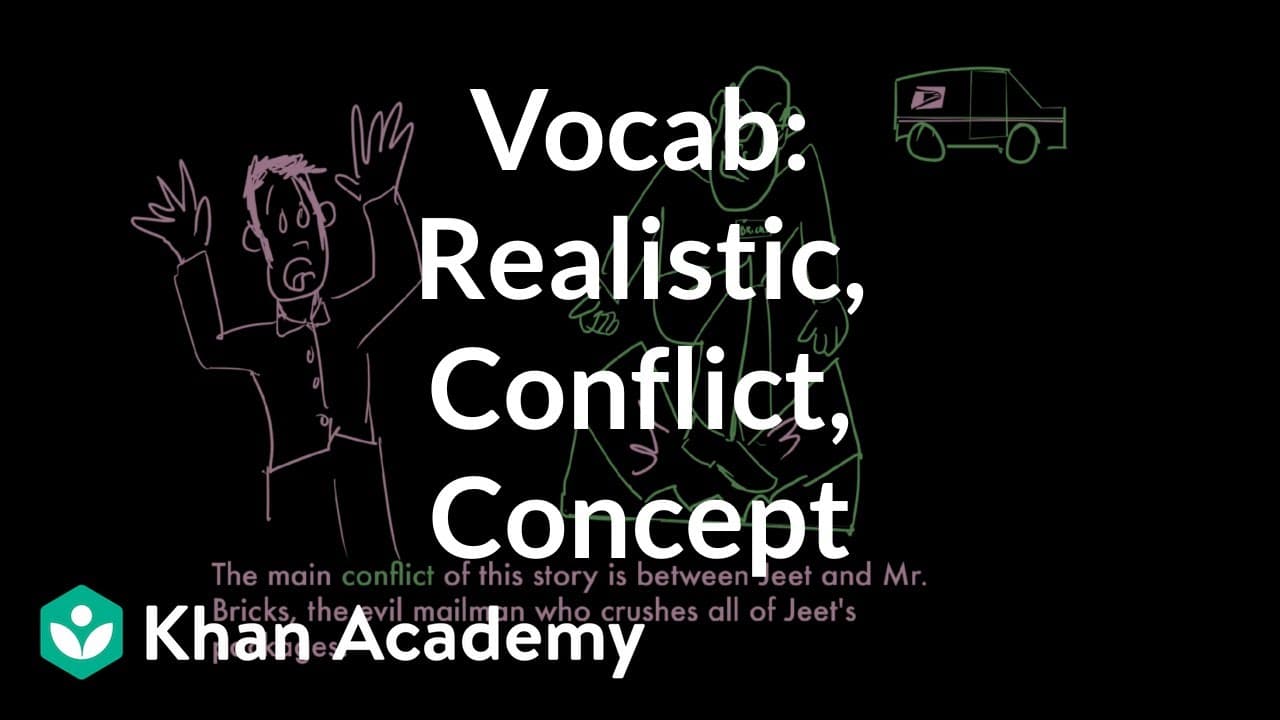
In this engaging vocabulary lesson, the narrator, David, turns a moment of personal disappointment into a learning opportunity. After receiving a rejection letter from a publisher for his fictional novel, 'Moon Goblin Detectives: Life on the Dark Side,' David analyzes the editor's critique to teach three high-utility academic vocabulary words: concept, conflict, and realistic. The video uses a humorous narrative framework to contextualize these terms, making abstract definitions concrete and memorable for students. The video breaks down each word individually, exploring their parts of speech and specific meanings. It specifically highlights the nuance of the word 'conflict,' explaining how its pronunciation and meaning shift when functioning as a noun versus a verb (heteronyms). The lesson also defines 'concept' as a general idea and 'realistic' as an adjective describing things true to life. The definitions are reinforced through whimsical animated examples, including dinosaurs on Mars and an evil mailman named Mr. Bricks. Teachers can use this video to introduce essential literary and academic vocabulary. It is particularly useful for English Language Arts units focused on story elements, as it defines 'conflict' in a literary sense. The video also supports instruction on context clues, word usage, and the difference between fantasy and realistic fiction. The humorous tone and simple visual animations keep students engaged while effectively delivering direct vocabulary instruction.

Khan AcademyKhan Academy

3mins 43s

Mastering the Difference Between Affect and Effect

Mastering the Difference Between Affect and Effect

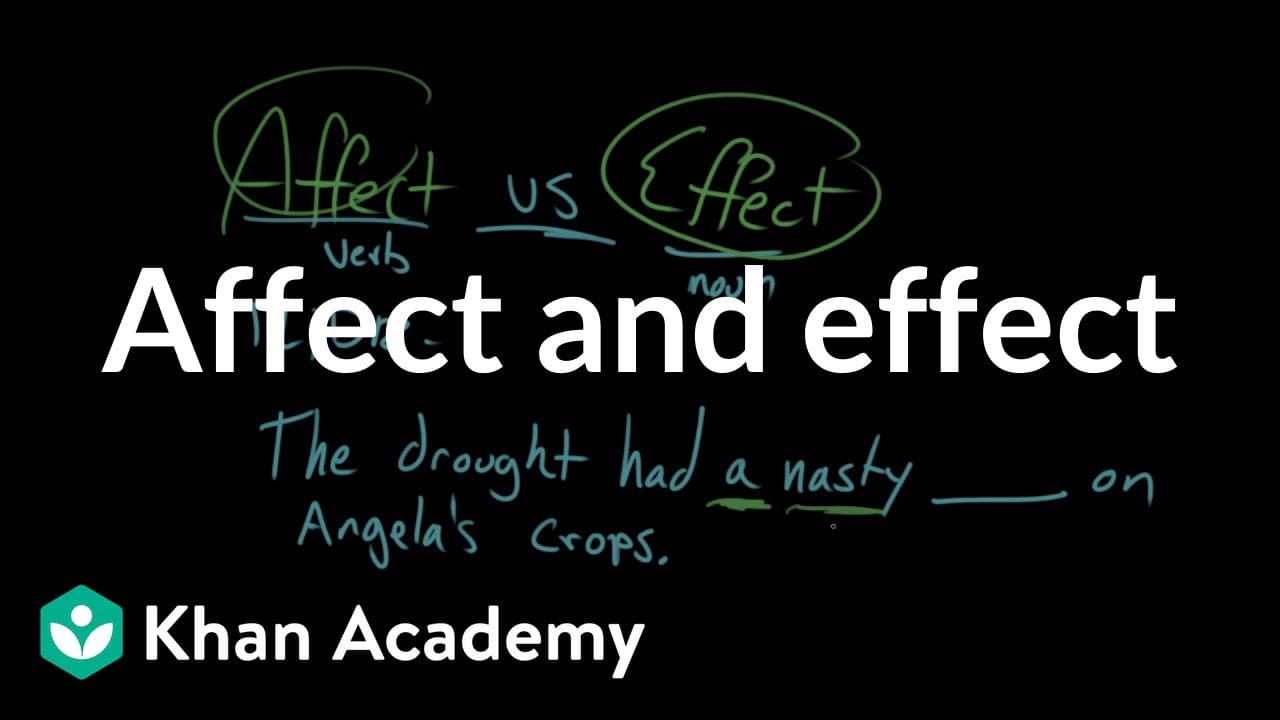
This video provides a clear and practical guide to distinguishing between the commonly confused words "affect" and "effect." Using a digital blackboard style, the narrator breaks down the primary rule that "affect" functions as a verb while "effect" functions as a noun. Through concrete examples involving a drought and crops, the video demonstrates how to identify which word is grammatically correct based on its role in the sentence as either an action or a result. The video delves deeper than simple definitions by addressing rare but grammatically correct exceptions to the general rule. It explains how "effect" can be used as a verb (meaning to bring about or create, as in "effect change") and how "affect" can be used as a noun (a psychology term describing personality or demeanor). The narrator offers stylistic advice on these exceptions, suggesting that while they are correct, they often cause confusion and might be best avoided in general writing. For educators, this resource serves as an excellent tool for grammar instruction and writing workshops. It demystifies a persistent trouble spot for students of all ages, offering a straightforward "TL;DR" rule for quick recall while acknowledging the nuance of advanced English usage. The content is valuable for strengthening proofreading skills, enhancing vocabulary precision, and helping students navigate the complexities of English homophones.

Khan AcademyKhan Academy

4mins 18s

Decoding Confusing Texts Using Context Clues

Decoding Confusing Texts Using Context Clues

This engaging educational video explores the critical role of context in communication, using relatable text message scenarios to demonstrate how easily misunderstandings can occur. The presenter, Justin, walks viewers through two distinct examples of confusion caused by ambiguous language: a conversation about "followers" that conflates track teammates with social media audiences, and a discussion about a "forecast" that could refer to either vacation weather or business sales projections. By breaking down these interactions, the video illustrates how looking at surrounding sentences helps decode intended meaning. Key themes include reading comprehension, context clues, multiple-meaning words (polysemy), and digital literacy. The video highlights how the same word can mean completely different things depending on the situation and how our own mental frameworks influence our interpretation of messages. It emphasizes the importance of analyzing the "whole picture" rather than isolated phrases to achieve clarity. This resource is highly valuable for English Language Arts classrooms as a hook for lessons on context clues, inference, and vocabulary. The modern, digital-native format of analyzing text bubbles makes the abstract concept of "context" concrete and relevant for students. Teachers can use this video to spark discussions about clear communication, have students analyze their own ambiguous messages, or introduce the concept of homonyms and polysemous words in a fun, low-stakes environment.

Miacademy & MiaPrep Learning ChannelMiacademy & MiaPrep Learning Channel

5mins 12s

How to Master Frequently Confused Words: Advice, Allowed, Break, and Bear

How to Master Frequently Confused Words: Advice, Allowed, Break, and Bear

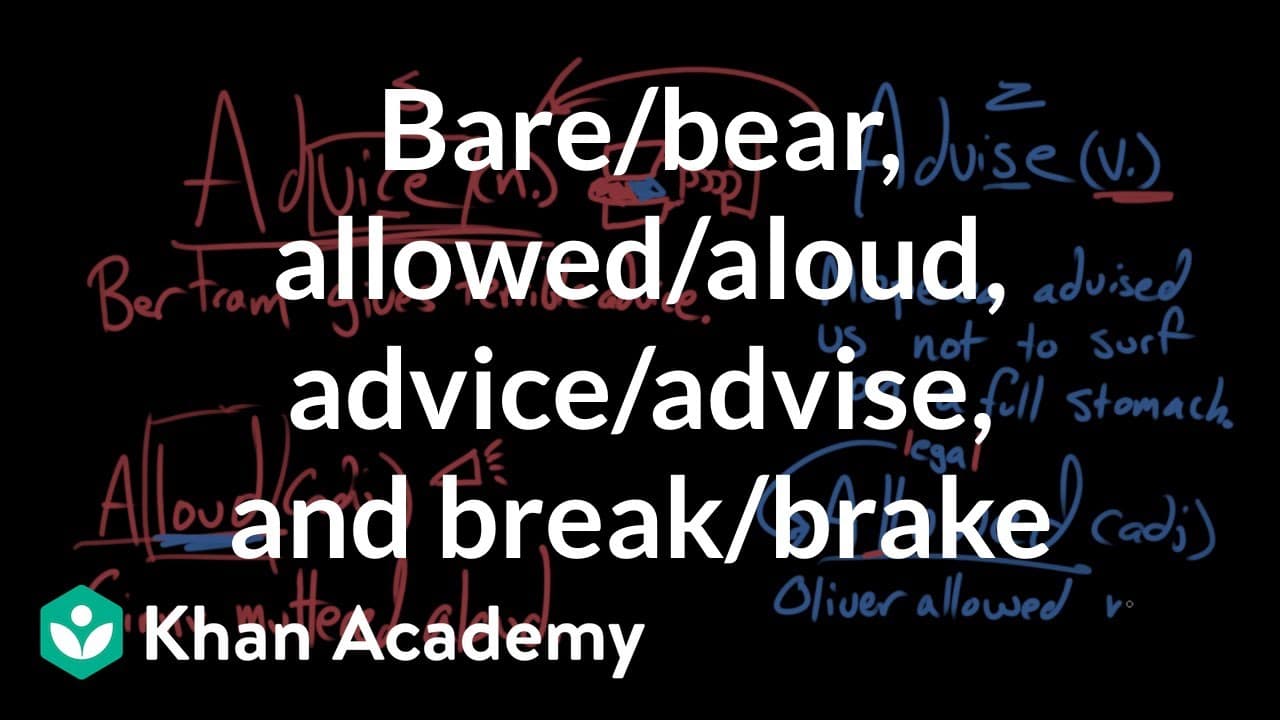
This instructional video guides viewers through four sets of frequently confused words in the English language: advice/advise, aloud/allowed, break/brake, and bear/bare. Through a collaborative narration by David and Iman, the video breaks down the grammatical differences (such as noun versus verb forms) and spelling variations that distinguish these tricky pairings. Each set is accompanied by clear definitions, sentence examples, and visual demonstrations on a blackboard-style background. Key themes include homophones, parts of speech identification, and the use of mnemonic devices to aid memory. The video specifically highlights how slight changes in spelling—like the placement of the letter 'e' in 'break' versus 'brake'—can drastically alter a word's meaning. It also explores pronunciation nuances, such as the soft 's' in advice versus the 'z' sound in advise, helping students connect auditory cues to spelling rules. This video is a valuable resource for English Language Arts classrooms focusing on spelling, vocabulary, and writing mechanics. Teachers can use it to introduce these specific confusing words or as a remediation tool for students struggling with homophones in their writing. The explicit teaching of mnemonic strategies provides students with practical, metacognitive tools they can independently apply during writing and editing tasks.
Khan AcademyKhan Academy

6mins 11s

Materials

Double Take Presenter Script

Double Take Presenter Script

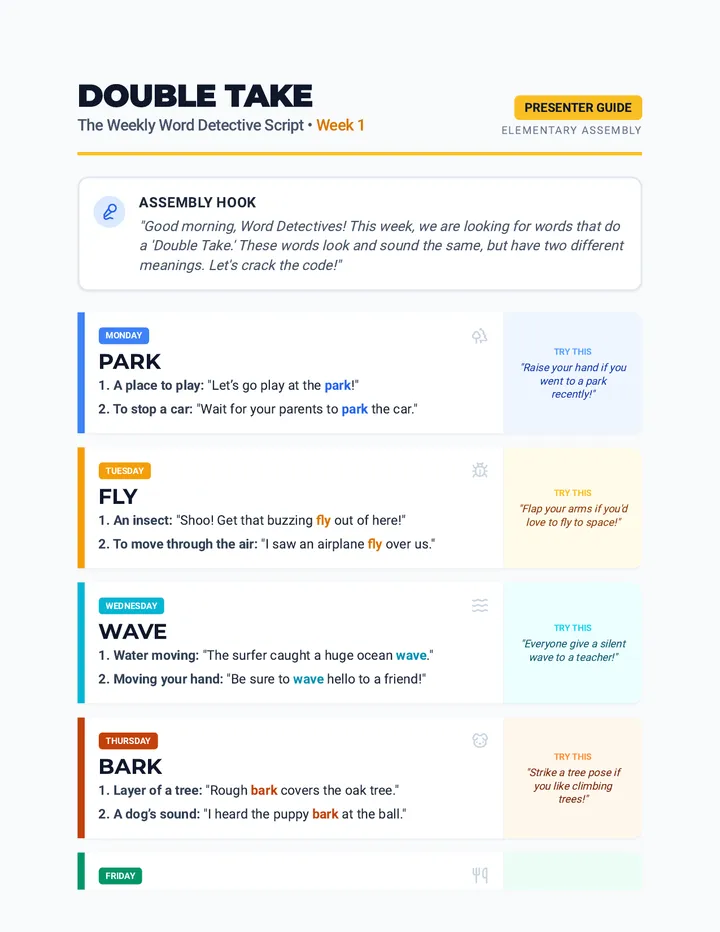
An expanded two-week presenter guide for morning assemblies, providing ten multiple-meaning words (homonyms) with definitions, sentence examples, and interactive student prompts.

RB

Rachelle Baker

Red Word Practice Grid

Red Word Practice Grid

A clean, professional 4x12 grid for 'Red Word' reading practice. It features 46 scrambled high-frequency words with check-boxes for student tracking, a total score area, and a single-page layout.

AT

Andrea T

Galactic Grammar Packet

Galactic Grammar Packet

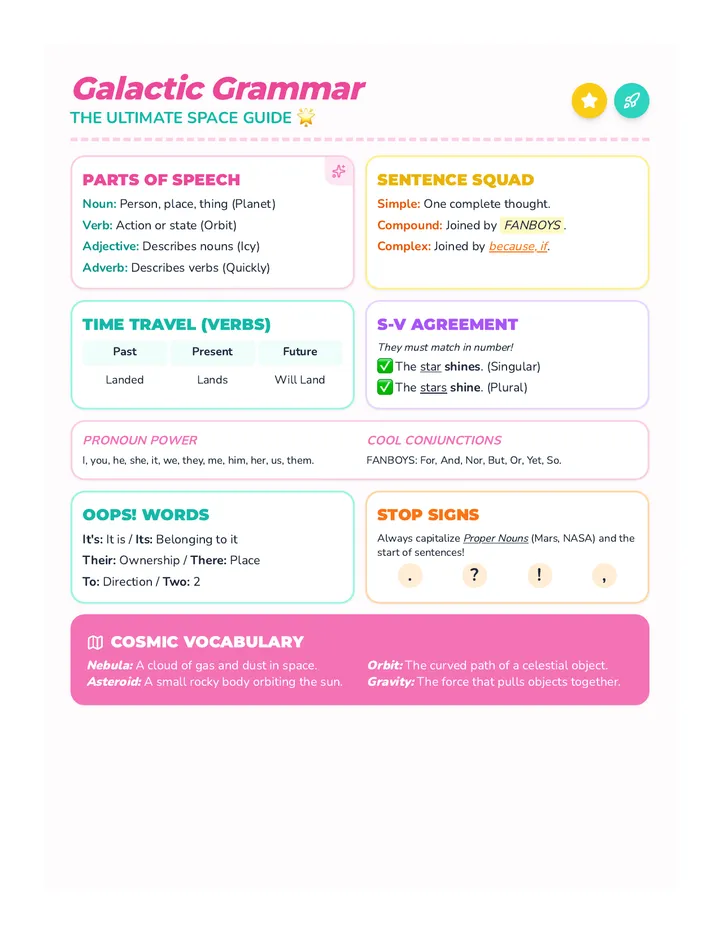
A two-page 5th-grade grammar packet featuring a 'Galactic Grammar' reference guide and a 'Mission Control' practice worksheet. The material uses a bright, preppy aesthetic with space-themed vocabulary and comprehensive coverage of parts of speech, sentence structure, and punctuation.

MA

Madelyne Ashbaugh

Blue Tier Daily Routine Guide

Blue Tier Daily Routine Guide

A comprehensive 4-page instructional routine blueprint, decoding matrix, T-chart evidence organizer, and full gamified toolkit featuring Trashketball, Capture the Flag, Syllable Slam, and IREAD-3 test strategies.

M

Melinda.Rader

Pun Patrol Worksheet

Pun Patrol Worksheet

A simplified, highly accessible 2-page upper elementary worksheet themed around pun detectives with streamlined case cards, clear fill-in lines, student name, number, and date fields, and playful picture illustrations.

Sequences

Unit 1 Pacing Guide Document

Testing Our Limits Unit Sequence

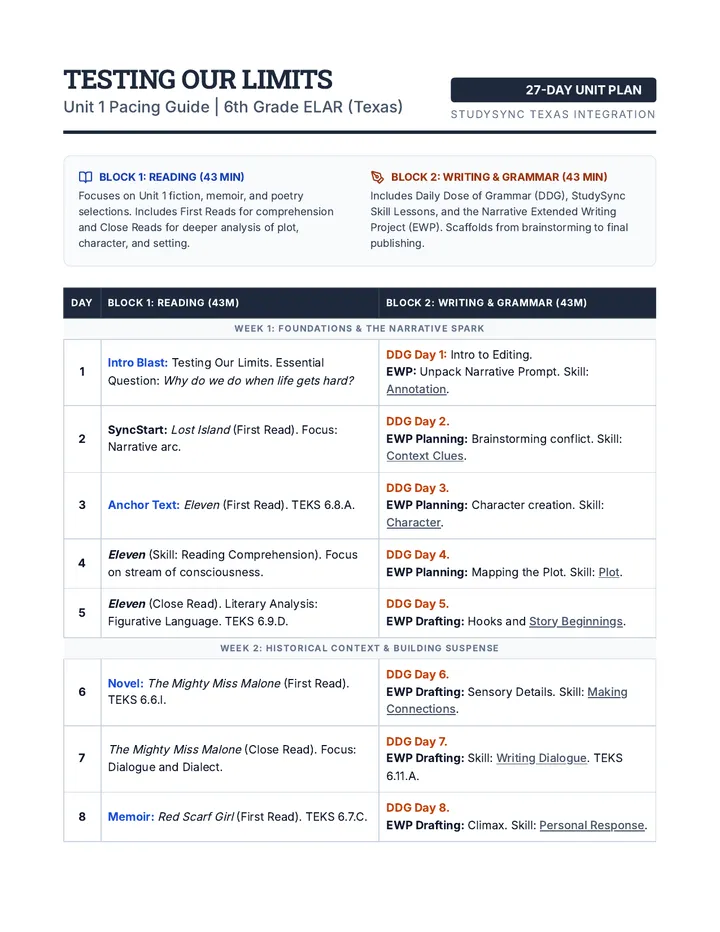
A 27-day instructional sequence for 6th Grade ELAR Unit 1: Testing Our Limits, featuring dual blocks for Reading and Writing with daily grammar and skill scaffolding.

DM

Dawn Mustian

81
I Sit I Tap Slides

Reading Foundations

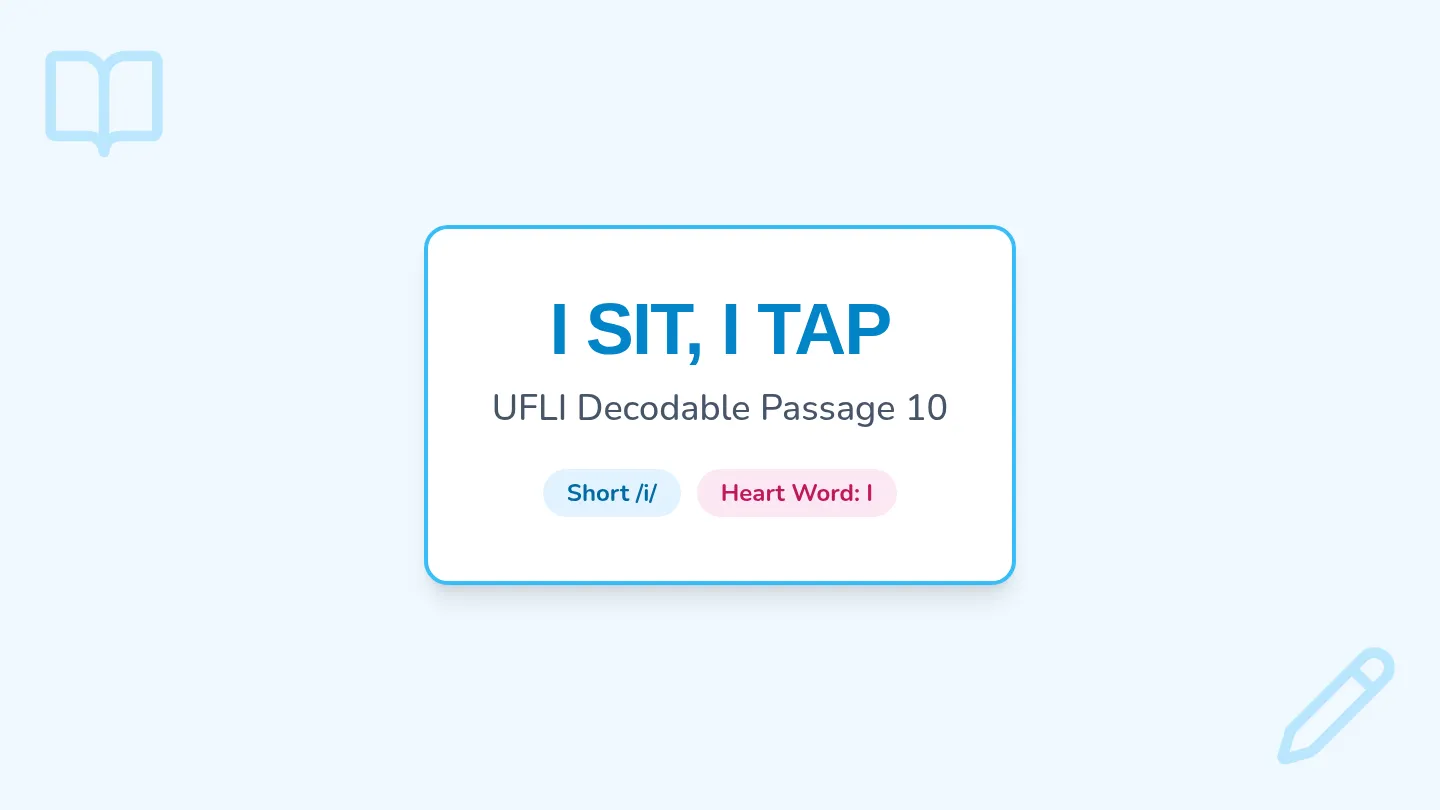
A collection of decodable passages and activities aligned with UFLI Foundations, focusing on systematic phonics and heart word acquisition. Each lesson centers on a specific phonics skill and accompanying "heart words" to build reading fluency.

N

npowers

54
Inflections and Past Tense Worksheets 2 v2

Word Study Master Collection

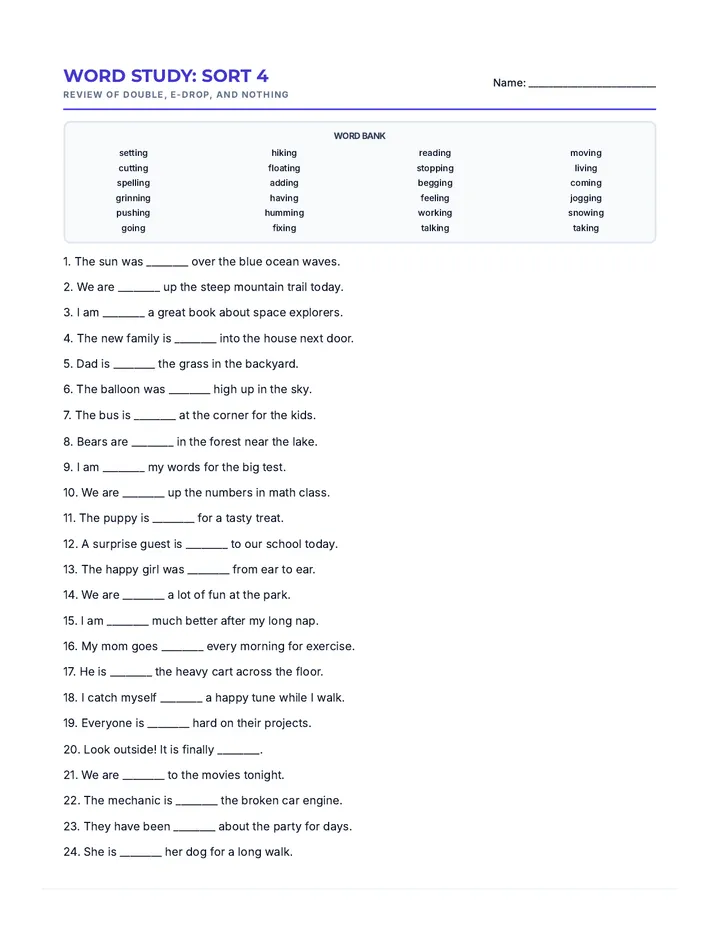
A comprehensive collection of 56 word study sorts for 4th-grade students, covering everything from basic vowel patterns and inflected endings to advanced syllable junctures, prefixes, and suffixes.

N

nmack

15
Unit Intake Exam

Spelling Sleuths

A series of detective-themed spelling units for 4th grade, focusing on complex digraphs, blends, and vowel patterns through investigative activities.

H

hmcgrath

31
Daily Drops Practice Packet

Language Drops Routine

A high-impact, daily ELA review routine for 4th-grade students, aligned with TEKS Editing and Mechanics. Consistently revisits spelling, grammar, punctuation, and sentence editing across multiple weeks to build mastery.

EO

Emily Ondreas

18
Week 1 Spiral Pack Worksheet

Spiral Skills Sprint

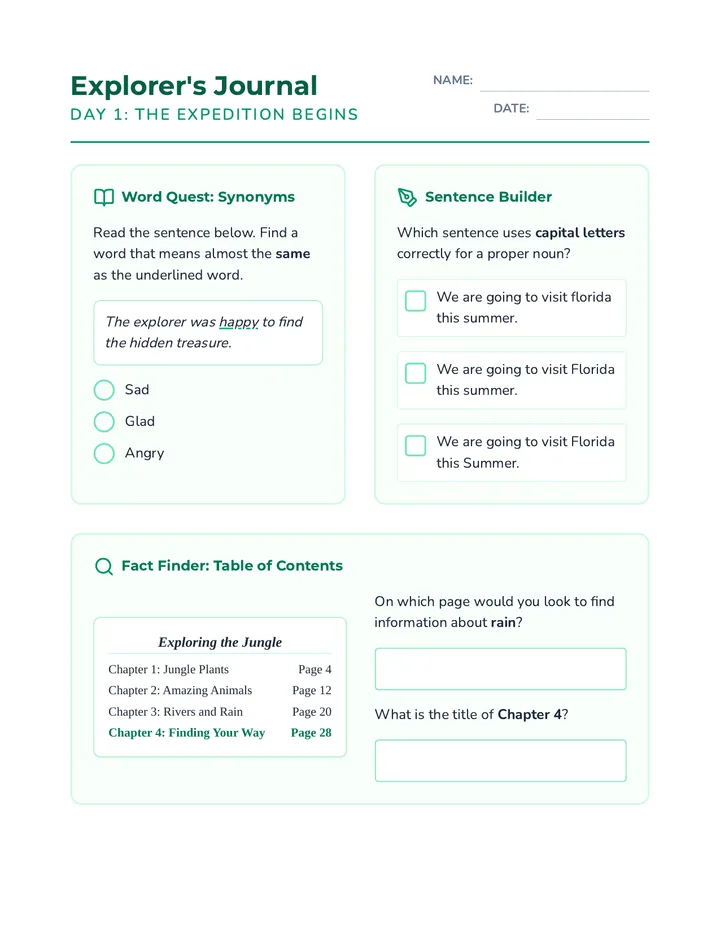
A 25-day spiral review program designed to prepare 2nd grade students for NWEA MAP Growth assessments, focusing on vocabulary, composition, and research skills. Each week provides a thematic challenge in an "Explorer's Journal" format to keep students engaged.

CH

Courtney Holdren

20

Lessons

Progression Annuelle Grammaire Guide Pedagogique

Portrait de Monstre

Une leçon complète pour étudier la structure du portrait d'un personnage imaginaire (l'ogre) à travers l'analyse d'un texte littéraire et documentaire. Elle comprend des fiches de lecture, d'analyse de structure et de vocabulaire pour guider les élèves vers la rédaction autonome de leur propre créature légendaire.

LP

LAURENT PERCHE

24
MCAS Quest Slides

MCAS ELA Champions

A comprehensive ELA test preparation series designed for 3rd grade students to master MCAS-style questions and vocabulary through engaging games.

C

cfassel

3
Curator Guide Teacher Guide

Word Museum Mystery

An interactive lesson reviewing context clues, multiple-meaning words, and affixes through a "Museum Mystery" theme tailored for Indiana IREAD-2 preparation.

B

Barbara.Bentley

4
Grammar Guru Guide Reference

Grammar Greatness

A comprehensive 5th-grade grammar review covering essential skills from parts of speech to complex sentence structure, designed with a fun, preppy aesthetic.

MA

Madelyne Ashbaugh

11
Homophone Highwire Slides

Homophone Highwire

A fun, sky-themed lesson for Grade 3 students to master tricky homophones through visual presentation, a collaborative board game, and targeted practice.

A

amagalhaes

5
OSAS Prep Guided Notes Worksheet

OSAS Test Mastery

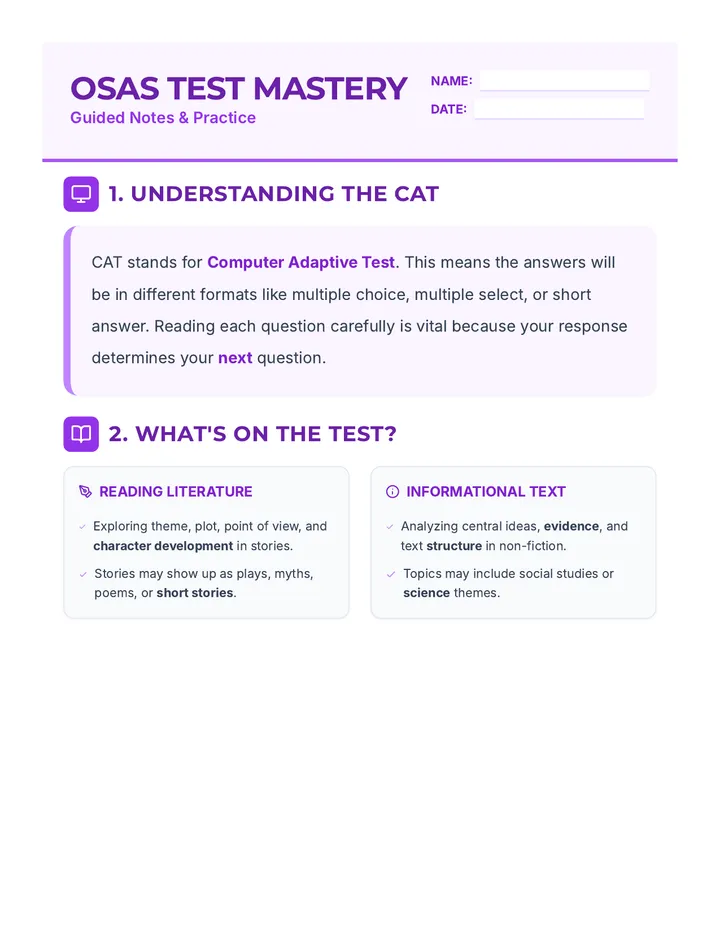
A comprehensive 6th grade ELA test preparation lesson covering OSAS strategies, question types, and performance tasks.

CG

Candace Ghelfi

2