Master Curriculum Roadmap Guide Curriculum & Pacing Guide
Word Cartography: 7th Grade
Daily 30-Minute Gap-Closing Intervention aligned to Lowman Study Sheet & TMS Pacing Calendar
Pacing: 36 Weeks (4 Nine Weeks) 30 Minutes Daily / 100% STAAR Aligned
Lowman Alignment & Gap Closing Philosophy
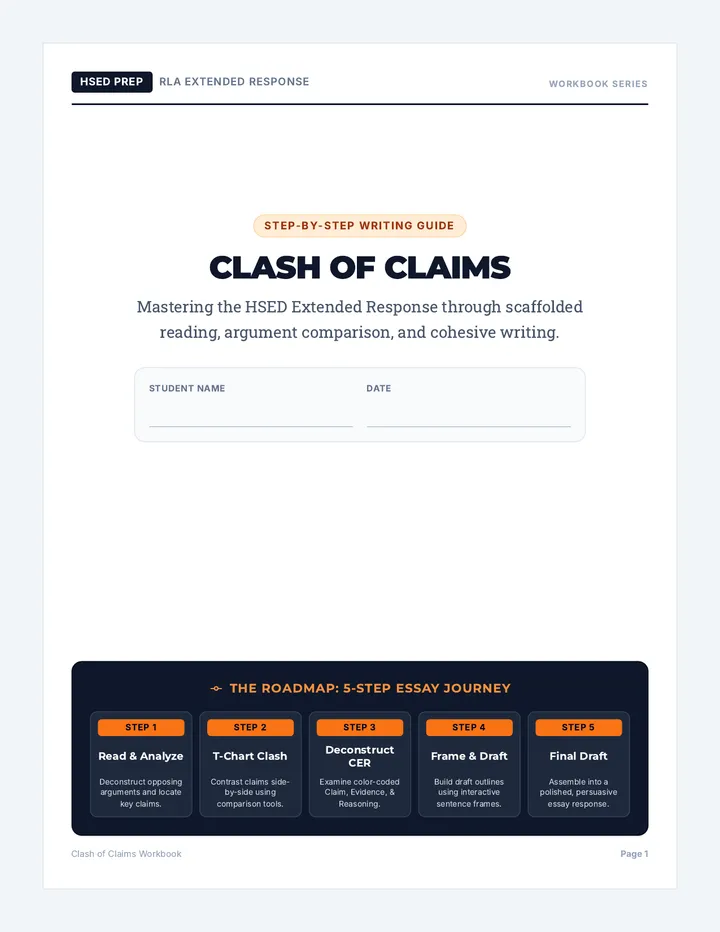
This intervention curriculum targets critical seventh-grade reading, vocabulary, and writing skills to systematically close achievement gaps. Built upon the **Lowman Education Study Sheet** framework and the **2025-2026 TMS Pacing Calendar**, each 30-minute lesson connects vocabulary acquisition (affixes, roots, and context clues) with genre elements, text structure analysis, and evidence-based constructed responses.
The Daily 30-Minute Engine
01 Word Explorer
5 Mins: Foundational skills warm-up focusing on word parts (prefixes, suffixes, roots) or reference resources.
02 Mini-Lesson
10 Mins: Direct modeling of targeted Lowman skills (e.g., plot elements, informational features, or text structures).
03 Active Map
10 Mins: Collaborative analysis of short, high-leverage literary or informational texts.
04 Quiz/Check
5 Mins: Daily progress check to capture student mastery and direct immediately next-day support.
Weekly Structural Pathway
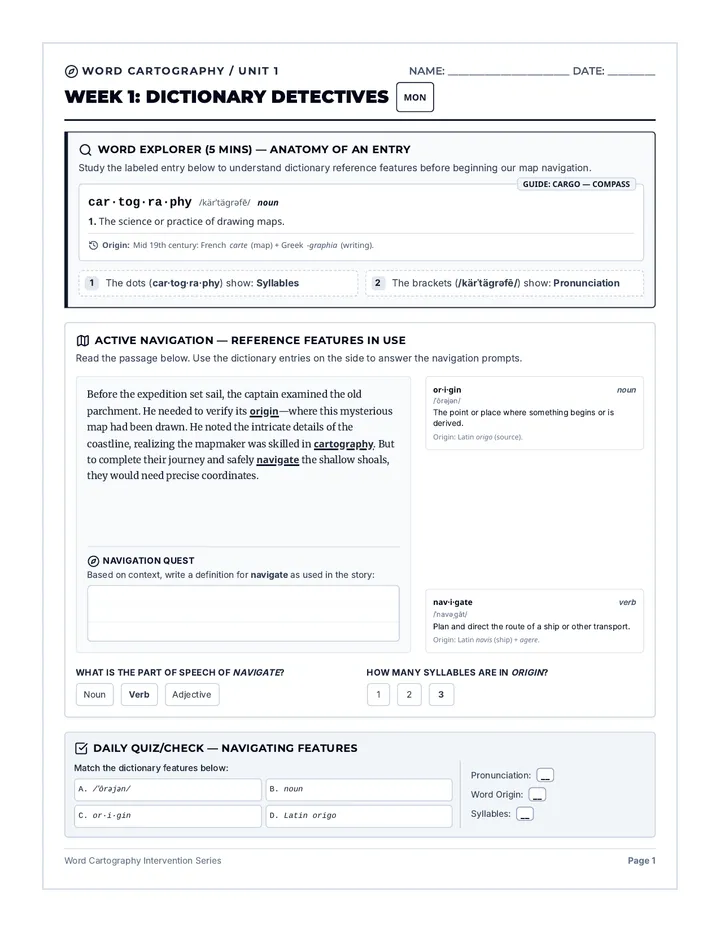
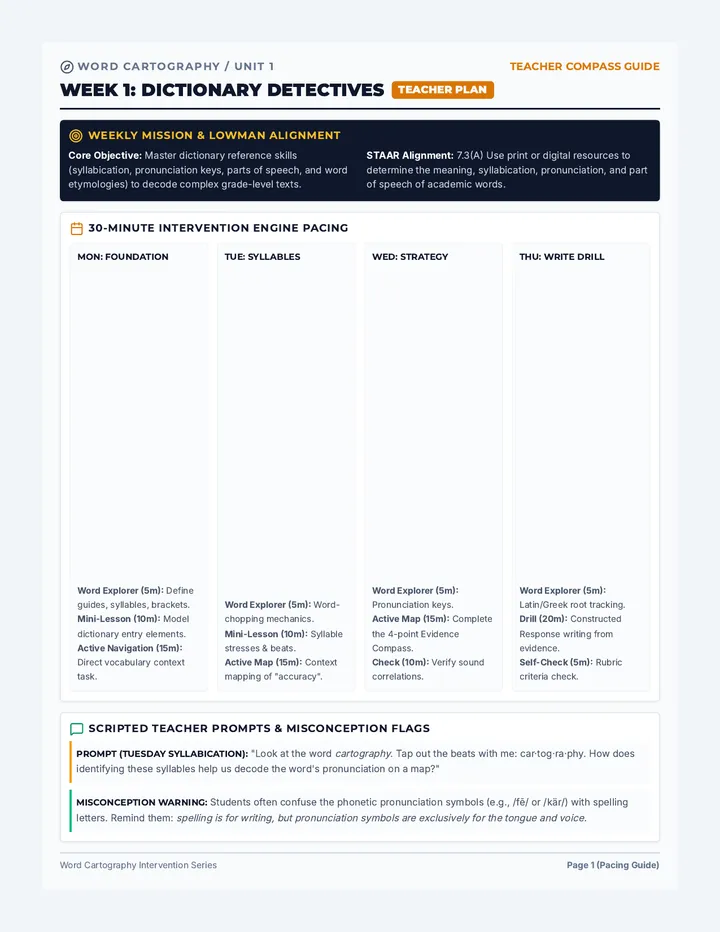
Mon: Foundational Vocabulary & Word Parts (Lowman list).
Tue: Reading Comprehension Mini-Lesson & Active Navigation.
Wed: Applied Strategy: Close reading analysis of text evidence.
Thu: Constructed Response Drill (Short or Extended Essay).
Fri: Weekly Quiz Day (10-minute check on weekly target skills).
Continuous Progress Monitoring
Zero High-Stakes CBAs: High-stress benchmark assessments are removed in favor of consistent, short weekly quizzes.
Weekly Quizzes: Completed every Friday to measure target spelling, roots, context clues, and comprehension.
Immediate Data Loop: Quiz results immediately guide Monday's Word Explorer adjustments.
Self-Mapping Tracker: Students plot their own weekly quiz scores inside their Cartography Binder.
The Six TMS Pacing Units
Unit 1: Literacy Essentials
Weeks 1 - 3 (10 Days) | 1st Qtr
Reference resources, dictionary definitions, and the 4-Step Compass. Evaluated via weekly Quizzes 1-3.
Unit 2A: Fiction & Narrative
Weeks 4 - 9 (18 Days) | 1st Qtr
Plot, characterization, theme, narrative nonfiction. Evaluated via weekly Quizzes 4-9.
Unit 2B: Drama & Poetry
Weeks 10 - 12 (15 Days) | 2nd Qtr
Meter, graphical structures, dialogue, and stage directions. Evaluated via weekly Quizzes 10-12.
Unit 3: Informational Texts
Weeks 13 - 18 (28 Days) | 2nd Qtr
Thesis, organizational patterns (cause/effect), and expository writing. Evaluated via weekly Quizzes 13-18.
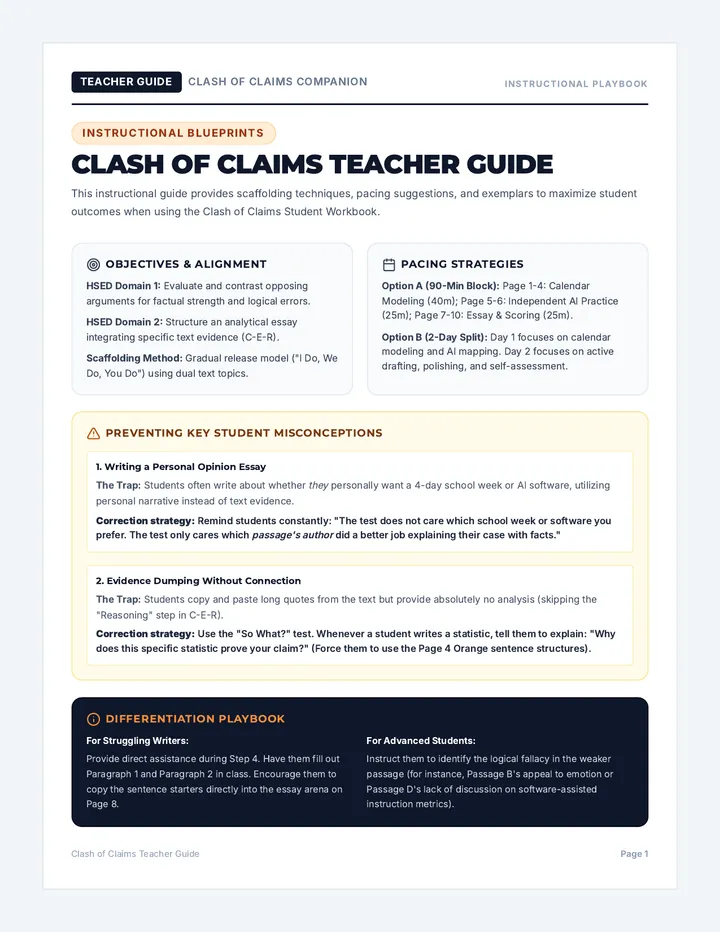
Unit 4: Argumentative Texts
Weeks 19 - 23 (25 Days) | 3rd Qtr
Claims, supporting evidence, and rhetorical devices. Evaluated via weekly Quizzes 19-23.
Unit 5 & 6: Cross-Genre & Rev
Weeks 24 - 36 | 3rd & 4th Qtr
Dual selection connections, STAAR reviews, and final synthesis. Evaluated via weekly Quizzes 24-36.
Word Cartography Intervention Series Page 1 of 3
Detailed Roadmap: Semester 1 (Weeks 1 – 18)
Integrating TMS Units 1, 2A, 2B, and 3 with Lowman study guide terms and consistent Friday quizzes.
1st & 2nd Nine Weeks
First Nine Weeks: Foundational Literacy & Narrative
Week Unit Focus (TMS) Lowman Study Sheet Alignment (Vocabulary & Mechanics) Weekly Friday Quiz Target 1 Classroom Procedures Dictionary reference features (Syllabication, Pronunciation, Part of Speech, Origin) Quiz 1: Resources & Syllabus Clues 2 Unit 1: Essentials Prefixes: pre-, mis-, over-, mid- Suffix: -ment 3 Unit 1: Essentials Prefixes: dis-, non-, in-, ir- Roots: auto, graph, gen 4 Unit 2A: Fiction Prefixes: sub-, under-, fore- Suffixes: -ity/-ty, -ible/-able 5 Unit 2A: Fiction Prefixes: trans-, super-, anti- Roots: bene, loc, man/manu 6 Unit 2A: Narrative Prefixes: inter-, semi-, de-, pre- Suffixes: -al/-ial, -ic 7 Unit 2A: Narrative Roots: dic/dict, scrib/script, jur/jus Suffix: -ous/-eous/-ious 8 Unit 2A: Assessment Latin Root: motive ("move/motion") Editing: Pronouns & verb tenses 9 Unit 2A & 1st Nine Weeks Cumulative Vocabulary Mastery Drills Quiz 9: 1st Nine Weeks Cumulative Quiz
Second Nine Weeks: Drama, Poetry, & Informational
Week Unit Focus (TMS) Lowman Study Sheet Alignment (Vocabulary & Mechanics) Weekly Friday Quiz Target 10 Unit 2B: Drama Roots: mis/mit, omni Suffix: -ive 11 Unit 2B: Poetry Roots: luc, photo Root: translucent 12 Unit 2B: Assessment Roots: sens/senti, log/logue Editing: Semicolons & commas in series 13 Unit 3A: Informational Roots: vis/vid, geo, meter Organization: definition, chronological 14 Unit 3A: Informational Roots: phil/phile, vac Latin Root: accumulate 15 Unit 3B: Comp & Gram Editing: Commonly confused terms (its/it's, affect/effect, there/their/they're) Quiz 15: Confused Words & Summarizing Texts 16 Unit 3B: Comp & Gram Editing: Conjunctive adverbs (CAs) and semicolon punctuation rules Quiz 16: Conjunctive Adverbs & Writing Intros 17 Unit 3: Assessment Editing: Capitalization (historical events, titles) & spelling checklists Quiz 17: Spelling, Capitalization, & Essay Drafting 18 Unit 3 Informational Content Synthesis & Editing Checklist Mastery Quiz 18: Semester 1 Cumulative Quiz
Word Cartography Intervention Series Page 2 of 3
Detailed Roadmap: Semester 2 (Weeks 19 – 36)
Integrating TMS Units 4, 5, and 6 with Lowman study guide terms and consistent Friday quizzes.
3rd & 4th Nine Weeks
Third Nine Weeks: Rhetorical, Argumentative, & Connections
Week Unit Focus (TMS) Lowman Study Sheet Alignment (Vocabulary & Mechanics) Weekly Friday Quiz Target 19 Unit 4A: Argument Claim, target audience, and types of supporting evidence: logical, empirical, anecdotal Quiz 19: Argument Claims & Evidence types 20 Unit 4A: Argument Rhetorical structures: counterargument, concession, rebuttal Bias, loaded language 21 Unit 4B: Comp/Gram Writing: Strong introductions, thesis statement construction, transitions Quiz 21: Argumentative Thesis & Transitions 22 Unit 4B: Comp/Gram Editing: Subordinating & correlative conjunctions (AAAWWUBBIS, either/or) Quiz 22: Coordinating & Correlative Conjunctions 23 Unit 4: Assessment Logical Fallacies: sweeping generalizations, hyperbole, stereotyping Quiz 23: Logical Fallacies & Argument Structure 24 Unit 5: Connections Lowman Connections strategy: locating text similarities and differences Quiz 24: Dual Selections Connections 25 Unit 5: Connections Author's Craft: imagery, figurative language, tone comparisons Quiz 25: Tone, Imagery, & Author's Craft 26 Unit 5: Assessment Editing: Prepositional phrase checks and subject-verb agreement Quiz 26: Prepositional Agreement & Short Answers 27 Unit 5 Synthesis Unit 5 & 3rd Nine Weeks Cumulative Vocabulary Mastery Drills Quiz 27: 3rd Nine Weeks Cumulative Quiz
Fourth Nine Weeks: Testing Window & Synthesis Projects
Week Unit Focus (TMS) Lowman Study Sheet Alignment (Vocabulary & Mechanics) Weekly Friday Quiz Target 28 STAAR Review (Mar 23) Cumulative vocab: affixes/roots review, dictionary search drills Quiz 28: STAAR Word Parts Practice 29 STAAR Review (Mar 30) Revising & Editing: combining sentences, correcting unclear pronouns Quiz 29: STAAR Revising & Editing Practice 30 STAAR Window (Apr 6) Self-monitoring stress strategies, testing focus, daily confidence check Quiz 30: Stress-Free Strategy Reflection 31 STAAR Window (Apr 13) Post-test growth logs & academic goal-setting for Unit 6 Quiz 31: STAAR Reflection & Skill Translation 32 Unit 6: Synthesis (Apr 20) Primary vs. secondary source research terms, crediting creators Quiz 32: Research Sources Identification 33 Unit 6: Synthesis (Apr 27) Sentence clarity, combining techniques, and text structures Quiz 33: Infographics & Combined Sentences 34 Unit 6: Synthesis (May 4) Oral presentation vocabulary & direct address rhetoric Quiz 34: Media Bias & Presentation Prep 35 Unit 6: Synthesis (May 11) Peer review mechanics editing checklist Quiz 35: Editing Conventions & Final Check 36 End-of-Year (May 18) End-of-Year Portfolio Showcase & Final Growth Review Map Quiz 36: Final Growth Map Quiz
Word Cartography Intervention Series Page 3 of 3
Pioneer Launch Slides Word Cartography
Session 1.1
7th Grade Intervention Launch
Welcome, Word
Cartographers
We are not just memorizing words. We are mapping the terrain of reading, unlocking complex ideas, and taking charge of our academic future.
Topic: Mapping Unknown Words Slide 1 of 5
Word Cartography
The Mission
Why Vocabulary
Changes Everything
In 7th grade, informational texts (like science, social studies, and news) are packed with academic words.
If you don't know the words, the passage feels like an unmapped wilderness. Knowing them turns you into an explorer.
85,000+ Words
The size of the academic vocabulary gap we are closing together this school year.
30 Minutes Daily
Focused, daily training is all it takes to build master-level reading navigation.
Topic: Empowering Readers Slide 2 of 5
Word Cartography
Our Strategy
The Four-Step Compass Strategy
Four ways authors hide the meanings of hard words right in the text
N
Definition
The author defines the word right after using it.
Look for: "is called", "or"
E
Synonym
The author uses an easier word with the same meaning.
Look for: "similar to", "also"
S
Antonym
The author pairs the hard word with its direct opposite.
Look for: "however", "unlike"
W
Example
The author provides concrete clues to show the word in action.
Look for: "such as", "like"
Topic: Context Clues Method Slide 3 of 5
Word Cartography
Active Practice
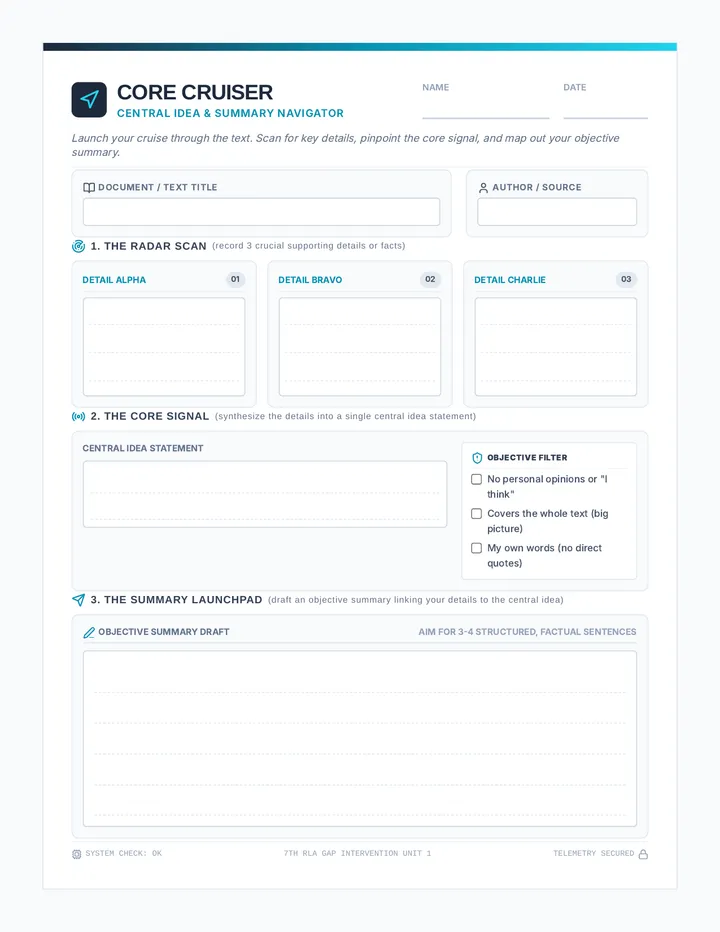
Expedition Challenge: Can We Decode It?
Expedition Passage
"The explorer’s path was formidable; it was incredibly difficult to navigate, with sheer cliffs and sudden blizzards blocking progress."
Find the step that unlocks the meaning of formidable .
Mapping the Clues
1
The unknown word is formidable .
2
The text says: "incredibly difficult to navigate" .
3
This is a Definition Clue (North).
Formidable = Very challenging or difficult to overcome.
Compass Strategy Guide Anchor Chart & Strategy Cheat-Sheet
The Four-Step Compass
Your visual guide to unlocking unknown academic vocabulary in complex texts.
Name: ______________________
Date: ______________________
Navigating the Wilderness of Words
Authors leave built-in context clues around difficult words. Use this compass to scan the sentence for clues!
North (N) Step 1
Definition Clues
The author directly explains or defines the meaning of the difficult word immediately after introducing it in the sentence.
Signal Words to Spot
is defined as, is, means, refers to, which is, or
Real Example
"The tundra, or a vast, treeless arctic region, is frozen for most of the year."
East (E) Step 2
Synonym Clues
The author repeats the general idea of the difficult word using a simpler, more familiar word with a similar meaning nearby.
Signal Words to Spot
also known as, like, similar to, in other words, that is
Real Example
"The general issued a solemn decree; in other words, his formal order was very serious."
South (S) Step 3
Antonym Clues
The author pairs the difficult word with its direct opposite. By identifying what the word is NOT, you can figure out what it is.
Signal Words to Spot
but, however, unlike, in contrast, on the other hand, although
Real Example
"Unlike his brother who was incredibly talkative, Mark was highly laconic."
West (W) Step 4
Example Clues
The author lists real-world, concrete examples of the difficult word in action, allowing you to synthesize its common features.
Signal Words to Spot
such as, for example, including, like, specifically, to illustrate
Real Example
"The room was filled with memorabilia, including old baseball gloves, vintage posters, and concert tickets."
Cartographer's Pro-Tip: The Substitution Check
Once you think you have mapped the meaning of the difficult word using a compass direction, substitute your simplified meaning back into the sentence. If the sentence still makes complete sense, you have mapped the word accurately!
Word Cartography Intervention Series Strategy Anchor Chart: Level 7 RLA
Pioneer Baseline Worksheet Diagnostic Baseline Check
Pioneer Baseline Worksheet
Establishing your starting vocabulary and informational reading compass.
Name: ______________________
Date: ______________________
Instructions for Students
This diagnostic helps us map what you already know about words and texts. Read each question carefully. Try your best on every section—this is our launching point!
Section 1: Context Clue Navigation
8 points
1. "The arid desert landscape was completely barren; not a single plant, tree, or patch of grass could survive in the parched, dry soil."
Based on the context clues, what is the meaning of the word barren ?
A Overflowing with fresh resources and water
B Empty, dry, and unable to support life
C Extremely cold and covered in layers of snow
D Full of active and moving desert animals
2. "Although Clara’s brother was normally extremely gregarious, Clara herself preferred to stay quiet and avoid crowds."
Which context clue direction (N, E, S, W) is used here, and what does gregarious mean?
A North (Definition) – Meaning quiet and reserved
B East (Synonym) – Meaning highly intelligent
C South (Antonym) – Meaning highly social and outgoing
D West (Example) – Meaning afraid of the dark
Section 2: Morphological Roots
6 points
Match each common Latin/Greek root or prefix below to its correct meaning by writing the corresponding letter.
_____ 1. Pre- (Prefix)
_____ 2. -ject (Root)
_____ 3. Chron (Root)
A. Time (e.g., chronological)
B. Before / Earlier (e.g., prefix)
C. To throw (e.g., eject, reject)
Word Cartography Baseline Assessment Page 1 of 2
Section 3: Informational Passage Analysis
Read the science text below to answer the evidence and synthesis questions.
10 points
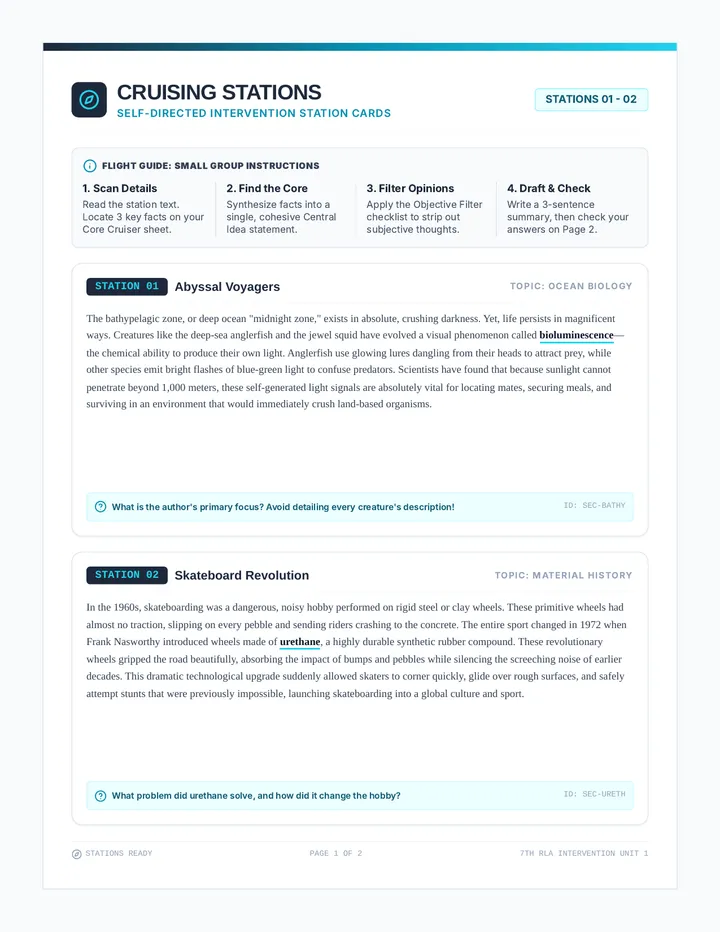
Passage: The Subterranean Pioneers
Life in the Abyssal Void
Deep within the Mariana Trench lies an ecosystem that seems completely inhospitable to life. In this abyssal void, there is absolutely zero sunlight, and the water pressure is high enough to crush a steel submarine. Scientists initially believed this deep ocean floor was completely devoid of living organisms, meaning it was entirely empty and lacking any forms of biology.
However, expeditions discovered bizarre bacterial colonies clustered around hydrothermal vents. These deep-sea vents spew hot, toxic sulfur directly into the ocean. Instead of relying on sunlight for energy—as surface plants do through photosynthesis—these unique bacteria use a process called chemosynthesis. They convert toxic chemical sulfur into vital nutrients. This discovery completely transformed our biological maps, showing that life is incredibly resilient.