Atlas Prologue Slides Literary Fiction Unit
Lesson 1: Deep Reading & Characterization
Grade 6-8 ELA
Chapter 1: The Copper Binding
The Whispering Atlas
Unlocking character traits, unspoken motives, and the mysteries of setting in coastal fiction.
STEAL Character Traits
Atmospheric Setting
Text-Based Evidence
Analytical Framework
How Authors Show Character (S.T.E.A.L.)
S
Speech
What does the character say? Tone, dialect, vocabulary, and pauses reveal priorities.
T
Thoughts
What internal fears, desires, or doubts does the character keep hidden from others?
E
Effect
How do surrounding characters react, step back, or change when this person enters?
A
Actions
What physical choices does the character make under sudden stress or temptation?
L
Looks
Expression, posture, clothing wear, and gear show their role and background.
Key Insight: Great authors rarely state "Maya was careful." They prove it through ink-stained fingertips, hesitation before locked doors, and double-checking latch gears.
World-Building Analysis
Setting as a Living Character
Story Excerpt
"The rain did not merely fall over Oakhaven Point; it gnawed at the salt-gray shingles. Inside grandfather's tower archive, the air tasted of dried cedar, damp hemp, and sleeping iron."
Notice sensory details: sound of rain, smell of cedar, taste of salt air.
Sensory Immersion
Grounds the reader immediately using multi-sensory descriptions (smell, touch, sound).
Mood & Foreshadowing
Words like gnawed and sleeping iron warn us that danger is awakening nearby.
Question: How does the stormy coastal tower shape the siblings' sense of urgency?
Character Foil & Dynamics
Maya vs. Bram: Opposing Forces
Maya Vance (13)
The Thinker
Apprentice Archivist: Observant, patient, meticulous.Core Motivation: Wants to understand mechanisms and protect history.Fatal Flaw: Hesitation and paralysis caused by fear of failure.
Bram Vance (11)
The Catalyst
Restless Explorer: Intuitive, courageous, impatient.Core Motivation: Craves discovery and proving his bravery.Fatal Flaw: Impulsiveness; touches objects before testing traps.
Literary Concept: When two opposite characters contrast each other's traits, they are called character foils .
Active Reading Mission
Today's Investigation Protocol
1
First Read: Flow
Read Chapter 1 passage silently. Track the central discovery of the copper-bound atlas and compass.
2
Second Read: Evidence
Highlight Maya's decisions in yellow. Underline setting clues about the coastal storm in blue.
3
Synthesize & Defend
Complete the Character Detective Worksheet. Quote exact phrases from the text to justify your claims.
Ready your pencils and highlighters. Let's enter the tower.
Open Character Detective Worksheet
Character Detective Worksheet The Whispering Atlas
Chapter 1: The Copper Binding • Literary Analysis
Name: ___________________
Date: _____________
Class: ___________________
Score: _____ / 25
Directions: Read the story passage carefully. Annotate as you read: underline descriptions of the stormy setting, and bracket [ ] moments where Maya and Bram react differently to danger.
[1] The storm did not merely fall over Oakhaven Point; it gnawed at the salt-gray shingles like a living beast. Inside the grandfather’s third-floor archive, the air tasted of dried cedar shavings, damp hemp rigging, and slumbering iron. Maya Vance held her breath, adjusting the brass collar of the lantern. At thirteen, she had memorized every creaking floorboard between the map table and the storm-shutters, knowing which ones groaned underfoot and which kept silent counsel.
[2] “There is nothing here except moldy ledger books, Maya,” her eleven-year-old brother Bram muttered, dragging the toe of his scuffed leather boot against the floorboards. He spun a brass plumb bob on its twine string, letting it swing inches from an inkwell. “Grandfather went to the harbor master three hours ago. If we’re caught up here—”
[3] “Catch the bob before it shatters the well,” Maya whispered sharply, not turning around. Her fingers worked delicately along the underside of the mahogany cabinet. “Grandfather didn't hide his journal in the ledgers. He hid it where the damp wouldn’t penetrate. Look at the timber grain here; the corner joint is false.”
[4] A faint click echoed through the drafty tower. A recessed drawer slid forward three inches. Inside rested an oblong folio bound not in calfskin or vellum, but in hammered copper, greened with sea-tarnish. Fastened around its girth was a lock shaped like a six-pointed star, cold and unyielding. Beside it lay a bronze pocket compass whose needle did not point north, but trembled toward the southwest cliffs—straight toward the forbidden Whispering Caverns.
[5] Bram lunged forward, hand outstretched. “Let me see it!”
[6] “Stop!” Maya blocked his arm with her notebook, heart hammering against her ribs. She studied the lock’s tiny interlocking tumblers. “Look at the verdigris around the latch pins. If you force the clasp without setting the outer ring, the internal teeth will snap and jam permanently. We observe first. We understand the mechanism. Then we turn.”
Margin Annotation Checkpoint
1. Sensory Detail Circle: Circle two phrases in paragraph [1] that appeal to senses other than sight.
2. Contrast Note: In the margin next to paragraph [5-6], write one word that summarizes Bram's impulse and one word for Maya's reaction.
Page 1 of 2 • Continue to reverse for analytical tasks
Part II: Characterization & Textual Evidence
Character Detective Guide Teacher Guide & Answer Key
Educator Resource
Lesson 1: Characters & Cartography • Chapter 1 Analysis
Standards: CCSS.ELA-LITERACY.RL.6.1, RL.6.3, RL.7.1
Learning Objective: Students will infer character traits and values from dialogue and physical actions using the STEAL protocol, citing verbatim textual evidence and explaining the symbolic function of setting.
Task 1: STEAL Matrix Exemplar Key
Maya Vance (Meticulous / Cautious / Analytical):
Evidence: Memorized creaking floorboards (par. 1); inspects wood grain of false joint (par. 3); warns against forcing lock pins (par. 6).Priority: Preservation, precision, understanding danger before acting.
Bram Vance (Impulsive / Daring / Restless):
Evidence: Scuffs boots, swings plumb bob recklessly (par. 2); lunges to snatch folio immediately (par. 5).Priority: Immediate sensory excitement, thrill of discovery, chafes at rules.
Task 2: Setting Analysis Key
Correct Answer: C
Rationale: The personification of the storm “gnawing like a living beast” introduces tension and vulnerability, establishing an ominous, foreboding mood rather than coziness or security.
Task 3: Scoring Guide (8 Pts)
Claim (2 pts): Interprets philosophy (deliberation over impulse).
Evidence (3 pts): Cites floorboards, wood grain, or lock pins.
Reasoning (3 pts): Explains how method protects them from danger.
Classroom Debrief Prompts (Socratic Seminar)
Pacing & Tension: How does Bram's swinging plumb bob function as a visual metaphor for the ticking clock and rising danger in the archive?Foil Dynamics: Why do narrative authors pair cautious intellectuals (Maya) with impulsive explorers (Bram)? Which character would survive longer alone?
The Whispering Atlas • Lesson 1 Educator Facilitation Guide Single-Page Reference Key
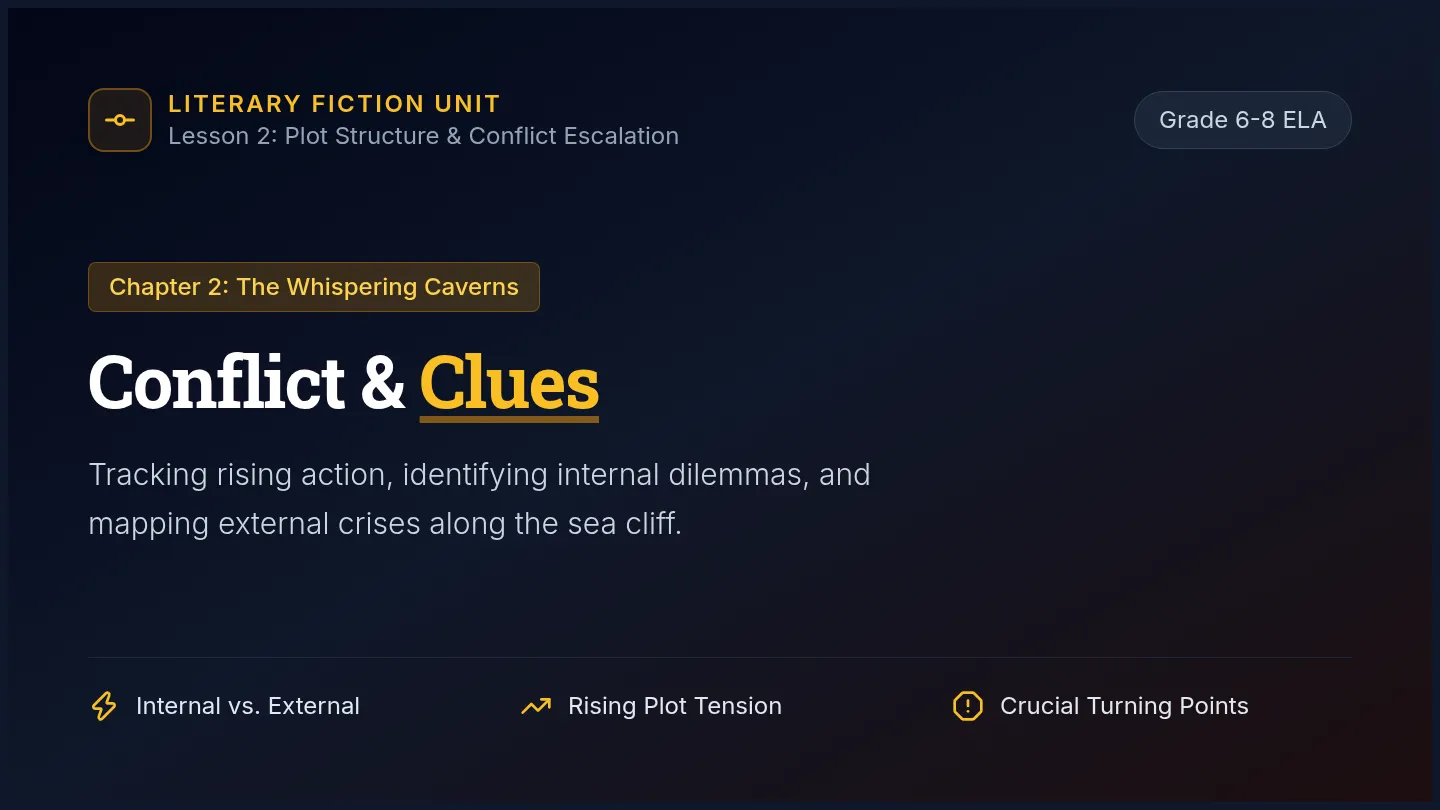
Plot Tension Slides Literary Fiction Unit
Lesson 2: Plot Structure & Conflict Escalation
Grade 6-8 ELA
Chapter 2: The Whispering Caverns
Conflict & Clues
Tracking rising action, identifying internal dilemmas, and mapping external crises along the sea cliff.
Internal vs. External
Rising Plot Tension
Crucial Turning Points
Narrative Architecture
The Anatomy of Literary Conflict
Internal
Character vs. Self
The battle takes place inside the character's heart or mind: fear, guilt, pride, moral doubt, or indecision.
Story Example: Maya’s fear of making a mistake versus her need to take charge and trust her instincts.
External
Character vs. Outside World
The protagonist struggles against nature, other characters, ancient mechanisms, or societal constraints.
Story Example: Sinking tides, crashing sea swells in the caverns, and Bram’s refusal to follow safety rules.
Golden Rule: External conflicts test characters, but internal conflicts define who they become.
Plot Mechanics
The Rising Action Pressure Cooker
Step 1
Inciting Spark
The compass needle spins toward the forbidden coastal cavern, forcing a decision.
Step 2
First Barrier
The tide rushes into the lower cavern faster than expected, cutting off the safe retreat path.
Step 3
Escalation
Bram reaches for a bronze prism; his reckless step triggers a rockfall that traps his ankle.
Step 4
The Crossroads
Water rises to Bram's knees. Maya must drop the fragile atlas or find a way to free him in seconds.
Notice how each complication raises the stakes: from curiosity to lost exit, to physical peril, to life-or-death choice!
Detective Strategy
How to Chart Narrative Tension
Identify the Goal
What does each character desperately want at the start of the scene? (e.g., Bram wants the prism; Maya wants caution).
Spot the Obstacle
What physical or psychological barrier blocks that goal? Name the conflict type precisely.
Examine the Cost
What must the protagonist sacrifice or change about themselves to survive the crisis?
Ready to examine Chapter 2? Pay close attention to how the tide controls the clock.
Open Conflict Crossroads Worksheet
Conflict Crossroads Worksheet The Whispering Atlas
Chapter 2: The Rising Tide • Conflict & Plot Tension
Name: ___________________
Date: _____________
Class: ___________________
Score: _____ / 25
Directions: Read Chapter 2 below. As you read, write [INT] next to lines showing Maya's inner doubts, and [EXT] next to lines where nature or physical obstacles threaten the siblings.
[7] The cavern did not welcome them; it hissed. Cold seawater churned against the black basalt pillars of the sea-cave, foaming into emerald froth around Maya’s shins. Bram was already six paces ahead, holding their backup carbide lamp high. Above them, the cavern roof tapered into a vault dripping with ancient salt-icicles that chimed like crystal in the sea wind.
[8] “Bram, wait!” Maya pleaded, tucking the heavy copper-bound atlas tighter beneath her oilcloth jacket. The bronze compass needle was spinning in frantic half-circles now, reacting to the mineral veins running through the damp stone walls. “The tide table in grandfather’s log said high water wasn’t until sundown, but the wind is driving the surf in early. Look at the waterline on that shelf!”
[9] “Look at the pedestal!” Bram shouted back, his voice echoing off the wet ceiling. At the center of an elevated rock ledge sat a triangular bronze prism, polished to a mirror gleam. “The compass brought us straight to it! We just grab it and run before the water cuts the ledge off!”
[10] “Don’t touch it!” Maya’s cry came an instant too late. Bram scrambled up the slick slope of shale and gripped the prism. The moment he lifted it from its cradle, a sickening grinding sound shuddered through the rock floor. A support keystone above the ledge broke free with the sound of a pistol crack.
[11] Bram leaped back, but the falling slab struck the shale ledge, pinning his left boot beneath a massive wedge of slate. “Maya! My foot—it’s wedged! It won't budge!” His bravado evaporated, replaced by raw panic as a wave surged through the lower arch, flooding the chamber to his knees.
[12] Maya froze. Her mind raced through calculations: the slab weighed at least two hundred pounds; her arms lacked the leverage alone; and the water was rising three inches every minute. To reach him, she would have to set down the fragile copper folio into the salt surf, likely destroying grandfather's irreplaceable living map forever. For three agonizing seconds, terror clamped her throat like a vise.
Conflict Identification Checkpoint
1. External Obstacle: In paragraph [11], what two physical forces combine to threaten Bram's life?
2. Internal Dilemma: In paragraph [12], what painful choice creates Maya's inner crisis?
Page 1 of 2 • Continue to reverse for analytical tasks
Conflict Crossroads Guide Teacher Guide & Answer Key
Educator Resource
Lesson 2: Conflict & Clues • Chapter 2 Plot Mechanics
Standards: CCSS.ELA-LITERACY.RL.6.3, RL.6.5, RL.7.3
Learning Objective: Students will track how rising action complications amplify tension, categorize internal vs. external conflicts, and analyze how an author structures pivotal dilemmas to reveal character values.
Task 1: Rising Action Plot Arc Key
Complication 1 (Nature): Early high tide driven by wind cuts off the planned escape route before they can safely explore the cavern (par. 8).
Complication 2 (Flaw): Bram grabs the bronze prism without checking for pressure traps, triggering a ceiling collapse that pins his foot under shale (par. 10-11).
Crisis Peak (Dilemma): Maya faces an agonizing trade-off: hold grandfather's precious folio or drop it in saltwater to free her drowning brother (par. 12).
Task 2: Conflict Exemplars
Character vs. Nature: Seawater foaming around shins and rising three inches every minute. Forces urgency.
Character vs. Self: Maya’s paralyzing terror clamped like a vise; choosing between book preservation and human life.
Task 3: Multiple Choice Rationale
Correct Answer: B
Rationale: Precise quantitative rates like “three inches every minute” function as a narrative clock, intensifying the emotional pressure on both Maya and the reader.
Task 4: Analytical Prediction Exemplar
Exemplar Student Response: Maya will choose to drop or risk the atlas to save Bram. Although she deeply reveres grandfather's historical records (spending hours preserving ledgers and studying clockwork latches in Chapter 1), her protective instinct over Bram has already been shown when she leaped between him and the false cabinet. Her core identity is a problem solver, not a bystander; her love for family will ultimately outweigh archival caution.
Facilitation Question for Close Reading
Prompt: “If Bram had listened to Maya’s warning in paragraph 10, would they still have found whatever secret the cavern holds? Does Bram’s recklessness speed up discovery or threaten catastrophe?”
The Whispering Atlas • Lesson 2 Educator Facilitation Guide Single-Page Reference Key
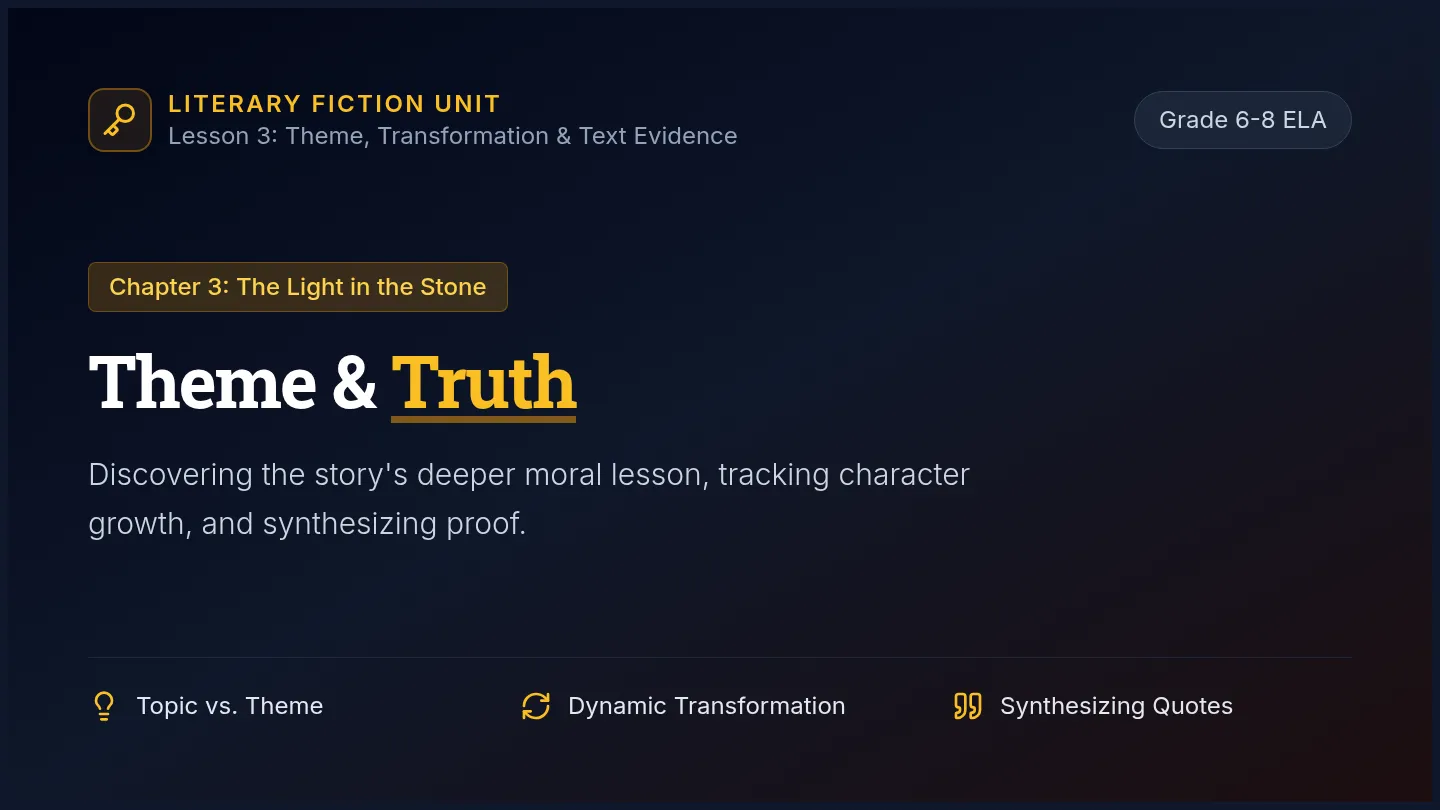
Theme Hunter Slides Literary Fiction Unit
Lesson 3: Theme, Transformation & Text Evidence
Grade 6-8 ELA
Chapter 3: The Light in the Stone
Theme & Truth
Discovering the story's deeper moral lesson, tracking character growth, and synthesizing proof.
Topic vs. Theme
Dynamic Transformation
Synthesizing Quotes
Critical Distinction
Topic is One Word. Theme is a Statement.
Not Just a Topic
A topic is merely the general subject the story touches on:
Courage Knowledge Family
Too broad! It doesn't express what the author argues about that subject.
Thematic Statement
A full complete sentence stating a universal human truth:
“True wisdom is not hoarding knowledge in dark archives, but using it boldly to protect the people we love.”
Answers: What does Maya's journey prove to all human beings?
Formula: [Topic] + [Author’s argument about how characters respond] = Universal Theme.
Character Evolution
How Character Arcs Reveal Theme
Beginning (Chapter 1)
Maya the Cautious Observer
Relies on rules, books, and staying hidden.
Paralyzed by the thought of damaging old relics.
Climax & Ending (Chapter 3)
Maya the Decisive Leader
Sacrifices the folio's pristine copper cover.
Uses mechanism knowledge as a tool to save her brother.
The gap between who Maya was in Chapter 1 and who she becomes in Chapter 3 is where the theme lives .
Culminating Challenge
Thematic Evidence Synthesis
1
Read Climax
Witness how Maya uses the copper folio to pry the stone and align the beam of light.
2
Select Evidence
Locate two quotes: one from the beginning and one from the resolution that prove her growth.
3
Construct Claim
Write a formal analytical paragraph defending the story’s central theme using CER structure.
Turn to the final chapter excerpt. Let's uncover the secret of the light.
Open Thematic Evidence Worksheet
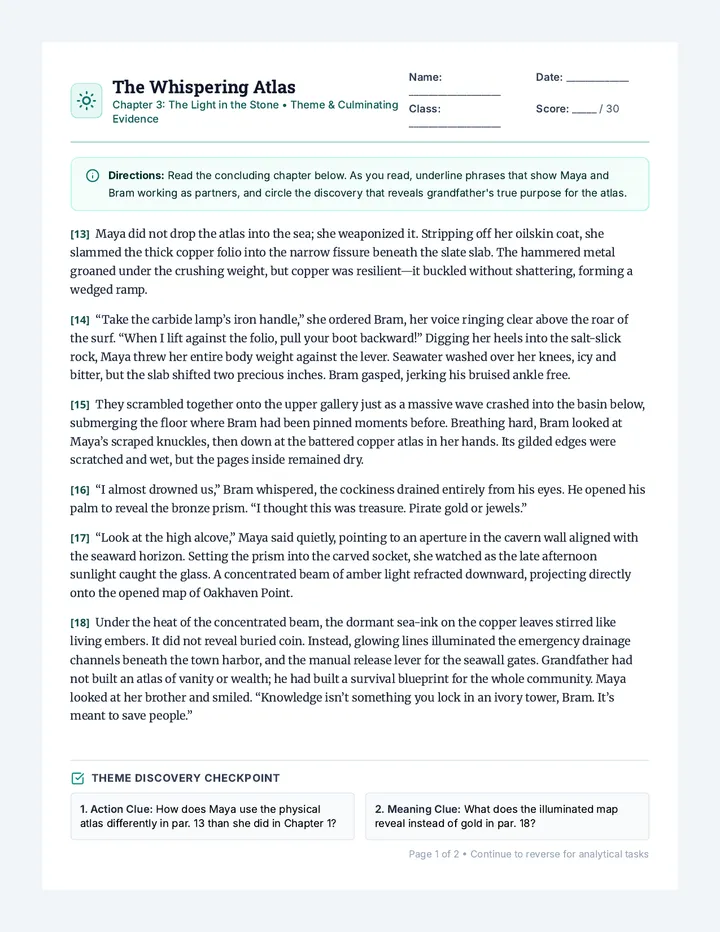
Thematic Evidence Worksheet The Whispering Atlas
Chapter 3: The Light in the Stone • Theme & Culminating Evidence
Name: ___________________
Date: _____________
Class: ___________________
Score: _____ / 30
Directions: Read the concluding chapter below. As you read, underline phrases that show Maya and Bram working as partners, and circle the discovery that reveals grandfather's true purpose for the atlas.
[13] Maya did not drop the atlas into the sea; she weaponized it. Stripping off her oilskin coat, she slammed the thick copper folio into the narrow fissure beneath the slate slab. The hammered metal groaned under the crushing weight, but copper was resilient—it buckled without shattering, forming a wedged ramp.
[14] “Take the carbide lamp’s iron handle,” she ordered Bram, her voice ringing clear above the roar of the surf. “When I lift against the folio, pull your boot backward!” Digging her heels into the salt-slick rock, Maya threw her entire body weight against the lever. Seawater washed over her knees, icy and bitter, but the slab shifted two precious inches. Bram gasped, jerking his bruised ankle free.
[15] They scrambled together onto the upper gallery just as a massive wave crashed into the basin below, submerging the floor where Bram had been pinned moments before. Breathing hard, Bram looked at Maya’s scraped knuckles, then down at the battered copper atlas in her hands. Its gilded edges were scratched and wet, but the pages inside remained dry.
[16] “I almost drowned us,” Bram whispered, the cockiness drained entirely from his eyes. He opened his palm to reveal the bronze prism. “I thought this was treasure. Pirate gold or jewels.”
[17] “Look at the high alcove,” Maya said quietly, pointing to an aperture in the cavern wall aligned with the seaward horizon. Setting the prism into the carved socket, she watched as the late afternoon sunlight caught the glass. A concentrated beam of amber light refracted downward, projecting directly onto the opened map of Oakhaven Point.
[18] Under the heat of the concentrated beam, the dormant sea-ink on the copper leaves stirred like living embers. It did not reveal buried coin. Instead, glowing lines illuminated the emergency drainage channels beneath the town harbor, and the manual release lever for the seawall gates. Grandfather had not built an atlas of vanity or wealth; he had built a survival blueprint for the whole community. Maya looked at her brother and smiled. “Knowledge isn’t something you lock in an ivory tower, Bram. It’s meant to save people.”
Theme Discovery Checkpoint
1. Action Clue: How does Maya use the physical atlas differently in par. 13 than she did in Chapter 1?
2. Meaning Clue: What does the illuminated map reveal instead of gold in par. 18?
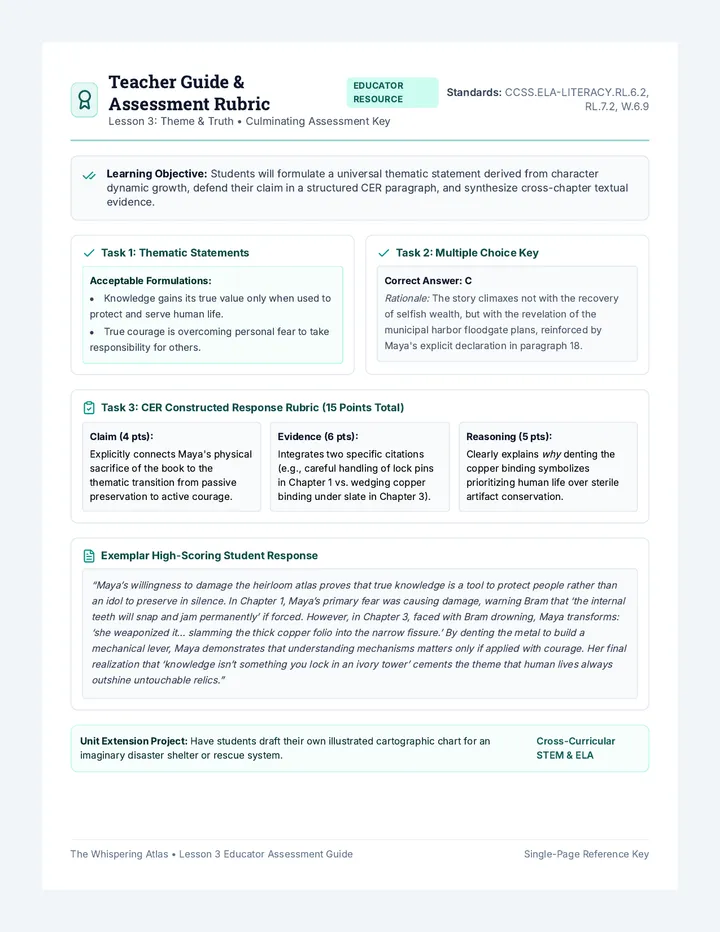
Thematic Evidence Guide Teacher Guide & Assessment Rubric
Educator Resource
Lesson 3: Theme & Truth • Culminating Assessment Key
Standards: CCSS.ELA-LITERACY.RL.6.2, RL.7.2, W.6.9
Learning Objective: Students will formulate a universal thematic statement derived from character dynamic growth, defend their claim in a structured CER paragraph, and synthesize cross-chapter textual evidence.
Task 1: Thematic Statements
Acceptable Formulations:
Knowledge gains its true value only when used to protect and serve human life.
True courage is overcoming personal fear to take responsibility for others.
Task 2: Multiple Choice Key
Correct Answer: C
Rationale: The story climaxes not with the recovery of selfish wealth, but with the revelation of the municipal harbor floodgate plans, reinforced by Maya's explicit declaration in paragraph 18.
Task 3: CER Constructed Response Rubric (15 Points Total)
Claim (4 pts): Explicitly connects Maya's physical sacrifice of the book to the thematic transition from passive preservation to active courage.
Evidence (6 pts): Integrates two specific citations (e.g., careful handling of lock pins in Chapter 1 vs. wedging copper binding under slate in Chapter 3).
Reasoning (5 pts): Clearly explains why denting the copper binding symbolizes prioritizing human life over sterile artifact conservation.
Exemplar High-Scoring Student Response
“Maya’s willingness to damage the heirloom atlas proves that true knowledge is a tool to protect people rather than an idol to preserve in silence. In Chapter 1, Maya’s primary fear was causing damage, warning Bram that ‘the internal teeth will snap and jam permanently’ if forced. However, in Chapter 3, faced with Bram drowning, Maya transforms: ‘she weaponized it... slamming the thick copper folio into the narrow fissure.’ By denting the metal to build a mechanical lever, Maya demonstrates that understanding mechanisms matters only if applied with courage. Her final realization that ‘knowledge isn’t something you lock in an ivory tower’ cements the theme that human lives always outshine untouchable relics.”
Unit Extension Project: Have students draft their own illustrated cartographic chart for an imaginary disaster shelter or rescue system. Cross-Curricular STEM & ELA
The Whispering Atlas • Lesson 3 Educator Assessment Guide Single-Page Reference Key