Basecamp Setup Slides Lesson 1 • 4th Grade Literacy
Story Mountain Quest
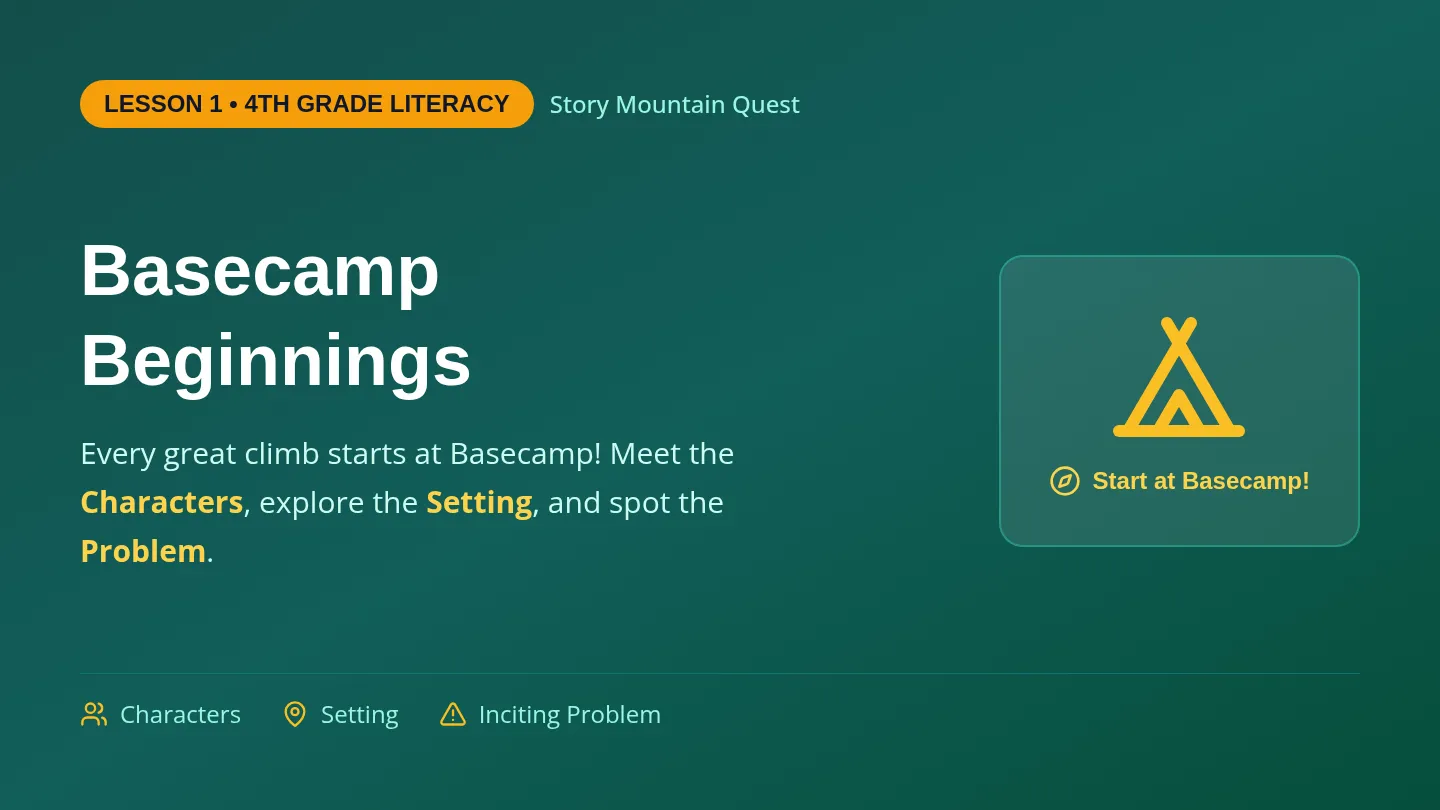
Basecamp Beginnings
Every great climb starts at Basecamp! Meet the Characters, explore the Setting, and spot the Problem.
Start at Basecamp!
Characters
Setting
Inciting Problem
Today's Basecamp Goal
Learning Target
"I can identify the characters, setting, and main problem at the beginning of a story."
WHO?
Characters
WHERE & WHEN?
Setting
WHAT GOES WRONG?
The Problem
Packing Your Gear: Characters & Setting
Characters
The people, animals, or creatures who take action in the story.
Ask: Who is this story mostly about?
Setting
Where and when the story takes place (like a rainy Tuesday at school).
Ask: Where are they, and what time is it?
The Spark That Starts the Climb
The Problem
Without a problem, the story stays flat at Basecamp! The problem is the challenge that forces the character to start climbing Plot Mountain.
Detective Tip: Look for words like "suddenly," "oh no," "missing," or "broken."
Let's Scout Basecamp!
Guided Practice
The Locked Treehouse
On a sunny Saturday morning, twins Zoe and Sam climbed up to their backyard treehouse with a plate of blueberry muffins. When Zoe tugged on the wooden door, it would not budge! The rusty padlock had clicked shut, and the only key was sitting inside on the floor.
Turn & Talk: Who are the characters, what is the setting, and what is the problem?
Basecamp Scouted!
Ready to Climb
Characters
Twins Zoe and Sam
Setting
Backyard treehouse on a sunny Saturday morning
The Problem
The door is padlocked, and the key is trapped inside!
Next Up: Your Turn on the Basecamp Detective Worksheet!
Basecamp Detective Worksheet Basecamp Beginnings
Lesson 1 • 4th Grade Literacy Worksheet
Name: _______________________ Date: ____________
Characters (Who?)
The people or animals in the story.
Setting (Where/When?)
The place and time the story happens.
Problem (What's Wrong?)
The challenge that starts the adventure.
The Missing Lunchbox Mystery
Read Carefully
On a chilly Monday morning in October, Mateo and his best friend Priya walked into Oakwood Elementary School's noisy cafeteria. The lunch bell would not ring for three hours, so students were setting their backpacks along the brick wall before heading to homeroom.
Mateo unhooked his bright green dinosaur lunchbox to double-check that his mom had packed his favorite apple slices. Just then, his teacher waved him over to help carry a stack of library books. Mateo set his lunchbox on the bench for one minute. When he turned back around, the green lunchbox had vanished! Only a trail of shiny silver stickers led toward the hallway door.
Part 1 Circle the best answer for each question.
1. Who are the main characters introduced in this story?
A. Mateo and his mom
B. Mateo and his best friend Priya
C. Priya and the school librarian
D. Only Mateo's homeroom teacher
2. What is the setting of the story?
A. A sunny park on Saturday afternoon
B. Mateo's kitchen on Friday night
C. Oakwood Elementary's cafeteria on a chilly Monday morning
D. The school bus after dismissal
3. What is the inciting problem that starts the climb?
A. Mateo has to carry heavy library books.
B. The lunch bell will not ring for three hours.
C. Mateo's green dinosaur lunchbox vanishes from the bench.
D. The cafeteria is too noisy before homeroom.
Basecamp Beginnings — Page 2
Name: _______________________
Part 2 Pack Your Basecamp Backpack
Use details from "The Missing Lunchbox Mystery" to fill in each Basecamp box.
1. Characters (Who is in the story?):
2. Setting (Where AND when does the story happen?):
3. The Problem (What goes wrong at the end of the passage?):
Part 3 Look Ahead Up the Mountain!
What do you think Mateo and Priya will do next to start solving the mystery? Write 2 sentences.
Basecamp Teacher Guide Basecamp Teacher Guide
Lesson 1 • 4th Grade Replacement Literacy • 45 Minutes
Educator Resource
Learning Objective
Students will identify the characters , setting , and inciting problem (Exposition) in a short narrative and explain how the problem launches the plot.
Materials Needed
Basecamp Setup Slides
Basecamp Detective Worksheet
3-color highlighters
45-Minute Pacing Plan
Time
Lesson Segment
Teacher Actions & Student Engagement
0–5 min
Warm-Up (Slides 1–2)
Introduce the Plot Mountain unit. Explain that before hikers climb a mountain, they pack at Basecamp.
5–15 min
Explicit Teach (Slides 3–4)
Teach Characters (Who), Setting (Where & When), and Problem (The Spark). Emphasize that setting includes BOTH place and time.
15–25 min
Guided Practice (Slides 5–6)
Read "The Locked Treehouse" aloud. Students Turn & Talk to name characters, setting, and problem before checking Slide 6.
25–40 min
Independent Work (Worksheet)
Read "The Missing Lunchbox Mystery" together once for fluency, then let students complete Parts 1–3 independently or in pairs.
40–45 min
Wrap-Up
Share 2–3 predictions from Part 3 and preview Lesson 2: climbing up the Rising Action!
Replacement Scaffolds
Color-Coding: Highlight Characters in green, Setting in blue, and the Problem in yellow before answering Part 2.Sentence Starters: "The main characters are..." / "The story takes place at ___ during ___."
Common Misconceptions
Forgetting "When": Students often name the place (cafeteria) but forget the time (chilly Monday morning in October).Minor Details as Problem: Remind students that a noisy room is a detail—the vanishing lunchbox is the story problem.
Bridge to Lesson 2: Save students' Part 3 predictions to compare with how Rising Action works in Lesson 2!
Basecamp Worksheet Answer Key
Reference for "The Missing Lunchbox Mystery"
Part 1: Multiple Choice
1. B — Mateo and his best friend Priya
Both are introduced right at the start walking into the cafeteria.
2. C — Oakwood Elementary's cafeteria on a chilly Monday morning
Includes both the place (cafeteria) and time (chilly Monday morning in October).
3. C — Mateo's green dinosaur lunchbox vanishes from the bench.
This is the main problem that sparks the mystery.
Part 2: Pack Your Basecamp Backpack (Sample Responses)
1. Characters
Mateo, his best friend Priya, and his teacher.
2. Setting
Oakwood Elementary School's noisy cafeteria on a chilly Monday morning in October (before homeroom).
3. The Problem
Mateo sets his green dinosaur lunchbox on the bench to help his teacher, and when he turns back, it is gone—leaving only a trail of silver stickers.
Part 3: Look Ahead Up the Mountain! (Look-Fors)
Accept any logical 2-sentence prediction that follows the sticker trail clue (e.g., "Mateo and Priya will follow the shiny silver stickers out into the hallway. They will check near the lockers or lost-and-found to see who took the lunchbox." ).
Story Peak Slides 4th Grade Literacy
Story Structure Expedition
Plot Mountain Explorers
Discover how Rising Action, Climax, and Falling Action power every great story.
Climb the Story!
Rising Action
Climax
Falling Action
Today's Expedition Goal
Learning Target
"I can identify the rising action, climax, and falling action in a story and explain how they build the plot."
The 5 Stops on Plot Mountain
1 Beginning Meet characters
2 Rising Action The climb
3 Climax The summit
4 Falling Action The descent
5 Ending Problem solved
Stop 2: The Climb
Rising Action
The events where the problem grows bigger and the characters face challenges on their way to the top.
Clue 1
Obstacles pop up and make things harder.
Clue 2
Excitement and suspense keep building up.
Clue 3
Characters try different ways to fix the problem.
Stop 3: The Summit
Climax
The biggest turning point of the story! It is the most exciting moment when the character faces the main problem head-on.
Clue 1
Your heart beats fastest—maximum tension!
Clue 2
A big choice or action changes everything.
Clue 3
Usually happens near the end, not the very last line.
Stop 4: The Descent
Falling Action
The events that happen right after the climax. The tension calms down and loose ends start to tie up.
Clue 1
The big rush or danger is now over.
Clue 2
Characters react to what just happened.
Clue 3
Leads smoothly into the final ending.
Let's Climb Together!
Guided Practice
The Science Fair Volcano
Jaden carried his baking-soda volcano into the gym for the science fair. Suddenly, his shoe slipped on a wet spot, and the volcano tipped sideways! Jaden lunged forward and caught the cardboard cone just one inch above the floor before it could smash. Everyone nearby gasped and then cheered. Jaden set his volcano safely on the display table and wiped the sweat from his forehead.
Turn & Talk: Which sentence is the Rising Action, Climax, and Falling Action?
The Science Fair Volcano: Mapped!
Check Our Climb
Rising Action
Jaden's shoe slips on a wet spot, and his volcano tips sideways!
The problem starts!
Climax
Jaden lunges forward and catches the volcano one inch above the floor!
Biggest turning point!
Falling Action
Everyone cheers, and Jaden sets his volcano safely on the table.
Tension calms down!
Next Up: Your Turn on the Plot Mountain Worksheet!
Plot Mountain Worksheet Plot Mountain Explorers
4th Grade Literacy Worksheet
Name: _______________________ Date: ____________
Rising Action
Events where the problem grows bigger and suspense builds.
Climax
The biggest turning point and most exciting moment.
Falling Action
Events right after the climax as tension calms down.
Maya's Missing Sketchbook
Read Carefully
After school on Friday, Maya zipped her backpack and hurried toward the front doors. She could not wait to show her grandma her new sketchbook full of bird drawings. Halfway down the hall, Maya reached into her bag to check on it—and froze. The sketchbook was gone!
Maya dashed back to the art room and checked under every table, but it was not there. Dark rain clouds were gathering outside, and the afternoon buses would leave in five minutes. Her heart pounded as she sprinted out to the courtyard, scanning the benches. Then, she spotted a bright blue corner sticking out from under a bench near the curb—right as Bus 14 rolled up and opened its doors!
Maya raced across the wet sidewalk, dove down to grab the sketchbook before the wind could blow it into a puddle, and sprinted onto the bus just before the doors hissed shut. She collapsed into a seat, wiped a few raindrops off the cover with her sleeve, and flipped it open. Every single bird drawing was safe and dry. Maya smiled and leaned back for the ride home.
Part 1 Circle the best answer for each question.
1. Which event is part of the rising action?
A. Maya wants to show her grandma her drawings.
B. Maya searches the art room and courtyard as time runs out.
C. Maya wipes raindrops off the cover on the bus.
D. Maya smiles and leans back for the ride home.
2. What is the climax (biggest turning point) of the story?
A. Maya zips her backpack after school on Friday.
B. Dark rain clouds gather in the sky outside.
C. Maya grabs the sketchbook and makes it onto Bus 14 just in time.
D. Maya checks under every table in the art room.
3. Which event belongs in the falling action?
A. Maya wipes off the cover and sees her drawings are safe.
B. Maya notices her sketchbook is missing in the hallway.
C. Bus 14 pulls up to the curb outside school.
D. Maya sprints out to the courtyard to look at the benches.
Plot Mountain Explorers — Page 2
Name: _______________________
Part 2 Map Maya's Plot Mountain
Write 1–2 complete sentences in each box to explain what happens in each part of the story.
1. Rising Action (What problem happens, and how does the worry build?)
2. Climax (What is the most exciting turning point?)
3. Falling Action (What happens right after the climax to calm things down?)
Part 3 You Are the Author! Finish the Plot
Story Starter (Rising Action): Leo's bright red kite got tangled in the high branches of an oak tree at the park. The wind began to blow harder, and the string started to slip from his hands...
Write the Climax (1–2 sentences: What exciting thing happens at the turning point?):
Write the Falling Action (1 sentence: What happens right after?):
Story Peak Teacher Guide Story Peak Teacher Guide
4th Grade Replacement Literacy • 45 Minutes
Educator Resource
Learning Objective
Students will identify the rising action , climax , and falling action in a short narrative and explain how each part moves the plot forward (aligned to CCSS RL.4.3).
Materials Needed
Story Peak Slides
Plot Mountain Worksheet
Highlighters (3 colors)
45-Minute Pacing Plan
Time
Lesson Segment
Teacher Actions & Student Engagement
0–5 min
Warm-Up (Slides 1–2)
Introduce the Plot Mountain metaphor. Ask: "What happens when you hike up a steep mountain, reach the top, and walk back down?" Connect to stories.
5–15 min
Explicit Teach (Slides 3–5)
Teach Rising Action, Climax, and Falling Action using the 3 detective clues on each slide. Have students use hand motions (climb up, peak, slide down).
15–25 min
Guided Practice (Slides 6–7)
Choral-read "The Science Fair Volcano." Use Turn & Talk to identify each part before revealing Slide 7.
25–40 min
Independent Work (Worksheet)
Read "Maya's Missing Sketchbook" (read aloud once for fluency support). Students complete Parts 1–3 while teacher circulates.
40–45 min
Wrap-Up & Share
Invite 2–3 students to read their Leo's Kite mini-climax from Part 3. Revisit the learning target.
Replacement / Intervention Scaffolds
Color-Coding: Have students underline Rising Action in green, Climax in orange, and Falling Action in blue before writing in Part 2.Sentence Frames: Post frames: "The problem grows when..." / "The turning point is when..." / "Right after, ..." Oral Rehearsal: Let emerging writers whisper-tell their Part 3 climax to a partner before writing.
Common Misconceptions
Climax = Beginning of Problem: Students often pick when the problem first appears. Remind them the climax is the biggest turning point near the end.Climax = Last Sentence: Emphasize that the climax happens before things calm down in the falling action.Skipping Falling Action: Show how stories need a "cool-down" step after the big moment.
Quick Check Tip: Ask students, "Could the story end right after this sentence?" If yes, they may have found the falling action or resolution—not the climax!
Worksheet Answer Key
Reference for "Maya's Missing Sketchbook" & Creative Prompt
Part 1: Multiple Choice
1. B — Maya searches the art room and courtyard as time runs out.
Explanation: Searching while rain clouds gather and buses are about to leave builds suspense (Rising Action).
2. C — Maya grabs the sketchbook and makes it onto Bus 14 just in time.
Explanation: This is the highest-tension turning point where the main problem is resolved.
3. A — Maya wipes off the cover and sees her drawings are safe.
Explanation: This happens right after the climax as the tension eases (Falling Action).
Part 2: Map Maya's Plot Mountain (Sample Responses)
1. Rising Action
Maya realizes her sketchbook is missing. She searches the art room and sprints to the courtyard as dark clouds gather and buses prepare to leave.
2. Climax
Maya spots the sketchbook under a bench, dives to grab it before the wind blows it into a puddle, and leaps onto Bus 14 right before the doors close.
3. Falling Action
Maya sits down on the bus, wipes the raindrops off the cover with her sleeve, and checks to see that all her bird drawings are safe and dry.
Part 3: You Are the Author! (Look-Fors & Sample)
Look-Fors: The Climax should show Leo taking a big action or facing the peak moment with the kite/wind. The Falling Action should show the immediate calm-down right after.
Sample Climax: Leo grabbed the string with both hands, planted his feet, and gave one mighty tug just as a gust of wind snapped the kite free from the branch! Sample Falling Action: Leo slowly reeled the kite back down to the grass and let out a big sigh of relief.
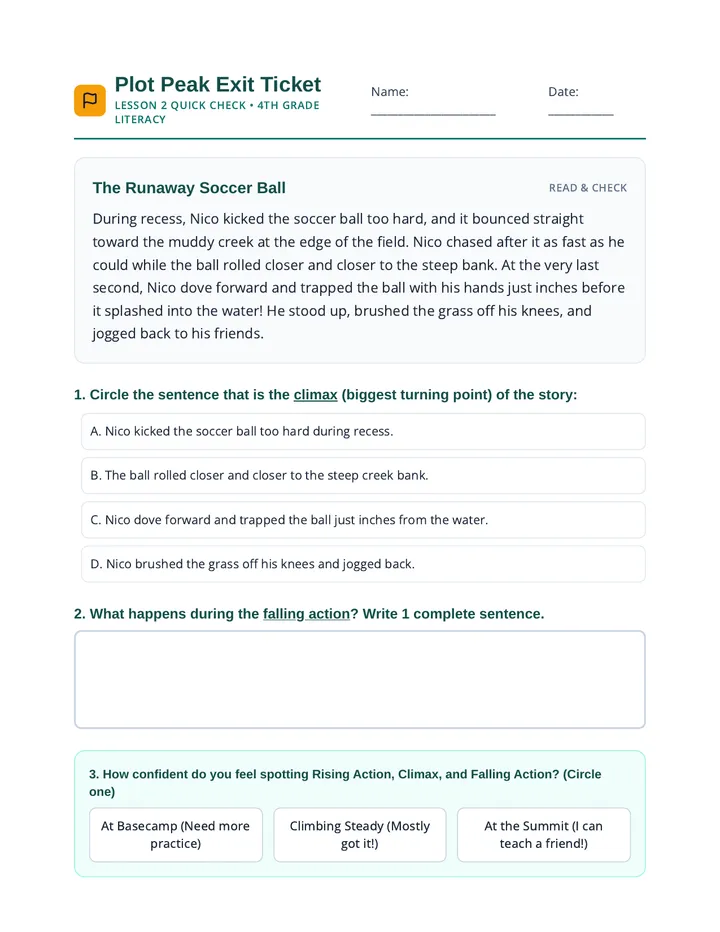
Plot Peak Exit Ticket Plot Peak Exit Ticket
Lesson 2 Quick Check • 4th Grade Literacy
Name: _______________________ Date: ____________
The Runaway Soccer Ball
Read & Check
During recess, Nico kicked the soccer ball too hard, and it bounced straight toward the muddy creek at the edge of the field. Nico chased after it as fast as he could while the ball rolled closer and closer to the steep bank. At the very last second, Nico dove forward and trapped the ball with his hands just inches before it splashed into the water! He stood up, brushed the grass off his knees, and jogged back to his friends.
1. Circle the sentence that is the climax (biggest turning point) of the story:
A. Nico kicked the soccer ball too hard during recess.
B. The ball rolled closer and closer to the steep creek bank.
C. Nico dove forward and trapped the ball just inches from the water.
D. Nico brushed the grass off his knees and jogged back.
2. What happens during the falling action? Write 1 complete sentence.
3. How confident do you feel spotting Rising Action, Climax, and Falling Action? (Circle one)
At Basecamp (Need more practice)
Climbing Steady (Mostly got it!)
At the Summit (I can teach a friend!)
Resolution Builders Slides Lesson 3 • 4th Grade Literacy
Story Mountain Quest
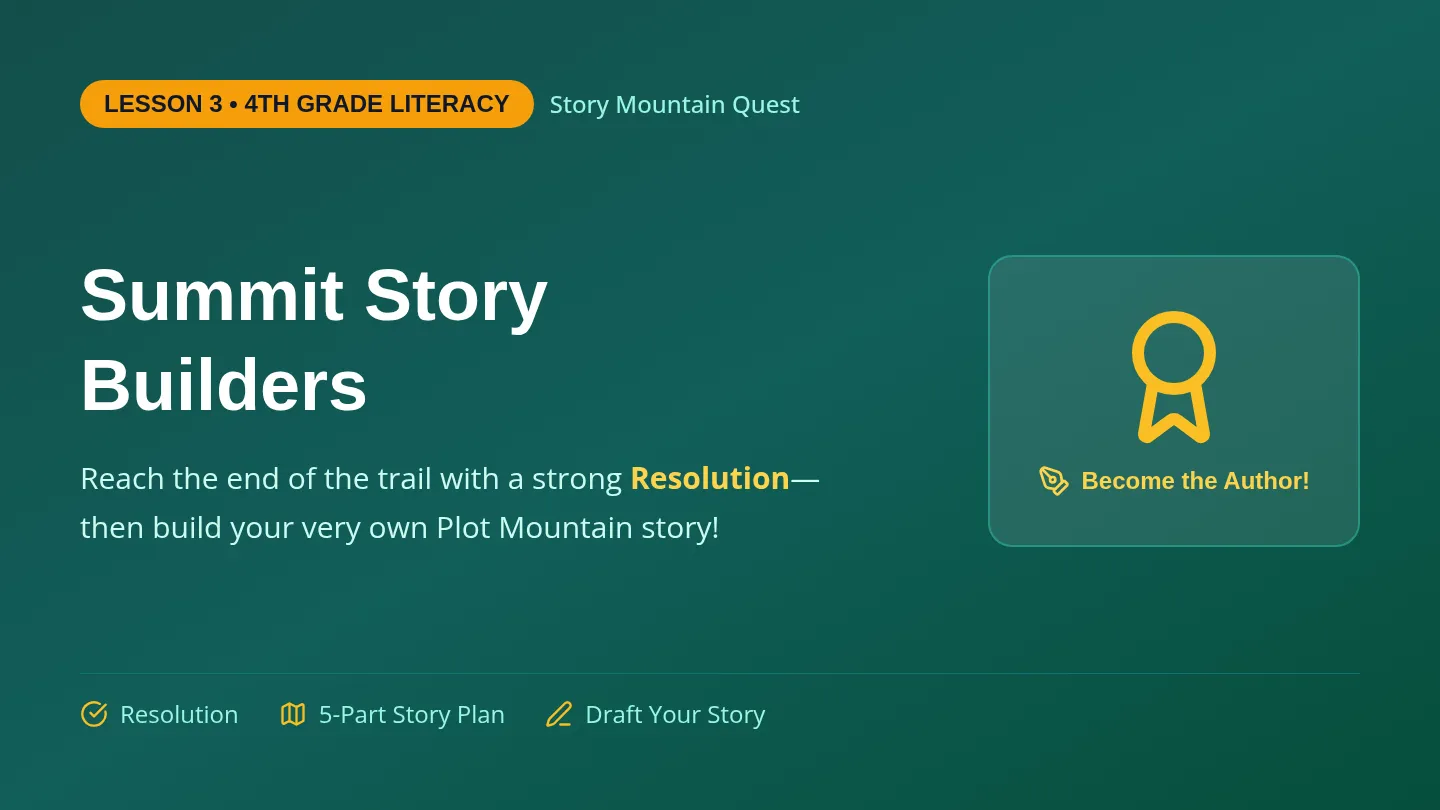
Summit Story Builders
Reach the end of the trail with a strong Resolution—then build your very own Plot Mountain story!
Become the Author!
Resolution
5-Part Story Plan
Draft Your Story
Today's Builder Goal
Learning Target
"I can write a clear resolution and plan an original story that includes all five parts of Plot Mountain."
First we learn how stories land safely at the end, then we plan and write!
Stop 5: End of the Trail
Resolution
The final ending of the story! The main problem is solved, and we see how the character feels or what they learned.
Strong Ending
"Mateo shared his apple slices with Priya and promised to keep his lunchbox zipped."
Too Sudden!
"He found it. The end."
Your 5-Part Story Checklist
1. Beginning
Who, where, when, & the problem
2. Rising Action
2–3 steps where worry grows
3. Climax
Biggest turning point!
4. Falling Action
Things calm down right after
5. Resolution
Problem solved & lesson/feeling
Great authors plan all 5 stops BEFORE they start writing!
Example Story Blueprint
Model Plan
Beginning: Mia & her puppy Max at the park; Max slips his leash!
Rising Action: Mia chases Max past the swings and toward the busy gate.
Climax: Mia squeaks Max's favorite duck toy, and Max skids to a stop at the gate!
Falling Action: Mia clips the leash back on and gives Max a big hug.
Resolution: They walk home safely, and Mia always checks the clasp twice now.
Author's Workshop Time!
Step 1: Plan (Page 1)
Fill in all 5 boxes on your Story Blueprint Worksheet using short notes.
Step 2: Write (Page 2)
Turn your plan into a complete 1-paragraph or 2-paragraph story!
Pick a character, set a problem, and climb Plot Mountain!
Story Blueprint Worksheet Summit Story Builders
Lesson 3 • Story Blueprint & Drafting
Name: _______________________ Date: ____________
Step 1: Plan all 5 parts of your original story below using short notes before you write your draft on Page 2.
1. Beginning / Basecamp (Characters, Setting, & Starting Problem):
2. Rising Action (2–3 events where the problem grows bigger):
3. Climax (The biggest turning point / most exciting moment):
4. Falling Action (What happens right after the climax?):
5. Resolution (How is the problem solved? How does the character feel?):
Step 2: Write Your Story
Name: _______________________
Story Title:
Author's Plot Mountain Self-Check (Check off each part after writing):
Beginning
Rising Action
Climax
Falling Action
Resolution
Summit Teacher Guide Summit Teacher Guide
Lesson 3 • 4th Grade Replacement Literacy • 45 Minutes
Educator Resource
Learning Objective
Students will craft a clear resolution and plan and draft a short original narrative that includes all five parts of Plot Mountain (aligned to CCSS W.4.3).
Materials Needed
Resolution Builders Slides
Story Blueprint Worksheet
Pencils & story starters
45-Minute Workshop Pacing Plan
Time
Lesson Segment
Teacher Actions & Student Engagement
0–10 min
Mini-Lesson (Slides 1–4)
Teach Resolution ("End of the Trail") and compare a strong ending vs. a sudden ending. Review the 5-part checklist.
10–15 min
Model Blueprint (Slide 5)
Walk through the Mia & Max example plan so students see that planning uses short notes, not full paragraphs.
15–25 min
Student Planning (Page 1)
Students complete all 5 boxes on Page 1 of the Story Blueprint Worksheet. Teacher checks Climax & Resolution before drafting.
25–40 min
Drafting & Conferencing (Page 2)
Students draft their stories on Page 2 and use the 5-part self-check at the bottom. Teacher holds 1-minute conferences.
40–45 min
Author's Chair
Celebrate 2–3 student authors reading their stories aloud; peers identify the Climax and Resolution they heard.
Replacement Scaffolds
Idea Bank: Offer 3 quick problems if a student gets stuck: lost pet, broken science project, or locked out before dinner. Transition Words: Post First, Next, Suddenly, After that, Finally to help students connect their 5 boxes into sentences.
1-Minute Conference Prompts
"Point to your Climax—what makes that the most exciting moment?" "How does your character feel in the Resolution?"
Unit Celebration: Display completed stories on a "Plot Mountain Trail" bulletin board!
4th Grade Story Structure Rubric
Quick Assessment for Story Blueprint Worksheet (Page 2 Draft)
Plot Element
3 — Summit Ready
2 — Climbing Steady
1 — At Basecamp
Beginning (Basecamp)
Clearly introduces character(s), setting (place & time), and a clear problem.
Includes character and problem, but setting is unclear or missing time/place.
Missing character, setting, or starting problem.
Rising Action
Includes 2+ connected events that build suspense toward the climax.
Includes 1 event between the problem and climax.
Jumps straight from the problem to the ending.
Climax
Features an exciting, unmistakable turning point where the problem is faced.
Turning point is present, but feels rushed or low-tension.
No clear turning point in the story.
Falling Action
Shows 1–2 events right after the climax as tension eases.
Briefly mentions what happens after, or blends into resolution.
Skips straight from climax to "The end."
Resolution
Solves the main problem and shows how the character feels or what they learned.
Solves the problem, but ends abruptly without character reaction.
Problem remains unsolved or story feels unfinished.
Scoring Tip for Replacement Literacy:
Focus feedback on plot completeness (all 5 stops present in order) before mechanics. A student who successfully moves from problem → rising action → climax → falling action → resolution has mastered the unit's core standard!