Little Pumpkin Homework Packet Level K • Self-Contained ELA
Little Pumpkin Homework
Name:
Date:
1
Night 1: Read & Annotate
Touch each dot to read. Then follow the color code!
Read 3 times: ★ ★ ★
The Big Orange Pumpkin
Follow the dots
I see a big pumpkin.
● ● ● ● ●
It sits in the patch.
● ● ● ● ●
It grows on a vine.
● ● ● ● ●
We can pick it up.
● ● ● ● ●
It is round and orange!
● ● ● ● ●
Crayon Annotation Mission
Yellow Circle
Find and circle the word the
Orange Box
Draw a box around the word pumpkin
★
Star Choice
Draw a star next to your favorite line
Check-In: What did we find in the patch?
🎃 A pumpkin
🍎 An apple
🌻 A flower
Self-Contained ELA • Level K Page 1 of 4 • Monday / Night 1
Level K • Self-Contained ELA
Little Pumpkin Homework
Name:
2
Night 2: Story Comprehension
Circle the right picture answer for each question.
Comprehension
1. What color is the pumpkin?
Orange
Blue
Purple
2. What does the pumpkin grow on?
🌿 A green vine
🌲 A tall pine tree
🚗 A big car
3. What shape is the pumpkin?
🟠 Round
📐 Triangle
4. Draw the big orange pumpkin sitting in the patch:
Self-Contained ELA • Level K Page 2 of 4 • Tuesday / Night 2
Level K • Self-Contained ELA
Little Pumpkin Homework
Name:
3
Night 3: Phonics & Word Power
Practice sight words and letter sounds from our story.
Word Skills
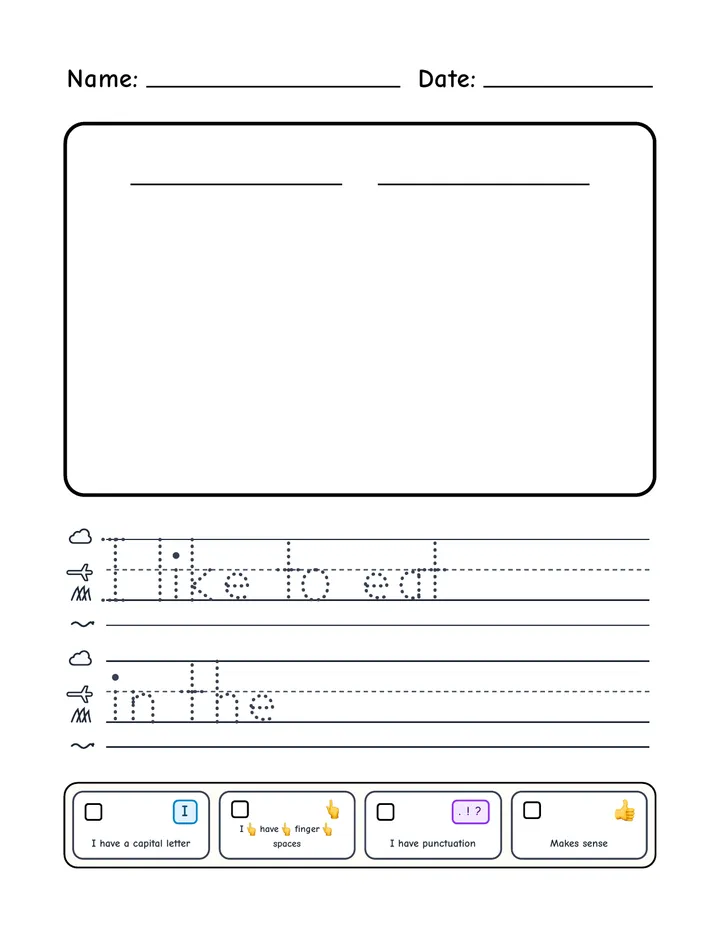
Part 1: Trace the Story Sight Words
Word 1
see
Say: "I see it"
Word 2
big
Say: "A big pumpkin"
Word 3
in
Say: "In the patch"
Part 2: Rhyme Connect
Draw a line to match the words that rhyme (end with the same sound):
pick
vine
round
line
kick
sound
Part 3: Tap the Sounds (Elkonin Boxes)
Say the word slowly. Write 1 letter in each sound box:
🐘 "big"
🪴 "pot"
Self-Contained ELA • Level K Page 3 of 4 • Wednesday / Night 3
Level K • Self-Contained ELA
Little Pumpkin Homework
Name:
4
Night 4: My Pumpkin Writing
Draw your favorite pumpkin in the patch and complete your sentence.
Drawing & Writing
Prompt: Draw a big orange pumpkin on a green vine in the patch.
3 Colors Details
Complete the Sentence:
Word Bank: orange vine patch
The pumpkin is
It sits in the
Student Self-Check:
How did this week feel?
😄 Easy 🙂 Just Right 🤔 Needed Help
Self-Contained ELA • Level K Page 4 of 4 • Thursday / Night 4
Pumpkin Secrets Homework Packet Level 2 • Self-Contained ELA
Pumpkin Secrets Homework
Name:
Date:
1
Night 1: Read & Annotate
Read the passage carefully, then complete the active reading marks.
Fluency Stars: ★ ★ ★
From Tiny Seed to Giant Pumpkin
Passage #1
[1] In the warm spring soil, a farmer plants a tiny flat seed. Warm sunlight and gentle rain help a green sprout push upward. Soon, long fuzzy vines stretch across the wide muddy field. Bright yellow blossoms open wide, inviting friendly bees to carry golden pollen.
[2] When the yellow flower drops off, a small green bump begins to swell. Day after day, it drinks water through its thick curly stem. As crisp autumn arrives, the heavy pumpkin turns a brilliant bright orange. Now, excited families visit the busy patch to harvest their favorite pumpkin!
Active Reading Annotation Guide
▢ Blue Box
Put a box around 2 action verbs showing how the pumpkin grows.
Green Line
Underline 3 things that help the plant grow (water, sun, etc.).
Orange Circle
Circle the word blossoms and write its meaning below.
🎃
Text Clue Quick Check:
What does the word blossom mean in paragraph 1?
Answer: A bright
Self-Contained ELA • Level 2 Page 1 of 4 • Monday / Night 1
Level 2 • Self-Contained ELA
Pumpkin Secrets Homework
Name:
2
Night 2: Comprehension & Text Clues
Use clues from the story to answer each question.
Text Clues
1. Why do bright yellow blossoms open wide on the pumpkin vines?
A To invite friendly bees to visit and carry pollen.
B To hide from the warm sunlight under the dirt.
C To scare away birds flying over the farm field.
2. Cause & Effect: Match each Cause with its Effect
Draw a line between the matching pairs:
Cause 1: Sunlight and gentle rain soak into the soil.
Cause 2: Crisp autumn weather arrives at the farm.
Effect A: The heavy green pumpkin turns bright orange.
Effect B: A tiny green sprout pushes upward.
3. Written Response with Text Evidence
What happens to the small green bump after the flower drops off?
Sentence Stem Helper:
"After the flower drops off, the bump begins to swell because..."
Self-Contained ELA • Level 2 Page 2 of 4 • Tuesday / Night 2
Level 2 • Self-Contained ELA
Pumpkin Secrets Homework
Name:
3
Night 3: Language & Vocabulary
Build compound words and practice action verbs from the story.
Language Skills
Part 1: Compound Words (Two words join together!)
Add the two smaller words together to create the compound word from the text:
sun + light =
out + side =
Part 2: Action Verbs in Action
Choose the best action verb from the word box to complete each sentence:
stretches swells harvest
1. The long fuzzy vine across the field.
2. The green bump as it drinks water.
3. Excited families their favorite pumpkins.
Part 3: Sentence Editor (Fix the 2 Mistakes!)
Find the missing capital letter and ending mark. Rewrite correctly:
a tiny seed grows into a big round pumpkin
Self-Contained ELA • Level 2 Page 3 of 4 • Wednesday / Night 3
Level 2 • Self-Contained ELA
Pumpkin Secrets Homework
Name:
4
Night 4: Guided Informational Writing
Write a short paragraph explaining how a pumpkin grows.
Structured Writing
Paragraph Frame & Guide:
Capital letter Text details Period .
Step 1 (Topic): Tell how a pumpkin begins in the spring soil.
Step 2 (Details): Describe the vines, flowers, and growing green bump.
Step 3 (Ending): Tell what happens when the pumpkin turns orange in autumn.
Topic Sentence: A pumpkin begins its life as a tiny...
Detail 1: First, sunlight and rain help the sprout grow long...
Detail 2: Next, yellow blossoms drop off and a green bump...
Conclusion: Finally, in crisp autumn, the big pumpkin turns...
Draw a pumpkin on a vine:
Caption Line:
Write one sentence describing your drawing:
Weekly Goal: I used neat handwriting: [ ] Yes [ ] Working on it
Self-Contained ELA • Level 2 Page 4 of 4 • Thursday / Night 4
Pumpkin Science Homework Packet Level 4 • Self-Contained ELA
Pumpkin Science Homework
Name:
Date:
1
Night 1: Read & Annotate
Read the informational passage carefully and mark key evidence.
Fluency Tracker: ★ ★ ★
The Amazing Science of Pumpkins
Informational Text
¶ 1 Although commonly called vegetables in the kitchen, botanists classify pumpkins as fruits because they develop from flowering blossoms and contain internal seeds. Originating thousands of years ago in the Americas, these resilient plants belong to the gourd family. They produce heavy, round fruit supported by trailing vines and broad green leaves.
¶ 2 The anatomical structure of a pumpkin is uniquely adapted for survival and reproduction. The tough outer rind, called the exocarp, serves as a protective armor that defends the fruit against hungry insects and rot. Inside, moist fibrous pulp holds hundreds of nutrient-rich seeds. Each seed is shielded by a hard outer coat, allowing it to stay dormant until moist spring soil triggers germination.
¶ 3 Pumpkins also provide important agricultural benefits to our ecosystem. Sprawling, umbrella-like leaves act as natural living mulch, shading the ground to trap soil moisture and prevent invasive weeds. Furthermore, pumpkin flowers produce sweet golden nectar that nourishes vital pollinator populations like honeybees and bumblebees.
Active Reading Annotation Protocol
[ ] Brackets
Put brackets around two pumpkin parts described in ¶ 2.
Underline
Underline why botanists classify pumpkins as fruits in ¶ 1.
★ Margin Star
Place a star next to the sentence describing how pumpkin leaves protect soil in ¶ 3.
Active Note: 6-Word Main Idea Summary
In 6 words or less, summarize why pumpkins are botanically fruits:
Self-Contained ELA • Level 4 Page 1 of 4 • Monday / Night 1
Level 4 • Self-Contained ELA
Pumpkin Science Homework
Name:
2
Night 2: Evidence & Comprehension
Answer each question by directly referencing evidence from the text.
Text Evidence
1. According to Paragraph 1, why do scientists classify pumpkins as fruits?
A Because they grow high on trees and taste sweet in baked pies.
B Because they develop from flowering blossoms and contain internal seeds.
C Because they require cold winter weather to grow roots under the ground.
2. Compare Pumpkin Structures: Rind vs. Seeds
Write one key fact from Paragraph 2 under each category:
Outer Rind / Exocarp (¶ 2)
How does the rind protect the fruit?
Internal Seeds (¶ 2)
What enables the seeds to survive until spring?
3. Short Constructed Response: Citing Direct Text Clues
How do the broad leaves of a pumpkin plant help protect the farm soil?
Sentence Stem: According to paragraph 3, the broad leaves protect soil by...
Self-Contained ELA • Level 4 Page 2 of 4 • Tuesday / Night 2
Level 4 • Self-Contained ELA
Pumpkin Science Homework
Name:
3
Night 3: Nouns & Adjectives
Identify naming words (nouns) and describing words (adjectives) from the story.
Grammar Focus
N Noun: A Person, Place, or Thing
Examples from text: pumpkin, rind, seed, flower
A Adjective: A Describing Word
Examples from text: tough, fibrous, broad, golden
Part 1: Sort the Words from the Passage
Write each word from the bank into the correct box:
pumpkin tough rind fibrous seed broad
Nouns (Things)
Adjectives (Describing Words)
Part 2: Match the Describing Word to the Noun it Describes
Draw a line connecting the adjective to the noun it describes in our story:
tough
fibrous
broad
leaves
rind
pulp
Part 3: Find Both in a Sentence
In each sentence below, circle the NOUN and draw a box around the ADJECTIVE :
1. The pumpkin has a tough rind for protection. [ 1 noun • 1 adjective ]
2. Honeybees drink golden nectar from the blossom. [ 1 noun • 1 adjective ]
Self-Contained ELA • Level 4 Page 3 of 4 • Wednesday / Night 3
Level 4 • Self-Contained ELA
Pumpkin Science Homework
Name:
4
Night 4: Evidence-Based Response
Synthesize information from the text into a complete structured paragraph.
Written Response
Writing Prompt:
Explain how a pumpkin's anatomical features (such as its rind or seeds) help it survive and reproduce.
Claim 2 Details Ending
Sentence 1 (Topic/Claim): State how pumpkin anatomy is engineered for protection and growth.
Sentence 2 (Text Evidence 1): Explain how the tough outer rind defends against pests and rot.
Sentence 3 (Text Evidence 2): Explain how the hard seed coats allow seeds to survive winter.
Sentence 4 (Conclusion): Conclude with a thought about pumpkin life cycles.
Claim / Topic Sentence:
Detail #1 (Rind Defense):
Detail #2 (Seed Survival):
Concluding Thought:
Weekly Writing Rubric:
Check each box before handing in your weekly packet:
Used text evidence Capital letters & periods Reviewed with helper
Self-Contained ELA • Level 4 Page 4 of 4 • Thursday / Night 4
Pumpkin Central Idea Assessment Level 4 • Self-Contained ELA
Pumpkin Central Idea Assessment
Name:
Date:
Reading Assessment: Central Idea & Evidence
Read the passage below once to yourself, then answer the two written questions.
Total Points: / 10
The Built-In Armor of Pumpkins
Informational Text
Pumpkins have evolved remarkable physical defenses that protect their seeds from harsh conditions until spring arrives. On the outside, a tough ribbed rind covered in a waxy layer shields the fruit from freezing autumn frosts, hungry insects, and rot. Inside the dense pulp, hundreds of flat seeds are encased in hard outer hulls that guard them against moisture loss and fungal infections. Because of these strong protective adaptations, pumpkin seeds can survive the bitterly cold winter underground and sprout successfully once warm spring sunshine returns.
1 Question 1: Central Idea (4 Points)
Written Response
What is the central idea of this passage? In your own words, explain the main point the author wants readers to understand:
Sentence Starter Helper: "The central idea of this passage is that pumpkins..."
2 Question 2: Supporting Text Evidence (6 Points)
Written Response
Write two specific pieces of evidence from the text that directly support the central idea:
Evidence Detail #1 (How does the rind protect?):
Evidence Detail #2 (How are the seeds protected?):
Student Assessment Checklist:
Check off each item before turning in your paper:
Identified central idea Gave 2 exact details Used complete sentences
Self-Contained ELA • Level 4 Assessment Standards: RI.4.2 (Central Idea & Key Details)
Little Turkey Homework Packet Level K • Self-Contained ELA
Little Turkey Homework
Name:
Date:
1
Night 1: Read & Annotate
Touch each dot to read. Then follow the color code!
Read 3 times: ★ ★ ★
The Big Brown Turkey
Follow the dots
I see a big turkey.
● ● ● ● ●
It walks on the farm.
● ● ● ● ●
It has a big tail.
● ● ● ● ●
The turkey can run fast.
● ● ● ● ●
It is brown and tall!
● ● ● ● ●
Crayon Annotation Mission
Yellow Circle
Find and circle the word the
Brown Box
Draw a box around the word turkey
★
Star Choice
Draw a star next to your favorite line
Check-In: What animal did we see on the farm?
🦃 A turkey
🐸 A frog
🐟 A fish
Self-Contained ELA • Level K Page 1 of 4 • Monday / Night 1
Level K • Self-Contained ELA
Little Turkey Homework
Name:
2
Night 2: Story Comprehension
Circle the right picture answer for each question.
Comprehension
1. What color is the turkey?
Brown
Pink
Green
2. Where does the turkey walk?
🚜 On the farm
🌊 In the ocean
🚀 On the moon
3. What can the turkey do?
💨 Run fast
🤿 Swim deep
4. Draw the big brown turkey with its big tail on the farm:
Self-Contained ELA • Level K Page 2 of 4 • Tuesday / Night 2
Level K • Self-Contained ELA
Little Turkey Homework
Name:
3
Night 3: Phonics & Word Power
Practice sight words and letter sounds from our story.
Word Skills
Part 1: Trace the Story Sight Words
Word 1
see
Say: "I see it"
Word 2
has
Say: "It has a tail"
Word 3
can
Say: "It can run"
Part 2: Rhyme Connect
Draw a line to match the words that rhyme (end with the same sound):
run
tail
tall
mail
sun
ball
Part 3: Tap the Sounds (Elkonin Boxes)
Say the word slowly. Write 1 letter in each sound box:
🏃 "run"
🐔 "hen"
Self-Contained ELA • Level K Page 3 of 4 • Wednesday / Night 3
Level K • Self-Contained ELA
Little Turkey Homework
Name:
4
Night 4: My Turkey Writing
Draw your turkey on the farm and complete your sentence.
Drawing & Writing
Prompt: Draw a big brown turkey with a colorful tail on the farm.
3 Colors Details
Complete the Sentence:
Word Bank: brown tail farm
The turkey is
It walks on the
Student Self-Check:
How did this week feel?
😄 Easy 🙂 Just Right 🤔 Needed Help
Self-Contained ELA • Level K Page 4 of 4 • Thursday / Night 4
Turkey Secrets Homework Packet Level 2 • Self-Contained ELA
Turkey Secrets Homework
Name:
Date:
1
Night 1: Read & Annotate
Read the passage carefully, then complete the active reading marks.
Fluency Stars: ★ ★ ★
Feathers, Fans, and Fast Feet
Passage #1
[1] In the quiet morning woods, a wild turkey steps softly over crunchy autumn leaves. Thick brown and bronze plumage covers its round body and keeps it warm in chilly weather. With sharp eyes, the hungry bird scratches the dirt to uncover acorns, berries, and crunchy seeds.
[2] When danger comes near, a wild turkey uses smart tricks to stay safe. It can sprint across a grassy field faster than a running dog, or spread its wide tail feathers like a giant fan. At sunset, the heavy bird flaps its strong wings and flies up into high tree branches to sleep safely all night long.
Active Reading Annotation Guide
▢ Blue Box
Put a box around 2 action verbs showing how the turkey moves.
Green Line
Underline 3 foods the turkey uncovers in the woods.
Amber Circle
Circle the word plumage and write its meaning below.
🦃
Text Clue Quick Check:
What does the word plumage mean in paragraph 1?
Answer: A bird's
Self-Contained ELA • Level 2 Page 1 of 4 • Monday / Night 1
Level 2 • Self-Contained ELA
Turkey Secrets Homework
Name:
2
Night 2: Comprehension & Text Clues
Use clues from the story to answer each question.
Text Clues
1. Why does a wild turkey fly up into high tree branches at sunset?
A To sleep safely high off the ground all night long.
B To look for ocean fish swimming in the river below.
C To build a warm fire out of dry autumn leaves.
2. Cause & Effect: Match each Cause with its Effect
Draw a line between the matching pairs:
Cause 1: The turkey scratches the dirt with sharp eyes watching.
Cause 2: Danger comes near the turkey in the woods.
Effect A: It sprints fast across the grassy field.
Effect B: It uncovers acorns, berries, and seeds to eat.
3. Written Response with Text Evidence
How does a wild turkey stay warm during chilly autumn weather?
Sentence Stem Helper:
"A wild turkey stays warm in chilly weather because..."
Self-Contained ELA • Level 2 Page 2 of 4 • Tuesday / Night 2
Level 2 • Self-Contained ELA
Turkey Secrets Homework
Name:
3
Night 3: Language & Vocabulary
Build compound words and practice action verbs from the story.
Language Skills
Part 1: Compound Words (Two words join together!)
Add the two smaller words together to create a compound word:
sun + set =
farm + yard =
Part 2: Action Verbs in Action
Choose the best action verb from the word box to complete each sentence:
scratches sprint flaps
1. The hungry turkey the dirt for acorns.
2. A wild turkey can faster than a running dog.
3. At sunset, the bird its strong wings to fly up high.
Part 3: Sentence Editor (Fix the 2 Mistakes!)
Find the missing capital letter and ending mark. Rewrite correctly:
a wild turkey sleeps high in the tree branches
Self-Contained ELA • Level 2 Page 3 of 4 • Wednesday / Night 3
Level 2 • Self-Contained ELA
Turkey Secrets Homework
Name:
4
Night 4: Guided Informational Writing
Write a short paragraph explaining how wild turkeys live and stay safe.
Structured Writing
Paragraph Frame & Guide:
Capital letter Text details Period .
Step 1 (Topic): Tell what a wild turkey looks like in the autumn woods.
Step 2 (Details): Describe what it eats and how it escapes from danger.
Step 3 (Ending): Tell where the turkey sleeps safely at sunset.
Topic Sentence: A wild turkey has thick brown...
Detail 1: First, it scratches the dirt to find...
Detail 2: Next, if danger comes near, it can...
Conclusion: Finally, at sunset, the turkey flies up...
Draw a turkey in a tree:
Caption Line:
Write one sentence describing your drawing:
Weekly Goal: I used neat handwriting: [ ] Yes [ ] Working on it
Self-Contained ELA • Level 2 Page 4 of 4 • Thursday / Night 4
Turkey Science Homework Packet Level 4 • Self-Contained ELA
Turkey Science Homework
Name:
Date:
1
Night 1: Read & Annotate
Read the informational passage carefully and mark key evidence.
Fluency Tracker: ★ ★ ★
The Remarkable Biology of Wild Turkeys
Informational Text
¶ 1 Native to the forests and grasslands of North America, wild turkeys are large, ground-dwelling birds built for survival. Unlike domestic farm turkeys, wild turkeys are sleek, alert, and surprisingly athletic. They can sprint at speeds up to twenty miles per hour and fly short distances at over fifty miles per hour to escape predators.
¶ 2 A wild turkey's body features specialized adaptations for both communication and defense. Over five thousand dark, iridescent feathers shimmer with copper and green hues while insulating the bird against winter cold. On its head, a fleshy flap called a snood changes color when the bird is excited, and sharp leg spurs help adult males defend their territory.
¶ 3 Wild turkeys also play a helpful ecological role in woodland habitats. As omnivores, they forage across the forest floor for acorns, wild berries, and crop-damaging insects such as grasshoppers and beetles. By scratching up leaf litter, turkeys naturally aerate the soil and help scatter native tree seeds across the forest.
Active Reading Annotation Protocol
[ ] Brackets
Put brackets around two body adaptations described in ¶ 2.
Underline
Underline how fast wild turkeys can run and fly in ¶ 1.
★ Margin Star
Place a star next to the sentence describing how turkeys help forest soil in ¶ 3.
Active Note: 6-Word Main Idea Summary
In 6 words or less, summarize how wild turkeys escape predators:
Self-Contained ELA • Level 4 Page 1 of 4 • Monday / Night 1
Level 4 • Self-Contained ELA
Turkey Science Homework
Name:
2
Night 2: Evidence & Comprehension
Answer each question by directly referencing evidence from the text.
Text Evidence
1. According to Paragraph 1, how are wild turkeys different from domestic farm turkeys?
A They live in icy arctic caves and eat only ocean fish.
B They are sleek, alert, and athletic birds that can sprint and fly fast.
C They have no feathers and sleep underground all winter.
2. Compare Turkey Adaptations: Feathers vs. Snood & Spurs
Write one key fact from Paragraph 2 under each category:
Iridescent Feathers (¶ 2)
How do the feathers help the turkey survive winter?
Snood & Leg Spurs (¶ 2)
How do the snood and spurs help the turkey?
3. Short Constructed Response: Citing Direct Text Clues
How do wild turkeys help woodland habitats when they forage for food?
Sentence Stem: According to paragraph 3, wild turkeys help woodland habitats by...
Self-Contained ELA • Level 4 Page 2 of 4 • Tuesday / Night 2
Level 4 • Self-Contained ELA
Turkey Science Homework
Name:
3
Night 3: Nouns & Adjectives
Identify naming words (nouns) and describing words (adjectives) from the story.
Grammar Focus
N Noun: A Person, Place, or Thing
Examples from text: turkey, feather, snood, forest
A Adjective: A Describing Word
Examples from text: wild, sleek, sharp, dark
Part 1: Sort the Words from the Passage
Write each word from the bank into the correct box:
turkey sleek feathers sharp forest fleshy
Nouns (Things / Places)
Adjectives (Describing Words)
Part 2: Match the Describing Word to the Noun it Describes
Draw a line connecting the adjective to the noun it describes in our story:
iridescent
sharp
fleshy
spurs
feathers
flap
Part 3: Find Both in a Sentence
In each sentence below, circle the NOUN and draw a box around the ADJECTIVE :
1. Wild turkeys eat wild berries on the forest floor. [ 1 noun • 1 adjective ]
2. The bird grows dark feathers for winter warmth. [ 1 noun • 1 adjective ]
Self-Contained ELA • Level 4 Page 3 of 4 • Wednesday / Night 3
Level 4 • Self-Contained ELA
Turkey Science Homework
Name:
4
Night 4: Evidence-Based Response
Synthesize information from the text into a complete structured paragraph.
Written Response
Writing Prompt:
Explain how a wild turkey's physical features (such as its speed, feathers, or spurs) help it survive in the wild.
Claim 2 Details Ending
Sentence 1 (Topic/Claim): State how wild turkeys have special body features built for survival.
Sentence 2 (Text Evidence 1): Explain how fast running or flying helps turkeys escape predators.
Sentence 3 (Text Evidence 2): Explain how thick feathers keep them warm or how spurs defend territory.
Sentence 4 (Conclusion): Conclude with a thought about why wild turkeys thrive in forests.
Claim / Topic Sentence:
Detail #1 (Speed & Escape):
Detail #2 (Feathers or Spurs):
Concluding Thought:
Weekly Writing Rubric:
Check each box before handing in your weekly packet:
Used text evidence Capital letters & periods Reviewed with helper
Self-Contained ELA • Level 4 Page 4 of 4 • Thursday / Night 4
Turkey Central Idea Assessment Level 4 • Self-Contained ELA
Turkey Central Idea Assessment
Name:
Date:
Reading Assessment: Central Idea & Evidence
Read the passage below once to yourself, then answer the two written questions.
Total Points: / 10
Built-In Survival Tools of Wild Turkeys
Informational Text
Wild turkeys possess remarkable physical traits that help them stay safe and survive in rugged forest habitats. Because they spend most of their time searching for food on the ground, turkeys rely on keen eyesight that spots movement from far away and strong legs capable of sprinting at twenty miles per hour. At dusk, these heavy birds use powerful wings to roost high in tall tree branches, keeping them safely out of reach of nighttime predators like foxes and coyotes. Thanks to these natural survival tools, wild turkeys thrive across North American woodlands in every season.
1 Question 1: Central Idea (4 Points)
Written Response
What is the central idea of this passage? In your own words, explain the main point the author wants readers to understand:
Sentence Starter Helper: "The central idea of this passage is that wild turkeys..."
2 Question 2: Supporting Text Evidence (6 Points)
Written Response
Write two specific pieces of evidence from the text that directly support the central idea:
Evidence Detail #1 (How do eyesight and legs help?):
Evidence Detail #2 (How do wings keep them safe at night?):
Student Assessment Checklist:
Check off each item before turning in your paper:
Identified central idea Gave 2 exact details Used complete sentences
Self-Contained ELA • Level 4 Assessment Standards: RI.4.2 (Central Idea & Key Details)