Clue Hunters Slides Nature's Secret Blueprints • Day 1
Standard: RI.4.1
Clue Hunters:
Explicit Evidence & Inferences
How an engineer solved a high-speed train mystery by reading the clues hidden in nature.
Target 1: Cite exact facts stated in the text
Target 2: Combine clues + knowledge to infer
The Detective's Two Tools
RI.4.1 Foundation
Tool #1
Explicit Evidence
"Right on the page!"
Information that is directly and clearly stated in black and white by the author. You can point your finger right at it!
Detective Prompt:
"The text explicitly states that..."
Tool #2
Drawing Inferences
"Between the lines!"
A logical conclusion you make by connecting text clues with what you already know (schema). The author hints at it!
Detective Equation:
Text Clues + My Schema = Inference
Both tools require proof! Every conclusion must cite text evidence.
Case File: The Exploding Tunnel Boom
The Engineering Crisis
Field Notes • Japan (1990)
The 500-Series Shinkansen bullet train ran at 186 miles per hour. But whenever it exited a narrow tunnel, it produced a deafening thunderclap boom heard a quarter-mile away!
Why did this happen?
The blunt, round nose pushed a wall of air forward like a piston. As it burst out of the tunnel mouth, the air exploded with noise.
Explicit Detail Hunt:
What speed did the train reach? Find the number directly in the text notes.
Inference Question:
Why were neighbors living near the tunnel tracks furious at the train company?
Chief Engineer Eiji Nakatsu needed a quiet solution—and he loved birdwatching!
Nature's Blueprint: The Kingfisher Beak
Biomimicry in Action
1. Observation
The kingfisher dives from low-resistance air into dense water at lightning speed without making a single splash!
2. Shape Clue
Its beak is long, slender, and diamond-shaped. Water smoothly parts around it rather than bunching up into shockwaves.
3. Invention
Engineers redesigned the front of the train to match a 50-foot steel kingfisher nose. The sonic boom vanished completely!
Result: The redesigned train ran 10% faster and used 15% less electricity!
Citing Text Evidence
How to Cite Evidence Like a Pro
Writing Stems
Step 1: State Answer
Answer the question directly using your own clear words.
"The engineers remodeled the train nose because..."
Step 2: Quote Clue
Quote exact words or specific facts from the passage.
"According to paragraph 3, the author states '...'"
Step 3: Explain Link
Explain how the quote proves your answer or inference.
"This proves that the streamlined shape..."
Rule: An answer without cited evidence is just an opinion! Back it up with proof.
Your Detective Assignment
Student Worksheet
Kingfisher Clues Investigation Log
1
Read "The Bird That Quieted a Bullet Train" on your handout.
2
Underline Explicit Facts in green. Circle Inference Clues in orange.
3
Complete the Evidence Citing Table using direct quotes and paragraph numbers.
Independent & Partner Practice Let's solve the case!
Kingfisher Clues Worksheet Biomimicry Dossier: Case #01
Standard RI.4.1 • Explicit Evidence & Inferences
Name:
Date:
The Bird That Quieted a Bullet Train
By Science Reporter Marcus Thorne
¶ 1 In the late 1990s, Japan’s Shinkansen bullet trains were engineering marvels capable of traveling over 180 miles per hour. However, high speed created an unexpected obstacle. Whenever a train entered a tunnel at maximum velocity, it crammed the air inside into a tight pocket of atmospheric pressure. As the train rocketed out of the tunnel mouth, this compressed air expanded with a deafening “boom” that sounded like thunder, shaking houses and rattling windows a quarter-mile away.
¶ 2 Japanese noise regulations strictly prohibited loud industrial sounds near residential neighborhoods. Railway bosses turned to Chief Engineer Eiji Nakatsu to fix the crisis. Fortunately, Nakatsu was an avid birdwatcher who frequently studied wildlife in his spare time. He realized that living creatures had already spent millions of years solving physics problems.
¶ 3 Nakatsu remembered the kingfisher, a riverbird that spots fish from high branches and plunges headfirst into rivers to hunt. When diving from thin air into heavy, dense water, the kingfisher creates barely a ripple. Its long, pointed beak has a diamond-shaped cross section that slices cleanly through liquid without pushing a wall of water ahead of it.
¶ 4 Nakatsu and his team redesigned the front car of the 500-Series Shinkansen train, crafting a steel nose 49 feet long that mimicked the kingfisher’s beak. The result was extraordinary: the tunnel boom disappeared completely. Even better, the streamlined bird design reduced air resistance by 30 percent, allowing the train to travel 10 percent faster while using 15 percent less electric power.
Part 1: Explicit Evidence Hunt
(Direct facts stated word-for-word in the text)
1. What specific environmental problem did the Shinkansen train create when exiting tunnels?
A) Sparks flew from wheels damaging tracks
B) A deafening boom shook windows and homes
C) Smoke clouds filled surrounding neighborhoods
D) High vibration cracked nearby road bridges
Which paragraph proves this answer? Paragraph #
2. What two energy and speed improvements happened after the train was redesigned? Cite the exact percentages from paragraph 4.
Unit: Nature's Secret Blueprints • Lesson 1 Page 1 of 2 • Continue to page 2
Case #01: Detective Inferences & Synthesis
Target: Text Clue + Schema = Inference
Part 2: Inferences Between the Lines
(Not directly stated; infer using text clues)
3. Why did Eiji Nakatsu's hobby of birdwatching give him a unique advantage over other railway engineers?
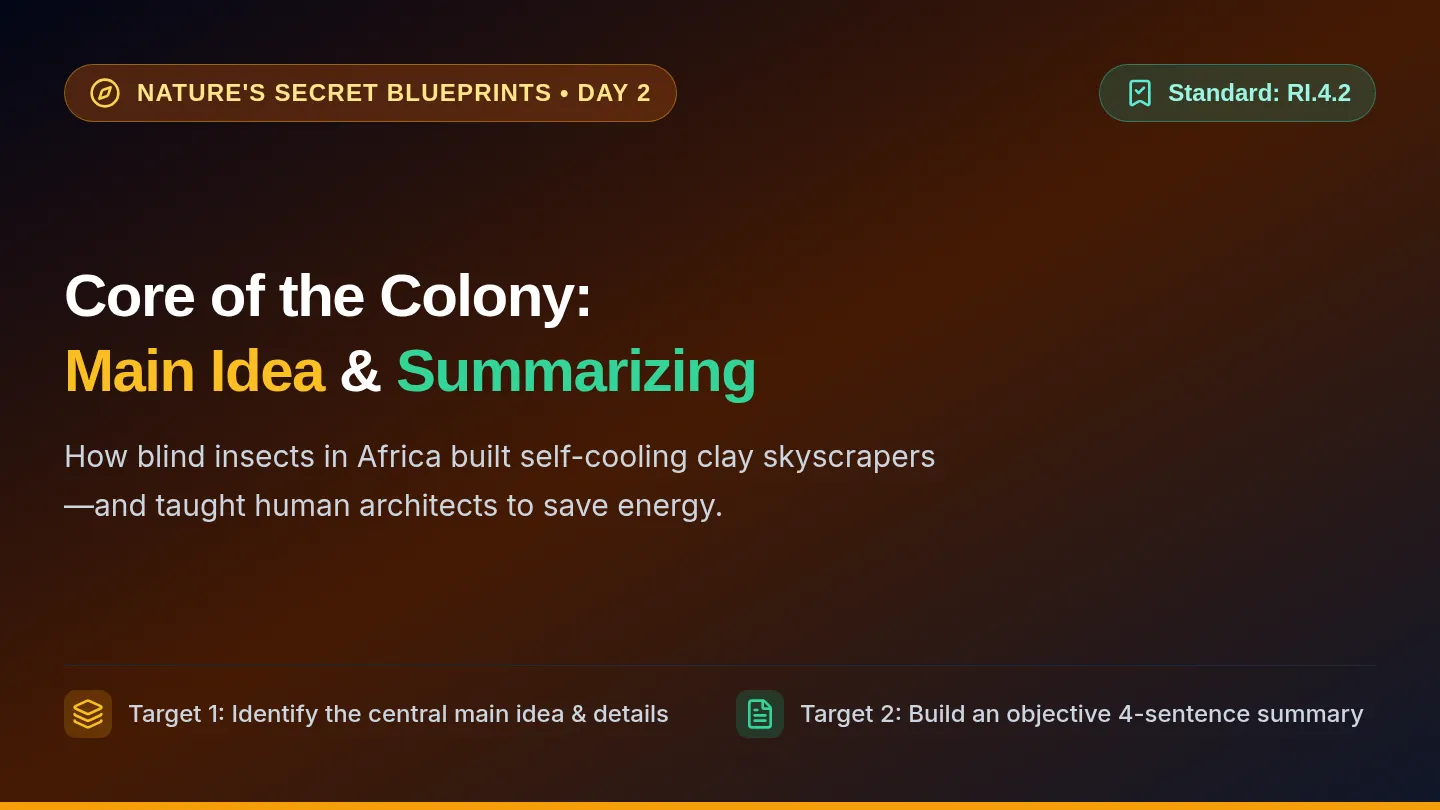
Colony Core Slides Nature's Secret Blueprints • Day 2
Standard: RI.4.2
Core of the Colony:
Main Idea & Summarizing
How blind insects in Africa built self-cooling clay skyscrapers—and taught human architects to save energy.
Target 1: Identify the central main idea & details
Target 2: Build an objective 4-sentence summary
The "Stool Model" of Informational Text
RI.4.2 Foundation
The Seat
The Main Idea
The Big Point the author wants you to understand.
It covers the entire passage like an umbrella or the seat of a stool. If the seat is missing, the whole article collapses!
Guiding Question:
"What is the single most important message about this topic?"
The Legs
Supporting Key Details
Specific facts, reasons, and evidence that hold up the seat.
Each key detail proves, explains, or shows how the main idea is true. Without sturdy legs, the main idea cannot stand.
Test the Detail:
"Does this specific fact directly prove the main idea seat?"
Key details support the main idea—they don't compete with it!
Case File: The African Termite Castle
Natural Air Conditioning
The Natural Mystery
In Zimbabwe, outside temperatures swing wildly from 104°F at noon to 35°F at night.
Yet inside massive 20-foot termite mounds, millions of termites keep their fungus gardens at an exact, unwavering 87°F year-round without any electricity!
The Secret: A network of chimney vents and underground flues constantly draws cool air into the bottom while releasing hot air through the top chimney.
The Human Blueprint
Architect Mick Pearce copied this chimney chimney system when designing the Eastgate Centre shopping mall in Harare.
The Result:
The building stays cool naturally, saving 3.5 million dollars in air-conditioning electricity bills!
How do we turn this incredible story into an accurate summary?
The Great Detail Filter: Trivia vs. Key Detail
Common Pitfall
Just Fun Trivia (Leave Out)
Fascinating facts that add color, but aren't necessary to understand the main idea.
Example:
"Termite queens can lay thousands of eggs each day."
→ Cool fact, but does it explain how buildings stay cool? No!
Essential Key Detail (Keep In)
Critical facts that directly explain how the main idea works in the real world.
Termite Towers Worksheet Biomimicry Dossier: Case #02
Standard RI.4.2 • Main Idea & Key Details
Name:
Date:
Sky-High Mud Castles
How Termite Architecture Inspired Cool Cities
¶ 1 On the sun-baked plains of southern Africa, microscopic builders construct towering skyscrapers of their own. African mound-building termites mix soil, saliva, and wood fragments to build mud pinnacles rising more than twenty feet into the blazing sky. To human observers, these massive mounds look like rough mounds of baked earth, but inside lies a marvel of natural climate control.
¶ 2 Termites cannot survive without farming a special fungus that serves as their primary food supply. This fragile crop dies if nest temperatures fluctuate even slightly away from 87 degrees Fahrenheit. Yet outside on the savanna, brutal daytime temperatures soar above 104 degrees, while nighttime drops to 35 degrees. Without any electrical wiring or fans, the termites keep their nursery at a stable, perfect climate.
¶ 3 Their secret is passive ventilation. Termites hollow out underground tunnels that siphon cool air from damp ground into the base of the mound. As body heat from millions of moving termites warms the central chambers, that warm air naturally rises through tall central chimneys and vents into the atmosphere. This continuous draft acts like a natural lung, breathing fresh oxygen in and pushing stale heat out.
¶ 4 In Harare, Zimbabwe, architect Mick Pearce studied these mounds to design the Eastgate Centre, a modern shopping and office complex. Instead of installing expensive air conditioners, Pearce engineered concrete chimneys, open shafts, and nighttime fan cycles that mimic termite mounds. The building uses 90 percent less energy than comparable office buildings, proving how nature’s blueprints can solve our biggest energy dilemmas.
Part 1: The Main Idea Stool
(What is the big point, and what 3 facts hold it up?)
The Stool Seat: Central Main Idea What is the text mostly about?
Leg 1: Animal Adaptation
How do termites keep their mound at 87°F?
Leg 2: Human Invention
How did Mick Pearce use this in the Eastgate Centre?
Leg 3: Real Impact
What specific energy or cost benefit occurred?
Unit: Nature's Secret Blueprints • Lesson 2 Page 1 of 2 • Continue to page 2
Case #02: Sifting & Summarizing
Target: Filter Facts & Build Objective Summary
Part 2: The Detail Sifter
Label each statement: [K] Key Detail or [T] Fun Trivia
1. Termite saliva and soil combine to make hardened mud structures.
[ ]
2. Termite mounds use chimney drafts to cycle cool air in and warm air out.
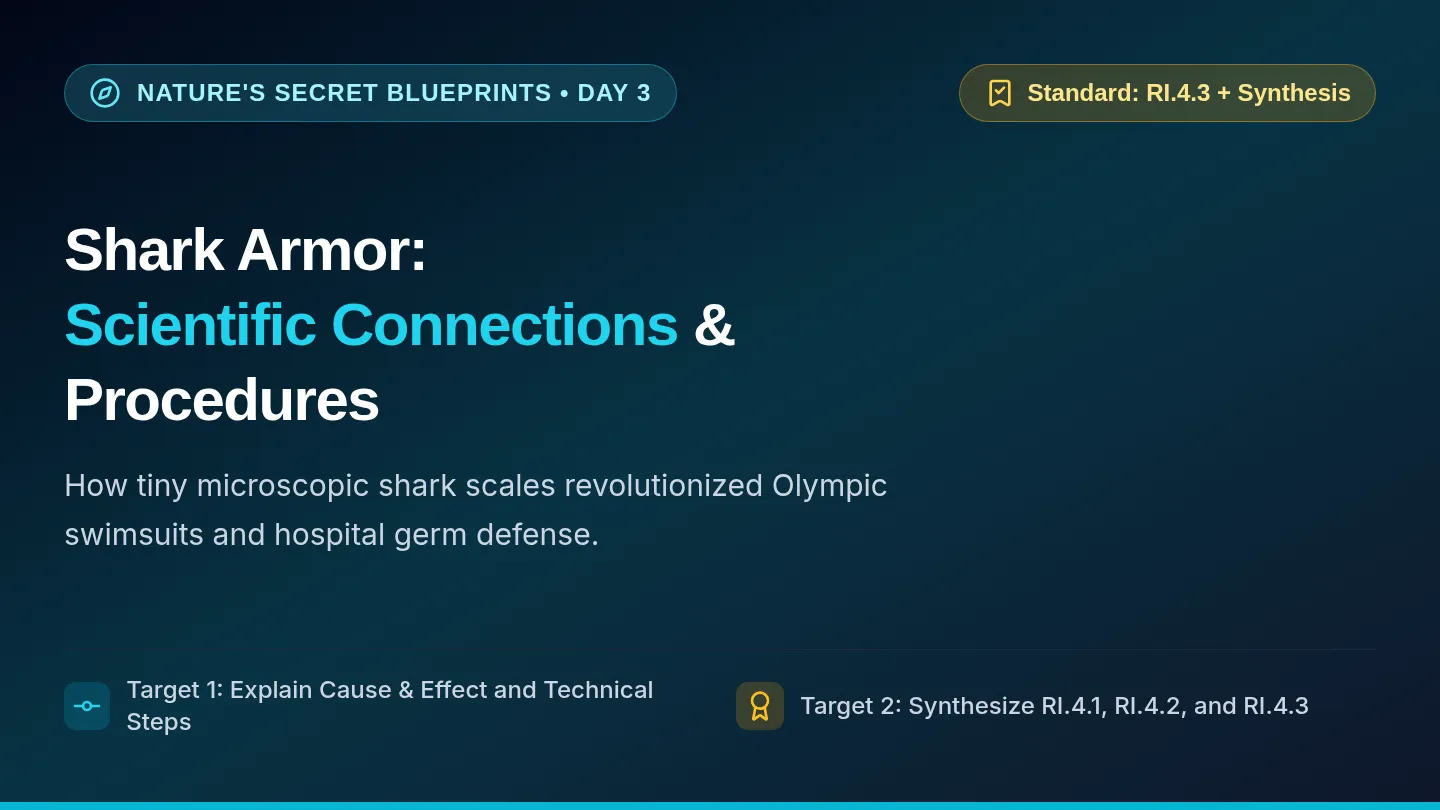
Shark Armor Slides Nature's Secret Blueprints • Day 3
Standard: RI.4.3 + Synthesis
Shark Armor:
Scientific Connections & Procedures
How tiny microscopic shark scales revolutionized Olympic swimsuits and hospital germ defense.
Target 1: Explain Cause & Effect and Technical Steps
Target 2: Synthesize RI.4.1, RI.4.2, and RI.4.3
Making Connections in Informational Texts
RI.4.3 Core Skills
Cause & Effect
"What happened & Why?"
Explaining how one event or natural feature directly triggers another event or outcome.
Technical Procedure
"How does it work?"
Describing ordered steps engineers follow to develop and manufacture new technology.
Concept Comparison
"How do ideas relate?"
Connecting ideas across different fields—like ocean biology and hospital medicine!
In standard RI.4.3, we look for relationships between ideas, events, and procedures.
The Secret of Dermal Denticles
Ocean Biology Clue
Microscopic Discovery
A shark feels smooth if stroked head-to-tail, but rough like sandpaper if stroked backwards. Why?
Under a microscope, shark skin is covered in millions of interlocking tooth-like scales called dermal denticles.
Each denticle has tiny microscopic grooves running along its spine that change how water flows over the animal.
The Two Superpowers
1. Speed & Drag Reduction
The grooves channel water, eliminating turbulent swirls (vortices) that slow swimmers down.
2. Clean Surface (Anti-Fouling)
Algae, barnacles, and bacteria physically cannot cling to the shifting micro-ridge pattern!
How did scientists turn these shark teeth into life-saving human inventions?
Tracing Cause-and-Effect Chains
RI.4.3 in Action
Follow the chain reaction from microscopic scale to global breakthrough:
CAUSE #1
Shark scales have microscopic ridges
EFFECT → CAUSE
Ridges break up swirling water eddies
EFFECT → CAUSE
Drag decreases by 4% across the body
FINAL OUTCOME
Swimmers shatter Olympic world records!
Signal words to locate connections: because, therefore, as a result, leading to, consequently .
Technical Procedure: The "Sharklet" Shield
Engineering Steps
Shark Skin Worksheet Biomimicry Dossier: Case #03
Standard RI.4.3 + Synthesis • Relationships & Procedures
Name:
Date:
Micro-Shields of the Ocean
How Shark Scales Reshaped Medicine and Speed
¶ 1 Most ocean creatures collect algae, barnacles, and slimy bacteria on their bodies over time. Yet sharks remain spotless, cruising through deep waters with smooth, pristine skin. If you examine shark skin through an electron microscope, you will discover that it is not smooth at all. Instead, it is armed with millions of microscopic, overlapping tooth-like scales called dermal denticles.
¶ 2 Each denticle features tiny ridges aligned in the direction of moving water. As a shark accelerates, these microscopic grooves disrupt swirling water eddies, or vortices, that pull backwards against normal swimming bodies. Because the ridges smooth the flow of water, friction drag decreases by roughly 4 percent. In 2008, athletic gear designers copied this texture to create Olympic swimsuits, helping swimmers break dozens of world records before the suits were deemed an unfair advantage.
¶ 3 A materials scientist named Dr. Anthony Brennan uncovered an even more vital relationship: bacteria were completely incapable of colonizing the denticles. Bacteria thrive on flat, calm surfaces where they can anchor themselves and multiply into toxic biofilms. The razor-thin diamond patterns of shark denticles proved too physically demanding and unstable for bacteria to grip.
¶ 4 Dr. Brennan and his team engineered a synthetic silicone material called “Sharklet” that duplicates this microscopic diamond pattern. When applied as an adhesive film on hospital tray tables, bed rails, and door handles, Sharklet prevents 94 percent of harmful bacterial growth. Most importantly, it kills zero germs with toxic chemicals; rather, its physical geometry simply prevents superbugs from settling, solving a major healthcare crisis through pure biomimicry.
Part 1: Cause-and-Effect Relationship Flowchart
(RI.4.3 • Trace what happened and why based on text facts)
1. The Biological Cause
What physical shape exists on each dermal denticle?
2. Scientific Mechanism
Why can't bacteria settle onto this texture?
3. Practical Effect
What happened when Sharklet was put in hospitals?
Unit: Nature's Secret Blueprints • Lesson 3 Page 1 of 2 • Continue to page 2
Case #03: Triple-Standard Synthesis Challenge
RI.4.1 (Evidence) • RI.4.2 (Main Idea) • RI.4.3 (Connections)
Part 2: Technical Procedure Steps
Number the steps from 1 (First) to 3 (Last)
Engineers manufactured adhesive silicone films with microscopic diamond ridges. Step [ ]