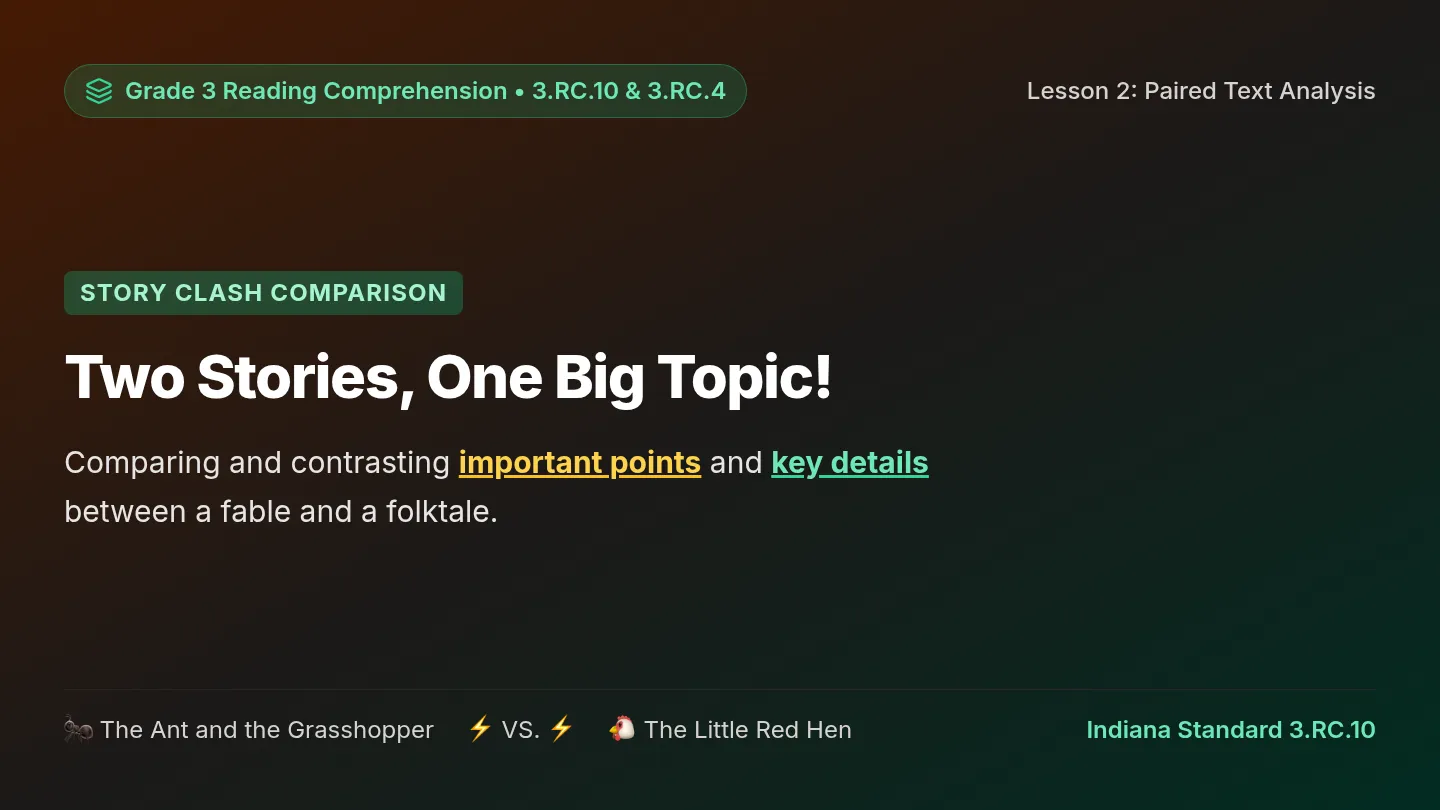
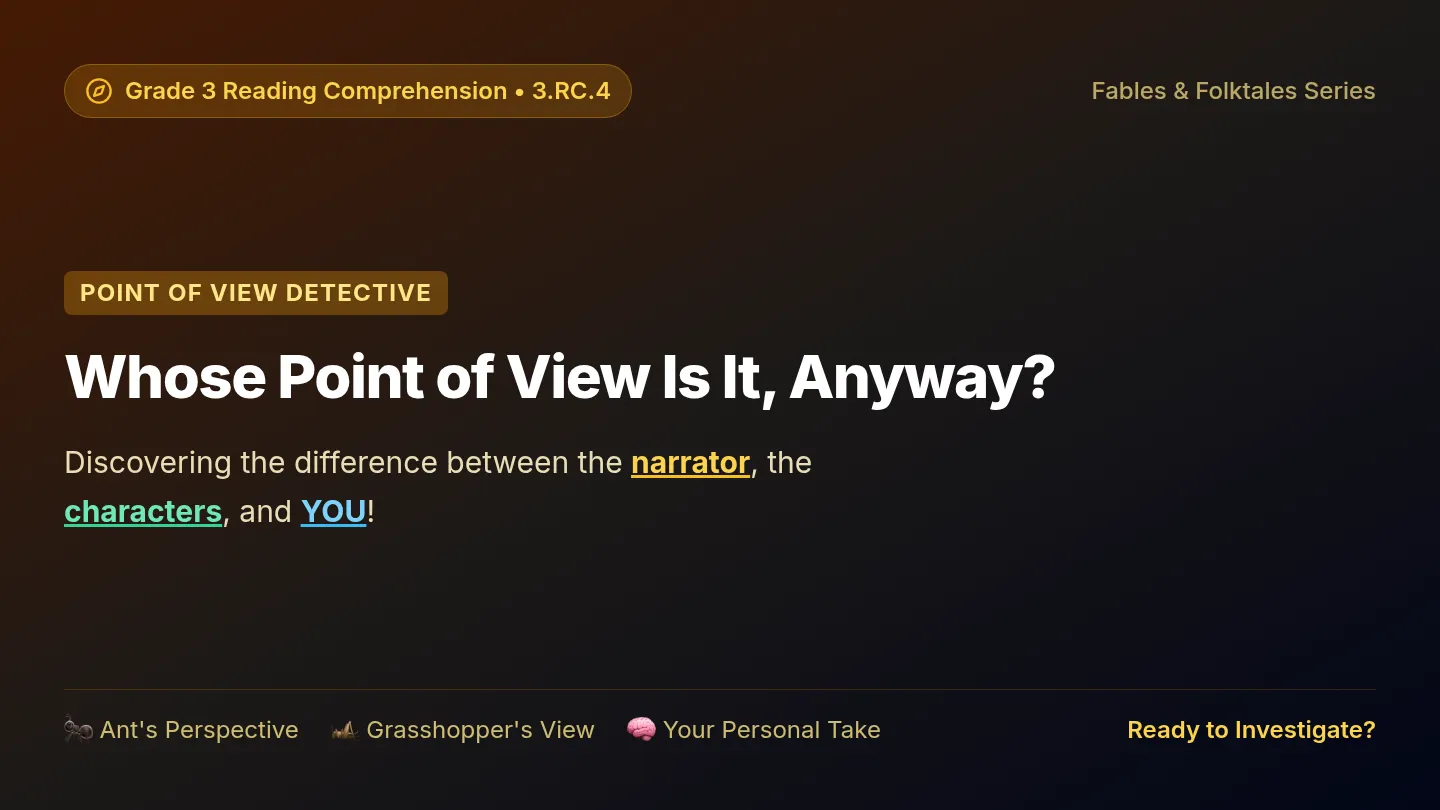
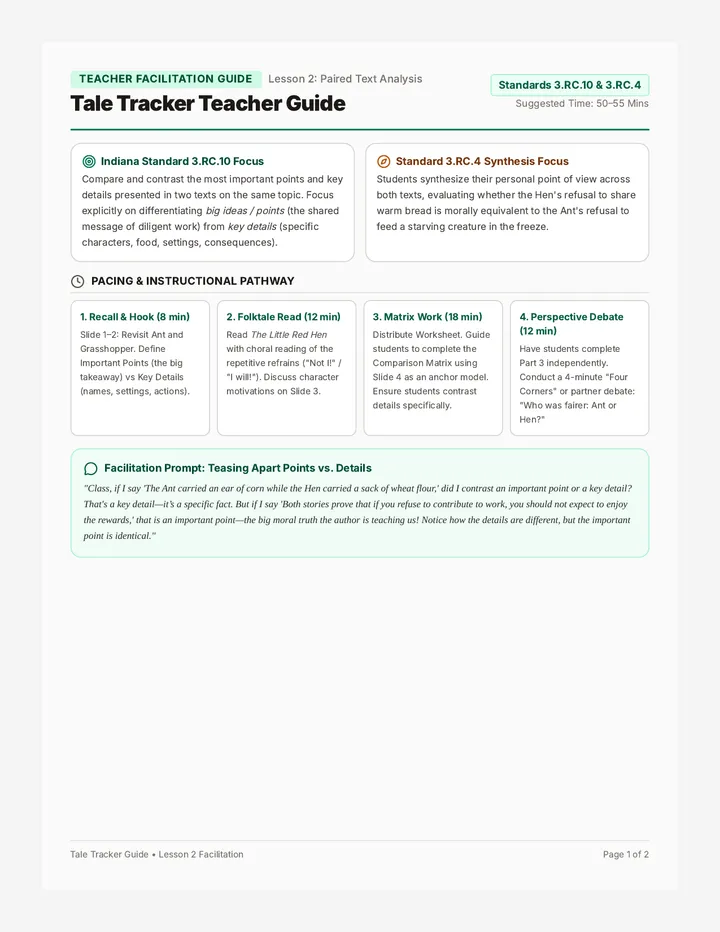
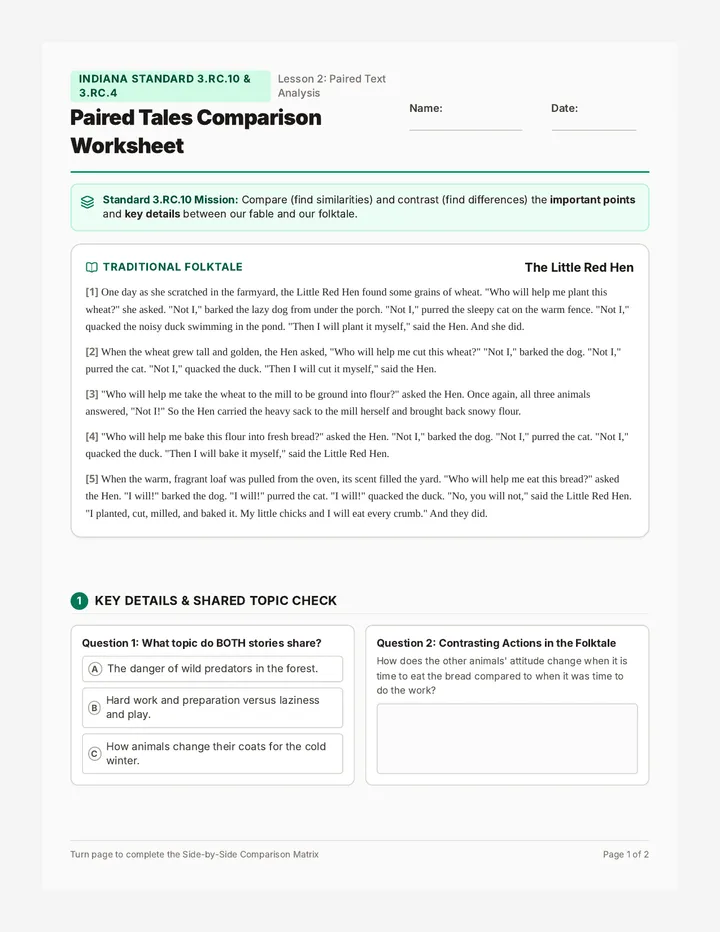
A two-lesson English Language Arts sequence for 3rd grade focusing on Indiana standards 3.RC.4 (Point of View) and 3.RC.10 (Compare and Contrast Across Texts) using paired fables and folktales. Students examine character, narrator, and personal viewpoints before analyzing key details and themes across texts.
Your Turn: Distinguish your personal point of view from the Ant's and the Grasshopper's. If you were the Ant, would you turn the Grasshopper away, give him food freely, or offer a trade/compromise? Explain your reasons using the sentence starters below to show how your viewpoint differs from the characters.
• "The Ant believes that..."
• "The Grasshopper believes that..."
• "However, my personal point of view is that..."
Detective Checklist:
Named Ant's POV Named Grasshopper's POV Stated my own Personal POV
Indiana ELA Standard 3.RC.4 • Point of View Analysis Page 2 of 2
Acceptable text evidence:
"chirping and singing to its heart’s content", "Why bother about winter?", "plenty of food at present."
Part 2 - Narrator's POV & Multiple Choice:
Question A (Open Response): The narrator believes foresight, discipline, and planning ahead are necessary virtues. The narrator does not take the Grasshopper's side; the moral proves the narrator approves of the Ant's lifestyle. Question B (Multiple Choice):Correct Answer is B (The narrator believes planning for the future is essential, while the Grasshopper only thinks about the present).
Part 3 - Personal POV Exemplar Response:
"The Ant believes that you must work hard and that those who played deserve nothing. The Grasshopper believes life should be fun and not full of worry. However, my personal point of view is that while the Grasshopper made a bad mistake, it is unkind to let someone suffer in the snow. If I were the Ant, I would share a little corn, but make the Grasshopper promise to help me harvest next summer."
Common Misconceptions & Corrections
Misconception: POV = Plot Summary
Students often describe what happens ("The Ant carried corn") instead of how the character feels or thinks. Correction: Prompt: "That is what the Ant did. How does the Ant feel about working?"
Misconception: Personal POV must match the Moral
Students assume they will be marked wrong if they disagree with the Ant or the moral. Correction: Reassure them that standard 3.RC.4 specifically tests their ability to distinguish their view from the text!
Tiered Differentiation
Support / Striving Learners:
Provide sentence stems with word banks (e.g., prepared, irresponsible, generous, strict). Highlight Grasshopper dialogue in yellow and Ant dialogue in green directly on the text before writing.
Extension / High-Achievers:
Have students write a 4-sentence dialogue from the Grasshopper's perspective in winter arguing that his music brought joy and mental health to the meadow and therefore had value.
Standard 3.RC.4 Mastery Guide • Fable & Folktale Bundle Page 2 of 2
Farmyard; wheat to flour to bread; Dog, Cat, Duck watch Hen eat.
Both texts share the same main point, but use completely different characters, settings, and food details!
Synthesizing Perspectives
Compare the Ant's Choice & the Hen's Choice
🐜 Ant Refuses to Share
The Grasshopper is starving in the deadly cold. The Ant tells him to dance all winter and shuts the door.
Life-or-death survival consequence.
🐔 Hen Refuses to Share
The Dog, Cat, and Duck are not starving; they just want a free warm feast without doing any of the farm work!
Fairness and shared labor consequence.
Personal POV Challenge: Do you view the Hen's actions as fairer than the Ant's actions? Why or why not?
Worksheet Mission
Compare & Contrast Masters
Your Paired Text Mission
Complete your Paired Tales Comparison Worksheet!
1. Analyze Details
Identify characters, tools, food types, and settings in each tale.
2. Match Main Points
Find the big lessons both authors want readers to understand.
3. Contrast Choices
Compare how Hen and Ant responded to idle companions.
Standard 3.RC.10 Focus Bring your sharpest detective eyes!
|
| Who worked vs. Who was idle (Contrast) |
|
|
| Main Point / Moral (Compare) |
|
|
| Final Consequence for Idle Characters |
|
|
3
Comparative Response: Whose Action Was Fairer?
Both the Ant and the Little Red Hen refused to share food with animals who refused to work. Do you think the Ant's choice or the Hen's choice was fairer? Distinguish your personal point of view from both characters by explaining your reasons below.
• "Both stories show that..."
• "However, the Ant's situation is different because..."
• "In my personal point of view, the [Ant / Hen] acted more fairly because..."
Comparison Check:
Compared Important Points Contrasted Key Details Stated Personal View
Indiana ELA Standards 3.RC.10 & 3.RC.4 • Paired Text Analysis Page 2 of 2
Sunny summer meadow to freezing snow; raw ear of corn / grain.
Little Red Hen does all steps; Dog, Cat, Duck nap, play, swim.
Main Point / Moral
Prepare today for the needs of tomorrow; don't waste time.
Those who do not participate in labor do not earn the reward.
Consequence
Grasshopper starves in cold; Ant refuses him food.
Hen eats bread with chicks; animals watch without eating.
Part 3 Exemplar Response:
"Both stories show that people who refuse to work when asked should not expect to get the rewards that others worked hard to produce. However, the Ant's situation is different because the Grasshopper was facing life-or-death starvation in the freezing snow, while the farm animals just missed out on a snack. In my personal point of view, the Little Red Hen acted more fairly because the other animals were not starving; they were just lazy and selfish after being asked four separate times to help."
Standards Proficiency Rubric (3.RC.10 & 3.RC.4)
Level 4: Advanced
Accurately compares main points and contrasts key details with specific text quotes; clearly explains and defends personal POV with nuanced moral reasoning.
Level 3: Proficient
Accurately identifies the shared main point and contrasts at least 3 key details in the matrix; distinguishes personal POV from characters with reasons.
Level 2: Approaching
Confuses some points with details (e.g. lists plot events instead of themes); states personal opinion but fails to contrast it with the characters.
Level 1: Beginning
Unable to identify shared topic without heavy prompting; cannot differentiate characters' viewpoints or provide personal stance.
ELL / Striving Scaffold: Use a color-coded two-column T-chart (Orange for Meadow/Ant; Green for Farm/Hen) before transferring to the 3-column matrix.