Fortress Fiasco Worksheet Reading & Sequencing
Fortress Fiasco
Name:
Date:
Active Reading Mission:
Pay close attention to the order of events. Since transition words like "first" or "next" aren't in the story, you'll need to use your clues to see how the fort was built!
The Great Living Room Fort
[P1] Morning came, and Leo and Mia decided today was perfect for building a grand fortress. They searched the house for the ultimate construction supplies, gathering four sturdy kitchen chairs, three heavy wool blankets from the hallway closet, and a mountain of fluffy cushions from the sofa.
[P2] To build their structure, they carefully arranged the heavy chairs in a neat square in the center of the room. They draped the wool blankets over the top to form a low ceiling, and Mia tossed the cushions inside to create a soft floor.
[P3] Suddenly, disaster struck! The thickest wool blanket was far too heavy for the chairs. It slowly began to slide down, and with a sudden swoosh, the entire ceiling came crashing down directly onto Mia’s head, burying her in blankets!
[P4] After laughing at their sudden collapse, they refused to give up and came up with a clever new plan. Leo ran to find thick textbooks to anchor the heavy blanket corners on the chair seats, while Mia fetched big plastic chip clips to clamp the sheets tightly together.
[P5] With everything secure, their living room fort was sturdy and safe. They crawled inside with a bright flashlight, a favorite storybook, and a plate of warm chocolate chip cookies, ready for their cozy rainy-day adventure to begin.
1
Chronological Challenge
Directions: Put the events in order by labeling each box below using: 1 (first), 2 (next), 3 (then), 4 (after), or 5 (finally).
The thick wool blanket slips, causing the entire ceiling of the fort to crash down.
Leo and Mia search the house to gather chairs, blankets, and sofa cushions.
The children secure the blanket corners using heavy textbooks and plastic chip clips.
They arrange the chairs in a neat square and drape blankets over the top to make a roof.
They crawl inside their sturdy fort with a flashlight, cookies, and a storybook.
Page 1 of 2
Comprehension & Design
Fortress Fiasco
Evidence & Evaluation
2
Text-Dependent Investigations
1. Which of these events best describes how Leo and Mia's attitude changes after their first fort collapses?
A) They get highly frustrated and decide to watch television instead.
B) They laugh at the sudden collapse and immediately make a new plan.
C) They argue over whose wool blanket was too heavy for the fort.
D) They clean up their supplies and wait for their parents to help.
PARAGRAPH NUMBER:
2. After the collapse, which of these events happens first to help Leo and Mia rebuild a stronger roof?
A) Mia fetches plastic chip clips to clamp the sheets together.
B) Leo runs to find heavy textbooks to weight down the blanket corners.
C) They grab their favorite books and crawl inside with a flashlight.
D) They replace the heavy wool blankets with lighter cotton sheets.
PARAGRAPH NUMBER:
3
Blueprint Designer
Sketch your dream blanket fort below. What is one special feature you would include? Describe it in two complete sentences.
Fort Floor Plan
Draw your top-down blueprint here!
Design Features & Specs
Feature 1:
Feature 2:
Explain your design in 2 sentences:
Page 2 of 2
Fortress Fiasco Teacher Guide Teacher Resource & Key
Fortress Fiasco Lesson Guide
Grade Level: 1st - 3rd Grade
Suggested Lesson Flow
1. Hook & Warm-Up (5 Mins): Ask students what materials they would use to build a fort. Discuss the word "sturdy" versus "unstable".2. Guided Reading (10 Mins): Read the story as a class or in pairs. Have students pay attention to the paragraph labels [P1]-[P5].3. Sequencing Challenge (10 Mins): Students arrange events by labeling them with descriptive numbers: 1 (first) to 5 (finally).4. Paragraph Keying (10 Mins): Guide students to complete the multiple choice questions, reminding them to write the correct paragraph number (e.g. P4) as proof of their answers.5. Blueprint Design (10 Mins): Allow creative sketching time and sentence sharing.
Guiding Discussion Prompts
Making Connections: "Have you ever experienced a small setback like Mia and Leo did? How did you feel, and what did you do next?"Identifying Cause & Effect: "Why did the first fort collapse? What physics or weight problem happened? How did clamping change the structure?"Character Traits: "How do Leo and Mia show resilience? What paragraph shows they don't give up when things fall down?"
STEM Extension: Tabletop Forts
Challenge students to construct a mini desktop fort using only 10 craft sticks (or plastic straws), tape, and 2 tissue sheets.
Must hold its own weight for at least 1 minute
Must fit a small token (like an eraser) inside
Encourages rapid testing and engineering rebuilds
Chronological Key
3
then • Blanket slips & ceiling crashes.
1
first • Search house & gather core supplies.
4
after • Secure with books and chip clips.
2
next • Arrange chairs in square & roof.
5
finally • Crawl inside with flashlight & book.
Text Question Key
1 Attitude Shift (Question 1)
Correct Option: B (They laugh and make a new plan).
Paragraph Number: P4 or 4.
2 Rebuilding Sequence (Question 2)
Correct Option: B (Leo runs to find heavy textbooks).
Paragraph Number: P4 or 4.
Cozy Classroom Series • Lesson 1 Page 1 of 1
Kitchen Chaos Worksheet Reading & Sequencing
Kitchen Chaos
Name:
Date:
Active Reading Mission:
Pay close attention to the order of events. Since transition words like "first" or "next" aren't in the story, you'll need to use your clues to see how the cake was baked!
The Great Birthday Bake
[P1] Morning came, and Leo and Mia decided today was perfect for baking a surprise birthday cake for their mother. They searched the pantry for ingredients, collecting flour, sugar, baking powder, and rich cocoa powder. They set out a large mixing bowl, a wooden spoon, and two round metal pans on the kitchen counter.
[P2] To make their chocolate batter, they carefully measured the dry ingredients and cracked three large eggs into the bowl. Mia slowly stirred in the cold milk while Leo greased the baking pans. They poured the thick batter into the pans and placed them into the preheated oven.
[P3] Suddenly, disaster struck! A strange, sweet smell filled the kitchen as the cake baked. Looking through the glass oven window, they saw the batter bubbling wildly and spilling over the edges of the pans, dripping onto the hot oven floor and creating a smoky mess. They had accidentally used baking soda instead of baking powder!
[P4] After turning off the oven and cleaning the sticky spill with their father, they refused to give up and came up with a clever new plan. Mia decided to crumble the salvageable, baked cake centers into a big glass bowl, while Leo whipped up fresh cream and sliced strawberries to layer between the chocolate crumbs.
[P5] With everything assembled, their fancy chocolate-strawberry trifle was beautiful and complete. They placed it in the refrigerator to chill before dinner, excited to present their delicious, accidental masterpiece to their mother.
1
Chronological Challenge
Directions: Put the events in order by labeling each box below using: 1 (first), 2 (next), 3 (then), 4 (after), or 5 (finally).
The chocolate cake batter bubbles wildly and spills over the edges of the baking pans.
Leo and Mia search the house to gather flour, sugar, eggs, and baking pans.
The children layer chocolate cake crumbles with fresh whipped cream and strawberries in a glass bowl.
They mix the ingredients into batter and place the filled baking pans into the preheated oven.
They place their completed chocolate trifle into the refrigerator to chill before dinner.
Page 1 of 2
Comprehension & Design
Kitchen Chaos
Evidence & Evaluation
2
Text-Dependent Investigations
1. Which of these events best describes how Leo and Mia react when their birthday cake overflows in the oven?
Kitchen Chaos Teacher Guide Teacher Resource & Key
Kitchen Chaos Lesson Guide
Grade Level: 1st - 3rd Grade
Suggested Lesson Flow
1. Hook & Warm-Up (5 Mins): Ask students if they've ever cooked or baked. Ask what makes cakes rise up fluffy. Introduce the idea of chemical reactions in baking.2. Guided Reading (10 Mins): Read "The Great Birthday Bake." Focus on the turning point in Paragraph 3: why substituting ingredients caused an accident. Use paragraph labels [P1]-[P5].3. Sequencing Challenge (10 Mins): Students arrange the events by writing the correct sequence words: 1 (first) to 5 (finally).4. Paragraph Keying (10 Mins): Review the two multiple choice questions. Model how to locate and cite the specific paragraph number (e.g. P4) as proof of their answers.5. Dessert Cross-Section (10 Mins): Encourage students to design a dream dessert and label the layered components.
Guiding Discussion Prompts
Comparing Scenarios: "How is the conflict in Kitchen Chaos similar to Blanket Castle? How did both sets of children react to their plans crashing?"Scientific Thinking: "Why is baking called 'chemistry' in the kitchen? Why can't we easily swap ingredients like baking soda and baking powder?"Growth Mindset: "A mistake turned into a fancy strawberry trifle. Can you think of another mistake that turned into something awesome?"
STEM Quick Science: Leavening Bubbles
Demonstrate the difference between leaveners in front of the class using small plastic cups.
Cup 1: Mix 1 tsp baking soda + 2 tbsp warm water (No reaction)Cup 2: Mix 1 tsp baking powder + 2 tbsp warm water (Brisk fizzing!)Explain that baking soda needs an acid (like vinegar) to fizz, while baking powder already contains acid and activates with water.
Chronological Key
3
then • Cake batter overflows in oven.
1
first • Search pantry & gather supplies.
4
after • Layer cake crumbles with cream.
2
next • Mix batter & place pans in oven.
5
finally • Chill trifle in refrigerator.
Text Question Key
1 Attitude Shift (Question 1)
Correct Option: C (They stay positive, clean up, and invent).
Paragraph Number: P4 or 4.
Language Learning Worksheet Reading & Sequencing
Words Without Borders
Name:
Date:
Active Reading Mission:
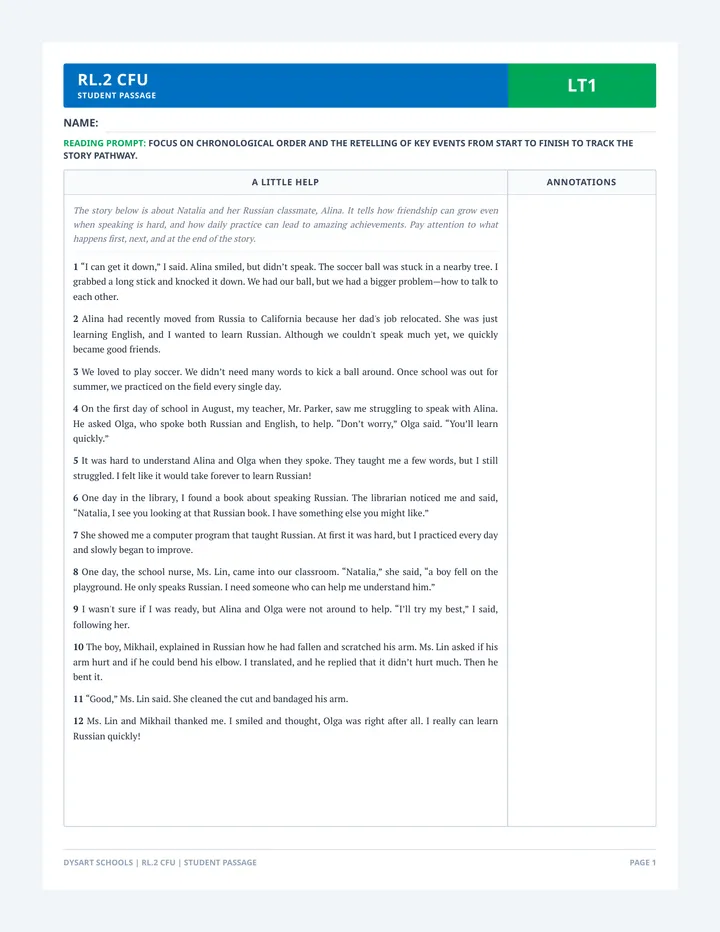
Pay close attention to the order of events. Since transition words like "first" or "next" aren't in the story, you'll need to use logical clues to see how Natalia learns her new phrases!
A Friendship Without Words
[P1] At the start of summer, a new girl named Alina moved next door. Alina had just arrived from Ukraine and spoke very little English, while Natalia spoke only English. One sunny afternoon, they knocked a soccer ball out of a tall oak tree together and realized they could laugh, play, and run without using any words. By August, they were playground partners.
[P2] When school began in late August, Mr. Parker welcomed everyone back to class. Natalia was determined to learn Russian so she could surprise Alina with real conversations. To begin, Mr. Parker asked Olga, an older student who spoke both languages, to help Natalia practice basic phrases during lunch recess. Natalia worked hard repeating the unfamiliar sounds.
[P3] To build on her daily practice, Natalia visited the school library during study hall. Ms. Lin, the friendly librarian, showed her a grammar book, but Natalia found the dense pages too confusing. Instead, Natalia used a colorful library computer program to learn conversational vocabulary through interactive games.
[P4] One afternoon at recess, disaster struck on the school playground. A younger boy named Mikhail fell off the swings and began to cry, calling out in fast, worried Russian. Alina ran to help, but she could not understand what he was pointing at. Natalia calmly walked over, listened carefully, and recognized the Russian word for "ankle" that she had practiced on her computer. She quickly explained the injury to Mr. Parker.
[P5] At the end of the school day, Natalia walked home with Olga. She felt incredibly proud of helping Mikhail and realized she could actually understand and speak a new language. Natalia smiled and concluded that Olga was right when she had promised that determination and practice are the ultimate keys to unlocking any language.
1
Chronological Challenge
Directions: Put the events in order by labeling each box below using: 1 (first), 2 (next), 3 (then), 4 (after), or 5 (finally).
A younger boy named Mikhail falls on the playground, and Natalia translates his words.
Natalia and Alina knock a soccer ball out of a tall tree and become friends.
Natalia uses a colorful library computer program to practice conversational Russian.
Mr. Parker asks an older student named Olga to help Natalia practice basic phrases.
Natalia walks home with Olga, realizing her practice has unlocked a new language.
Language Learning Teacher Guide Teacher Resource & Key
Words Without Borders Lesson Guide
Grade Level: 1st - 3rd Grade
Suggested Lesson Flow
1. Hook & Warm-Up (5 Mins): Ask students: "How can you make a new friend if you don't speak the same language?" Discuss how actions, smiles, and play bridge borders.2. Guided Reading (10 Mins): Read "A Friendship Without Words." Focus on Natalia's motivation: how empathy drives her hard work to learn Russian. Use paragraph labels [P1]-[P5].3. Sequencing Challenge (10 Mins): Have students sequence her steps using the descriptive words: 1 (first) to 5 (finally).4. Paragraph Keying (10 Mins): Review the three screenshot-style questions. Guide students to write the correct paragraph number (e.g. P1, P2, P5) as proof of their answers.5. Greeting Card Design (10 Mins): Allow students to draw and write bilingual greetings, sharing their welcoming cards.
Guiding Discussion Prompts
Empathy & Inclusion: "Alina had just moved from Ukraine. How did Natalia make her feel welcomed before they could even talk to each other?"Determined Actions: "Why did Natalia find the library grammar book confusing but succeed with the computer program? How does trying different study methods help?"Language Power: "How did Natalia's practice help save the day for Mikhail on the playground? What does this teach us about the value of learning languages?"
Cultural Extension: Classroom Hello
Create a "Hello" world map in the classroom to build language curiosity.
Teach students how to say hello in 4 languages: Spanish (Hola), Ukrainian (Pryvit), Russian (Privet), and French (Bonjour).
Practice greeting a classmate with a smile, handshake, or wave while using these words.
Chronological Key
4
after • Mikhail falls and Natalia translates.
1
first • Soccer ball out of tree; become friends.
3
then • Use computer program to practice words.
2
next • Mr. Parker asks Olga to help Natalia.
5
finally • Walk home; proud of bilingual success.
Text Question Key
1 Friendship Start (Question 1)
Correct Option: A (Knock soccer ball out of tree).
Paragraph Number: P1 or 1.
2 First Action (Question 2)