Cli-Fi Foundations Slides Lesson 1 • Field Archive
Worlds Under Strain
An introduction to climate fiction and close reading for environmental clues.
Focus: Setting, Mood & Early Theme Clues Echoes of Tomorrow
Genre Briefing
What Is Climate Fiction (Cli-Fi)?
Climate fiction tells stories about how human communities live through, adapt to, or resist environmental change.
Shifting Worlds
Set in a near-future or altered Earth shaped by rising seas, droughts, or storms.
Human Stakes
Focuses on everyday choices, survival, memory, and community under pressure.
Urgent Themes
Uses speculative settings to ask big questions about responsibility and hope.
Close Reading Lens
Setting Is Never Just Scenery
Traditional Setting
Tells the reader where and when a story happens so we can picture the scene.
Cli-Fi Setting
Acts as an active force. Every cracked riverbed or salt-stained wall signals mood , conflict , and theme .
Reading Strategy
Three Steps for Close Reading Cli-Fi
1
Spot Environmental Shifts
Underline sensory details about weather, water, land, or sky that feel altered or strained.
2
Name the Mood
Ask: What feeling do these details create? (e.g., dread, resilience, nostalgia, urgency)
3
Connect to a Big Idea
Ask: What is the author suggesting about how humans treat nature—or each other?
Model Excerpt • "The Salt Line"
"By noon, the harbor's chalky tide line sat three streets inland, crusting the bakery steps with white grit. Mara still swept the stoop every morning, though no customer had bought bread since April."
Notice the Detail
What has changed in Mara's town, and what small detail proves it?
Spot the Clue
Why does Mara keep sweeping? What theme might her habit hint at?
Your Turn
Setting Clues Worksheet
Read the full opening excerpt of "The Salt Line" carefully.
Underline three environmental details that shape the mood.
Complete the Environmental Evidence Tracker with exact quotes.
Setting Clues Worksheet Name: ____________________________________ Date: ________________
Lesson 1 • Climate Fiction Close Reading
Setting Clues Worksheet
Field Archive 01
Directions: Read the excerpt below. As you read, underline details about the changing environment and notice how Mara responds to her surroundings.
Excerpt: “The Salt Line”
[1]By noon, the harbor’s chalky tide line sat three streets inland, crusting the bakery steps with white grit. Mara still swept the stoop every morning, though no customer had bought bread since April. Her broom scraped a rhythm against the stone, stubborn as a heartbeat.
[2]Across the avenue, rusted streetlamps leaned over shallow pools where minnows darted between drowned mailboxes. Most neighbors had packed their trunks onto high-wheeled carts and headed for the Ridge weeks ago. They told Mara she was foolish to guard an empty oven.
[3]Still, she kept the brass bell above the door polished. Inside, jars of rainwater lined the flour shelves, each labeled with the date of the last clean storm. When the wind shifted south, carrying the sharp scent of brine, Mara opened the shutters anyway—determined that someone would remember the street as a home, not just a warning.
Part 1: First Impressions
1. What physical evidence in paragraphs 1–2 shows that the town’s environment has drastically changed?
2. Why does Mara keep sweeping the stoop and polishing the brass bell even though her neighbors have left?
Part 2: Environmental Evidence Tracker
Setting → Mood → Theme
Choose three specific quotes from “The Salt Line” that describe the environment or Mara’s interaction with it. Record the quote, the mood it creates, and what big idea (theme clue) it suggests.
Textual Evidence (Quote & Para. #)
Mood / Feeling Created
Early Theme Clue (Big Idea)
Part 3: Early Theme Hypothesis
3. Which statement best captures an emerging theme in “The Salt Line”?
A. People should never live near the ocean because tides are unpredictable.
B. Even when environmental loss reshapes a place, small daily acts preserve human dignity and memory.
C. Baking bread is the most important skill a community needs during a flood.
D. Moving to higher ground always solves the problem of rising sea levels.
4. Explain your choice above using one piece of evidence from the text.
Worlds Under Strain Teacher Guide Lesson 1 Teacher Guide
Worlds Under Strain
45 Minutes
Learning Objective
Students will identify defining features of climate fiction and cite specific environmental details from a text to explain how setting creates mood and hints at a central theme.
Lesson Pacing
Time
Segment
Teacher Moves
10 min
Genre Hook (Slides 1–3)
Introduce cli-fi. Contrast traditional setting (backdrop) with cli-fi setting (active force shaping stakes).
10 min
Modeled Close Read (Slides 4–5)
Walk through the 3-step protocol. Think aloud on “chalky tide line” and Mara’s sweeping habit.
18 min
Independent / Pair Work
Students read “The Salt Line” and complete Parts 1–3 on the Setting Clues Worksheet.
7 min
Share-Out & Debrief
Compare theme clues from the tracker. Preview Lesson 2: moving from clues to full theme statements.
Key Discussion Prompts
Why might an author choose a familiar place (a bakery, a mailbox) to show climate change rather than a huge disaster scene?
What is the difference between noticing a detail and explaining what it reveals ?
Differentiation
Support: Pre-highlight one quote in each paragraph so students focus on naming mood and theme clues.Extension: Ask early finishers to identify the simile in paragraph 1 (“stubborn as a heartbeat”) and explain its effect.
Answer Key: Setting Clues Worksheet
Sample Responses
Part 1: First Impressions
1. Physical evidence of change: The tide line now sits “three streets inland,” leaving white salt grit on the bakery steps. Streetlamps lean over pools of water with minnows swimming between “drowned mailboxes.”
2. Why Mara keeps sweeping & polishing: She wants to preserve a sense of normalcy, care, and memory so the street is remembered “as a home, not just a warning.”
Part 2: Environmental Evidence Tracker (Sample Entries)
Textual Evidence
Mood / Feeling
Early Theme Clue
“crusting the bakery steps with white grit” (Para. 1)
bleak, encroaching, eerie
Rising waters slowly overtake everyday human spaces.
“minnows darted between drowned mailboxes” (Para. 2)
haunting, abandoned
Nature reclaims neighborhoods when communities are forced to leave.
“jars of rainwater... labeled with the date of the last clean storm” (Para. 3)
precious, fragile, urgent
Clean resources become rare treasures that people must carefully protect.
Part 3: Early Theme Hypothesis
3. Correct Answer: B. Even when environmental loss reshapes a place, small daily acts preserve human dignity and memory. (Options A, C, and D are either too literal, overly narrow, or contradicted by the text.)
4. Sample Explanation: In paragraph 3, Mara opens the shutters despite the brine-scented wind because she is “determined that someone would remember the street as a home, not just a warning.” This shows that her daily routines are meant to protect memory and dignity.
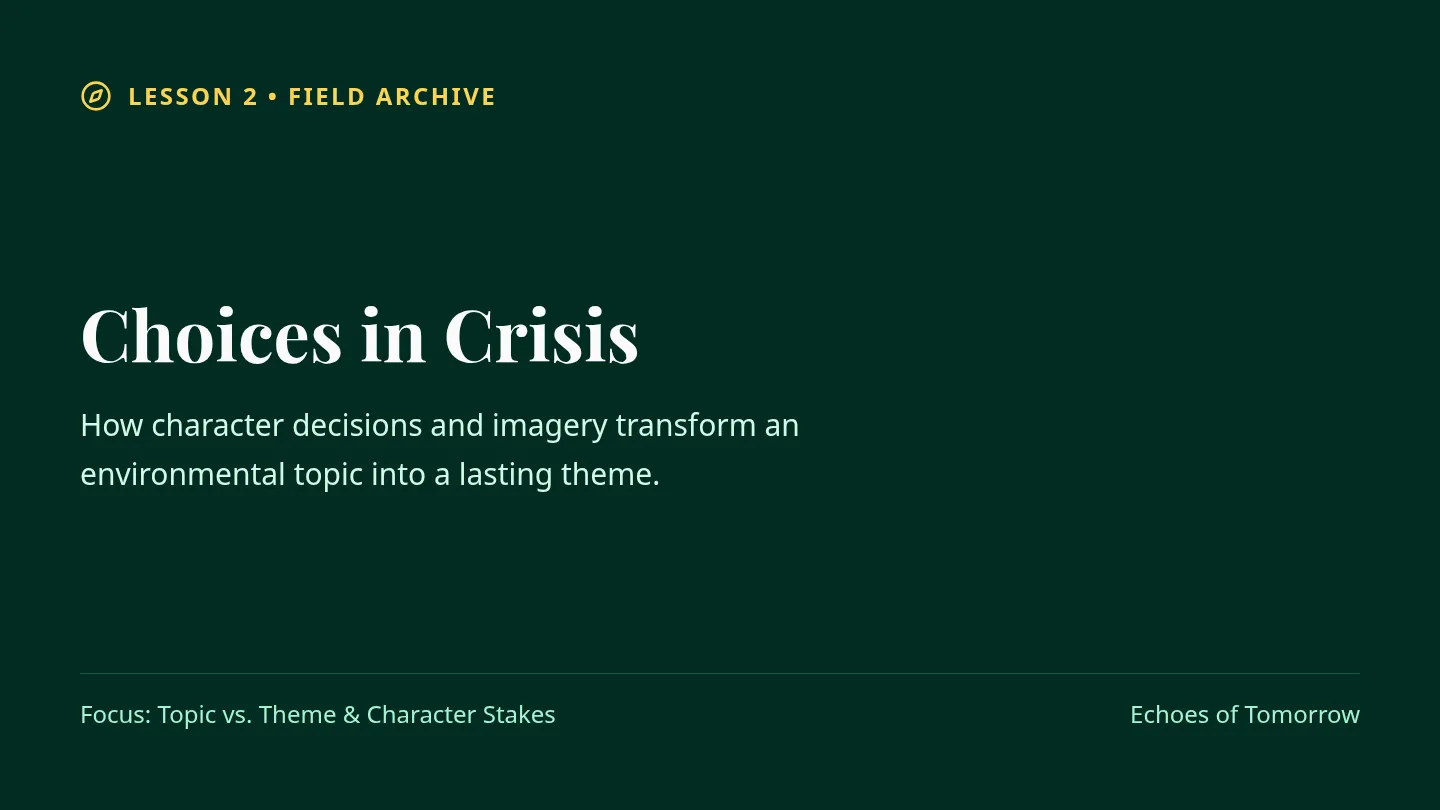
Character Stakes Slides Lesson 2 • Field Archive
Choices in Crisis
How character decisions and imagery transform an environmental topic into a lasting theme.
Focus: Topic vs. Theme & Character Stakes Echoes of Tomorrow
Core Distinction
Topic vs. Theme Statement
TOPIC
1–2 Words (The Subject)
Names what the story is about , without saying what the author believes.
Examples: Drought, survival, memory, greed
THEME
A Complete Insight
A full sentence expressing a universal truth or insight revealed through the story.
Example: Scarcity tests whether a community chooses hoarding or solidarity.
Author’s Craft
Two Levers That Reveal Theme
1. Character Choices
When resources run low, what do characters protect, share, or abandon? Their sacrifices point straight to the theme.
2. Figurative Imagery
Metaphors and sensory images (like “silver threads of rain” or “iron-locked skies”) show emotional stakes.
Drafting Tool
Building a Theme Statement
Formula:
In times of [environmental crisis], people often [character response], revealing that [universal insight].
Model (from “The Salt Line”):
When rising seas erase a town, holding onto small daily rituals preserves human dignity and memory.
Your Turn
Theme Tracker Worksheet
Read “Rain Catchers” closely, marking character choices and imagery.
Separate the story’s topic from its theme .
Draft a complete theme statement backed by two exact quotes.
Theme Tracker Worksheet Name: ____________________________________ Date: ________________
Lesson 2 • Theme & Character Stakes
Theme Tracker Worksheet
Field Archive 02
Directions: Read “Rain Catchers.” Circle one difficult choice a character makes, and underline two vivid images of water or sky.
Excerpt: “Rain Catchers”
[1]For fourteen months, the valley sky had looked like hammered tin—bright, dry, and unforgiving. On the roof of Apartment 4B, Tomas and his sister Nadia rigged blue tarps to funnel morning dew into a dented steel drum. Every drop sounded like a coin hitting the bottom.
[2]When the drum finally reached half-full, Mr. Alvarez from downstairs knocked with an empty kettle and a trembling hand. Tomas glanced at his own wilted bean plants, then at the padlock hanging from the tarp rope. “We barely have enough for our own week,” Tomas muttered.
[3]Nadia did not hesitate. She unhooked the padlock, dipped a chipped mug into the drum, and filled Mr. Alvarez’s kettle to the rim. “If the roof dries up, we’ll need neighbors more than we need beans,” she said quietly, watching the thin silver line of water catch the sun.
Part 1: Topic vs. Theme
1. List two 1–2 word topics explored in “Rain Catchers” (for example: scarcity ).
2. Why is “water shortage” a topic rather than a theme?
Part 2: Craft & Character Analysis
Choices & Imagery
3. Contrast Tomas’s instinct in paragraph 2 with Nadia’s choice in paragraph 3. What does Nadia’s decision reveal about survival in a crisis?
4. Look at the imagery in paragraph 1 (“hammered tin” and “a coin hitting the bottom”). How do these comparisons shape the reader’s understanding of water in this world?
Part 3: Draft Your Theme Statement
Write a complete theme statement for “Rain Catchers” (avoid naming characters or plot details—state a universal insight). Then copy two exact quotes that prove your theme.
5. Theme Statement:
6. Supporting Textual Evidence (2 exact quotes with paragraph numbers):
Choices in Crisis Teacher Guide Lesson 2 Teacher Guide
Choices in Crisis
45 Minutes
Learning Objective
Students will distinguish between a story’s topic and its theme statement, and analyze how character choices and figurative imagery develop a theme in climate fiction.
Lesson Pacing
Time
Segment
Teacher Moves
10 min
Topic vs. Theme (Slides 1–2)
Have students shout out topics from Lesson 1, then convert one together into a full theme sentence.
10 min
Craft Levers (Slides 3–4)
Explain how character sacrifices and metaphors reveal authorial message. Introduce the theme formula.
18 min
Close Reading (“Rain Catchers”)
Students read and complete the Theme Tracker Worksheet independently or with a partner.
7 min
Theme Workshop
Read 2–3 student theme statements aloud and check: Is it universal? Is it proven by quotes?
Common Misconceptions
Naming a topic: Students write “sharing water” instead of a complete claim. Prompt them with: “What does the story say about sharing?” Including plot: Remind students that theme statements should not mention “Nadia” or “beans.”
Differentiation
Support: Provide the Slide 4 sentence frame on a desk card for Part 3.Extension: Ask students to argue whether Tomas or Nadia is more realistic, using evidence from the text.
Answer Key: Theme Tracker Worksheet
Sample Responses
Part 1: Topic vs. Theme
1. Topics: Scarcity, generosity, community, survival, drought (any two 1–2 word subjects).
2. Why “water shortage” is a topic: It only names the subject or problem in the story. It does not express a complete message or universal insight about how people respond to that problem.
Part 2: Craft & Character Analysis
3. Tomas vs. Nadia: Tomas looks at the padlock and worries about his own plants, wanting to hoard what little water they have. Nadia unhooks the lock and fills Mr. Alvarez’s kettle, showing that long-term survival in a crisis depends on mutual care and community trust rather than isolation.
4. Imagery (“hammered tin” / “coin”): Comparing the sky to “hammered tin” makes the drought feel harsh, metallic, and inescapable. Comparing each drop of dew to “a coin hitting the bottom” emphasizes that water has become as rare and precious as currency.
Part 3: Theme Statement & Evidence
5. Sample Theme Statement: During severe environmental scarcity, choosing generosity over self-protection strengthens the human bonds people need to survive.
6. Sample Supporting Evidence:
“She unhooked the padlock, dipped a chipped mug into the drum, and filled Mr. Alvarez’s kettle to the rim.” (Para. 3)
“‘If the roof dries up, we’ll need neighbors more than we need beans,’ she said quietly.” (Para. 3)
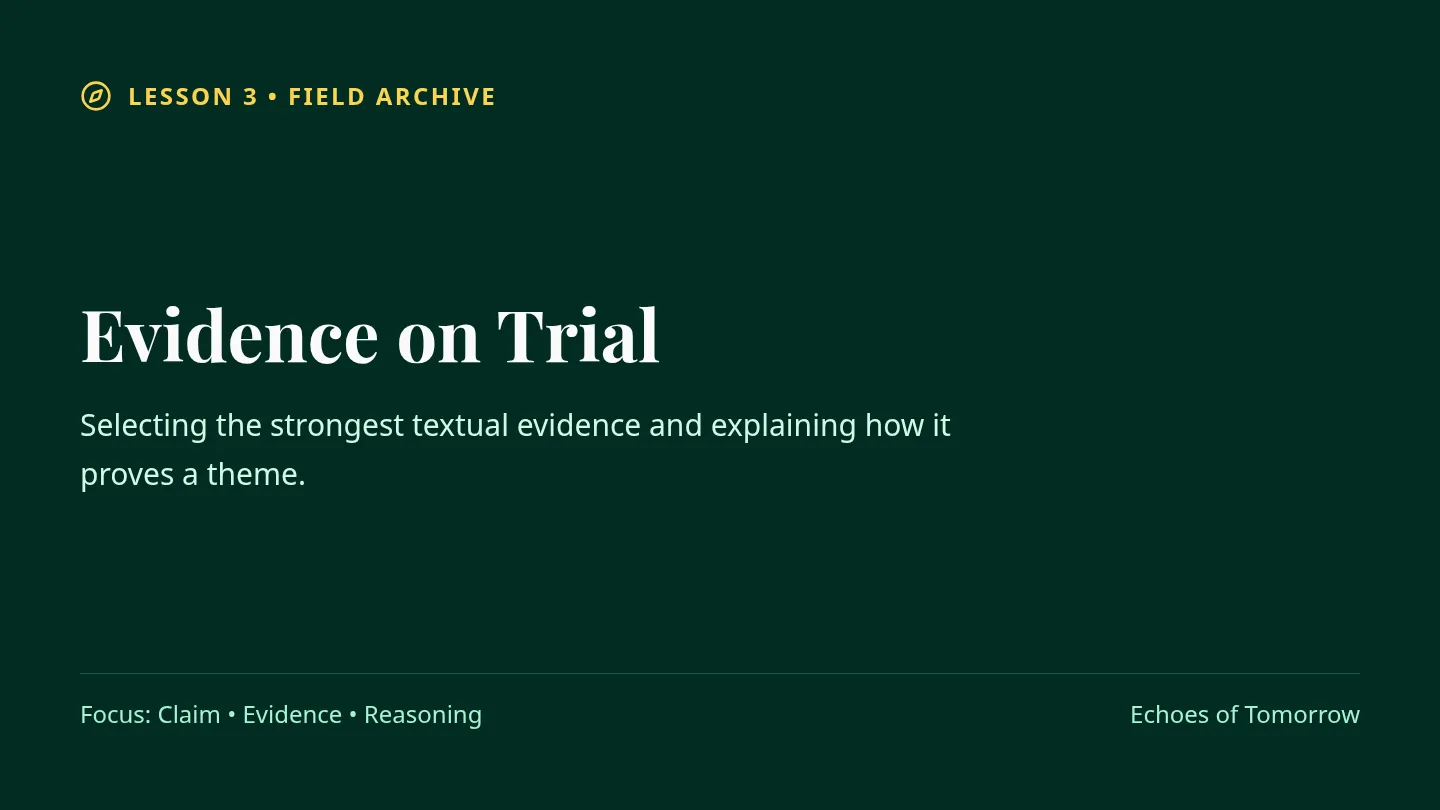
Evidence Craft Slides Lesson 3 • Field Archive
Evidence on Trial
Selecting the strongest textual evidence and explaining how it proves a theme.
Focus: Claim • Evidence • Reasoning Echoes of Tomorrow
Evidence Quality
Not All Quotes Are Equal
Surface Evidence
Merely confirms a plot fact or setting detail without showing character stakes or deeper meaning.
“Most neighbors had packed their trunks.”
Analytical Evidence
Captures a turning point, vivid imagery, or a character’s values under pressure.
“Determined that someone would remember the street as a home, not just a warning.”
Analytical Writing
The CER Paragraph Blueprint
Claim
State a clear, universal theme statement in your opening sentence.
Evidence
Weave in 2 exact, well-chosen quotes with brief context and paragraph numbers.
Reasoning
Unpack specific words or actions in each quote to prove how they support your claim.
Revision Upgrade
From Dropped Quote to Woven Reasoning
Needs Revision (Dropped Quote):
Mara cares about her home. “Her broom scraped a rhythm against the stone, stubborn as a heartbeat.” This shows she sweeps every day.
Strong Analysis (Woven + Reasoning):
Even as salt water creeps inland, Mara’s broom scrapes “stubborn as a heartbeat” (Para. 1), a simile suggesting that daily care keeps a community’s spirit alive.
Culminating Task
Theme Analysis Assessment
Read the new cli-fi excerpt, “The Seed Vault,” independently.
Complete the two close-reading checks on Page 1.
Write a polished CER paragraph proving the story’s central theme.
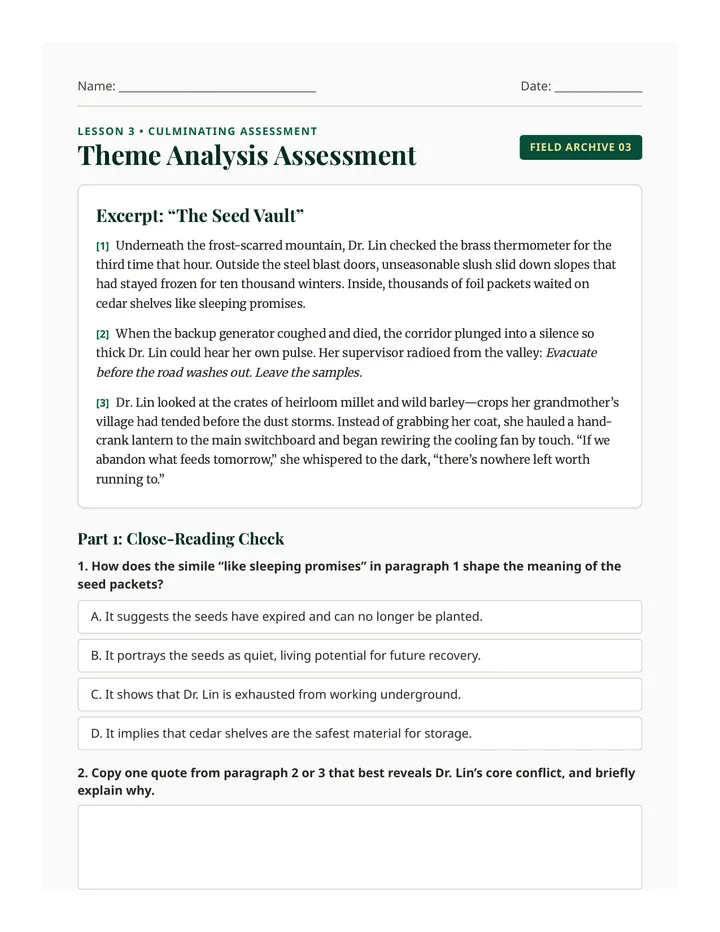
Theme Analysis Assessment Name: ____________________________________ Date: ________________
Lesson 3 • Culminating Assessment
Theme Analysis Assessment
Field Archive 03
Excerpt: “The Seed Vault”
[1]Underneath the frost-scarred mountain, Dr. Lin checked the brass thermometer for the third time that hour. Outside the steel blast doors, unseasonable slush slid down slopes that had stayed frozen for ten thousand winters. Inside, thousands of foil packets waited on cedar shelves like sleeping promises.
[2]When the backup generator coughed and died, the corridor plunged into a silence so thick Dr. Lin could hear her own pulse. Her supervisor radioed from the valley: Evacuate before the road washes out. Leave the samples.
[3]Dr. Lin looked at the crates of heirloom millet and wild barley—crops her grandmother’s village had tended before the dust storms. Instead of grabbing her coat, she hauled a hand-crank lantern to the main switchboard and began rewiring the cooling fan by touch. “If we abandon what feeds tomorrow,” she whispered to the dark, “there’s nowhere left worth running to.”
Part 1: Close-Reading Check
1. How does the simile “like sleeping promises” in paragraph 1 shape the meaning of the seed packets?
A. It suggests the seeds have expired and can no longer be planted.
B. It portrays the seeds as quiet, living potential for future recovery.
C. It shows that Dr. Lin is exhausted from working underground.
D. It implies that cedar shelves are the safest material for storage.
2. Copy one quote from paragraph 2 or 3 that best reveals Dr. Lin’s core conflict, and briefly explain why.
Part 2: Theme Analysis Paragraph (CER)
Claim • Evidence • Reasoning
Writing Prompt:
What central theme does “The Seed Vault” develop about human responsibility in the face of climate crisis? Write a well-structured Claim–Evidence–Reasoning paragraph that states a universal theme, weaves in two exact quotes from the excerpt, and explains how those details prove your theme.
☐ Universal theme claim (no plot summary) ☐ 2 woven quotes with paragraph #s ☐ Clear reasoning linking evidence to theme
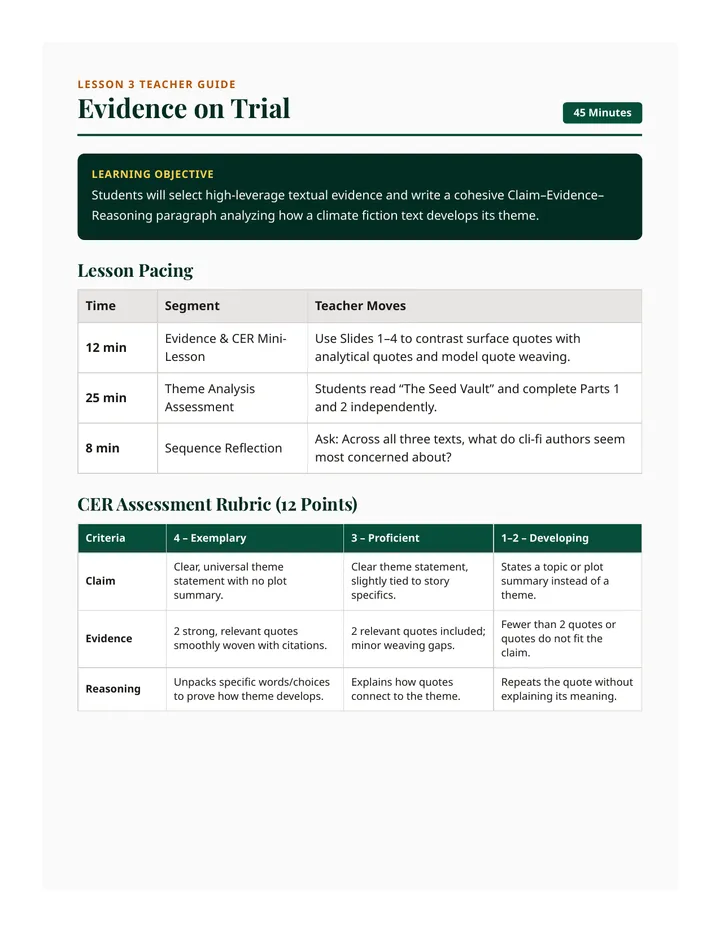
Evidence on Trial Teacher Guide Lesson 3 Teacher Guide
Evidence on Trial
45 Minutes
Learning Objective
Students will select high-leverage textual evidence and write a cohesive Claim–Evidence–Reasoning paragraph analyzing how a climate fiction text develops its theme.
Lesson Pacing
Time
Segment
Teacher Moves
12 min
Evidence & CER Mini-Lesson
Use Slides 1–4 to contrast surface quotes with analytical quotes and model quote weaving.
25 min
Theme Analysis Assessment
Students read “The Seed Vault” and complete Parts 1 and 2 independently.
8 min
Sequence Reflection
Ask: Across all three texts, what do cli-fi authors seem most concerned about?
CER Assessment Rubric (12 Points)
Criteria
4 – Exemplary
3 – Proficient
1–2 – Developing
Claim
Clear, universal theme statement with no plot summary.
Clear theme statement, slightly tied to story specifics.
States a topic or plot summary instead of a theme.
Evidence
2 strong, relevant quotes smoothly woven with citations.
2 relevant quotes included; minor weaving gaps.
Fewer than 2 quotes or quotes do not fit the claim.
Reasoning
Unpacks specific words/choices to prove how theme develops.
Explains how quotes connect to the theme.
Repeats the quote without explaining its meaning.
Answer Key: Theme Analysis Assessment
Key & Model
Part 1: Close-Reading Check
1. Correct Answer: B. It portrays the seeds as quiet, living potential for future recovery.
2. Sample Conflict Quote & Explanation: “Evacuate before the road washes out. Leave the samples.” (Para. 2) — This command forces Dr. Lin to choose between her own immediate safety and protecting the biodiversity that future generations will need.
Part 2: Model CER Paragraph
In “The Seed Vault,” the author develops the theme that protecting the future during an environmental crisis requires courage and sacrifice in the present. At the start of the excerpt, the foil packets are described “like sleeping promises” (Para. 1), a simile that frames the seeds not as mere objects, but as fragile hope for generations to come. When the power fails and her supervisor orders her to “Leave the samples” (Para. 2), Dr. Lin refuses to flee. Instead, she stays to rewire the cooling fan, declaring that “if we abandon what feeds tomorrow, there’s nowhere left worth running to” (Para. 3). Her choice proves that true survival means defending the resources that make a future possible, even at personal risk.